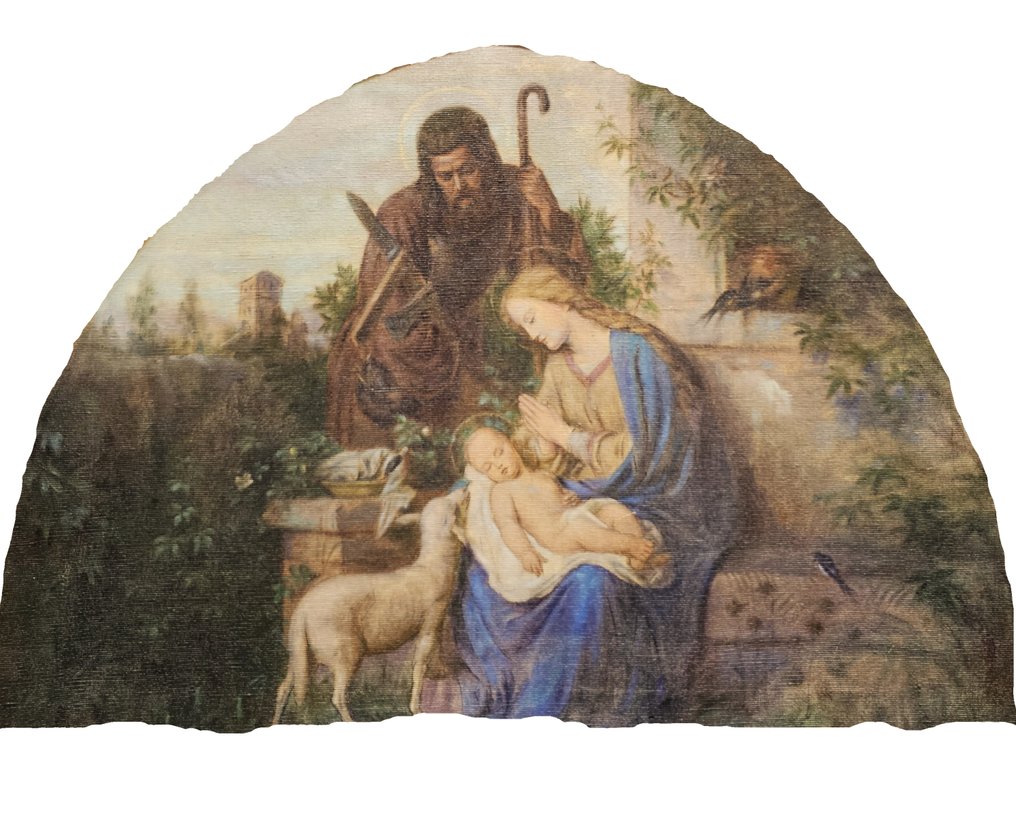
Spanish school (XIX-XX) - The Adoration of the Child



10
days
19
hours
12
minutes
46
seconds
Current bid
€ 10
Reserve price not met

8 other people are watching this object
 Bidder 0708 Bidder 0708 | €10 |
|---|
Catawiki Buyer Protection
Your payment’s safe with us until you receive your object.View details
Trustpilot 4.4 | 122473 reviews
Rated Excellent on Trustpilot.
The Adoration of the Child is an original oil painting by the Spanish school (19th–20th century) dated ca. 1900–1910, produced in Spain, sold with a frame, measuring 71 × 99 cm, weighing 6 kg, unsigned and in good condition.
AI-assisted summary
Description from the seller
Technical sheet
Adoration of the Child Jesus
Author: Anonymous from the Spanish School
Chronology: c. 1900
Technique: Oil on canvas
Measurements: 64 × 90 cm (without frame) · 71 × 99 cm (with frame)
Support: Stretched canvas on original curved frame.
Style: late Romantic eclecticism with echoes of Pre-Raphaelitism.
Condition: Excellent, with period patina and excellent chromatic stability.
Marco: Gilded arched frame with a historicist character, perfectly in harmony with the sacred composition.
2. Compositional and iconographic description
The work presents a delicate and devotional Christmas scene, ideal for these special dates: the Virgin holds the sleeping Baby Jesus on her lap while an innocent lamb—symbol of purity and redemptive sacrifice—approaches tenderly. Behind them, a humble-appearing male figure—probably Saint Joseph or a shepherd—envelops the scene with protective serenity.
The semicircular composition, clearly influenced by Renaissance and Baroque styles, recalls the curved pediments used in devotional altarpieces.
The background opens up to an ethereal landscape of distant architecture and idealized lushness, which adds depth and spiritual calm.
Highlight the delicacy of the blue folds of the Marian cloak, the softness of the childlike modeling, and the symbolic presence of the bird perched on the branch, a nod to the Annunciation and hope.
The fine, enveloping, and harmonious brushstroke displays a sensitivity close to the sacred recreations of Luis de Madrazo, José Benlliure, or even the spiritual refinement of the German Nazarenes, adapted to the Spanish taste of the turn of the century.
3. Style, Context, and Artistic Valuation
This painting is part of the Spanish devotional tradition from the late 19th and early 20th centuries, a period when there was an effort to recover the aesthetic serenity of classicism and the narrative emotion of sacred iconography. Its semi-circular arch format, uncommon outside religious commissions, adds exclusivity and an air of a private chapel piece.
The gentle treatment of light, silky tones, and compositional balance bring it closer to the intimate spirituality of artists like Mariano Fortuny in his most academic phase, Muñoz Degrain in his mystical visions, or even the Italian pioneers of Purism.
All of this makes the work an exceptional example of domestic sacred painting, refined and full of symbolism — a perfect acquisition for collectors seeking emotive, beautiful pieces with a timeless Christmas charm.
Seller's Story
At Barcelona Art Gallery, we are a large family of art collectors in Barcelona who have been acquiring all kinds of paintings for 2 centuries.
Headquartered in the Les Corts neighborhood of Barcelona.
We offer part of our private collection for auction: high period and modern paintings that we have been acquiring over time, mainly from art galleries, antique dealers, auctions, private collections and very diverse origins.
Translated by Google TranslateTechnical sheet
Adoration of the Child Jesus
Author: Anonymous from the Spanish School
Chronology: c. 1900
Technique: Oil on canvas
Measurements: 64 × 90 cm (without frame) · 71 × 99 cm (with frame)
Support: Stretched canvas on original curved frame.
Style: late Romantic eclecticism with echoes of Pre-Raphaelitism.
Condition: Excellent, with period patina and excellent chromatic stability.
Marco: Gilded arched frame with a historicist character, perfectly in harmony with the sacred composition.
2. Compositional and iconographic description
The work presents a delicate and devotional Christmas scene, ideal for these special dates: the Virgin holds the sleeping Baby Jesus on her lap while an innocent lamb—symbol of purity and redemptive sacrifice—approaches tenderly. Behind them, a humble-appearing male figure—probably Saint Joseph or a shepherd—envelops the scene with protective serenity.
The semicircular composition, clearly influenced by Renaissance and Baroque styles, recalls the curved pediments used in devotional altarpieces.
The background opens up to an ethereal landscape of distant architecture and idealized lushness, which adds depth and spiritual calm.
Highlight the delicacy of the blue folds of the Marian cloak, the softness of the childlike modeling, and the symbolic presence of the bird perched on the branch, a nod to the Annunciation and hope.
The fine, enveloping, and harmonious brushstroke displays a sensitivity close to the sacred recreations of Luis de Madrazo, José Benlliure, or even the spiritual refinement of the German Nazarenes, adapted to the Spanish taste of the turn of the century.
3. Style, Context, and Artistic Valuation
This painting is part of the Spanish devotional tradition from the late 19th and early 20th centuries, a period when there was an effort to recover the aesthetic serenity of classicism and the narrative emotion of sacred iconography. Its semi-circular arch format, uncommon outside religious commissions, adds exclusivity and an air of a private chapel piece.
The gentle treatment of light, silky tones, and compositional balance bring it closer to the intimate spirituality of artists like Mariano Fortuny in his most academic phase, Muñoz Degrain in his mystical visions, or even the Italian pioneers of Purism.
All of this makes the work an exceptional example of domestic sacred painting, refined and full of symbolism — a perfect acquisition for collectors seeking emotive, beautiful pieces with a timeless Christmas charm.
Seller's Story
At Barcelona Art Gallery, we are a large family of art collectors in Barcelona who have been acquiring all kinds of paintings for 2 centuries.
Headquartered in the Les Corts neighborhood of Barcelona.
We offer part of our private collection for auction: high period and modern paintings that we have been acquiring over time, mainly from art galleries, antique dealers, auctions, private collections and very diverse origins.
Translated by Google TranslateDetails
Artist
Spanish school (XIX-XX)
Sold with frame
Yes
Sold by
Gallery
Edition
Original
Title of artwork
The Adoration of the Child
Technique
Oil painting
Signature
Not signed
Country of Origin
Spain
Condition
Good condition
Height
71 cm
Width
99 cm
Weight
6 kg
Depiction/Theme
Seascape
Style
Renaissance
Period
1900-1910
Sold by
