du Choul - Religion des Anciens Romains / Castrametation / Des Bains - 1567


09
days
11
hours
42
minutes
16
seconds
Current bid
€ 1
Reserve price not met

Expert
Selected by Ilaria Colombo
Specialist in old books, specialising in theological disputes since 1999.
Estimate € 1,000 - € 1,800
9 other people are watching this object
 Bidder 4837 Bidder 4837 | €1 |
|---|
Catawiki Buyer Protection
Your payment’s safe with us until you receive your object.View details
Trustpilot 4.4 | 122385 reviews
Rated Excellent on Trustpilot.
Discours de la religion des anciens Romains / de la castrametation & des bains, by Guillaume du Choul, a 1567 illustrated edition in French published in Lyon by Guillaume Rouille, bound in full leather, 554 pages, in good condition.
AI-assisted summary
Description from the seller
The book that reveals the secret rites of ancient Rome and Europe was no longer the same
Discourse on the religion of the ancient Romans (Discorso sulla religione degli antichi Romani)
of their camp arrangements and military discipline
Baths & Ancient Greek and Roman Exercises
These three parts constitute the entire content of the volume published in 1567.
Fundamental to the reconstruction of Roman religious symbolism, Guillaume du Choul's treatise reveals how rituals, military disciplines, daily cults, and thermal practices constituted a coherent system of power, identity, and imagery. Published in Lyon in 1567 by Guillaume Rouillé, one of the most important typographers and illustrators of the French Renaissance, this volume represents a monument of sixteenth-century antiquarian rediscovery, in which historical words and woodcut images collaborate to revive and legitimize the myths of Romanity. The abundance of figures—medals, reliefs, monuments, mythological scenes—transforms the book into a visual atlas of the ancient world, while the dual presence of the Discourse on Religion and the treatise on camp construction, baths, and ancient exercises offers the most comprehensive summary of its reflection. An intact copy in its textual and iconographic parts, with a strong material personality, fully preserves its Renaissance voice.
Market value
The Lyonese editions of Rouillé of Guillaume du Choul's antiquarian works are highly sought after for their iconographic richness and typographic beauty of the workshop. Similar copies, complete in both parts and with good readability of the woodcuts, circulate on the European market for between 200 and 800 euros per specimen in fair to good condition; restored or rebound specimens may command higher prices. Generally, the presence of over 500 medal reproductions and the five full-page plates positively influence the valuation, as does the preservation of the antique binding.
Physical description and condition
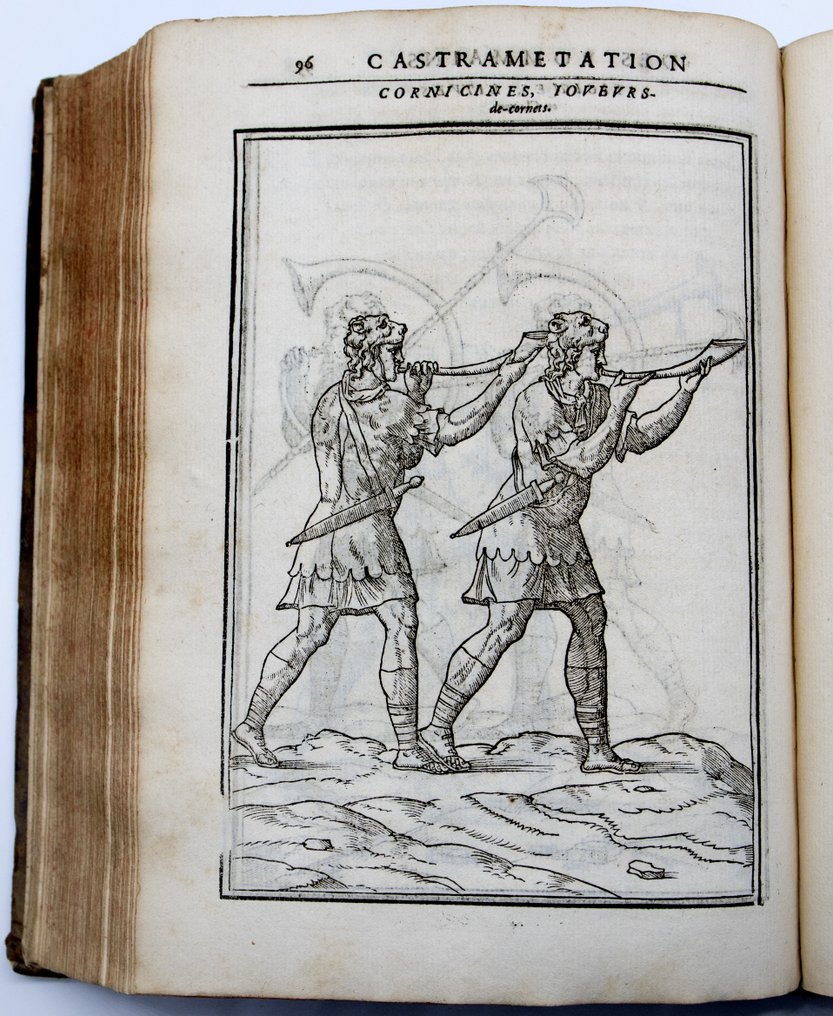
Ancient binding in full calf, with a nerved spine, gilt titles and decorations; wear to the boards. Missing front endpaper. Some browning and foxing; sharp woodcuts. The author's coat of arms on the verso of the frontispiece, 47 illustrations in the text, including 5 full-page, and over 500 engraved medals. Pp. 340; 52nn; 154; 8nn.
Full title and author
Discourse on the religion of the ancient Romans (Discorso sulla religione degli antichi Romani)
of their camp arrangements and military discipline
Baths & Ancient Greek and Roman Exercises
These three parts constitute the entire content of the volume.
Lyon, Guillaume Rouillé, 1567
Guillaume du Choul.
Context and Significance
Du Choul, a royal official, scholar, and great connoisseur of classical antiquities, composes here one of the most influential treatises of European antiquarianism of the 16th century. The work integrates literary sources, archaeological evidence, and a broad iconographic repertoire, aiming to reconstruct the origins of cults, military ceremonies, and daily practices of the Romans. The book fits into the larger movement of antiquarian revival, where images—medals, statues, reliefs—become fundamental for historical interpretation. The second part, on the military field and ancient baths, completes the project, offering a kind of compendium of the institutions and physical and spiritual rites of Roman culture. Rouillé's edition is considered one of the most beautiful and richest, thanks to the systematic use of xilography as a tool for knowledge rather than mere ornamentation. The work circulated throughout Europe, becoming a model for antiquarians, architects, iconographers, and scholars of classical religion.
Biography of the Author
Guillaume du Choul (1496–1560), counselor to the King of France and bailly of the mountains of Dauphiné, was one of the most important French antiquarians of the 16th century. A collector of medals and a deep connoisseur of classical sources, he was the first to systematically combine text and image as a historical method. His works were translated, reprinted, and imitated for over a century. His library of antiquities was considered one of the richest of his time.
Printing history and circulation
Guillaume Rouillé, active in Lyon between 1540 and 1589, was one of the leading European typographer-humanists, known for the elegance of his silographies, for the high-quality Roman and cursive types, and for the meticulous craftsmanship of his illustrated volumes. Du Choul's works were printed multiple times, but the 1567 edition represents one of the most complete and best-illustrated. Despite his popularity, complete copies of both parts with the full iconographic apparatus are less common than their relative dissemination would suggest.
BIBLIOGRAPHY AND REFERENCES
Brunet II, 888
Adams, D 1167
Mortimer, French 173
Pettegree & Walsby, French Vernacular Books
Rogers, Renaissance Views of Classical Antiquity
USTC 29831
WorldCat, BnF Gallica, Edit16 (for variants and localizations)
Modern studies: B. Céard, 'Curiosity in the Renaissance'; J. Balsamo, Lyon, center of French humanism; E. Oberhuber (on medals and ancient iconography).
Seller's Story
Luxury Books: Your Go-To Guide for Nabbing Literary Treasures!
Embarking on the thrilling journey of collecting rare and timeless printed works? Here's your snappy rundown, "The Collector's Cheat Sheet," to ensure you're not just flipping pages but stacking up the value:
1. Edition and Rarity: Rarity is the name of the game. First editions, limited printings, and books flaunting unique features like eye-catching illustrations or mind-blowing bindings? Consider them the VIPs of the collector's world.
2. Condition & Dimension: Picture this – a book in mint condition, untouched by the woes of wear and tear. Now, flip the script: wear, foxing, discoloration – they're the villains here. And don't forget to size up the dimensions, because a book's size matters in the collector's universe.
3. Authenticity: In a world of replicas and forgeries, verifying a book's authenticity is your superhero move. Expert examination and authentication – your trusty sidekicks in this quest.
4. Provenance: Who owned it before you? If the book has hobnobbed with famous figures or danced through historical events, its value skyrockets. Every book has a story, but some have blockbuster tales.
5. Demand and Market Trends: Think of book values as the stock market of the literary world. Stay savvy on collector trends and market shifts to ride the waves of value.
6. Subject Matter: Some topics are like fine wine – they get better with time. Dive into subjects with a timeless appeal or ride the wave of emerging cultural and historical relevance.
7. Binding and Design: Beauty is more than skin deep. Intricate bindings, stunning covers, and illustrations – these are the accessories that make a book runway-ready in the collector's eyes.
8. Association Copies: Books with a personal touch – whether it's a connection to the author or a famous personality – elevate the historical vibes. A book with a backstory? Count us in.
9. Investment Potential: Passion is the engine, but some collectors eye future returns. Keep in mind, though, that the book market can be as unpredictable as a plot twist.
10. Expert Advice: New to the game? Don't play solo. Seek wisdom from the book gurus, hit up book fairs, and join collector communities. We at Luxury Books are the Yodas of the rare book galaxy, helping you build collections that scream sophistication and cultural clout.
Because collecting rare books isn't just about dollar signs – it's a journey of preserving heritage and embracing literary treasures. Happy collecting!
Translated by Google TranslateThe book that reveals the secret rites of ancient Rome and Europe was no longer the same
Discourse on the religion of the ancient Romans (Discorso sulla religione degli antichi Romani)
of their camp arrangements and military discipline
Baths & Ancient Greek and Roman Exercises
These three parts constitute the entire content of the volume published in 1567.
Fundamental to the reconstruction of Roman religious symbolism, Guillaume du Choul's treatise reveals how rituals, military disciplines, daily cults, and thermal practices constituted a coherent system of power, identity, and imagery. Published in Lyon in 1567 by Guillaume Rouillé, one of the most important typographers and illustrators of the French Renaissance, this volume represents a monument of sixteenth-century antiquarian rediscovery, in which historical words and woodcut images collaborate to revive and legitimize the myths of Romanity. The abundance of figures—medals, reliefs, monuments, mythological scenes—transforms the book into a visual atlas of the ancient world, while the dual presence of the Discourse on Religion and the treatise on camp construction, baths, and ancient exercises offers the most comprehensive summary of its reflection. An intact copy in its textual and iconographic parts, with a strong material personality, fully preserves its Renaissance voice.
Market value
The Lyonese editions of Rouillé of Guillaume du Choul's antiquarian works are highly sought after for their iconographic richness and typographic beauty of the workshop. Similar copies, complete in both parts and with good readability of the woodcuts, circulate on the European market for between 200 and 800 euros per specimen in fair to good condition; restored or rebound specimens may command higher prices. Generally, the presence of over 500 medal reproductions and the five full-page plates positively influence the valuation, as does the preservation of the antique binding.
Physical description and condition
Ancient binding in full calf, with a nerved spine, gilt titles and decorations; wear to the boards. Missing front endpaper. Some browning and foxing; sharp woodcuts. The author's coat of arms on the verso of the frontispiece, 47 illustrations in the text, including 5 full-page, and over 500 engraved medals. Pp. 340; 52nn; 154; 8nn.
Full title and author
Discourse on the religion of the ancient Romans (Discorso sulla religione degli antichi Romani)
of their camp arrangements and military discipline
Baths & Ancient Greek and Roman Exercises
These three parts constitute the entire content of the volume.
Lyon, Guillaume Rouillé, 1567
Guillaume du Choul.
Context and Significance
Du Choul, a royal official, scholar, and great connoisseur of classical antiquities, composes here one of the most influential treatises of European antiquarianism of the 16th century. The work integrates literary sources, archaeological evidence, and a broad iconographic repertoire, aiming to reconstruct the origins of cults, military ceremonies, and daily practices of the Romans. The book fits into the larger movement of antiquarian revival, where images—medals, statues, reliefs—become fundamental for historical interpretation. The second part, on the military field and ancient baths, completes the project, offering a kind of compendium of the institutions and physical and spiritual rites of Roman culture. Rouillé's edition is considered one of the most beautiful and richest, thanks to the systematic use of xilography as a tool for knowledge rather than mere ornamentation. The work circulated throughout Europe, becoming a model for antiquarians, architects, iconographers, and scholars of classical religion.
Biography of the Author
Guillaume du Choul (1496–1560), counselor to the King of France and bailly of the mountains of Dauphiné, was one of the most important French antiquarians of the 16th century. A collector of medals and a deep connoisseur of classical sources, he was the first to systematically combine text and image as a historical method. His works were translated, reprinted, and imitated for over a century. His library of antiquities was considered one of the richest of his time.
Printing history and circulation
Guillaume Rouillé, active in Lyon between 1540 and 1589, was one of the leading European typographer-humanists, known for the elegance of his silographies, for the high-quality Roman and cursive types, and for the meticulous craftsmanship of his illustrated volumes. Du Choul's works were printed multiple times, but the 1567 edition represents one of the most complete and best-illustrated. Despite his popularity, complete copies of both parts with the full iconographic apparatus are less common than their relative dissemination would suggest.
BIBLIOGRAPHY AND REFERENCES
Brunet II, 888
Adams, D 1167
Mortimer, French 173
Pettegree & Walsby, French Vernacular Books
Rogers, Renaissance Views of Classical Antiquity
USTC 29831
WorldCat, BnF Gallica, Edit16 (for variants and localizations)
Modern studies: B. Céard, 'Curiosity in the Renaissance'; J. Balsamo, Lyon, center of French humanism; E. Oberhuber (on medals and ancient iconography).
Seller's Story
Luxury Books: Your Go-To Guide for Nabbing Literary Treasures!
Embarking on the thrilling journey of collecting rare and timeless printed works? Here's your snappy rundown, "The Collector's Cheat Sheet," to ensure you're not just flipping pages but stacking up the value:
1. Edition and Rarity: Rarity is the name of the game. First editions, limited printings, and books flaunting unique features like eye-catching illustrations or mind-blowing bindings? Consider them the VIPs of the collector's world.
2. Condition & Dimension: Picture this – a book in mint condition, untouched by the woes of wear and tear. Now, flip the script: wear, foxing, discoloration – they're the villains here. And don't forget to size up the dimensions, because a book's size matters in the collector's universe.
3. Authenticity: In a world of replicas and forgeries, verifying a book's authenticity is your superhero move. Expert examination and authentication – your trusty sidekicks in this quest.
4. Provenance: Who owned it before you? If the book has hobnobbed with famous figures or danced through historical events, its value skyrockets. Every book has a story, but some have blockbuster tales.
5. Demand and Market Trends: Think of book values as the stock market of the literary world. Stay savvy on collector trends and market shifts to ride the waves of value.
6. Subject Matter: Some topics are like fine wine – they get better with time. Dive into subjects with a timeless appeal or ride the wave of emerging cultural and historical relevance.
7. Binding and Design: Beauty is more than skin deep. Intricate bindings, stunning covers, and illustrations – these are the accessories that make a book runway-ready in the collector's eyes.
8. Association Copies: Books with a personal touch – whether it's a connection to the author or a famous personality – elevate the historical vibes. A book with a backstory? Count us in.
9. Investment Potential: Passion is the engine, but some collectors eye future returns. Keep in mind, though, that the book market can be as unpredictable as a plot twist.
10. Expert Advice: New to the game? Don't play solo. Seek wisdom from the book gurus, hit up book fairs, and join collector communities. We at Luxury Books are the Yodas of the rare book galaxy, helping you build collections that scream sophistication and cultural clout.
Because collecting rare books isn't just about dollar signs – it's a journey of preserving heritage and embracing literary treasures. Happy collecting!
Translated by Google TranslateDetails
Number of Books
1
Subject
History
Book Title
Religion des Anciens Romains / Castrametation / Des Bains
Author/ Illustrator
du Choul
Condition
Good
Publication year oldest item
1567
Height
241 mm
Edition
1st Edition Thus, Illustrated Edition
Width
180 mm
Language
French
Original language
Yes
Publisher
Lyon, Guillaume Rouille, 1567
Binding/ Material
Leather
Extras
Tipped in plates
Number of pages
554
Sold by
