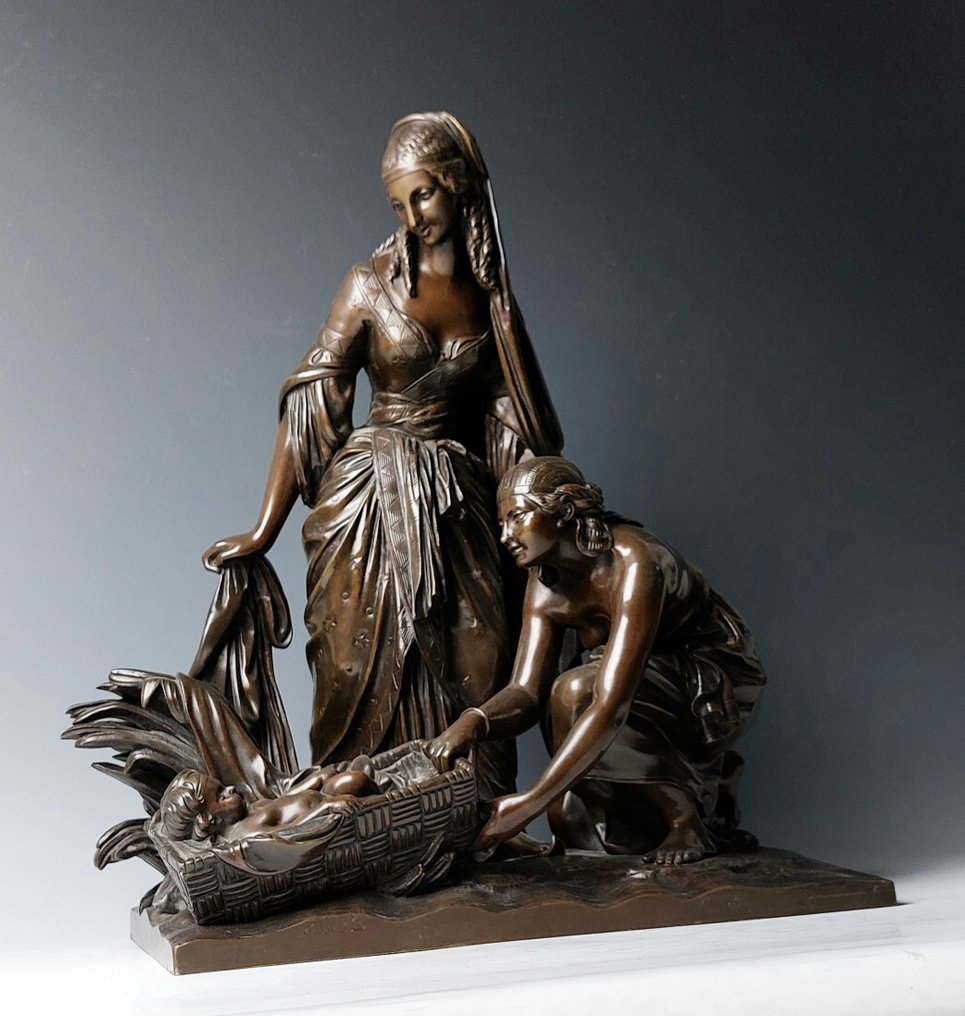
Susse Frères - Charles Cumberworth (1811-1852) - Sculpture, De dochter van de farao vindt Mozes - 40 cm - Bronze



04
days
20
hours
39
minutes
52
seconds
Current bid
€ 110
Reserve price not met

Expert
Selected by Paul Wullems
He accumulated 18 years' experience, worked as junior specialist at Sotheby’s and managed Kunsthandel Jacques Fijnaut.
Estimate € 2,800 - € 3,200
26 other people are watching this object
 Bidder 9939 Bidder 9939 | €110 | |
|---|---|---|
 Bidder 7579 Bidder 7579 | €100 | |
 Bidder 3788 Bidder 3788 | €1 |
Catawiki Buyer Protection
Your payment’s safe with us until you receive your object.View details
Trustpilot 4.4 | 123077 reviews
Rated Excellent on Trustpilot.
Description from the seller
Beautiful patinated bronze sculpture depicting the moment when Moses is found in his wicker basket by the daughter of the Pharaoh and her maid. Designed by the French sculptor Charles Cumberworth (1811-1952).
This iconic scene refers to the biblical story from Exodus in which Moses's mother (Jochebed) placed her baby in a watertight, reed basket on the Nile River to save him from the decree of the Egyptian Pharaoh to kill all Hebrew boys; the basket was found by the Pharaoh's daughter, who adopted the child and named him Moses.
The name Moses (or Musa) has a dual origin: the Hebrew part means 'drawn out of the water' (referring to his rescue from the Nile), while the Egyptian origin means 'son of' or 'child', as in names like Ramses (Son of Ra). The name thus connects his Hebrew heritage and rescue with his upbringing at the Egyptian court. The reason for
Since the population growth among the Israelites increased much faster than among the Egyptians, the Pharaoh decided to kill all the firstborn Israelite boys. He feared that they would join the enemy in a war against Egypt and thus threaten his power.
Later in the life of Moses, he is the one who, on God's command, calls down nine plagues upon the Egyptians to force Pharaoh to let the Israelites go. Only with the tenth plague, the death of all firstborn, did Pharaoh bow his knees. A repetition of the punishment previously pronounced by Pharaoh over the Israelites.
Cumberworth was a student of Jean-Jacques Pradier at the École des Beaux-Arts in Paris (1829), and there he began designing various bronze objects, such as vases, clocks, and candelabras. He exhibited at the Paris Salon from 1833 to 1848.
His most famous sculptures are Self-Love (Musée des Beaux-Arts de La Rochelle), Lesbia and her Muse (Paris, Musée du Louvre), and Paul and Virginia (1851). The sculpture being offered here at auction has only been on the market twice in the past ten years (as far as I could find). In any case, a quite rare piece.
Excellent condition! And very heavy, 15 kilograms!
Will be sent by registered mail.
Beautiful patinated bronze sculpture depicting the moment when Moses is found in his wicker basket by the daughter of the Pharaoh and her maid. Designed by the French sculptor Charles Cumberworth (1811-1952).
This iconic scene refers to the biblical story from Exodus in which Moses's mother (Jochebed) placed her baby in a watertight, reed basket on the Nile River to save him from the decree of the Egyptian Pharaoh to kill all Hebrew boys; the basket was found by the Pharaoh's daughter, who adopted the child and named him Moses.
The name Moses (or Musa) has a dual origin: the Hebrew part means 'drawn out of the water' (referring to his rescue from the Nile), while the Egyptian origin means 'son of' or 'child', as in names like Ramses (Son of Ra). The name thus connects his Hebrew heritage and rescue with his upbringing at the Egyptian court. The reason for
Since the population growth among the Israelites increased much faster than among the Egyptians, the Pharaoh decided to kill all the firstborn Israelite boys. He feared that they would join the enemy in a war against Egypt and thus threaten his power.
Later in the life of Moses, he is the one who, on God's command, calls down nine plagues upon the Egyptians to force Pharaoh to let the Israelites go. Only with the tenth plague, the death of all firstborn, did Pharaoh bow his knees. A repetition of the punishment previously pronounced by Pharaoh over the Israelites.
Cumberworth was a student of Jean-Jacques Pradier at the École des Beaux-Arts in Paris (1829), and there he began designing various bronze objects, such as vases, clocks, and candelabras. He exhibited at the Paris Salon from 1833 to 1848.
His most famous sculptures are Self-Love (Musée des Beaux-Arts de La Rochelle), Lesbia and her Muse (Paris, Musée du Louvre), and Paul and Virginia (1851). The sculpture being offered here at auction has only been on the market twice in the past ten years (as far as I could find). In any case, a quite rare piece.
Excellent condition! And very heavy, 15 kilograms!
Will be sent by registered mail.
Details
Era
1400-1900
Manufacturer/ Brand
Susse Frères
Over 200 years old
No
Country of Origin
France
Material
Bronze
Artist
Charles Cumberworth (1811-1852)
Title of artwork
De dochter van de farao vindt Mozes
Signature
Signed
Condition
Good condition
Height
40 cm
Width
36 cm
Depth
20 cm
Weight
15 kg
Sold by