Isabel de Santiago (1660/1670 - 1714), Attributed to - The Holy Family in contemplation




16
days
00
hours
26
minutes
07
seconds
Current bid
€ 1
Reserve price not met

Expert
Selected by Caterina Maffeis
Master in early Renaissance Italian painting with internship at Sotheby’s and 15 years' experience.
Estimate € 10,000 - € 12,000
5 other people are watching this object
 Bidder 2525 Bidder 2525 | €1 |
|---|
Catawiki Buyer Protection
Your payment’s safe with us until you receive your object.View details
Trustpilot 4.4 | 122473 reviews
Rated Excellent on Trustpilot.
The Holy Family in contemplation, attributed to Isabel de Santiago (1660/1670–1714), an oil on canvas in the 17th‑century Rococo Hispano‑Virreinal style from Peru, 119 × 99 cm with frame (approximately 8 kg) and unsigned, depicts the Sagrada Familia and is sold with frame.
AI-assisted summary
Description from the seller
Technical sheet
The Sagrada Familia in Contemplation
Author: Attributed to Isabel de Santiago (Royal Audience of Quito, circa 1660/1670 – 1714)
School / Style: Escuela Quiteña · Hispano-Virrein Baroque with echoes of late Mannerism.
Chronology: Early 17th century – circa 1600–1620
Technique: oil on canvas
Measurements: 119 × 99 cm with frame; 102 × 82 cm without frame
Support: Re-stretched canvas, antique frame
Dark framed border with gold fillets, solemn and liturgical.
Condition: Good; antique patina, stable craquelure, light restorations.
Curatorial note: The attribution to Isabel de Santiago—one of the few documented women artists of viceregal art and a direct disciple of master Nicolás de Goríbar—bestows this piece with an exceptional relevance within the colonial pictorial corpus.
2. Compositional and iconographic description
The scene develops a Sacred Family of profound emotional intimacy, an essential characteristic of Quito's early Baroque sensitivity. The triangular arrangement between Joseph, Mary, and the Child responds to a Mannerist design inherited from European models but reinterpreted with the softness and lyricism typical of Isabel de Santiago.
The Child Jesus, with soft cheeks, large expressive eyes, fully corresponds to the childhood types of Goríbar's workshop and the Quito school: round, tender faces with naive yet penetrating spirituality. His gesture of surrender — open hands, body offered towards the Virgin — is a recurring motif in the female devotional compositions of the period.
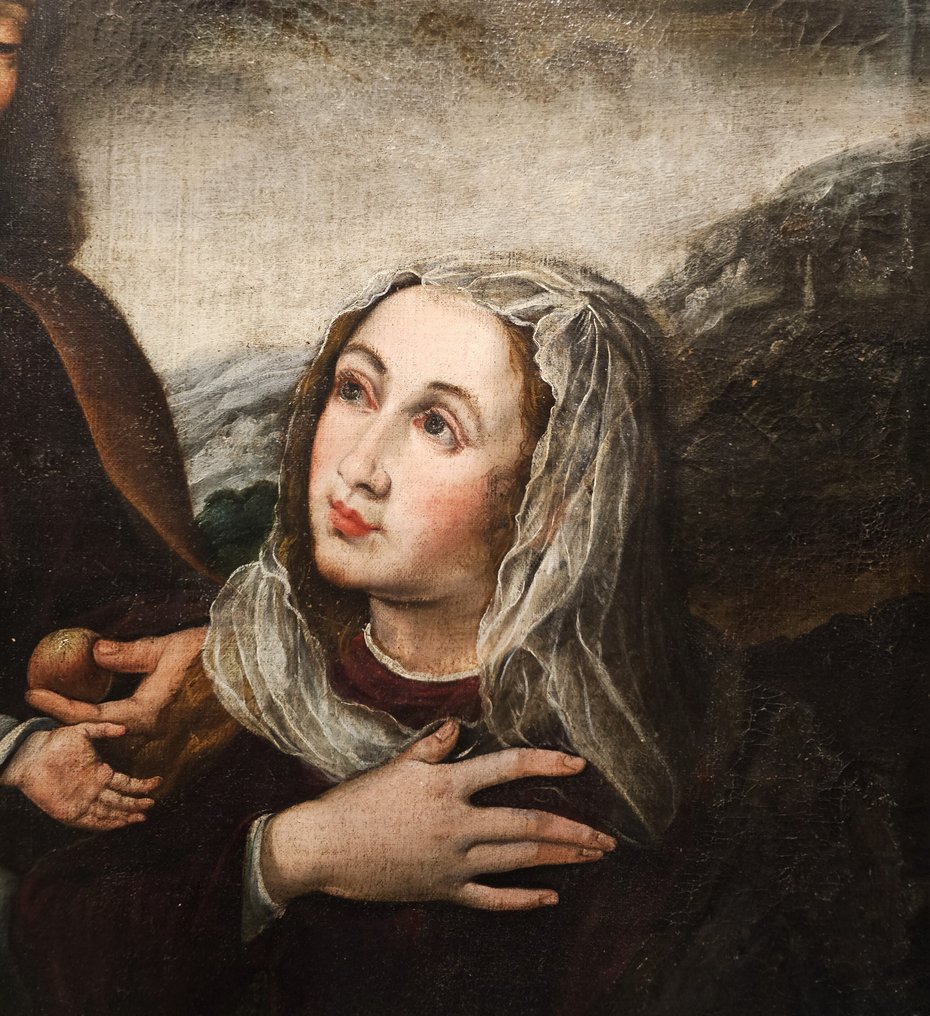
The Virgin, with her wispy veil and marbled light face, displays the elegance and spirituality characteristic of Isabel de Santiago: ethereal figures, uplifted gazes, and a perfect fusion of human motherhood and mystical fervor. The treatment of the fabrics, especially the semi-transparent white veil, is of such delicacy that it reveals an expert hand and singular sensitivity.
The background features an atmospheric landscape of blurred mountains and moving clouds, with typical Andean Baroque resources: suggested depth, lighting dramatization, and smooth chromatic transition.
Overall, the work stands out for its great expressive affectivity, the quality of the drawing, the refinement of the modeling, and the balance between devotion and humanity, all traits compatible with the hand of Isabel de Santiago.
3. Style, Attribution, and Curatorial Valuation
The work presents essential characteristics of 17th-century Quito Baroque.
Sweet, idealized, and spiritual facial features.
Soberly colorful with bright accents.
Expressive hand gestures, very characteristic of workshops inherited from Goríbar.
Devotional intimacy and emotional tenderness, the distinctive mark of Isabel de Santiago.
Isabel de Santiago, daughter of the indigenous painter Miguel de Santiago, was a key figure in the development of colonial baroque, part of a painting lineage that defined the artistic identity of the Royal Audience of Quito. Her work is extremely scarce, highly sought after by institutions and collectors of colonial art, and few pieces attributed to her remain in private hands.
The comparison with:
Miguel de Santiago (his father): in tender spirituality and children's anatomy.
Nicolás de Goríbar (his master): in veils, folds, and oval faces.
Luis de Morales in Spain: in intimacy and subtle pathos.
It is coherent and reinforces the attribution.
Curatorial assessment
We are faced with a highly exclusive work, relevant not only for its formal quality but also for its attribution to one of the few documented women artists of the Viceroyalty Baroque. Its rarity, preservation, iconography, and possible origin from a family workshop make it a piece of extraordinary museological and market interest.
Seller's Story
At Barcelona Art Gallery, we are a large family of art collectors in Barcelona who have been acquiring all kinds of paintings for 2 centuries.
Headquartered in the Les Corts neighborhood of Barcelona.
We offer part of our private collection for auction: high period and modern paintings that we have been acquiring over time, mainly from art galleries, antique dealers, auctions, private collections and very diverse origins.
Translated by Google TranslateTechnical sheet
The Sagrada Familia in Contemplation
Author: Attributed to Isabel de Santiago (Royal Audience of Quito, circa 1660/1670 – 1714)
School / Style: Escuela Quiteña · Hispano-Virrein Baroque with echoes of late Mannerism.
Chronology: Early 17th century – circa 1600–1620
Technique: oil on canvas
Measurements: 119 × 99 cm with frame; 102 × 82 cm without frame
Support: Re-stretched canvas, antique frame
Dark framed border with gold fillets, solemn and liturgical.
Condition: Good; antique patina, stable craquelure, light restorations.
Curatorial note: The attribution to Isabel de Santiago—one of the few documented women artists of viceregal art and a direct disciple of master Nicolás de Goríbar—bestows this piece with an exceptional relevance within the colonial pictorial corpus.
2. Compositional and iconographic description
The scene develops a Sacred Family of profound emotional intimacy, an essential characteristic of Quito's early Baroque sensitivity. The triangular arrangement between Joseph, Mary, and the Child responds to a Mannerist design inherited from European models but reinterpreted with the softness and lyricism typical of Isabel de Santiago.
The Child Jesus, with soft cheeks, large expressive eyes, fully corresponds to the childhood types of Goríbar's workshop and the Quito school: round, tender faces with naive yet penetrating spirituality. His gesture of surrender — open hands, body offered towards the Virgin — is a recurring motif in the female devotional compositions of the period.
The Virgin, with her wispy veil and marbled light face, displays the elegance and spirituality characteristic of Isabel de Santiago: ethereal figures, uplifted gazes, and a perfect fusion of human motherhood and mystical fervor. The treatment of the fabrics, especially the semi-transparent white veil, is of such delicacy that it reveals an expert hand and singular sensitivity.
The background features an atmospheric landscape of blurred mountains and moving clouds, with typical Andean Baroque resources: suggested depth, lighting dramatization, and smooth chromatic transition.
Overall, the work stands out for its great expressive affectivity, the quality of the drawing, the refinement of the modeling, and the balance between devotion and humanity, all traits compatible with the hand of Isabel de Santiago.
3. Style, Attribution, and Curatorial Valuation
The work presents essential characteristics of 17th-century Quito Baroque.
Sweet, idealized, and spiritual facial features.
Soberly colorful with bright accents.
Expressive hand gestures, very characteristic of workshops inherited from Goríbar.
Devotional intimacy and emotional tenderness, the distinctive mark of Isabel de Santiago.
Isabel de Santiago, daughter of the indigenous painter Miguel de Santiago, was a key figure in the development of colonial baroque, part of a painting lineage that defined the artistic identity of the Royal Audience of Quito. Her work is extremely scarce, highly sought after by institutions and collectors of colonial art, and few pieces attributed to her remain in private hands.
The comparison with:
Miguel de Santiago (his father): in tender spirituality and children's anatomy.
Nicolás de Goríbar (his master): in veils, folds, and oval faces.
Luis de Morales in Spain: in intimacy and subtle pathos.
It is coherent and reinforces the attribution.
Curatorial assessment
We are faced with a highly exclusive work, relevant not only for its formal quality but also for its attribution to one of the few documented women artists of the Viceroyalty Baroque. Its rarity, preservation, iconography, and possible origin from a family workshop make it a piece of extraordinary museological and market interest.
Seller's Story
At Barcelona Art Gallery, we are a large family of art collectors in Barcelona who have been acquiring all kinds of paintings for 2 centuries.
Headquartered in the Les Corts neighborhood of Barcelona.
We offer part of our private collection for auction: high period and modern paintings that we have been acquiring over time, mainly from art galleries, antique dealers, auctions, private collections and very diverse origins.
Translated by Google TranslateDetails
Artist
Isabel de Santiago (1660/1670 - 1714)
Sold with frame
Yes
Attribution
Attributed to
Title of artwork
The Holy Family in contemplation
Technique
Oil painting
Signature
Not signed
Country of Origin
Peru
Condition
Good condition
Height
119 cm
Width
99 cm
Weight
8 kg
Depiction/Theme
Religion
Style
Rococo
Period
17th century
Sold by
