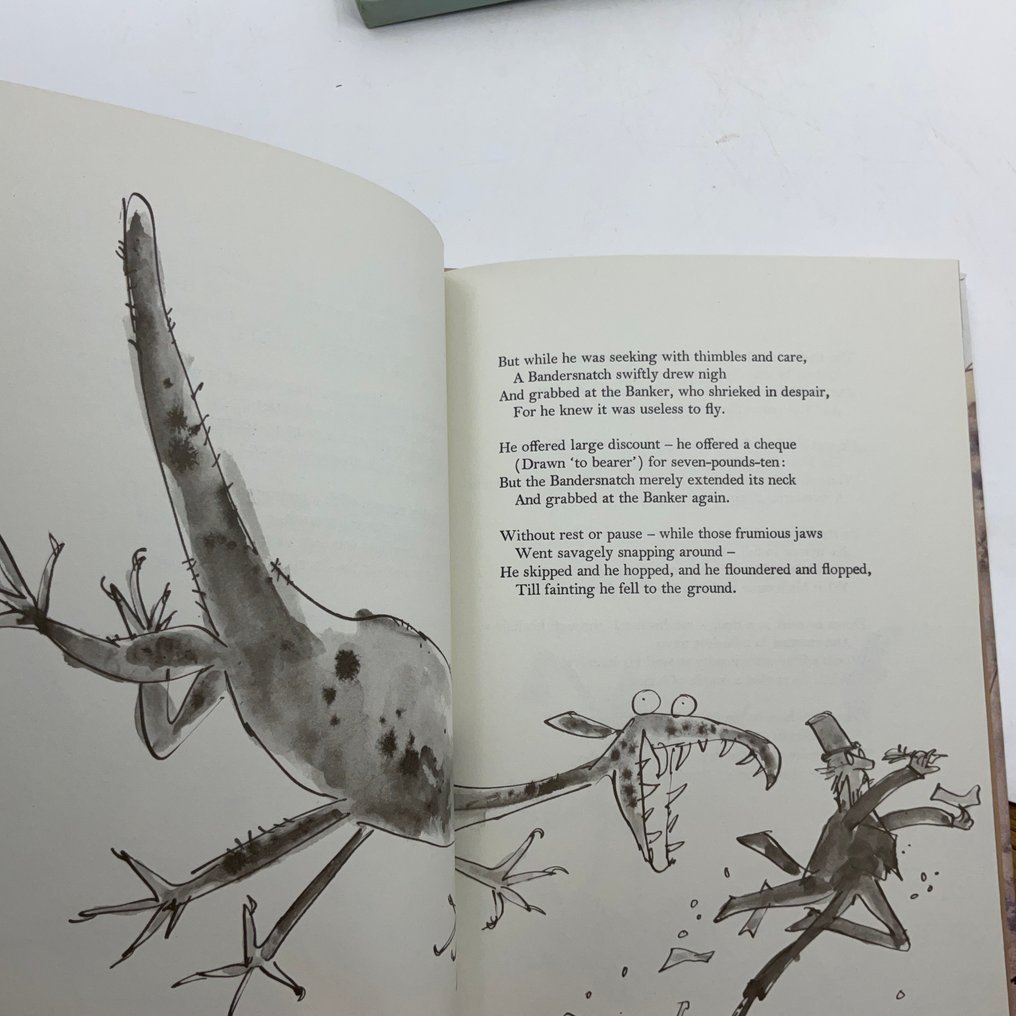
Lewis Carroll / Quentin Blake (ill) - The Hunting of the Snark - 1976


10
days
21
hours
29
minutes
48
seconds
Current bid
€ 1
No reserve price

Expert
Selected by Sebastian Hau
Founded and directed two French book fairs; nearly 20 years of experience in contemporary books.
Estimate € 110 - € 160
3 other people are watching this object
 Bidder 2151 Bidder 2151 | €1 |
|---|
Catawiki Buyer Protection
Your payment’s safe with us until you receive your object.View details
Trustpilot 4.4 | 122385 reviews
Rated Excellent on Trustpilot.
The Hunting of the Snark, an agony in Eight Fits, by Lewis Carroll with illustrations by Quentin Blake, Folio Society, London, 1976, first edition thus, hardback in English in very good condition with a decorated binding and slipcase.
AI-assisted summary
Description from the seller
"The Hunting of the Snark, an agony in Eight fits" by Lewis Carroll and illustrated by Quentin Blake - Folio Society, London - 1976 first thus UK edition - 18cmx15cm - condition: very good, in decorated binding, with all Blake illustrations, in slipcase
The Hunting of the Snark, subtitled An Agony, in Eight Fits, is a poem by the English writer Lewis Carroll. It is typically categorised as a nonsense poem. Written between 1874 and 1876, it borrows the setting, some creatures, and eight portmanteau words from Carroll's earlier poem "Jabberwocky" in his children's novel Through the Looking-Glass (1871).
Macmillan published The Hunting of the Snark in the United Kingdom at the end of March 1876, with nine illustrations by Henry Holiday. It had mixed reviews from reviewers, who found it strange. The first printing of the poem consisted of 10,000 copies. There were two reprints by the conclusion of the year; in total, the poem was reprinted 17 times between 1876 and 1908. The poem also has been adapted for musicals, movies, opera, plays, and music.
The narrative follows a crew of ten trying to hunt the Snark, a creature which may turn out to be a highly dangerous Boojum. The only crew member to find the Snark quietly vanishes, leading the narrator to explain that the Snark was a Boojum after all.
Carroll dedicated the poem to young Gertrude Chataway, whom he met in the English seaside town Sandown on the Isle of Wight in 1875. Included with many copies of the first edition of the poem was Carroll's religious tract, An Easter Greeting to Every Child Who Loves "Alice".
Various meanings in the poem have been proposed, among them existential angst, an allegory for tuberculosis, and a mockery of the Tichborne case.
While Carroll denied knowing the meaning behind the poem,[1] he agreed in an 1897 reply to a reader's letter with an interpretation of the poem as an allegory for the pursuit of happiness.[2][3] Henry Holiday, the illustrator of the poem, considered the poem a "tragedy
"The Hunting of the Snark, an agony in Eight fits" by Lewis Carroll and illustrated by Quentin Blake - Folio Society, London - 1976 first thus UK edition - 18cmx15cm - condition: very good, in decorated binding, with all Blake illustrations, in slipcase
The Hunting of the Snark, subtitled An Agony, in Eight Fits, is a poem by the English writer Lewis Carroll. It is typically categorised as a nonsense poem. Written between 1874 and 1876, it borrows the setting, some creatures, and eight portmanteau words from Carroll's earlier poem "Jabberwocky" in his children's novel Through the Looking-Glass (1871).
Macmillan published The Hunting of the Snark in the United Kingdom at the end of March 1876, with nine illustrations by Henry Holiday. It had mixed reviews from reviewers, who found it strange. The first printing of the poem consisted of 10,000 copies. There were two reprints by the conclusion of the year; in total, the poem was reprinted 17 times between 1876 and 1908. The poem also has been adapted for musicals, movies, opera, plays, and music.
The narrative follows a crew of ten trying to hunt the Snark, a creature which may turn out to be a highly dangerous Boojum. The only crew member to find the Snark quietly vanishes, leading the narrator to explain that the Snark was a Boojum after all.
Carroll dedicated the poem to young Gertrude Chataway, whom he met in the English seaside town Sandown on the Isle of Wight in 1875. Included with many copies of the first edition of the poem was Carroll's religious tract, An Easter Greeting to Every Child Who Loves "Alice".
Various meanings in the poem have been proposed, among them existential angst, an allegory for tuberculosis, and a mockery of the Tichborne case.
While Carroll denied knowing the meaning behind the poem,[1] he agreed in an 1897 reply to a reader's letter with an interpretation of the poem as an allegory for the pursuit of happiness.[2][3] Henry Holiday, the illustrator of the poem, considered the poem a "tragedy
Details
Number of Books
1
Subject
Children's books, Illustrated, Literature
Book Title
The Hunting of the Snark
Author/ Illustrator
Lewis Carroll / Quentin Blake (ill)
Condition
Very good
Publication year oldest item
1976
Edition
1st Edition Thus
Language
English
Original language
Yes
Binding/ Material
Hardback
Number of pages
0
Sold by
