Ludovico Mazzanti (1686–1775), Workshop of - Santo in adorazione del crocifisso

08
days
23
hours
58
minutes
14
seconds
Starting bid
€ 1
Reserve price not met

Expert
Selected by Caterina Maffeis
Master in early Renaissance Italian painting with internship at Sotheby’s and 15 years' experience.
Estimate € 2,500 - € 3,000
No bids placed
Catawiki Buyer Protection
Your payment’s safe with us until you receive your object.View details
Trustpilot 4.4 | 122529 reviews
Rated Excellent on Trustpilot.
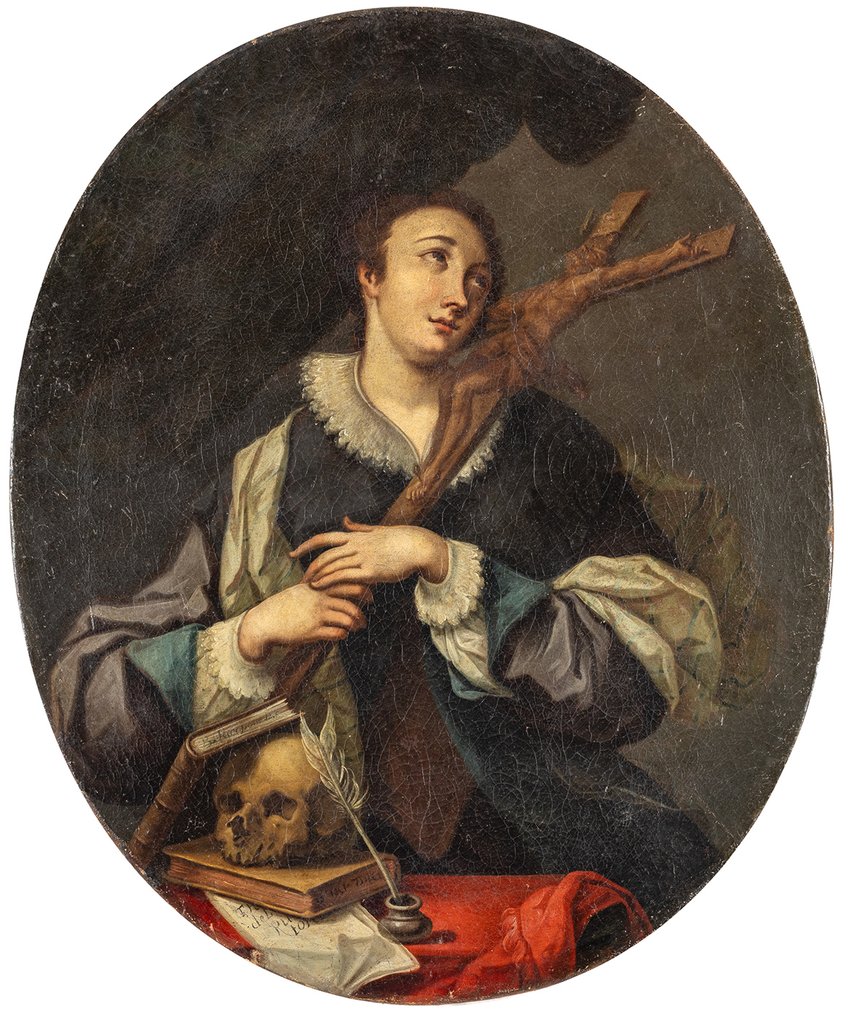
Santo in adorazione del crocifisso, an oil on oval canvas of 74 × 61 cm from the 18th century, attributed to the workshop of Ludovico Mazzanti in Italy.
AI-assisted summary
Description from the seller
Workshop of Ludovico Mazzanti
(Roma, 1686 – Viterbo, 1775)
Saint in adoration of the crucifix.
Oil on oval canvas, 74 x 61 cm.
NOTE: Publication of the Intermidiart collection works catalog. Certificate of Guarantee and Lawful Provenance. Work without frame:
We present in the auction catalog an interesting oil painting on oval canvas of good quality, depicting one of the scenes of a Saint or Beatus during the adoration of the Cross.
In the painting, the Saint or Beatus – depicted at a young age – is shown three-quarters view, looking upward while holding the Cross in a gesture of adoration. At the foot of the Cross, on a table covered with a red cloth, a skull and two books are placed. The iconography with the adoration of the crucifix, the skull, and the books symbolizes Christ's victory over sin and death. The skull of Adam, located at the foot of the cross, represents humanity and original sin, while the books may allude to the knowledge and the word of God that lead to salvation, highlighting Christ's sacrifice as redemption for all humanity.
From a stylistic point of view, it features a composition of suggestive quality, highly evolved and refined, with hues and luminous reflections that evoke the distinctive pictorial characteristics of a great master active in Rome and Naples in the first half of the eighteenth century, capable of creating an elegantly vibrant depiction with a Solimenesque influence.
Already considered attributable to the Roman sphere and at the same time close to the circle of Francesco Solimena, according to oral tradition, and subsequently made known – here and with caution – the correct attribution within the works carried out by the painter Ludovico Mazzanti (Rome, 1686 – Viterbo, 1775), of Roman origin and Neapolitan adoption.
The work indeed proves to be a valuable addition to the catalog of the Orvieto painter, and it can be dated to the fourth decade of the eighteenth century — during the Neapolitan stay — based on strict comparisons with paintings from the same period in Naples, such as Juditha and Holofernes from the Collection Motais de Narbonne, created in 1740 and now housed in the Bemberg Foundation collection in Toulouse, where the same physiognomic types and the same dynamic plasticity of the draperies are found.
Ludovico Mazzanti, along with Giovanni Odazzi, was the favorite pupil of Giovanni Battista Gaulli, into whose workshop he entered at a very young age in 1700. Influenced, like all the Roman painters of his generation, by Maratti's teachings, he nonetheless distinguished himself with a completely original classicist painting style, less delicate graphically but more substantial and palpable in terms of painting. His figures are characterized by a sanguine and earthly vitality, far from the ethereal delicacies of Giuseppe Bartolomeo Chiari, Luigi Garzi, and Giovanni Odazzi.
Among the most significant works painted by Mazzanti in Rome are the frescoes in the Church of Sant'Ignazio, the paintings for Sant'Andrea al Quirinale, and the two ceiling panels in the palace formerly belonging to de Carolis.
The painter worked in Naples from 1733, where he painted for the Church of the Gerolamini, the Abbey of Montevergine, and the Church of the Nunziatella. During his Neapolitan stay, he had the opportunity to study the works of Solimena, De Matteis, and De Mura, from whom he was strongly influenced, both in the chromatic range and in the plasticity of the figures. All these characteristics are found in the painting offered here, of great visual impact, in which the scene's dramatic intensity, set against a neutral background, is rendered with attention to naturalistic details, a true baroque model of heroine destined to meet great success among contemporaries.
Therefore, the previous attribution – as already mentioned – can be traced back to the Roman sphere and is close to the circle of the aforementioned Solimena, and today can be attributed to the painter Ludovico Mazzanti.
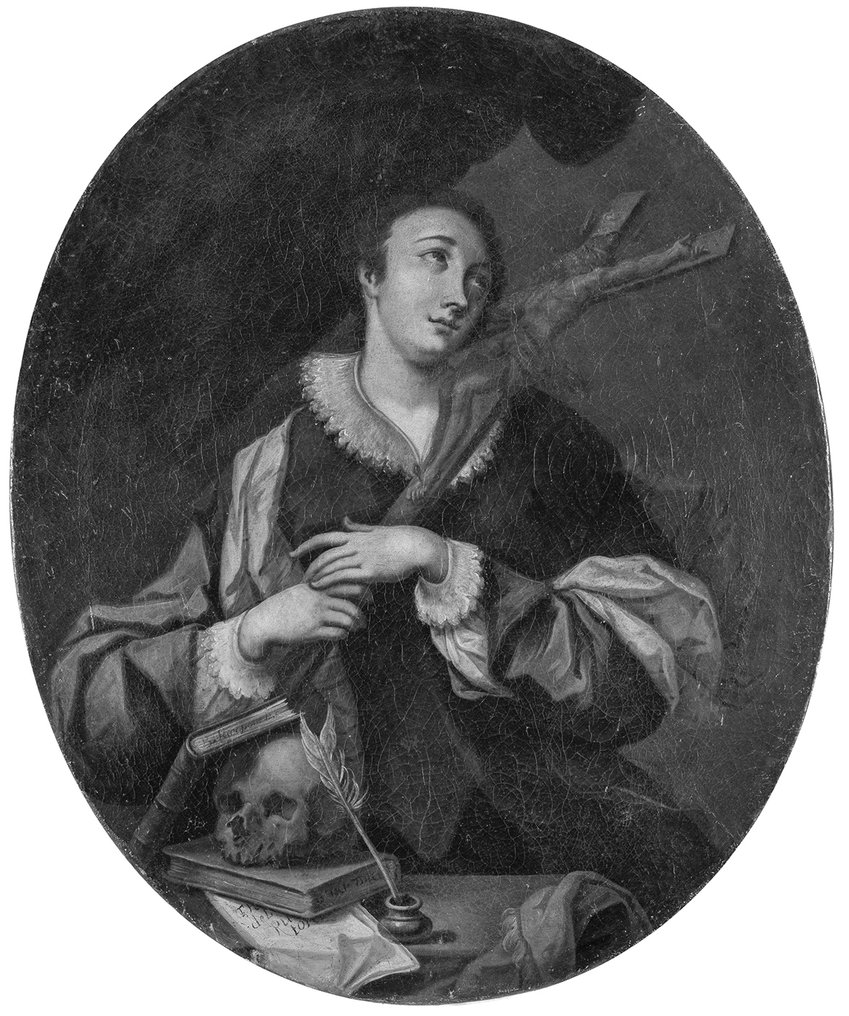
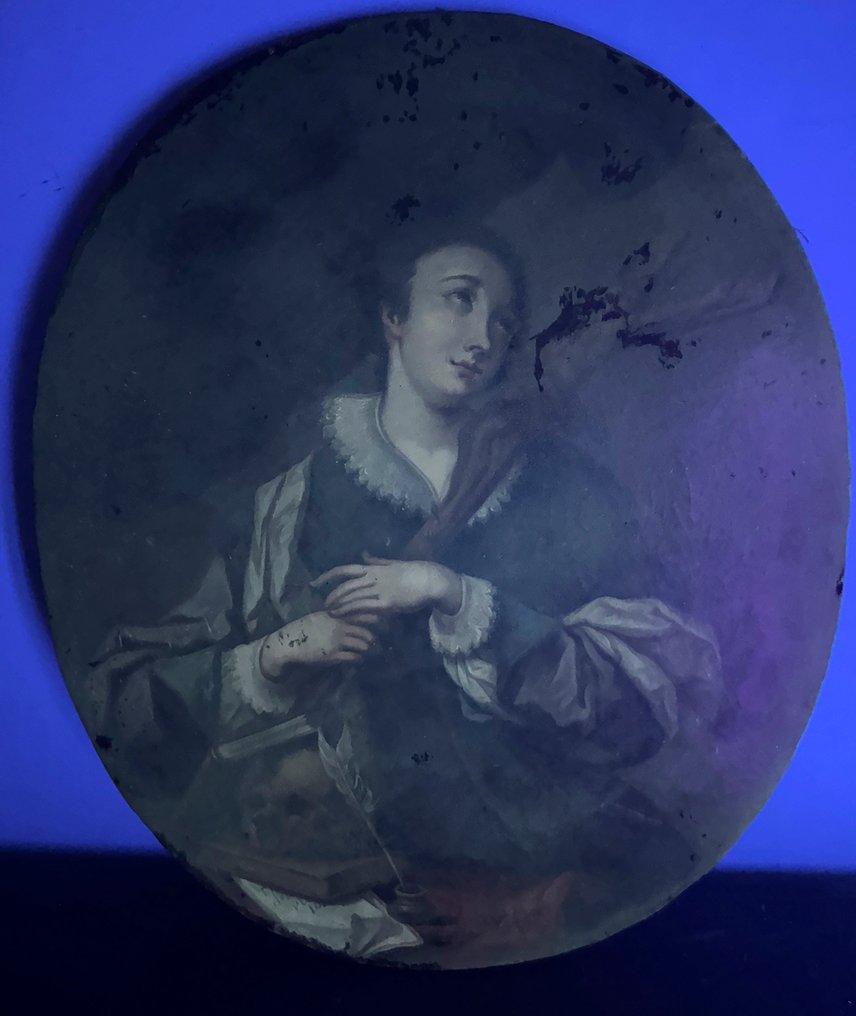
Regarding its conservation state, the canvas presents generally decent conditions considering the age of the painting. The painted surface shows a patina and does not display any reading difficulties. Under Wood's light, some small scattered restorations and slight veiling and oxidation of the painted surface are visible, but nothing truly significant. In sunlight, a fine craquelure related to the period can be seen. The dimensions of the oval-shaped canvas are 74 x 61 cm.
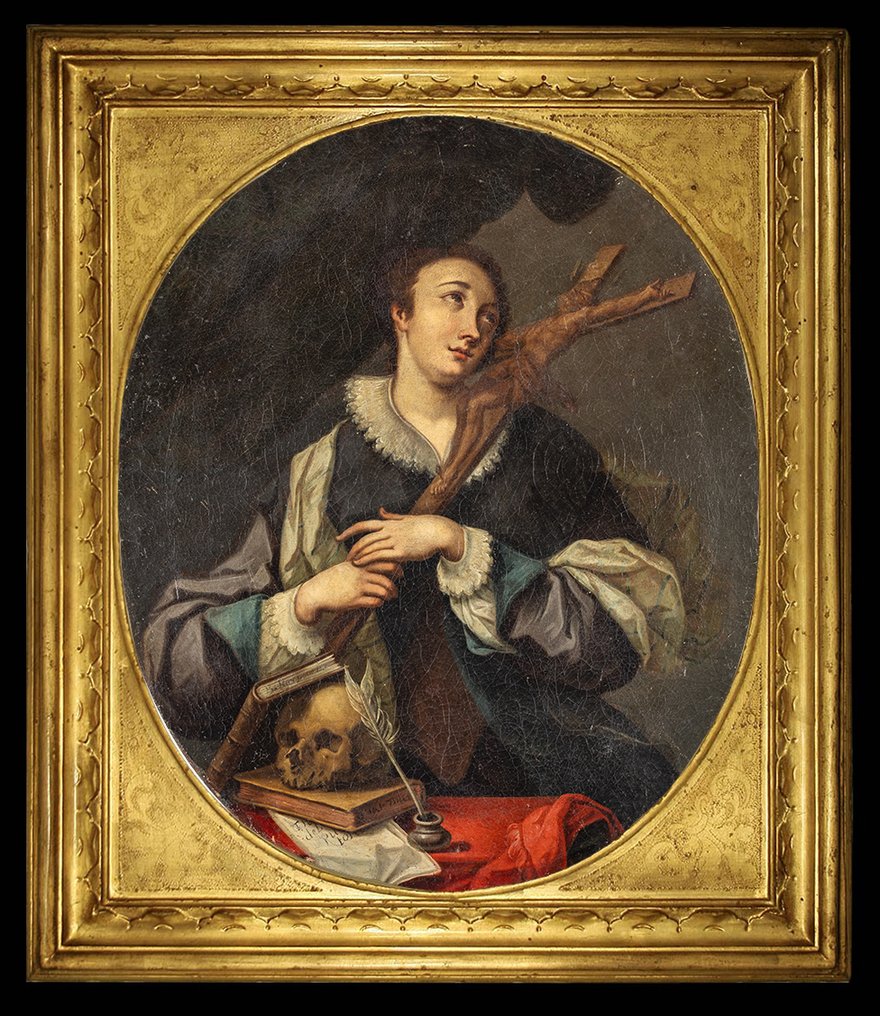
The painting is sold without its frame, despite being adorned with a beautiful, gilded Baroque-style frame.
Provenance: private collection
Publication
Unpublished
Myths and the Territory in Sicily with a thousand cultures. UNPUBLISHED QUADRERIA, general catalog of the paintings from the collection of the cycle 'Myths and the Territory,' Publisher Lab_04, Marsala, 2025.
In the case of sales outside the Italian territory, the buyer must wait for the export procedures to be completed.
Seller's Story
Born in Le Locle, Switzerland, in 1975, graduated as a commercial expert, he is the owner of the Intermidiart Ancient Art Gallery - founded in 2011 - in which he offers a fine selection of works of art, in particular 17th century paintings (such as Guido Reni , Francesco Furini, Pietro Novelli, Carlo Saraceni, Lorenzo Lippi, Bernardo Strozzi, others) and XVIII century (such as Luca Giordano, Giuseppe Maria Crespi, etc.).
He founded the cultural association "Fiera Franca Ss. Salvatore" in 2015, with the aim of representing an important vehicle for promoting knowledge of local art and culture.
It collaborates both with professionals in restoration and specialized laboratories for the technical studies and analysis of ancient works, and with national and international art historians and experts. After gaining work experience in national galleries and exhibitions, he boasts numerous essay publications. He has directed several editions of exhibitions for the unpublished cycle "MYTHS AND THE TERRITORY in Sicily of a thousand cultures", sponsored by the Ministry of Cultural Heritage, the Region of Sicily, Superintendence for Cultural and Environmental Heritage of Trapani, and other bodies.
Translated by Google TranslateWorkshop of Ludovico Mazzanti
(Roma, 1686 – Viterbo, 1775)
Saint in adoration of the crucifix.
Oil on oval canvas, 74 x 61 cm.
NOTE: Publication of the Intermidiart collection works catalog. Certificate of Guarantee and Lawful Provenance. Work without frame:
We present in the auction catalog an interesting oil painting on oval canvas of good quality, depicting one of the scenes of a Saint or Beatus during the adoration of the Cross.
In the painting, the Saint or Beatus – depicted at a young age – is shown three-quarters view, looking upward while holding the Cross in a gesture of adoration. At the foot of the Cross, on a table covered with a red cloth, a skull and two books are placed. The iconography with the adoration of the crucifix, the skull, and the books symbolizes Christ's victory over sin and death. The skull of Adam, located at the foot of the cross, represents humanity and original sin, while the books may allude to the knowledge and the word of God that lead to salvation, highlighting Christ's sacrifice as redemption for all humanity.
From a stylistic point of view, it features a composition of suggestive quality, highly evolved and refined, with hues and luminous reflections that evoke the distinctive pictorial characteristics of a great master active in Rome and Naples in the first half of the eighteenth century, capable of creating an elegantly vibrant depiction with a Solimenesque influence.
Already considered attributable to the Roman sphere and at the same time close to the circle of Francesco Solimena, according to oral tradition, and subsequently made known – here and with caution – the correct attribution within the works carried out by the painter Ludovico Mazzanti (Rome, 1686 – Viterbo, 1775), of Roman origin and Neapolitan adoption.
The work indeed proves to be a valuable addition to the catalog of the Orvieto painter, and it can be dated to the fourth decade of the eighteenth century — during the Neapolitan stay — based on strict comparisons with paintings from the same period in Naples, such as Juditha and Holofernes from the Collection Motais de Narbonne, created in 1740 and now housed in the Bemberg Foundation collection in Toulouse, where the same physiognomic types and the same dynamic plasticity of the draperies are found.
Ludovico Mazzanti, along with Giovanni Odazzi, was the favorite pupil of Giovanni Battista Gaulli, into whose workshop he entered at a very young age in 1700. Influenced, like all the Roman painters of his generation, by Maratti's teachings, he nonetheless distinguished himself with a completely original classicist painting style, less delicate graphically but more substantial and palpable in terms of painting. His figures are characterized by a sanguine and earthly vitality, far from the ethereal delicacies of Giuseppe Bartolomeo Chiari, Luigi Garzi, and Giovanni Odazzi.
Among the most significant works painted by Mazzanti in Rome are the frescoes in the Church of Sant'Ignazio, the paintings for Sant'Andrea al Quirinale, and the two ceiling panels in the palace formerly belonging to de Carolis.
The painter worked in Naples from 1733, where he painted for the Church of the Gerolamini, the Abbey of Montevergine, and the Church of the Nunziatella. During his Neapolitan stay, he had the opportunity to study the works of Solimena, De Matteis, and De Mura, from whom he was strongly influenced, both in the chromatic range and in the plasticity of the figures. All these characteristics are found in the painting offered here, of great visual impact, in which the scene's dramatic intensity, set against a neutral background, is rendered with attention to naturalistic details, a true baroque model of heroine destined to meet great success among contemporaries.
Therefore, the previous attribution – as already mentioned – can be traced back to the Roman sphere and is close to the circle of the aforementioned Solimena, and today can be attributed to the painter Ludovico Mazzanti.
Regarding its conservation state, the canvas presents generally decent conditions considering the age of the painting. The painted surface shows a patina and does not display any reading difficulties. Under Wood's light, some small scattered restorations and slight veiling and oxidation of the painted surface are visible, but nothing truly significant. In sunlight, a fine craquelure related to the period can be seen. The dimensions of the oval-shaped canvas are 74 x 61 cm.
The painting is sold without its frame, despite being adorned with a beautiful, gilded Baroque-style frame.
Provenance: private collection
Publication
Unpublished
Myths and the Territory in Sicily with a thousand cultures. UNPUBLISHED QUADRERIA, general catalog of the paintings from the collection of the cycle 'Myths and the Territory,' Publisher Lab_04, Marsala, 2025.
In the case of sales outside the Italian territory, the buyer must wait for the export procedures to be completed.
Seller's Story
Born in Le Locle, Switzerland, in 1975, graduated as a commercial expert, he is the owner of the Intermidiart Ancient Art Gallery - founded in 2011 - in which he offers a fine selection of works of art, in particular 17th century paintings (such as Guido Reni , Francesco Furini, Pietro Novelli, Carlo Saraceni, Lorenzo Lippi, Bernardo Strozzi, others) and XVIII century (such as Luca Giordano, Giuseppe Maria Crespi, etc.).
He founded the cultural association "Fiera Franca Ss. Salvatore" in 2015, with the aim of representing an important vehicle for promoting knowledge of local art and culture.
It collaborates both with professionals in restoration and specialized laboratories for the technical studies and analysis of ancient works, and with national and international art historians and experts. After gaining work experience in national galleries and exhibitions, he boasts numerous essay publications. He has directed several editions of exhibitions for the unpublished cycle "MYTHS AND THE TERRITORY in Sicily of a thousand cultures", sponsored by the Ministry of Cultural Heritage, the Region of Sicily, Superintendence for Cultural and Environmental Heritage of Trapani, and other bodies.
Translated by Google TranslateDetails
Artist
Ludovico Mazzanti (1686–1775), Workshop of
Sold with frame
No
Title of artwork
Santo in adorazione del crocifisso
Technique
Oil painting
Signature
Not signed
Country of Origin
Italy
Condition
Fair condition
Height
74 cm
Width
61 cm
Weight
4 kg
Depiction/Theme
Religion
Style
Baroque
Period
18th century
Sold by
