Pietro Scoppetta (1863 – 1920) - Paesaggio di campagna - NO RESERVE



10
days
19
hours
20
minutes
12
seconds
Starting bid
€ 1
No reserve price

Expert
Selected by Caterina Maffeis
Master in early Renaissance Italian painting with internship at Sotheby’s and 15 years' experience.
Estimate € 1,500 - € 2,000
No bids placed
Catawiki Buyer Protection
Your payment’s safe with us until you receive your object.View details
Trustpilot 4.4 | 122385 reviews
Rated Excellent on Trustpilot.
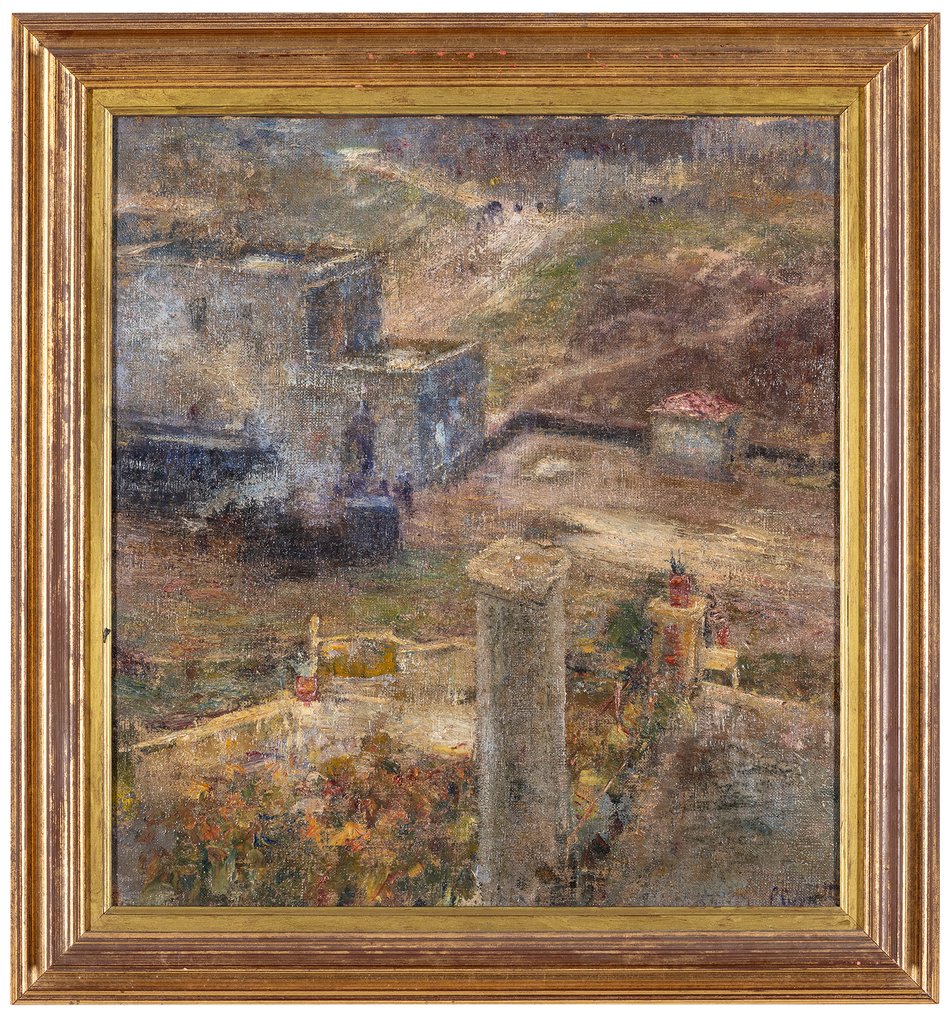
Paesaggio di campagna, an oil on canvas landscape by Pietro Scoppetta (1863–1920), dating to 1900–1910, Italian, signed by hand, measuring 65 × 61 cm with frame and sold with its frame.
AI-assisted summary
Description from the seller
PIETRO SCOPPETTA
(Amalfi, SA 1863 - Naples 1920)
Countryside landscape
Oil on canvas applied on cardboard, 52 x 48 cm.
Signed 'P. SCOPPETTA' at the bottom right.
Size with frame, approx. 65 x 61 x 5 cm.
NOTE: Publication of the collection catalog of Intermidiart works. On the back: inscription traces. Signed artwork. Certificate of Guarantee and Lawful Provenance. Artwork with gilded frame (defects):
This exquisite piece, originating from the antique market as an autographed work by the renowned Neapolitan painter Pietro Scoppetta (Amalfi, 1863 – Naples, 1920), focuses on a scene of an urban landscape with soft tones. Specifically, the painting is an example of his landscape work, depicting buildings in a hilly or coastal setting, with a foggy atmosphere and autumnal colors.
The artist, through the fusion of chromatic masses with quick and vibrant brushstrokes, creates a solid overall vision that perfectly recalls the style of that period. The work is characterized, in fact, by thick color palettes and a fluid, immediate style.
Pietro Scoppetta was born in Amalfi on February 15, 1863. Initially, he dedicated himself to architecture studies, which he later abandoned to attend painting courses with Giacomo Di Chirico. After leaving academic teachings, in 1891 he moved to Naples, where he began exhibiting in several shows organized by the local Società Promotrice, showcasing his talent mainly in views of his native Amalfi coast and the Valley of the Mills. Between 1889 and 1890, he was commissioned to fresco the ceilings of the Gambrinus Café, an elegant cultural gathering spot in Naples, alongside other artists. During the same period, he worked as an illustrator for some magazines owned by the Treves publishing house ('Cronaca Partenopea,' 'La Tavola Rotonda,' and 'L’Illustrazione Italiana').
Despite achieving commercial and critical success, in 1897 he decided to leave Italy to reside in London and Paris. In the French capital, where he lived from 1897 to 1903, he became part of the numerous Neapolitan painters attracted by the bourgeois allure of the Belle Epoque (Lionello Balestrieri, Arnaldo De Lisio, Ulisse Caputo, Raffaelle Ragione, Vincenzo La Bella). From his French experience, he drew important elements through his engagement with the works of the Impressionist painters, which he then reinterpreted in a completely personal way, developing a comprehensive and luminous painting technique. The Parisian period also brought about a profound change in the themes of his paintings: the landscape representations of the previous period were replaced by depictions of bourgeois life, in which the artist identified elements of optimism and tension towards the future, better suited to his nature. After 1910, he left Paris to settle in Rome, where he spent a long period at the home of his friend Pietro Carrara and his wife, Marchioness Maria Valdambrini. In his final years, he dedicated himself to poetry, publishing in 1919 the collection 'Rhythms of the Heart' under the pseudonym Pictor Petrus.
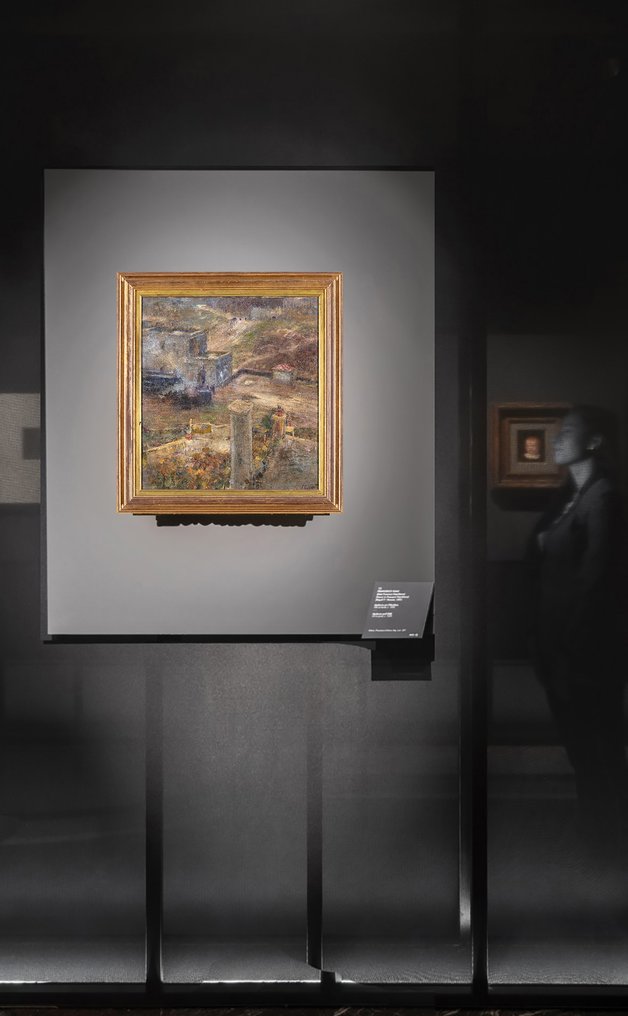
From a conservation perspective, the work presents with a patina and is in fair condition, with a painted surface showing signs of age. However, the decorative effect of the piece remains intact, and it is perfectly framed in a gold frame that adds further aesthetic value to the painting (dimensions approx. 65 x 61 x 5 cm, with some defects). The frame shown in the photos above was added to the artwork by the seller or a third party. The frame is provided at no additional cost so that it is ready for display upon arrival. The frame is included as a courtesy and is not considered an integral part of the artwork. Therefore, any potential damage to the frame that does not affect the artwork itself will not be accepted as a valid reason to open a claim or request order cancellation.
Provenance: private collection
Publication
Unpublished
Myths and the Territory in Sicily with a thousand cultures. UNPUBLISHED QUADRERIA, general catalog of the paintings from the collection of the cycle 'Myths and the Territory,' Publisher Lab_04, Marsala, 2025.
In the case of sales outside the Italian territory, the buyer must wait for the export procedures to be completed.
Seller's Story
Born in Le Locle, Switzerland, in 1975, graduated as a commercial expert, he is the owner of the Intermidiart Ancient Art Gallery - founded in 2011 - in which he offers a fine selection of works of art, in particular 17th century paintings (such as Guido Reni , Francesco Furini, Pietro Novelli, Carlo Saraceni, Lorenzo Lippi, Bernardo Strozzi, others) and XVIII century (such as Luca Giordano, Giuseppe Maria Crespi, etc.).
He founded the cultural association "Fiera Franca Ss. Salvatore" in 2015, with the aim of representing an important vehicle for promoting knowledge of local art and culture.
It collaborates both with professionals in restoration and specialized laboratories for the technical studies and analysis of ancient works, and with national and international art historians and experts. After gaining work experience in national galleries and exhibitions, he boasts numerous essay publications. He has directed several editions of exhibitions for the unpublished cycle "MYTHS AND THE TERRITORY in Sicily of a thousand cultures", sponsored by the Ministry of Cultural Heritage, the Region of Sicily, Superintendence for Cultural and Environmental Heritage of Trapani, and other bodies.
Translated by Google TranslatePIETRO SCOPPETTA
(Amalfi, SA 1863 - Naples 1920)
Countryside landscape
Oil on canvas applied on cardboard, 52 x 48 cm.
Signed 'P. SCOPPETTA' at the bottom right.
Size with frame, approx. 65 x 61 x 5 cm.
NOTE: Publication of the collection catalog of Intermidiart works. On the back: inscription traces. Signed artwork. Certificate of Guarantee and Lawful Provenance. Artwork with gilded frame (defects):
This exquisite piece, originating from the antique market as an autographed work by the renowned Neapolitan painter Pietro Scoppetta (Amalfi, 1863 – Naples, 1920), focuses on a scene of an urban landscape with soft tones. Specifically, the painting is an example of his landscape work, depicting buildings in a hilly or coastal setting, with a foggy atmosphere and autumnal colors.
The artist, through the fusion of chromatic masses with quick and vibrant brushstrokes, creates a solid overall vision that perfectly recalls the style of that period. The work is characterized, in fact, by thick color palettes and a fluid, immediate style.
Pietro Scoppetta was born in Amalfi on February 15, 1863. Initially, he dedicated himself to architecture studies, which he later abandoned to attend painting courses with Giacomo Di Chirico. After leaving academic teachings, in 1891 he moved to Naples, where he began exhibiting in several shows organized by the local Società Promotrice, showcasing his talent mainly in views of his native Amalfi coast and the Valley of the Mills. Between 1889 and 1890, he was commissioned to fresco the ceilings of the Gambrinus Café, an elegant cultural gathering spot in Naples, alongside other artists. During the same period, he worked as an illustrator for some magazines owned by the Treves publishing house ('Cronaca Partenopea,' 'La Tavola Rotonda,' and 'L’Illustrazione Italiana').
Despite achieving commercial and critical success, in 1897 he decided to leave Italy to reside in London and Paris. In the French capital, where he lived from 1897 to 1903, he became part of the numerous Neapolitan painters attracted by the bourgeois allure of the Belle Epoque (Lionello Balestrieri, Arnaldo De Lisio, Ulisse Caputo, Raffaelle Ragione, Vincenzo La Bella). From his French experience, he drew important elements through his engagement with the works of the Impressionist painters, which he then reinterpreted in a completely personal way, developing a comprehensive and luminous painting technique. The Parisian period also brought about a profound change in the themes of his paintings: the landscape representations of the previous period were replaced by depictions of bourgeois life, in which the artist identified elements of optimism and tension towards the future, better suited to his nature. After 1910, he left Paris to settle in Rome, where he spent a long period at the home of his friend Pietro Carrara and his wife, Marchioness Maria Valdambrini. In his final years, he dedicated himself to poetry, publishing in 1919 the collection 'Rhythms of the Heart' under the pseudonym Pictor Petrus.
From a conservation perspective, the work presents with a patina and is in fair condition, with a painted surface showing signs of age. However, the decorative effect of the piece remains intact, and it is perfectly framed in a gold frame that adds further aesthetic value to the painting (dimensions approx. 65 x 61 x 5 cm, with some defects). The frame shown in the photos above was added to the artwork by the seller or a third party. The frame is provided at no additional cost so that it is ready for display upon arrival. The frame is included as a courtesy and is not considered an integral part of the artwork. Therefore, any potential damage to the frame that does not affect the artwork itself will not be accepted as a valid reason to open a claim or request order cancellation.
Provenance: private collection
Publication
Unpublished
Myths and the Territory in Sicily with a thousand cultures. UNPUBLISHED QUADRERIA, general catalog of the paintings from the collection of the cycle 'Myths and the Territory,' Publisher Lab_04, Marsala, 2025.
In the case of sales outside the Italian territory, the buyer must wait for the export procedures to be completed.
Seller's Story
Born in Le Locle, Switzerland, in 1975, graduated as a commercial expert, he is the owner of the Intermidiart Ancient Art Gallery - founded in 2011 - in which he offers a fine selection of works of art, in particular 17th century paintings (such as Guido Reni , Francesco Furini, Pietro Novelli, Carlo Saraceni, Lorenzo Lippi, Bernardo Strozzi, others) and XVIII century (such as Luca Giordano, Giuseppe Maria Crespi, etc.).
He founded the cultural association "Fiera Franca Ss. Salvatore" in 2015, with the aim of representing an important vehicle for promoting knowledge of local art and culture.
It collaborates both with professionals in restoration and specialized laboratories for the technical studies and analysis of ancient works, and with national and international art historians and experts. After gaining work experience in national galleries and exhibitions, he boasts numerous essay publications. He has directed several editions of exhibitions for the unpublished cycle "MYTHS AND THE TERRITORY in Sicily of a thousand cultures", sponsored by the Ministry of Cultural Heritage, the Region of Sicily, Superintendence for Cultural and Environmental Heritage of Trapani, and other bodies.
Translated by Google TranslateDetails
Artist
Pietro Scoppetta (1863 – 1920)
Sold with frame
Yes
Sold by
Gallery
Edition
Original
Title of artwork
Paesaggio di campagna - NO RESERVE
Technique
Oil painting
Signature
Hand signed
Country of Origin
Italy
Condition
Fair condition
Height
65 cm
Width
61 cm
Weight
5 kg
Depiction/Theme
Landscape
Style
Realism
Period
1900-1910
Sold by
