Alessandro Longhi (1733–1813), ambito di, Attributed to - Ritratto di Elisabetta Marchi Callo Giurguich, 1756



09
days
21
hours
45
minutes
20
seconds
Starting bid
€ 1
Reserve price not met

Expert
Selected by Giulia Santoro
Specialised in 17th century Old Master paintings and drawings with auction house experience.
Estimate € 1,000 - € 1,200
No bids placed
Catawiki Buyer Protection
Your payment’s safe with us until you receive your object.View details
Trustpilot 4.4 | 122553 reviews
Rated Excellent on Trustpilot.
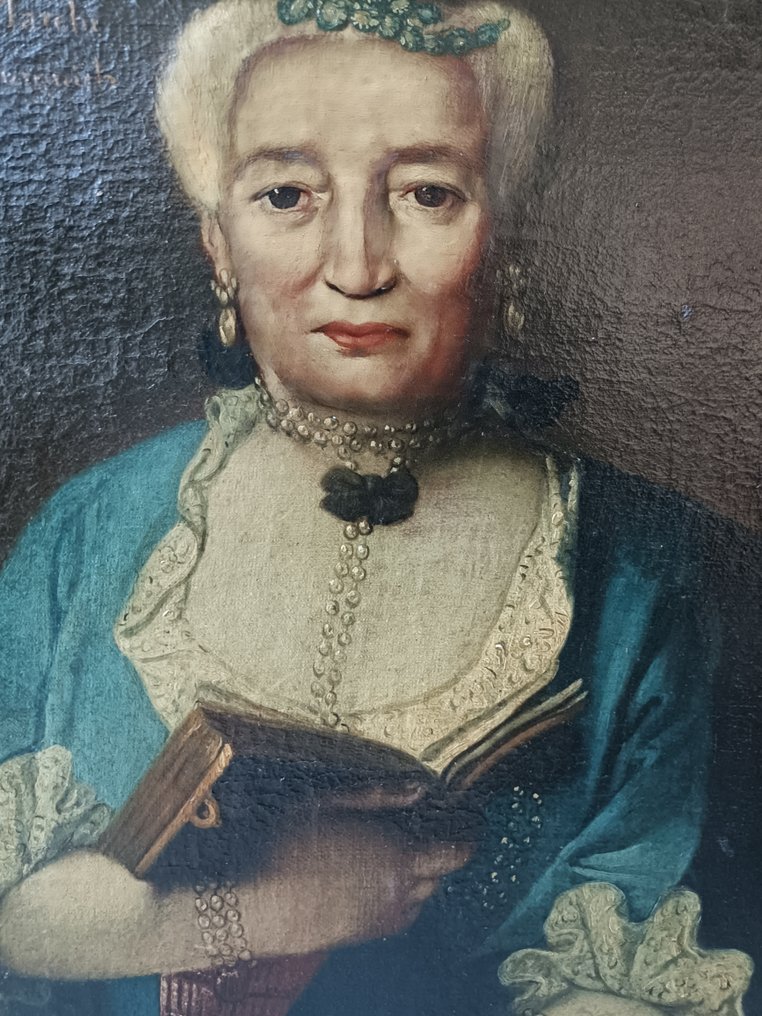
Ritratto di Elisabetta Marchi Callo Giurguich, 1756, oil on canvas, Italy.
AI-assisted summary
Description from the seller
Alessandro Longhi (Venice, 1733 – 1813), field of
Portrait of Elisabetta Marchi Callo Giurguich
Data: 1756 (data entered and registered)
Technique: Oil on canvas
Dimensions: 70 × 51 cm
Description of the work
The painting depicts Elisabetta Marchi Callo Giurguich, identified by the autograph inscription and the date 1756, elements that confer significant documentary value to the work. The figure is portrayed in half-length, facing forward, according to a composed and measured pose typical of mid-18th century Venetian portraiture intended for private clients. The lady wears an elegant dress in blue-green tones, enriched with fine lace and a pearl necklace, while holding a book, likely alluding to personal devotion or moral respectability.
The sober compositional layout, the neutral dark background, and the uniform light that delicately models the face and hands evoke a controlled pictorial language free of theatrical accents. The faithful and realistic depiction, combined with the detailed rendering of fabrics and jewelry, shows affinities with the portraiture of Alessandro Longhi's circle, characterized by a balanced blend of descriptive truth and formal decorum. The noblewoman's surname, likely of Slavic origin, suggests a cultural context linked to the territories of Venetian Dalmatia, an area where an educated clientele eager for figurative models updated on the lagoon tradition was widespread. The work thus reflects a mature Venetian figurative culture, expressed in a restrained and functional form typical of bourgeois and notable commissions active along the eastern Adriatic.
Biographical notes
Alessandro Longhi, son of the renowned painter Pietro Longhi, was one of the leading Venetian portraitists of the second half of the 18th century. Active mainly in Venice, he specialized in half-length portraits, distinguished by a sober and analytical style, attentive to facial features and the depiction of clothing and social attributes of his subjects. His work, primarily aimed at a bourgeois and cultured clientele, represents an important testimony of Venetian society at the time and influenced many painters active within the sphere of Venetian portraiture.
Condition
The painting shows signs of wear consistent with its age, with widespread craquelure and localized overpainting, particularly in the dark areas and some parts of the clothing. The pictorial surface is overall stable and legible, with a chromatic patina compatible with the dating.
Alessandro Longhi (Venice, 1733 – 1813), field of
Portrait of Elisabetta Marchi Callo Giurguich
Data: 1756 (data entered and registered)
Technique: Oil on canvas
Dimensions: 70 × 51 cm
Description of the work
The painting depicts Elisabetta Marchi Callo Giurguich, identified by the autograph inscription and the date 1756, elements that confer significant documentary value to the work. The figure is portrayed in half-length, facing forward, according to a composed and measured pose typical of mid-18th century Venetian portraiture intended for private clients. The lady wears an elegant dress in blue-green tones, enriched with fine lace and a pearl necklace, while holding a book, likely alluding to personal devotion or moral respectability.
The sober compositional layout, the neutral dark background, and the uniform light that delicately models the face and hands evoke a controlled pictorial language free of theatrical accents. The faithful and realistic depiction, combined with the detailed rendering of fabrics and jewelry, shows affinities with the portraiture of Alessandro Longhi's circle, characterized by a balanced blend of descriptive truth and formal decorum. The noblewoman's surname, likely of Slavic origin, suggests a cultural context linked to the territories of Venetian Dalmatia, an area where an educated clientele eager for figurative models updated on the lagoon tradition was widespread. The work thus reflects a mature Venetian figurative culture, expressed in a restrained and functional form typical of bourgeois and notable commissions active along the eastern Adriatic.
Biographical notes
Alessandro Longhi, son of the renowned painter Pietro Longhi, was one of the leading Venetian portraitists of the second half of the 18th century. Active mainly in Venice, he specialized in half-length portraits, distinguished by a sober and analytical style, attentive to facial features and the depiction of clothing and social attributes of his subjects. His work, primarily aimed at a bourgeois and cultured clientele, represents an important testimony of Venetian society at the time and influenced many painters active within the sphere of Venetian portraiture.
Condition
The painting shows signs of wear consistent with its age, with widespread craquelure and localized overpainting, particularly in the dark areas and some parts of the clothing. The pictorial surface is overall stable and legible, with a chromatic patina compatible with the dating.
Details
Artist
Alessandro Longhi (1733–1813), ambito di
Sold with frame
No
Attribution
Attributed to
Title of artwork
Ritratto di Elisabetta Marchi Callo Giurguich, 1756
Technique
Oil painting
Signature
Not signed
Country of Origin
Italy
Condition
Good condition
Height
70 cm
Width
51 cm
Period
18th century
Sold by
