Saint-Evremond - Les véritables Œuvres de Mr de Saint Evremond - 1706-1726



03
days
17
hours
38
minutes
16
seconds

No bids placed
Catawiki Buyer Protection
Your payment’s safe with us until you receive your object.View details
Trustpilot 4.4 | 122529 reviews
Rated Excellent on Trustpilot.
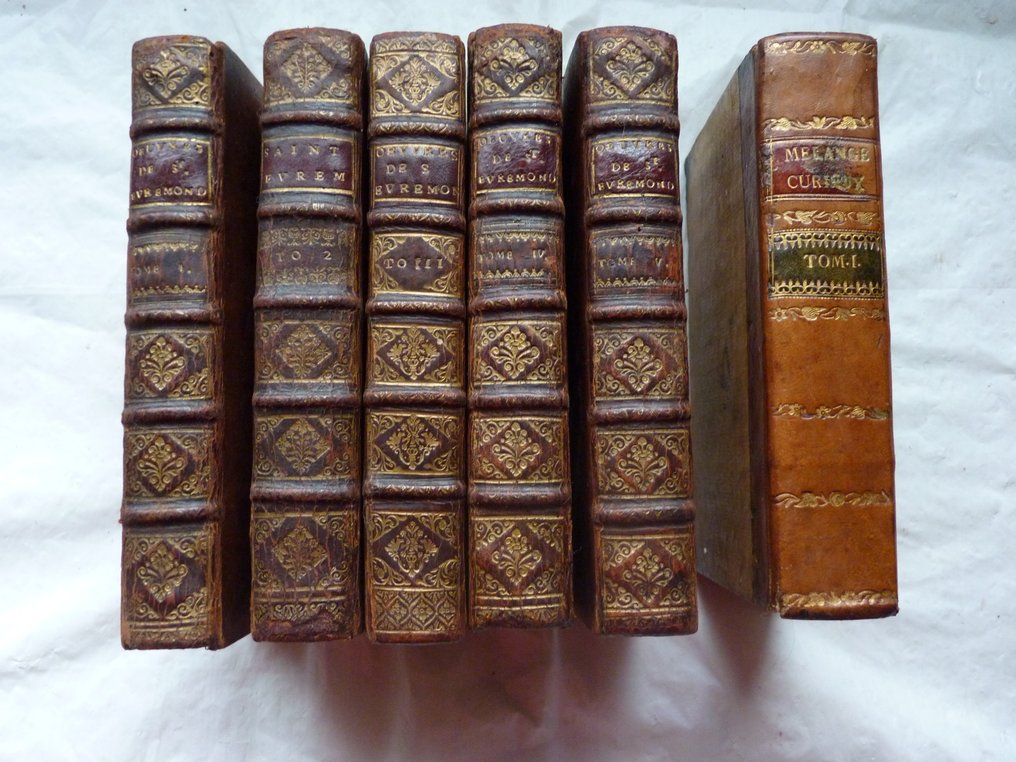
Six-volume revised edition in French of Les véritables Œuvres de Mr de Saint Evremond, published in London, bound in leather, about 3000 pages, measuring 17 cm by 9 cm, with prints dating from 1706 to 1726.
AI-assisted summary
Description from the seller
Charles Le Marquetel de Saint-Denis dit Saint-Évremond, seigneur de Saint-Ébremond, baptized on January 5, 1614 in Saint-Denis-le-Gast (in Normandy) and died on September 9, 1703 in London, was a French moralist and libertine critic.
This well-educated man begins a successful career in the army.
At the same time, he cultivated literature with a spirit of mockery and satire, associating with men of worth, such as Turenne, d'Albret, Créquy, Candale, Gramont, d'Olonne or Clérembault, without however neglecting the pleasure towards which his epicurean nature leads him.
The Fronde gave him the opportunity to demonstrate his courage and wit. He remained loyal to the royal cause and composed a witty pamphlet, much appreciated at court: The Retreat of M. de Longueville in his government of Normandy.
Forced into exile, he took refuge in Holland, then in England, where the court and literary circles welcomed him warmly.
In many respects, the incredulity and skepticism that shine through in the man who defines himself as "a philosopher equally far removed from the superstitious and the impious; a voluptuary who has no less aversion to debauchery than inclination for pleasures" foreshadow the philosophical tendencies that would characterize the Enlightenment in the following century.
His most famous work remains, without a doubt, the Conversation of Marshal d’Hocquincourt with Father Canaye, a marvel of wit and satire. His historical work, Reflections on the Various Geniuses of the Roman People (1663), inspired Montesquieu’s theories. Saint-Évremond addressed diverse themes, from literature (On Our Comedies, On Some Spanish, Italian, and French Books, Reflections on Ancient and Modern Tragedy, and Defense of Some Plays by Corneille) to contemporary history (Parallel of the Prince and of M. de Turenne). It is undoubtedly in his abundant correspondence that he revealed the best of a thought marked by independence, skepticism, and irony, and opposed to any systematic approach.
Consisting of the 'genuine works' to which was added as a supplement the 'curious mixture of the best pieces attributed to St Evremond'.
Second Edition revised and corrected (1706)
5 volumes (complete) for the Works.
1 volume (the first tome) for the 'curious mixture' (complete in itself) (1726)
Preface + 356, 406, 408, 408, 408, and 516 pages.
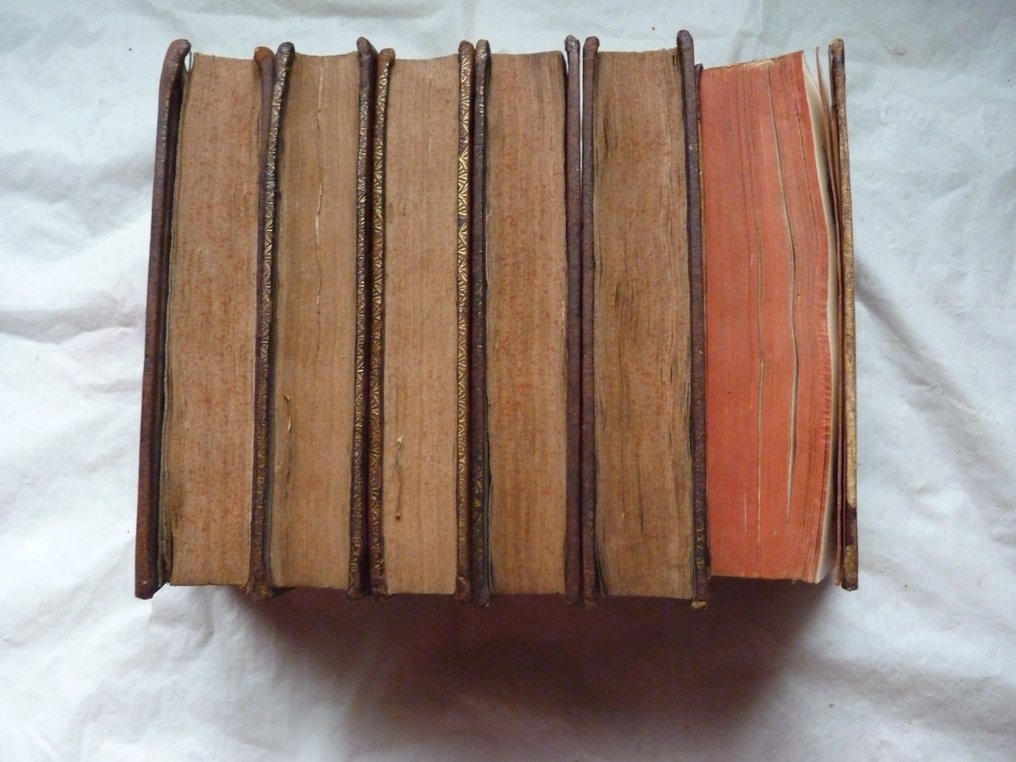
Solid leather binding with minor defects (damaged headcaps, loss of material: corners, edges, some corners show early cracks).
Fresh interior (non-serious dirt)
Half leather binding with corners for the 'mixture' (stains on the covers).
A frontispiece and an engraving in the supplement.
Nice lot
Charles Le Marquetel de Saint-Denis dit Saint-Évremond, seigneur de Saint-Ébremond, baptized on January 5, 1614 in Saint-Denis-le-Gast (in Normandy) and died on September 9, 1703 in London, was a French moralist and libertine critic.
This well-educated man begins a successful career in the army.
At the same time, he cultivated literature with a spirit of mockery and satire, associating with men of worth, such as Turenne, d'Albret, Créquy, Candale, Gramont, d'Olonne or Clérembault, without however neglecting the pleasure towards which his epicurean nature leads him.
The Fronde gave him the opportunity to demonstrate his courage and wit. He remained loyal to the royal cause and composed a witty pamphlet, much appreciated at court: The Retreat of M. de Longueville in his government of Normandy.
Forced into exile, he took refuge in Holland, then in England, where the court and literary circles welcomed him warmly.
In many respects, the incredulity and skepticism that shine through in the man who defines himself as "a philosopher equally far removed from the superstitious and the impious; a voluptuary who has no less aversion to debauchery than inclination for pleasures" foreshadow the philosophical tendencies that would characterize the Enlightenment in the following century.
His most famous work remains, without a doubt, the Conversation of Marshal d’Hocquincourt with Father Canaye, a marvel of wit and satire. His historical work, Reflections on the Various Geniuses of the Roman People (1663), inspired Montesquieu’s theories. Saint-Évremond addressed diverse themes, from literature (On Our Comedies, On Some Spanish, Italian, and French Books, Reflections on Ancient and Modern Tragedy, and Defense of Some Plays by Corneille) to contemporary history (Parallel of the Prince and of M. de Turenne). It is undoubtedly in his abundant correspondence that he revealed the best of a thought marked by independence, skepticism, and irony, and opposed to any systematic approach.
Consisting of the 'genuine works' to which was added as a supplement the 'curious mixture of the best pieces attributed to St Evremond'.
Second Edition revised and corrected (1706)
5 volumes (complete) for the Works.
1 volume (the first tome) for the 'curious mixture' (complete in itself) (1726)
Preface + 356, 406, 408, 408, 408, and 516 pages.
Solid leather binding with minor defects (damaged headcaps, loss of material: corners, edges, some corners show early cracks).
Fresh interior (non-serious dirt)
Half leather binding with corners for the 'mixture' (stains on the covers).
A frontispiece and an engraving in the supplement.
Nice lot
Details
Number of Books
6
Subject
Biographies and memoirs, Collected works, Literature, Philosophy, Poetry, Theatre
Book Title
Les véritables Œuvres de Mr de Saint Evremond
Author/ Illustrator
Saint-Evremond
Condition
Good
Publication year oldest item
1706
Publication year youngest item
1726
Height
17 cm
Edition
Revised edition
Width
9 cm
Language
French
Original language
Yes
Publisher
A Londres
Binding/ Material
Leather
Number of pages
3000
Sold by
