Charleton - Onomasticon Zoicon - 1668




08
days
13
hours
38
minutes
21
seconds
Current bid
€ 300
Reserve price not met

Expert
Selected by Ilaria Colombo
Specialist in old books, specialising in theological disputes since 1999.
Estimate € 700 - € 2,000
9 other people are watching this object
 Bidder 4056 Bidder 4056 | €300 |
|---|
Catawiki Buyer Protection
Your payment’s safe with us until you receive your object.View details
Trustpilot 4.4 | 122473 reviews
Rated Excellent on Trustpilot.
First edition of the illustrated Onomasticon Zoicon by Walter Charleton, 1668, published in Lyon by Jacobus Allestry, bound in full leather with plates and 363 pages.
AI-assisted summary
Description from the seller
Talking Besties, Stone Skeletons, and Lost Languages: An Illustrated Encyclopedic Bestiary
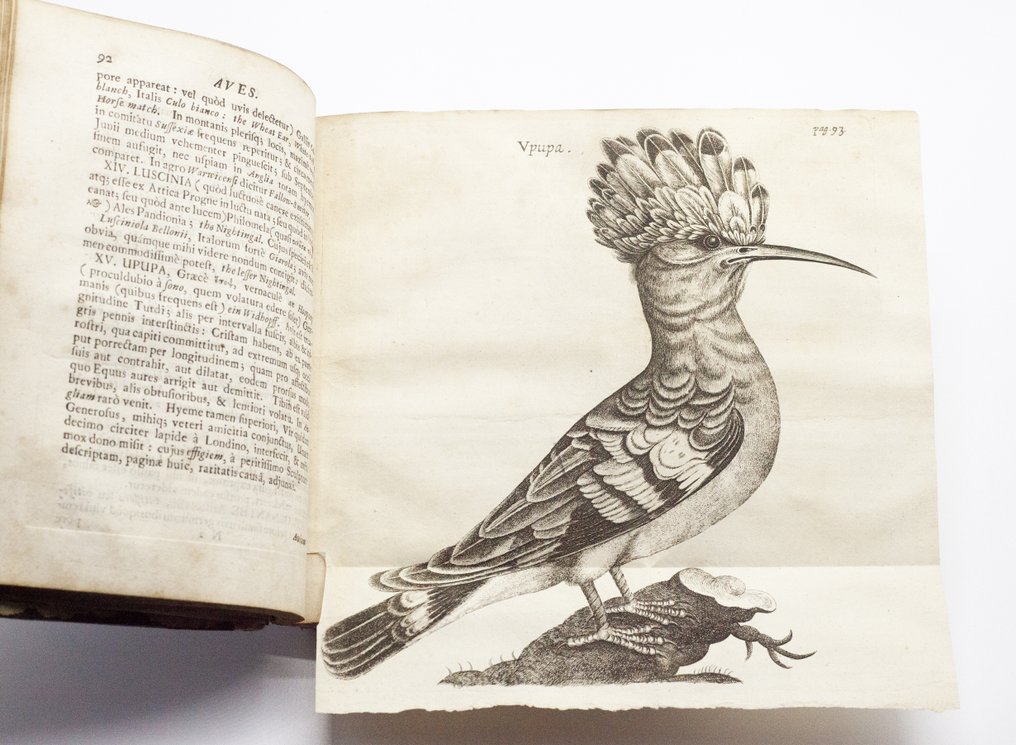
First edition of the rare Onomasticon Zoicon by Walter Charleton, published in Lyon in 1668 by Jacobus Allestry. A multifaceted work combining taxonomy, multilingual zoological nomenclature, comparative anatomy, and early fossil observations, illustrated with eight plates (six fold-out) and enriched with engravings in the text. A pioneering work in the history of natural history and scientific classification.
Market value
Complete copies of the first edition, with all plates and in contemporary binding, are very rare and can reach €2,000–€3,000, depending on the freshness of the illustrations and the condition of the volume. The collector's interest is heightened by the work's interdisciplinary and linguistic approach.
Physical description and condition
Full leather binding from the same period, spine with six nerves and gold title, visible signs of wear but solid structure. Internally in good condition: large engraved plates, crisp paper, sharp engravings. Professionally restored on a print. Marginal usage defects consistent with age. Genuine copy. Pp. (2); 18nn. 309; 34nn.
Full title and author
Onomasticon Zoicon, explaining the differences and proper names of most animals in multiple languages. It is supplemented by Mantissa Anatomica; and some works on various types of fossils.
Lyon: by Jacobus Allestry, 1668.
Author: Walter Charleton (Shempton Mallet 1619 – London 1707), English doctor and naturalist.
Context and Significance
The Zoicon Onomasticon is a pioneering work of systematic zoology and one of the first modern attempts to construct an animal taxonomy based on linguistic and morphological criteria. Walter Charleton, already known for his medico-philosophical works, creates here a catalog that goes beyond mere animal descriptions by also recording their specific names in Latin, Greek, Hebrew, Arabic, French, Italian, Spanish, German, and English, demonstrating a remarkable comparative erudition. This approach makes the work a kind of universal lexicon of the fauna known in the 17th century, prefiguring the great natural history encyclopedias of the following century.
Following this zoological section is an Anatomical Mantissa, in which the author presents observations derived from real dissections and physiological reasoning that reflect the contemporary debate between Galenic medicine and mechanistic medicine. Although not a school-trained anatomist, Charleton demonstrates a remarkable ability to synthesize the most up-to-date theories of his time, including those related to blood circulation, the respiratory system, and the function of internal organs.
The volume concludes with a treatise on fossils, which represents one of the earliest appearances of the theme in an encyclopedic work. Charleton interprets fossils not only as curiosities of nature but as objects worthy of scientific classification, foreshadowing the interest in paleontology and geology that would fully develop in the 18th century. Although his approach remains partly rooted in mythic-theological explanations, he introduces an observational perspective that places him among the pioneers of modern naturalistic thought.
Author Biography
Walter Charleton was the personal physician of Charles I of England and a member of the Royal Society. A natural philosopher and popularizer of Epicurean thought, he authored numerous treatises on physiology, philosophy, and natural history. His thought lies between Cartesian mechanism and Baroque vitalism, and he contributed to the transition from Galenic medicine to modern experimental science.
Printing history and circulation
Printed in Lyon by Jacobus Allestry (probably linked to Anglo-French editorial circuits), the Onomasticon experienced limited but influential circulation among European medical and scientific circles. Reprints and translations were not frequent, making this first edition the only authoritative and highly desirable version in the collecting world.
BIBLIOGRAPHY AND REFERENCES
Wellcome II, 324
Wing C3693
Krivatsy 2343
Thorndike, History of Magic and Experimental Science, vol. VIII
Seller's Story
Luxury Books: Your Go-To Guide for Nabbing Literary Treasures!
Embarking on the thrilling journey of collecting rare and timeless printed works? Here's your snappy rundown, "The Collector's Cheat Sheet," to ensure you're not just flipping pages but stacking up the value:
1. Edition and Rarity: Rarity is the name of the game. First editions, limited printings, and books flaunting unique features like eye-catching illustrations or mind-blowing bindings? Consider them the VIPs of the collector's world.
2. Condition & Dimension: Picture this – a book in mint condition, untouched by the woes of wear and tear. Now, flip the script: wear, foxing, discoloration – they're the villains here. And don't forget to size up the dimensions, because a book's size matters in the collector's universe.
3. Authenticity: In a world of replicas and forgeries, verifying a book's authenticity is your superhero move. Expert examination and authentication – your trusty sidekicks in this quest.
4. Provenance: Who owned it before you? If the book has hobnobbed with famous figures or danced through historical events, its value skyrockets. Every book has a story, but some have blockbuster tales.
5. Demand and Market Trends: Think of book values as the stock market of the literary world. Stay savvy on collector trends and market shifts to ride the waves of value.
6. Subject Matter: Some topics are like fine wine – they get better with time. Dive into subjects with a timeless appeal or ride the wave of emerging cultural and historical relevance.
7. Binding and Design: Beauty is more than skin deep. Intricate bindings, stunning covers, and illustrations – these are the accessories that make a book runway-ready in the collector's eyes.
8. Association Copies: Books with a personal touch – whether it's a connection to the author or a famous personality – elevate the historical vibes. A book with a backstory? Count us in.
9. Investment Potential: Passion is the engine, but some collectors eye future returns. Keep in mind, though, that the book market can be as unpredictable as a plot twist.
10. Expert Advice: New to the game? Don't play solo. Seek wisdom from the book gurus, hit up book fairs, and join collector communities. We at Luxury Books are the Yodas of the rare book galaxy, helping you build collections that scream sophistication and cultural clout.
Because collecting rare books isn't just about dollar signs – it's a journey of preserving heritage and embracing literary treasures. Happy collecting!
Translated by Google TranslateTalking Besties, Stone Skeletons, and Lost Languages: An Illustrated Encyclopedic Bestiary
First edition of the rare Onomasticon Zoicon by Walter Charleton, published in Lyon in 1668 by Jacobus Allestry. A multifaceted work combining taxonomy, multilingual zoological nomenclature, comparative anatomy, and early fossil observations, illustrated with eight plates (six fold-out) and enriched with engravings in the text. A pioneering work in the history of natural history and scientific classification.
Market value
Complete copies of the first edition, with all plates and in contemporary binding, are very rare and can reach €2,000–€3,000, depending on the freshness of the illustrations and the condition of the volume. The collector's interest is heightened by the work's interdisciplinary and linguistic approach.
Physical description and condition
Full leather binding from the same period, spine with six nerves and gold title, visible signs of wear but solid structure. Internally in good condition: large engraved plates, crisp paper, sharp engravings. Professionally restored on a print. Marginal usage defects consistent with age. Genuine copy. Pp. (2); 18nn. 309; 34nn.
Full title and author
Onomasticon Zoicon, explaining the differences and proper names of most animals in multiple languages. It is supplemented by Mantissa Anatomica; and some works on various types of fossils.
Lyon: by Jacobus Allestry, 1668.
Author: Walter Charleton (Shempton Mallet 1619 – London 1707), English doctor and naturalist.
Context and Significance
The Zoicon Onomasticon is a pioneering work of systematic zoology and one of the first modern attempts to construct an animal taxonomy based on linguistic and morphological criteria. Walter Charleton, already known for his medico-philosophical works, creates here a catalog that goes beyond mere animal descriptions by also recording their specific names in Latin, Greek, Hebrew, Arabic, French, Italian, Spanish, German, and English, demonstrating a remarkable comparative erudition. This approach makes the work a kind of universal lexicon of the fauna known in the 17th century, prefiguring the great natural history encyclopedias of the following century.
Following this zoological section is an Anatomical Mantissa, in which the author presents observations derived from real dissections and physiological reasoning that reflect the contemporary debate between Galenic medicine and mechanistic medicine. Although not a school-trained anatomist, Charleton demonstrates a remarkable ability to synthesize the most up-to-date theories of his time, including those related to blood circulation, the respiratory system, and the function of internal organs.
The volume concludes with a treatise on fossils, which represents one of the earliest appearances of the theme in an encyclopedic work. Charleton interprets fossils not only as curiosities of nature but as objects worthy of scientific classification, foreshadowing the interest in paleontology and geology that would fully develop in the 18th century. Although his approach remains partly rooted in mythic-theological explanations, he introduces an observational perspective that places him among the pioneers of modern naturalistic thought.
Author Biography
Walter Charleton was the personal physician of Charles I of England and a member of the Royal Society. A natural philosopher and popularizer of Epicurean thought, he authored numerous treatises on physiology, philosophy, and natural history. His thought lies between Cartesian mechanism and Baroque vitalism, and he contributed to the transition from Galenic medicine to modern experimental science.
Printing history and circulation
Printed in Lyon by Jacobus Allestry (probably linked to Anglo-French editorial circuits), the Onomasticon experienced limited but influential circulation among European medical and scientific circles. Reprints and translations were not frequent, making this first edition the only authoritative and highly desirable version in the collecting world.
BIBLIOGRAPHY AND REFERENCES
Wellcome II, 324
Wing C3693
Krivatsy 2343
Thorndike, History of Magic and Experimental Science, vol. VIII
Seller's Story
Luxury Books: Your Go-To Guide for Nabbing Literary Treasures!
Embarking on the thrilling journey of collecting rare and timeless printed works? Here's your snappy rundown, "The Collector's Cheat Sheet," to ensure you're not just flipping pages but stacking up the value:
1. Edition and Rarity: Rarity is the name of the game. First editions, limited printings, and books flaunting unique features like eye-catching illustrations or mind-blowing bindings? Consider them the VIPs of the collector's world.
2. Condition & Dimension: Picture this – a book in mint condition, untouched by the woes of wear and tear. Now, flip the script: wear, foxing, discoloration – they're the villains here. And don't forget to size up the dimensions, because a book's size matters in the collector's universe.
3. Authenticity: In a world of replicas and forgeries, verifying a book's authenticity is your superhero move. Expert examination and authentication – your trusty sidekicks in this quest.
4. Provenance: Who owned it before you? If the book has hobnobbed with famous figures or danced through historical events, its value skyrockets. Every book has a story, but some have blockbuster tales.
5. Demand and Market Trends: Think of book values as the stock market of the literary world. Stay savvy on collector trends and market shifts to ride the waves of value.
6. Subject Matter: Some topics are like fine wine – they get better with time. Dive into subjects with a timeless appeal or ride the wave of emerging cultural and historical relevance.
7. Binding and Design: Beauty is more than skin deep. Intricate bindings, stunning covers, and illustrations – these are the accessories that make a book runway-ready in the collector's eyes.
8. Association Copies: Books with a personal touch – whether it's a connection to the author or a famous personality – elevate the historical vibes. A book with a backstory? Count us in.
9. Investment Potential: Passion is the engine, but some collectors eye future returns. Keep in mind, though, that the book market can be as unpredictable as a plot twist.
10. Expert Advice: New to the game? Don't play solo. Seek wisdom from the book gurus, hit up book fairs, and join collector communities. We at Luxury Books are the Yodas of the rare book galaxy, helping you build collections that scream sophistication and cultural clout.
Because collecting rare books isn't just about dollar signs – it's a journey of preserving heritage and embracing literary treasures. Happy collecting!
Translated by Google TranslateDetails
Number of Books
1
Subject
History
Book Title
Onomasticon Zoicon
Author/ Illustrator
Charleton
Condition
Good
Publication year oldest item
1668
Height
211 mm
Edition
Illustrated Edition
Width
172 mm
Language
Latin
Original language
Yes
Publisher
Lugduni, Jacobum Allestry, 1668
Binding/ Material
Leather
Extras
Tipped in plates
Number of pages
363
Sold by
