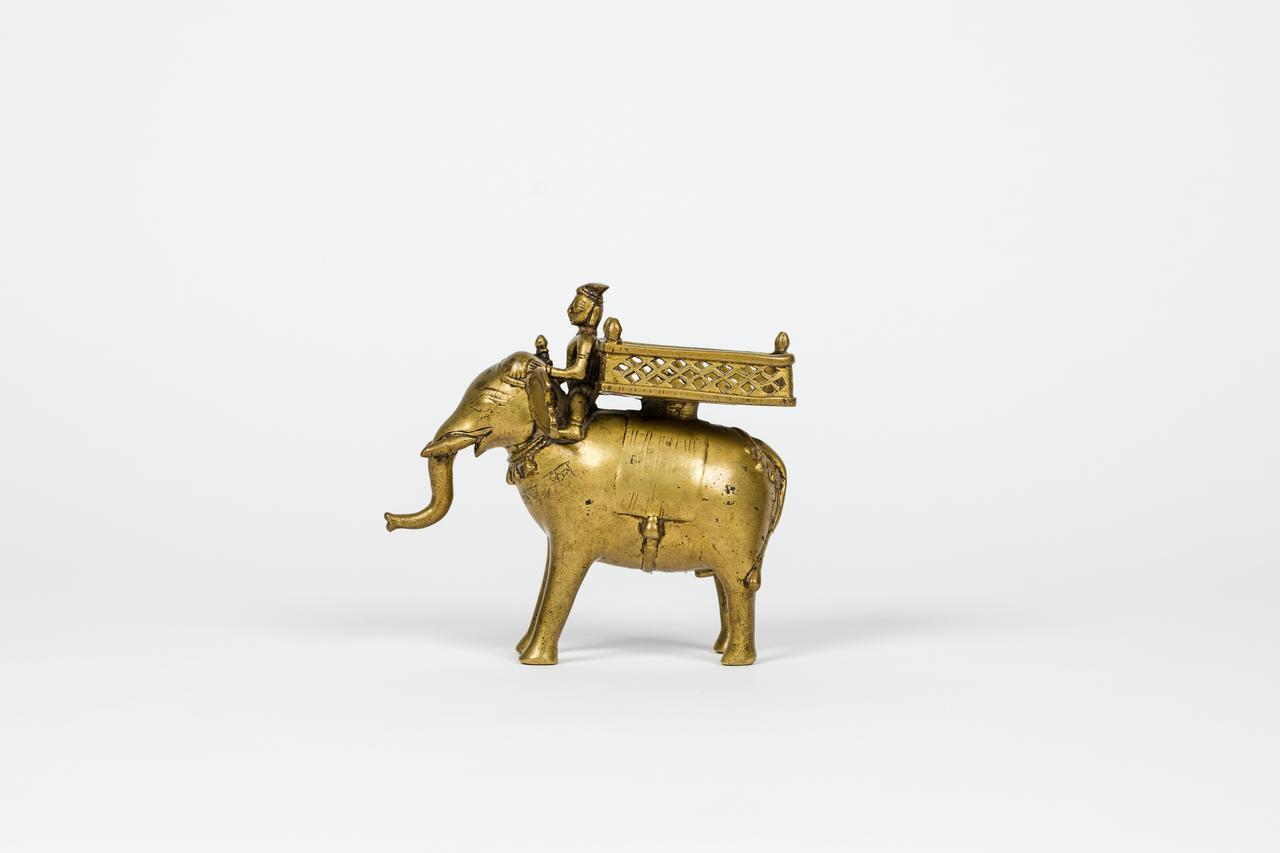
Votive ring with Nandī, liṅga, and Nāga, lost-wax bronze, India, 18th century - Talisman - Shaivite talisman


03
days
15
hours
36
minutes
53
seconds
Current bid
€ 2
Reserve price not met

Expert
Selected by Surya Rutten
Has over 25 years' experience in Asian art and owned an art gallery.
Estimate € 150 - € 200
7 other people are watching this object
 Bidder 7174 Bidder 7174 | €2 | |
|---|---|---|
| Bidder 7174 | €1 |
Catawiki Buyer Protection
Your payment’s safe with us until you receive your object.View details
Trustpilot 4.4 | 122529 reviews
Rated Excellent on Trustpilot.
Votive ring with Nandi, lingam and naga, in bronze with Persian wax casting from mid-India, 18th century, unisex, about 12 g and 7.8 cm wide, original attribution and sold with a stand from a private collection, of Śaivite talismanic type.
AI-assisted summary
Description from the seller
Votive ring with Nandī, liṅga, and Nāga – lost-wax bronze, South-Central India, 18th century
Small but very powerful Śaivite talisman, fused with lost wax wax in a copper-rich alloy and worn from long devotional handling: at the center of the setting, Nandī, the sacred bull and Śiva's vāhana, stands out, rendered reclining and adorned with garlands; on the right side, an aniconic liṅga rises, on the left, a protective Nāga coils around, while at the base, small reliefs can be interpreted as ritual offerings. The straightforward, almost plastic modeling, and the dark patina with tiny green concretions and shiny wear on the protrusions tell of a life dedicated to rituals: a 'ring-offering,' probably worn as a good luck charm or placed in a rural sanctuary.
Iconography is entirely linked to Śivaism: Nandi presides over the liṅga and mediates the devotee's devotion, while the Nāga seals the apotropaic dimension and the cosmic fertility of the cult. The archaic style and wear suggest a popular production from the Deccan/Mid-India region (Karnataka–Maharashtra area, with possible links to the Vīraśaiva/lingāyat communities), dating back to the 18th century.
Condition consistent with use, with slight abrasions and oxidations; typological quality and rarity remain fully legible.
7.8 cm with base
Votive ring with Nandī, liṅga, and Nāga – lost-wax bronze, South-Central India, 18th century
Small but very powerful Śaivite talisman, fused with lost wax wax in a copper-rich alloy and worn from long devotional handling: at the center of the setting, Nandī, the sacred bull and Śiva's vāhana, stands out, rendered reclining and adorned with garlands; on the right side, an aniconic liṅga rises, on the left, a protective Nāga coils around, while at the base, small reliefs can be interpreted as ritual offerings. The straightforward, almost plastic modeling, and the dark patina with tiny green concretions and shiny wear on the protrusions tell of a life dedicated to rituals: a 'ring-offering,' probably worn as a good luck charm or placed in a rural sanctuary.
Iconography is entirely linked to Śivaism: Nandi presides over the liṅga and mediates the devotee's devotion, while the Nāga seals the apotropaic dimension and the cosmic fertility of the cult. The archaic style and wear suggest a popular production from the Deccan/Mid-India region (Karnataka–Maharashtra area, with possible links to the Vīraśaiva/lingāyat communities), dating back to the 18th century.
Condition consistent with use, with slight abrasions and oxidations; typological quality and rarity remain fully legible.
7.8 cm with base
Details
Era
1400-1900
Laboratory Report
No laboratory report
Estimated period
18th century
Metal
Votive ring with Nandī, liṅga, and Nāga, lost-wax bronze, India, 18th century
Brand jewellery
No
Total weight
12 g
Condition
Good condition - used with some signs of wear
Gender
Unisex
Country of Origin
India
Dynastic Style/Period
British Raj (1858-1947)
Provenance
Private collection
Title additional information
Shaivite talisman
Attribution
Original
Sold with stand
Yes
Width
7.8 cm
Sold by