Antonis Oberman (1781–1845) - Stilleven met Bloemen - NO RESERVE



00
days
00
hours
55
minutes
00
seconds

64 other people are watching this object
 Bidder 0021 Bidder 0021 | €260 | |
|---|---|---|
 Bidder 8245 Bidder 8245 | €240 | |
| Bidder 0021 | €220 | |
Catawiki Buyer Protection
Your payment’s safe with us until you receive your object.View details
Trustpilot 4.4 | 123779 reviews
Rated Excellent on Trustpilot.
Stilleven met Bloemen - NO RESERVE is an 18th‑century Dutch still life by Antonis Oberman, executed in a mixed technique on paper and sold with a gilded frame.
AI-assisted summary
Description from the seller
Antonis Oberman (1781–1845)
Still Life with Flowers
Mixed technique on paper, hand-signed at the bottom right.
Gilded wooden frame with museum-gilded passe-partout; light foxing visible under UV.
Introduction
This exceptionally well-executed flower still life by Antonis Oberman belongs to the most characteristic genres in which this Amsterdam artist excelled. Oberman, trained at the Stadstekenacademie and active during the flourishing of Dutch Romanticism, developed into a master of botanical-inspired still lifes where scientific precision and aesthetic refinement harmoniously come together. His work aligns with the tradition of eighteenth- and early nineteenth-century floral painters, but is distinguished by a remarkable attention to detail, atmosphere, and the subdued lyricism of nature. This still life demonstrates Oberman's mastery of both drawing and color, and serves as an exemplary example of his delicate and technically refined oeuvre.
Description of the work
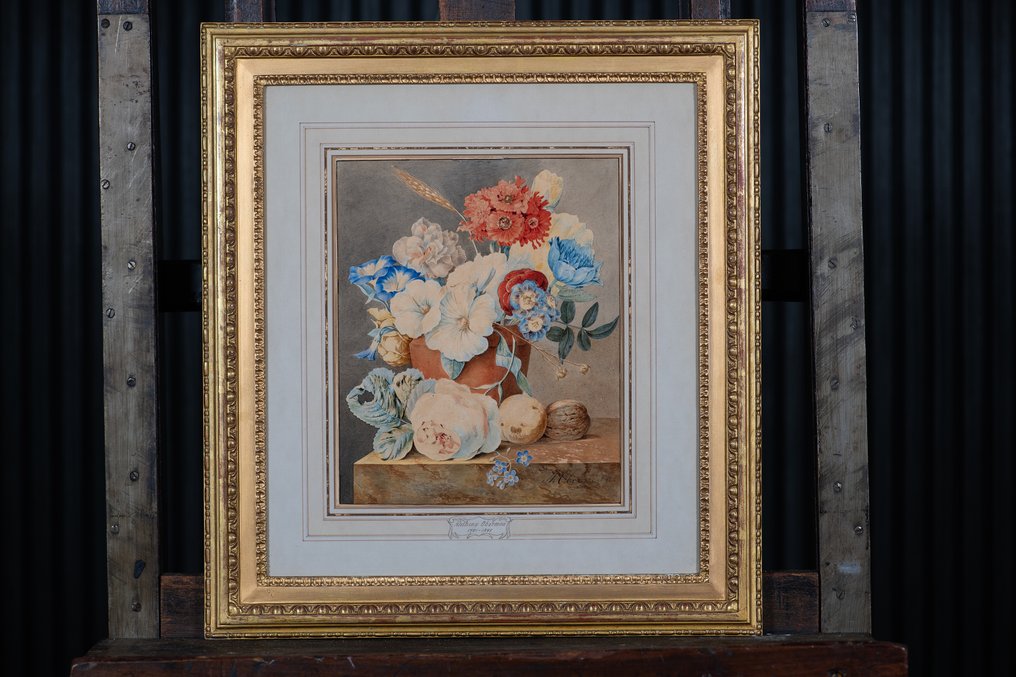
Centered on the page is a terracotta pot filled with a lush collection of flowers. The arrangement includes white bell-shaped flowers, blue accents in various shades, red-tinted blossoms, and soft pink roses, which serve as visual anchors within the composition. In the foreground, a ripe fruit and a walnut rest, meticulously depicted, while a vine of forget-me-nots adorns the lower edge. The choice of these specific flowers suggests not so much a symbolic program as a botanical ensemble where form variation, structure, and chromatic subtlety come together.
The textures are crafted with care: the fragile transparency of the white flowers contrasts with the velvety density of the red and the rich shades of the blue flower heads. The leaves display a precise depiction of venation and surface variations, elevating Oberman’s botanical study to art. The work exudes a quiet, almost meditative calm, enhanced by even lighting and the atmospheric background, which, without any distracting detail, fully supports the floral splendor.
The signature at the bottom right is clear, written in flowing calligraphic style, and forms an essential element for the authentic attribution to Oberman. The depiction is intact, with only slight foxing mainly in the background atmosphere, which is consistent with the age and conservation history of the work.
Technique and use of color
The mixed technique on paper—consisting of watercolor, gouache, and fine brushwork—demonstrates Oberman's technical versatility. The watercolor offers transparency and nuance, while the gouache intensifies certain accents and adds relief to the petals and fruits. The paint application is thin but layered, with subtle transitions that emphasize the natural curvature of the flower heads and leaf shapes.
The color palette is bright, yet subdued enough to remain naturalistic. The blue flowers form chromatic opposites to the warmer red and beige tones, creating a rhythmic distribution of color throughout the composition. The background in cool gray tones enhances the sense of depth and places the bouquet in a silent, timeless space. This balance of color and form is characteristic of the influence of romantic sensitivity on the botanical still life.
Composition and style
The composition is traditionally built around a central core, with a harmonious distribution of variations in color, rhythm, and volume. The terracotta pot acts as a sturdy focal point from which the flowers radiate upward and sideways in a controlled asymmetry. This structure aligns with the 18th-century tradition of floral arrangement but is refined by Oberman with a 19th-century sensitivity to clarity, simplicity, and naturalism.
The work clearly belongs to Dutch Romanticism, in which artists drew on the accuracy and richness of earlier generations but combined these with a more personal, aesthetically refined touch. Obermans' stylistic approach aligns with Dutch floral painters such as Jan van Os and Gerard van Spaendonck, and also corresponds internationally with the botanical mastery of Pierre-Joseph Redouté and Jean-Baptiste Monnoyer.
The artist
Antonis Oberman was trained at the Amsterdam City Drawing Academy, an institution that around 1800 placed great emphasis on accurate observation and drawing from nature. This academic foundation shaped him into one of the most talented still life painters and draftsmen of his generation. He specialized in flower still lifes, realistic botanical drawings, and miniatures, a genre in which his precise hand and eye for detail garnered great appreciation. Oberman's work fits within the context of a broader 19th-century appreciation for natural study, where accuracy, refined finishing, and contemplative beauty were central.
Condition and presentation
The work is excellently presented in a high-quality, richly gilded frame equipped with a classic mat with museum allure. The gilding enhances the clarity of the still life without overpowering it, while the glass protects the fragile paper. The foxing visible under UV light is superficial and does not compromise the integrity of the image. The colors remain remarkably fresh and consistent, indicating both high-quality pigments and careful conservation in the past.
Final remarks
This exceptionally refined still life by Antonis Oberman represents the best of the Dutch romantic tradition within botanical art. The combination of technical mastery, naturalistic accuracy, and harmonious aesthetics makes it a work of exceptional quality. The still life depicts an artist at the height of his abilities, who with a light, controlled hand managed to capture the fleeting beauty of flowers in a timeless visual poetry. It thus belongs to the valuable and rarer paper works from the early nineteenth century that are highly regarded both art-historically and in collecting terms.
The work 'Still Life with Flowers' is housed in a gilded wooden frame with plaster ornaments behind glass in a gilded museum-quality mat.
Total dimensions: 53.5x48.5cm
Visible artwork dimensions: 30x25cm
All shipments are sent in professional packaging via FedEx, DPD, or PostNL.
For all shipments, a surcharge for packaging material applies, which is already included in the stated shipping price.
We aim to deliver your artwork to you safely and in optimal condition, paying careful attention to packaging and the shipping process. If you have any questions or special requests, you can always contact Catawiki customer service.
The customer is responsible for any customs duties and additional costs that may apply upon delivery abroad.
Seller's Story
Welcome to Vandenberg Fine Art BV on Catawiki.
Vandenberg Fine Art BV specializes in painting from the 15th through the 19th century, with a particular focus on Dutch, Flemish, and Italian masters. Our carefully curated collection comprises high-quality artworks distinguished by their artistic merit, authenticity, and historical significance.
Our offering includes works by leading artists of the Dutch and Flemish schools, as well as important representatives of the Italian Renaissance and Baroque. Each artwork is selected with expertise and care, with close attention paid to condition, provenance, and art-historical relevance.
At Vandenberg Fine Art, reliability and transparency are fundamental values. We provide detailed descriptions, high-quality images, and thoroughly conducted provenance research. Our aim is to support both experienced collectors and emerging art enthusiasts in making well-informed decisions.
Explore our exclusive collection and experience the rich history and enduring beauty of classical painting.
Translated by Google TranslateAntonis Oberman (1781–1845)
Still Life with Flowers
Mixed technique on paper, hand-signed at the bottom right.
Gilded wooden frame with museum-gilded passe-partout; light foxing visible under UV.
Introduction
This exceptionally well-executed flower still life by Antonis Oberman belongs to the most characteristic genres in which this Amsterdam artist excelled. Oberman, trained at the Stadstekenacademie and active during the flourishing of Dutch Romanticism, developed into a master of botanical-inspired still lifes where scientific precision and aesthetic refinement harmoniously come together. His work aligns with the tradition of eighteenth- and early nineteenth-century floral painters, but is distinguished by a remarkable attention to detail, atmosphere, and the subdued lyricism of nature. This still life demonstrates Oberman's mastery of both drawing and color, and serves as an exemplary example of his delicate and technically refined oeuvre.
Description of the work
Centered on the page is a terracotta pot filled with a lush collection of flowers. The arrangement includes white bell-shaped flowers, blue accents in various shades, red-tinted blossoms, and soft pink roses, which serve as visual anchors within the composition. In the foreground, a ripe fruit and a walnut rest, meticulously depicted, while a vine of forget-me-nots adorns the lower edge. The choice of these specific flowers suggests not so much a symbolic program as a botanical ensemble where form variation, structure, and chromatic subtlety come together.
The textures are crafted with care: the fragile transparency of the white flowers contrasts with the velvety density of the red and the rich shades of the blue flower heads. The leaves display a precise depiction of venation and surface variations, elevating Oberman’s botanical study to art. The work exudes a quiet, almost meditative calm, enhanced by even lighting and the atmospheric background, which, without any distracting detail, fully supports the floral splendor.
The signature at the bottom right is clear, written in flowing calligraphic style, and forms an essential element for the authentic attribution to Oberman. The depiction is intact, with only slight foxing mainly in the background atmosphere, which is consistent with the age and conservation history of the work.
Technique and use of color
The mixed technique on paper—consisting of watercolor, gouache, and fine brushwork—demonstrates Oberman's technical versatility. The watercolor offers transparency and nuance, while the gouache intensifies certain accents and adds relief to the petals and fruits. The paint application is thin but layered, with subtle transitions that emphasize the natural curvature of the flower heads and leaf shapes.
The color palette is bright, yet subdued enough to remain naturalistic. The blue flowers form chromatic opposites to the warmer red and beige tones, creating a rhythmic distribution of color throughout the composition. The background in cool gray tones enhances the sense of depth and places the bouquet in a silent, timeless space. This balance of color and form is characteristic of the influence of romantic sensitivity on the botanical still life.
Composition and style
The composition is traditionally built around a central core, with a harmonious distribution of variations in color, rhythm, and volume. The terracotta pot acts as a sturdy focal point from which the flowers radiate upward and sideways in a controlled asymmetry. This structure aligns with the 18th-century tradition of floral arrangement but is refined by Oberman with a 19th-century sensitivity to clarity, simplicity, and naturalism.
The work clearly belongs to Dutch Romanticism, in which artists drew on the accuracy and richness of earlier generations but combined these with a more personal, aesthetically refined touch. Obermans' stylistic approach aligns with Dutch floral painters such as Jan van Os and Gerard van Spaendonck, and also corresponds internationally with the botanical mastery of Pierre-Joseph Redouté and Jean-Baptiste Monnoyer.
The artist
Antonis Oberman was trained at the Amsterdam City Drawing Academy, an institution that around 1800 placed great emphasis on accurate observation and drawing from nature. This academic foundation shaped him into one of the most talented still life painters and draftsmen of his generation. He specialized in flower still lifes, realistic botanical drawings, and miniatures, a genre in which his precise hand and eye for detail garnered great appreciation. Oberman's work fits within the context of a broader 19th-century appreciation for natural study, where accuracy, refined finishing, and contemplative beauty were central.
Condition and presentation
The work is excellently presented in a high-quality, richly gilded frame equipped with a classic mat with museum allure. The gilding enhances the clarity of the still life without overpowering it, while the glass protects the fragile paper. The foxing visible under UV light is superficial and does not compromise the integrity of the image. The colors remain remarkably fresh and consistent, indicating both high-quality pigments and careful conservation in the past.
Final remarks
This exceptionally refined still life by Antonis Oberman represents the best of the Dutch romantic tradition within botanical art. The combination of technical mastery, naturalistic accuracy, and harmonious aesthetics makes it a work of exceptional quality. The still life depicts an artist at the height of his abilities, who with a light, controlled hand managed to capture the fleeting beauty of flowers in a timeless visual poetry. It thus belongs to the valuable and rarer paper works from the early nineteenth century that are highly regarded both art-historically and in collecting terms.
The work 'Still Life with Flowers' is housed in a gilded wooden frame with plaster ornaments behind glass in a gilded museum-quality mat.
Total dimensions: 53.5x48.5cm
Visible artwork dimensions: 30x25cm
All shipments are sent in professional packaging via FedEx, DPD, or PostNL.
For all shipments, a surcharge for packaging material applies, which is already included in the stated shipping price.
We aim to deliver your artwork to you safely and in optimal condition, paying careful attention to packaging and the shipping process. If you have any questions or special requests, you can always contact Catawiki customer service.
The customer is responsible for any customs duties and additional costs that may apply upon delivery abroad.
Seller's Story
Welcome to Vandenberg Fine Art BV on Catawiki.
Vandenberg Fine Art BV specializes in painting from the 15th through the 19th century, with a particular focus on Dutch, Flemish, and Italian masters. Our carefully curated collection comprises high-quality artworks distinguished by their artistic merit, authenticity, and historical significance.
Our offering includes works by leading artists of the Dutch and Flemish schools, as well as important representatives of the Italian Renaissance and Baroque. Each artwork is selected with expertise and care, with close attention paid to condition, provenance, and art-historical relevance.
At Vandenberg Fine Art, reliability and transparency are fundamental values. We provide detailed descriptions, high-quality images, and thoroughly conducted provenance research. Our aim is to support both experienced collectors and emerging art enthusiasts in making well-informed decisions.
Explore our exclusive collection and experience the rich history and enduring beauty of classical painting.
Translated by Google TranslateDetails
Artist
Antonis Oberman (1781–1845)
Sold with frame
Yes
Title of artwork
Stilleven met Bloemen - NO RESERVE
Technique
Mixed media
Signature
Hand signed
Country of Origin
Netherlands
Condition
Good condition
Height
53.5 cm
Width
48.5 cm
Depiction/Theme
Still life
Style
Baroque
Period
18th century
Sold by
