Barbizon School (XIX) - De schilder zoekt zijn onderwerp - NO RESERVE



00
days
02
hours
05
minutes
20
seconds
Current bid
€ 350
No reserve price

81 other people are watching this object
 Bidder 9388 Bidder 9388 | €350 | |
|---|---|---|
| Bidder 8908 | €310 | |
| Bidder 9388 | €290 | |
Catawiki Buyer Protection
Your payment’s safe with us until you receive your object.View details
Trustpilot 4.4 | 123779 reviews
Rated Excellent on Trustpilot.
De schilder zoekt zijn onderwerp, a 19th‑century oil painting from France, framed.
AI-assisted summary
Description from the seller
Barbizon School (19th century)
The painter searches for his subject.
Oil paint on panel, signature in the lower right (illegible)
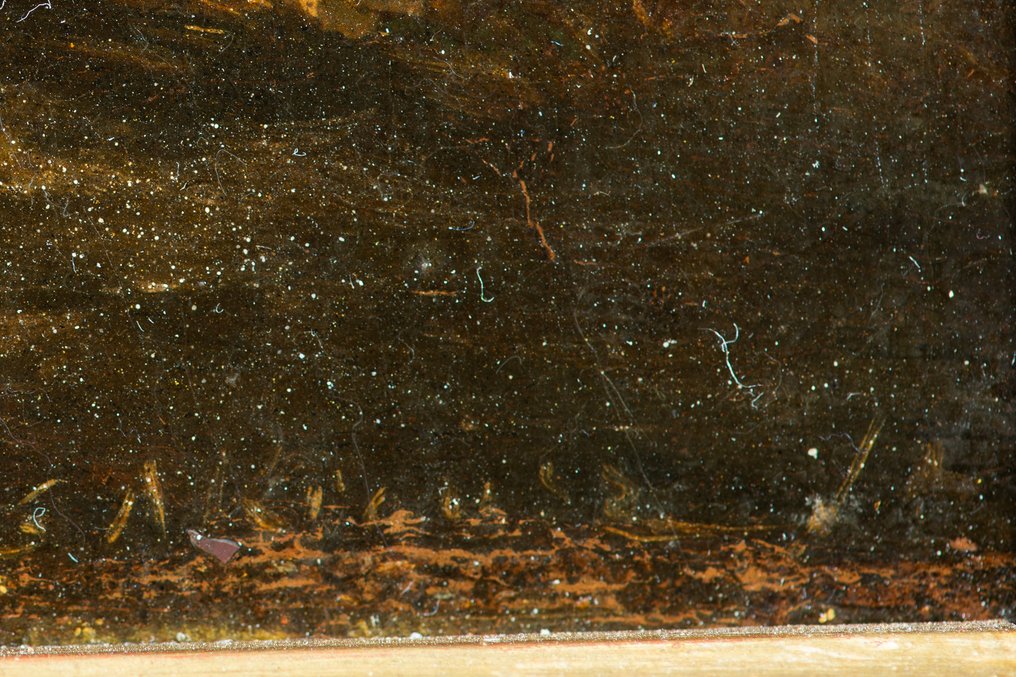
Condition: darkened paint areas, lightly yellowed varnish, targeted retouchings visible under UV.
Introduction
This refined 19th-century landscape is exemplary of the sensitivity and painterly innovations of the School of Barbizon, the influential group of French landscape painters who settled in and around the Forest of Fontainebleau from the 1830s onward. The artists of this movement, including Rousseau, Corot, and Daubigny, sought a truthful, directly observed visual language from nature. They turned away from the academic ideal and preferred intimate, honest landscapes where atmosphere and light take center stage. In this panel, these principles are clearly embodied. It shows not just a depiction of a place, but a moment of calm, exploration, and contemplation, in which the figure of the painter himself—modestly integrated into the composition—serves as the perfect symbol of the artistic quest that characterizes Barbizon.
Description of the work
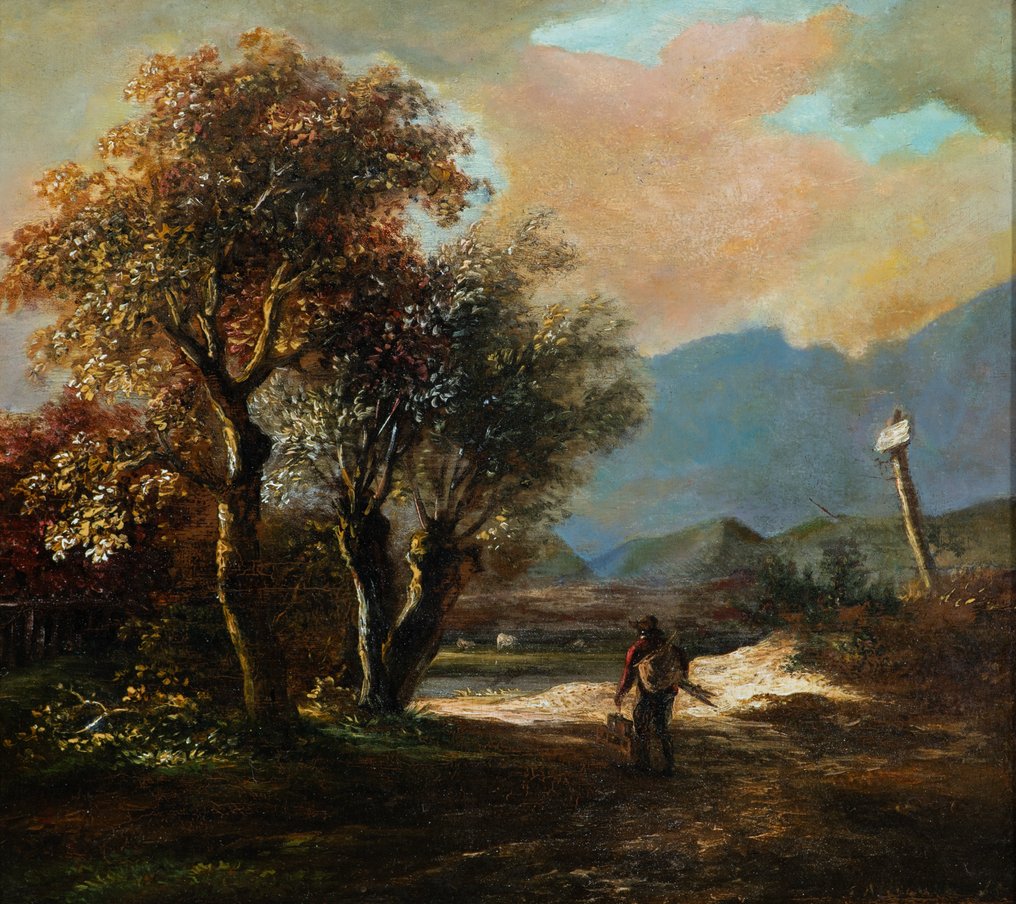
The landscape unfolds in a careful and nuanced build-up: on the left, imposing trees rise with canopies in warm red and ocher tones, whose refined brushwork accurately captures the natural variation of the foliage. The darker shadow areas between the trunks give the scene depth and anchorage, while light touches on leaves and moss suggest that sunlight, filtered through the crowns, gently touches the ground. The path that diagonally curves from the foreground toward the horizon creates a natural guide for the eye, leading the viewer effortlessly to the small figure in the middle ground: a walker or painter holding a painter's box, seemingly at a crossroads, searching for the right motif.
Behind it, a vast panorama opens up with hills in cool blue and green tones, gradually fading into the misty atmosphere in the distance. The sky is richly layered, with clouds built in gentle, almost pastel-like color transitions. The subtle modeling of the light—warm in the foreground, softly diffuse in the background—enhances the sense of depth and transforms the landscape into a space of stillness and reflection.
Technique and use of color
The panel is painted with a careful oil painting technique reminiscent of the study practices of Barbizon. The top layer of paint is built up from transparent glazes and more paste-like accents in the vegetation, creating a lively texture. The brushwork varies: delicate touches in the foliage contrast with broader, looser strokes in the sky and ground areas.
The color palette is balanced and natural, dominated by earth, ochre, and reddish-brown tones, contrasted by cooler blues and greens in the mountains and sky. The harmony between warm and cool elements is characteristic of the Barbizon aesthetic, where the play of light and atmosphere became more important than topographical accuracy. The current varnish layer is lightly yellowed, giving the darker areas a warmer tone; however, the overall color balance remains coherent and convincing.
Composition and art historical context
The composition follows classical Barbizon principles: a strong foreground anchoring the eye, a middle ground where a human figure introduces the narrative element without dominating nature, and a background carried by air and atmosphere. The waymarker post on the right is a subtle yet meaningful motif that appears in numerous 19th-century landscapes and here not only serves as a point of orientation but also enhances the suggestion of travel routes, choices, and artistic exploration.
The painting fits within the broader 19th-century realism that opposed academic idealizations and elevated nature as the primary subject. The School of Barbizon played a crucial role in this, serving as a bridge to impressionist experiments with outdoor light and direct observation. This panel shows how the perception of light and atmosphere takes precedence over narrative complexity: it is about experiencing the moment, not reconstructing a specific place.
The artist and stylistic embedding
Although the signature in the lower right is difficult to read, stylistic features, subject choice, and painting technique convincingly place the work within the Barbizon school. The painter demonstrates a subtle mastery of atmosphere, a balanced use of color, and a naturally appearing composition that aligns with the practices of Barbizon artists in the mid-19th century.
Style contemporaries within the same national tradition are: Théodore Rousseau, Jean-Baptiste-Camille Corot, Charles-François Daubigny.
International relatives who approached the landscape with similar sensitivity: John Constable, Ivan Shishkin.
Condition
The work is in a stable, authentic condition where signs of aging emphasize its historical character. The paint layer shows localized darkening due to natural aging of the binder and varnish. UV examination reveals retouchings, especially in the sky areas and parts of the vegetation, which have been carefully executed so as not to disturb the composition. The varnish layer is slightly yellowed but even. The panel is straight, solid, and undistorted, which is favorable for this support.
Final remarks
The painter seeks his subject and provides a atmospheric and compelling example of 19th-century Barbizon landscape painting, where tranquility, observation, and a connection with nature are central. The combination of an intimate scale, a subtly orchestrated color palette, sensitive lighting, and a human presence that enhances the contemplative context makes this work particularly attractive. It is a panel that captures the essence of Barbizon aesthetics: the poetic dialogue between artist and nature, recorded in a harmonious and authentic painterly whole.
The work 'The Painter Searches for His Subject' is set in a gilded wooden frame with a green velvet finish.
Total dimensions: 34x36cm
Panel dimensions: 34.5x50.5cm
All shipments are sent in professional packaging via FedEx, DPD, or PostNL.
For all shipments, a surcharge for packaging material applies, which is already included in the stated shipping price.
We aim to deliver your artwork to you safely and in optimal condition, paying careful attention to packaging and the shipping process. If you have any questions or special requests, you can always contact Catawiki customer service.
The customer is responsible for any customs duties and additional costs that may apply upon delivery abroad.
Seller's Story
Welcome to Vandenberg Fine Art BV on Catawiki.
Vandenberg Fine Art BV specializes in painting from the 15th through the 19th century, with a particular focus on Dutch, Flemish, and Italian masters. Our carefully curated collection comprises high-quality artworks distinguished by their artistic merit, authenticity, and historical significance.
Our offering includes works by leading artists of the Dutch and Flemish schools, as well as important representatives of the Italian Renaissance and Baroque. Each artwork is selected with expertise and care, with close attention paid to condition, provenance, and art-historical relevance.
At Vandenberg Fine Art, reliability and transparency are fundamental values. We provide detailed descriptions, high-quality images, and thoroughly conducted provenance research. Our aim is to support both experienced collectors and emerging art enthusiasts in making well-informed decisions.
Explore our exclusive collection and experience the rich history and enduring beauty of classical painting.
Translated by Google TranslateBarbizon School (19th century)
The painter searches for his subject.
Oil paint on panel, signature in the lower right (illegible)
Condition: darkened paint areas, lightly yellowed varnish, targeted retouchings visible under UV.
Introduction
This refined 19th-century landscape is exemplary of the sensitivity and painterly innovations of the School of Barbizon, the influential group of French landscape painters who settled in and around the Forest of Fontainebleau from the 1830s onward. The artists of this movement, including Rousseau, Corot, and Daubigny, sought a truthful, directly observed visual language from nature. They turned away from the academic ideal and preferred intimate, honest landscapes where atmosphere and light take center stage. In this panel, these principles are clearly embodied. It shows not just a depiction of a place, but a moment of calm, exploration, and contemplation, in which the figure of the painter himself—modestly integrated into the composition—serves as the perfect symbol of the artistic quest that characterizes Barbizon.
Description of the work
The landscape unfolds in a careful and nuanced build-up: on the left, imposing trees rise with canopies in warm red and ocher tones, whose refined brushwork accurately captures the natural variation of the foliage. The darker shadow areas between the trunks give the scene depth and anchorage, while light touches on leaves and moss suggest that sunlight, filtered through the crowns, gently touches the ground. The path that diagonally curves from the foreground toward the horizon creates a natural guide for the eye, leading the viewer effortlessly to the small figure in the middle ground: a walker or painter holding a painter's box, seemingly at a crossroads, searching for the right motif.
Behind it, a vast panorama opens up with hills in cool blue and green tones, gradually fading into the misty atmosphere in the distance. The sky is richly layered, with clouds built in gentle, almost pastel-like color transitions. The subtle modeling of the light—warm in the foreground, softly diffuse in the background—enhances the sense of depth and transforms the landscape into a space of stillness and reflection.
Technique and use of color
The panel is painted with a careful oil painting technique reminiscent of the study practices of Barbizon. The top layer of paint is built up from transparent glazes and more paste-like accents in the vegetation, creating a lively texture. The brushwork varies: delicate touches in the foliage contrast with broader, looser strokes in the sky and ground areas.
The color palette is balanced and natural, dominated by earth, ochre, and reddish-brown tones, contrasted by cooler blues and greens in the mountains and sky. The harmony between warm and cool elements is characteristic of the Barbizon aesthetic, where the play of light and atmosphere became more important than topographical accuracy. The current varnish layer is lightly yellowed, giving the darker areas a warmer tone; however, the overall color balance remains coherent and convincing.
Composition and art historical context
The composition follows classical Barbizon principles: a strong foreground anchoring the eye, a middle ground where a human figure introduces the narrative element without dominating nature, and a background carried by air and atmosphere. The waymarker post on the right is a subtle yet meaningful motif that appears in numerous 19th-century landscapes and here not only serves as a point of orientation but also enhances the suggestion of travel routes, choices, and artistic exploration.
The painting fits within the broader 19th-century realism that opposed academic idealizations and elevated nature as the primary subject. The School of Barbizon played a crucial role in this, serving as a bridge to impressionist experiments with outdoor light and direct observation. This panel shows how the perception of light and atmosphere takes precedence over narrative complexity: it is about experiencing the moment, not reconstructing a specific place.
The artist and stylistic embedding
Although the signature in the lower right is difficult to read, stylistic features, subject choice, and painting technique convincingly place the work within the Barbizon school. The painter demonstrates a subtle mastery of atmosphere, a balanced use of color, and a naturally appearing composition that aligns with the practices of Barbizon artists in the mid-19th century.
Style contemporaries within the same national tradition are: Théodore Rousseau, Jean-Baptiste-Camille Corot, Charles-François Daubigny.
International relatives who approached the landscape with similar sensitivity: John Constable, Ivan Shishkin.
Condition
The work is in a stable, authentic condition where signs of aging emphasize its historical character. The paint layer shows localized darkening due to natural aging of the binder and varnish. UV examination reveals retouchings, especially in the sky areas and parts of the vegetation, which have been carefully executed so as not to disturb the composition. The varnish layer is slightly yellowed but even. The panel is straight, solid, and undistorted, which is favorable for this support.
Final remarks
The painter seeks his subject and provides a atmospheric and compelling example of 19th-century Barbizon landscape painting, where tranquility, observation, and a connection with nature are central. The combination of an intimate scale, a subtly orchestrated color palette, sensitive lighting, and a human presence that enhances the contemplative context makes this work particularly attractive. It is a panel that captures the essence of Barbizon aesthetics: the poetic dialogue between artist and nature, recorded in a harmonious and authentic painterly whole.
The work 'The Painter Searches for His Subject' is set in a gilded wooden frame with a green velvet finish.
Total dimensions: 34x36cm
Panel dimensions: 34.5x50.5cm
All shipments are sent in professional packaging via FedEx, DPD, or PostNL.
For all shipments, a surcharge for packaging material applies, which is already included in the stated shipping price.
We aim to deliver your artwork to you safely and in optimal condition, paying careful attention to packaging and the shipping process. If you have any questions or special requests, you can always contact Catawiki customer service.
The customer is responsible for any customs duties and additional costs that may apply upon delivery abroad.
Seller's Story
Welcome to Vandenberg Fine Art BV on Catawiki.
Vandenberg Fine Art BV specializes in painting from the 15th through the 19th century, with a particular focus on Dutch, Flemish, and Italian masters. Our carefully curated collection comprises high-quality artworks distinguished by their artistic merit, authenticity, and historical significance.
Our offering includes works by leading artists of the Dutch and Flemish schools, as well as important representatives of the Italian Renaissance and Baroque. Each artwork is selected with expertise and care, with close attention paid to condition, provenance, and art-historical relevance.
At Vandenberg Fine Art, reliability and transparency are fundamental values. We provide detailed descriptions, high-quality images, and thoroughly conducted provenance research. Our aim is to support both experienced collectors and emerging art enthusiasts in making well-informed decisions.
Explore our exclusive collection and experience the rich history and enduring beauty of classical painting.
Translated by Google TranslateDetails
Artist
Barbizon School (XIX)
Sold with frame
Yes
Title of artwork
De schilder zoekt zijn onderwerp - NO RESERVE
Technique
Oil painting
Signature
Hand signed
Country of Origin
France
Condition
Good condition
Height
34 cm
Width
36 cm
Style
Barbizon school
Period
19th century
Sold by
