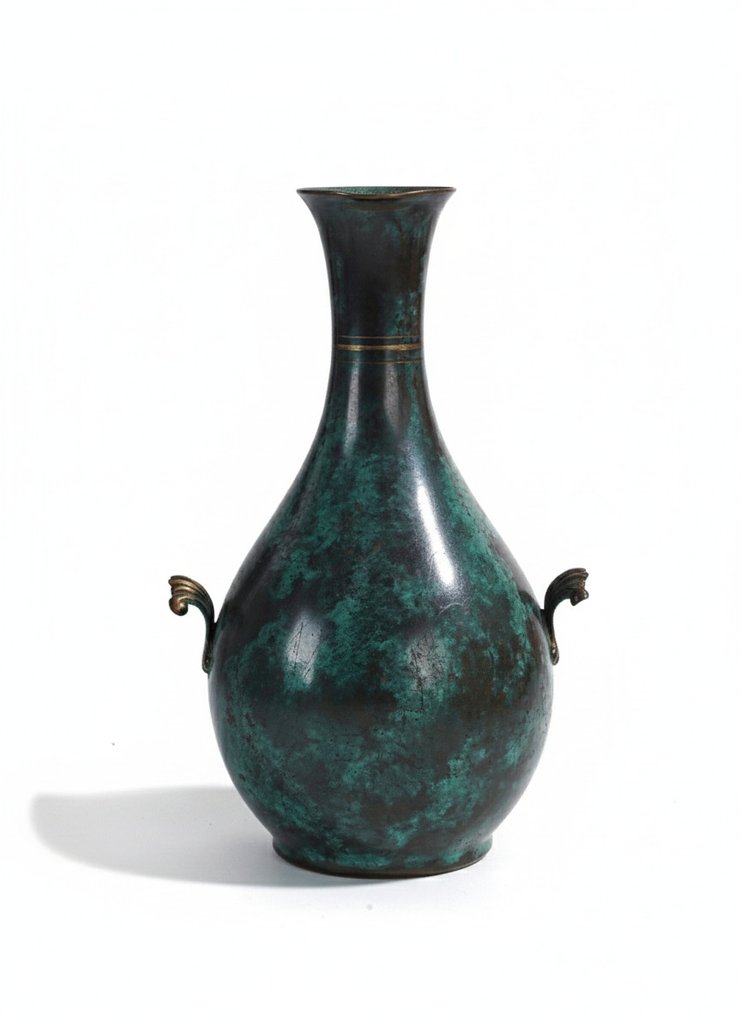
Vase - Italian 'Verdigris' patinated baluster vase in neo-classical style, mid-20th century • marked - Brass



Opens 11:00
Starting bid
€ 1
Add to your favourites to get an alert when the auction starts.

Expert
Selected by Elena Napoleone
Holds a bachelor's degree in history of art and architecture, with 12 years of experience in decorative arts.
Estimate € 150 - € 200
Catawiki Buyer Protection
Your payment’s safe with us until you receive your object.View details
Trustpilot 4.4 | 122813 reviews
Rated Excellent on Trustpilot.
Description from the seller
Italian 'Verdigris' patinated brass baluster vase in neo-classical style, mid-20th century • marked
specifications
Mid-century modern (grand tour revival)
dating: circa 1950 - 1970
Origin: Italy, Veneto region (Venice)
Brand: stamped on the underside 'made in Italy' with the stylized Venetian bridge symbol (Ponte di Rialto).
Material: brass (yellow copper) with chemical verdigris patina.
Technique: forced body with originally attached cast appliques.
dimensions: height: 20.5 cm | width (over the ears): 12 cm
Weight: 445 grams
description
An elegant, proportioned baluster vase with a flared, trumpet-shaped neck and a low-placed, rounded body. The object is made of brass and fully treated with an artistic, chemical patination that mimics the aesthetics of antique, oxidized bronze (verdigris). The surface displays a rich, marbled palette of emerald green, turquoise, and deep black, evoking a sense of significant age and archaeological origin.
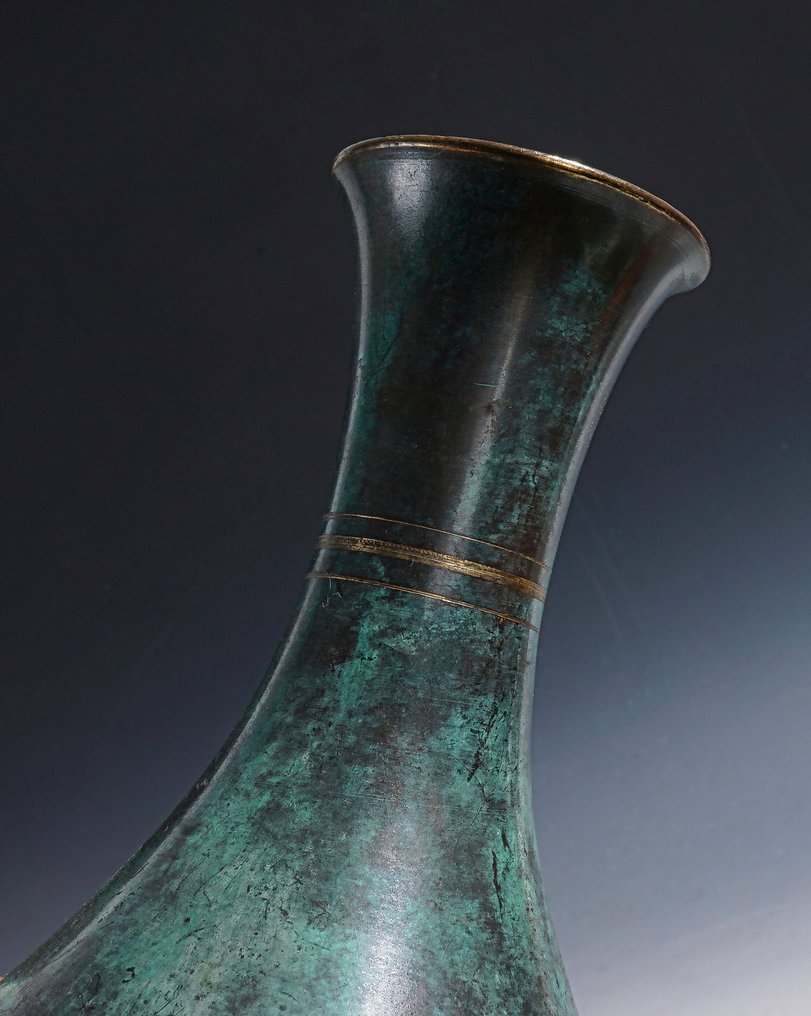
The vase is flanked by two stylistically matching, C-shaped volute ears with stylized acanthus or shell decorations. These cast ornaments are skillfully assembled during the manufacturing process and form an integral part of the silhouette. The neck is enriched with horizontal, incised ridges that cut through the patina and reveal the golden color of the underlying brass, creating a subtle, graphic contrast.
biography and context
This object is a characteristic example of Italian decorative art from the post-war period (ca. 1950-1970). During these decades, Italian workshops experienced a boom by exporting luxury interior objects that catered to the international taste for classical antiquity ('grand tour' nostalgia), but executed in lighter, modern materials. The mark with the bridge specifically refers to a Venetian workshop, likely operating within the cluster of metalworkers around the lagoon, known for their refined finishes on brass and bronze.
history and origin
Originating from a private collection. The object bears the characteristic export mark for the Italian market, indicating it was originally sold to international travelers or exported to department stores in Europe or the US in the mid-20th century.
Expert note:
dDze Vaas distinguishes itself through the state of the patina and the presence of the Venetian trademark, which attributes it to a specific production region. The confirmation that the ears are original to the design enhances the aesthetic coherence; it is a successful example of how mid-century design elements from antiquity were translated into modern interior pieces.
Seller's Story
Decaders Gallery – Eindhoven Region, Netherlands
Our passion lies in 20th century applied arts and design, with a particular focus on the Art Nouveau, Art Deco and Mid-Century Modern periods. But styles from the sixties, seventies and later also attract our attention. Each decade has made a unique contribution to the art world, which our name – *Decaders Gallery* – perfectly reflects.
Thanks to our love for art and design, we present new, special decorative objects every week. In addition, we have a broad interest in Asian art, antiques and collectibles. Our searches throughout Europe have led to a valuable network of like-minded enthusiasts, who help us track down unique finds.
This network has paid off: we are proud to have supplied artworks to renowned museums, including:
**The Netherlands:**
- CODA Museum, Apeldoorn
- Drents Museum, Assen
- National Textile Museum, Tilburg
- National Glass Museum, Leerdam
- Museum 'Amsterdam School' (*'t Schip*), Amsterdam
- PSV Football Museum, Eindhoven
- National War Museum, Overloon
**Belgium:**
- Musée de la Famenne, Marche-en-Famenne
- Museum of Natural Sciences, Belgium
**Spain:**
- Maritime Museum, Barcelona
We warmly invite you to visit our auctions with surprising artworks and follow us on Instagram. Discover your favorite decade at *Decaders Gallery*!
**Marc van der Heijden**
*Decaders Gallery, Netherlands*
Translated by Google TranslateItalian 'Verdigris' patinated brass baluster vase in neo-classical style, mid-20th century • marked
specifications
Mid-century modern (grand tour revival)
dating: circa 1950 - 1970
Origin: Italy, Veneto region (Venice)
Brand: stamped on the underside 'made in Italy' with the stylized Venetian bridge symbol (Ponte di Rialto).
Material: brass (yellow copper) with chemical verdigris patina.
Technique: forced body with originally attached cast appliques.
dimensions: height: 20.5 cm | width (over the ears): 12 cm
Weight: 445 grams
description
An elegant, proportioned baluster vase with a flared, trumpet-shaped neck and a low-placed, rounded body. The object is made of brass and fully treated with an artistic, chemical patination that mimics the aesthetics of antique, oxidized bronze (verdigris). The surface displays a rich, marbled palette of emerald green, turquoise, and deep black, evoking a sense of significant age and archaeological origin.
The vase is flanked by two stylistically matching, C-shaped volute ears with stylized acanthus or shell decorations. These cast ornaments are skillfully assembled during the manufacturing process and form an integral part of the silhouette. The neck is enriched with horizontal, incised ridges that cut through the patina and reveal the golden color of the underlying brass, creating a subtle, graphic contrast.
biography and context
This object is a characteristic example of Italian decorative art from the post-war period (ca. 1950-1970). During these decades, Italian workshops experienced a boom by exporting luxury interior objects that catered to the international taste for classical antiquity ('grand tour' nostalgia), but executed in lighter, modern materials. The mark with the bridge specifically refers to a Venetian workshop, likely operating within the cluster of metalworkers around the lagoon, known for their refined finishes on brass and bronze.
history and origin
Originating from a private collection. The object bears the characteristic export mark for the Italian market, indicating it was originally sold to international travelers or exported to department stores in Europe or the US in the mid-20th century.
Expert note:
dDze Vaas distinguishes itself through the state of the patina and the presence of the Venetian trademark, which attributes it to a specific production region. The confirmation that the ears are original to the design enhances the aesthetic coherence; it is a successful example of how mid-century design elements from antiquity were translated into modern interior pieces.
Seller's Story
Decaders Gallery – Eindhoven Region, Netherlands
Our passion lies in 20th century applied arts and design, with a particular focus on the Art Nouveau, Art Deco and Mid-Century Modern periods. But styles from the sixties, seventies and later also attract our attention. Each decade has made a unique contribution to the art world, which our name – *Decaders Gallery* – perfectly reflects.
Thanks to our love for art and design, we present new, special decorative objects every week. In addition, we have a broad interest in Asian art, antiques and collectibles. Our searches throughout Europe have led to a valuable network of like-minded enthusiasts, who help us track down unique finds.
This network has paid off: we are proud to have supplied artworks to renowned museums, including:
**The Netherlands:**
- CODA Museum, Apeldoorn
- Drents Museum, Assen
- National Textile Museum, Tilburg
- National Glass Museum, Leerdam
- Museum 'Amsterdam School' (*'t Schip*), Amsterdam
- PSV Football Museum, Eindhoven
- National War Museum, Overloon
**Belgium:**
- Musée de la Famenne, Marche-en-Famenne
- Museum of Natural Sciences, Belgium
**Spain:**
- Maritime Museum, Barcelona
We warmly invite you to visit our auctions with surprising artworks and follow us on Instagram. Discover your favorite decade at *Decaders Gallery*!
**Marc van der Heijden**
*Decaders Gallery, Netherlands*
Translated by Google TranslateDetails
Era
1900-2000
Weight
445 g
Country of Origin
Italy
Model
Italian 'Verdigris' patinated baluster vase in neo-classical style, mid-20th century • marked
Material
Brass
Style
Mid-century modern
Condition
Good condition - used with small signs of aging & blemishes
Height
20.5 cm
Width
12 cm
Depth
10 cm
Estimated Period
1950-1960
Sold by