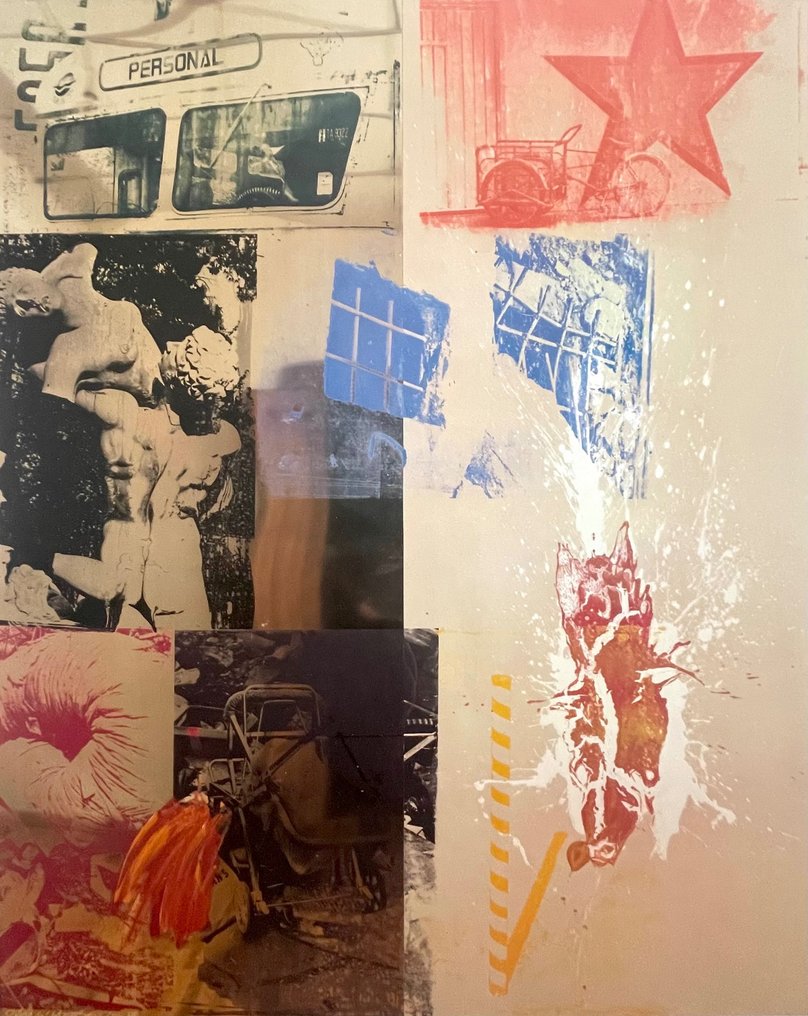
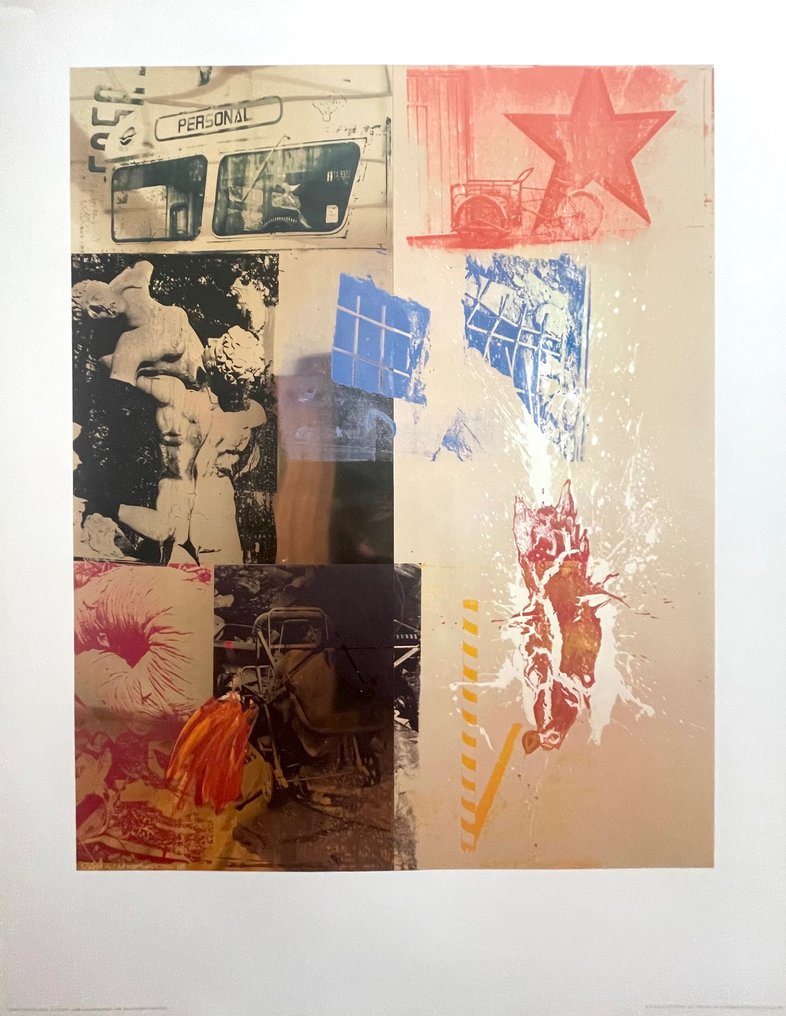
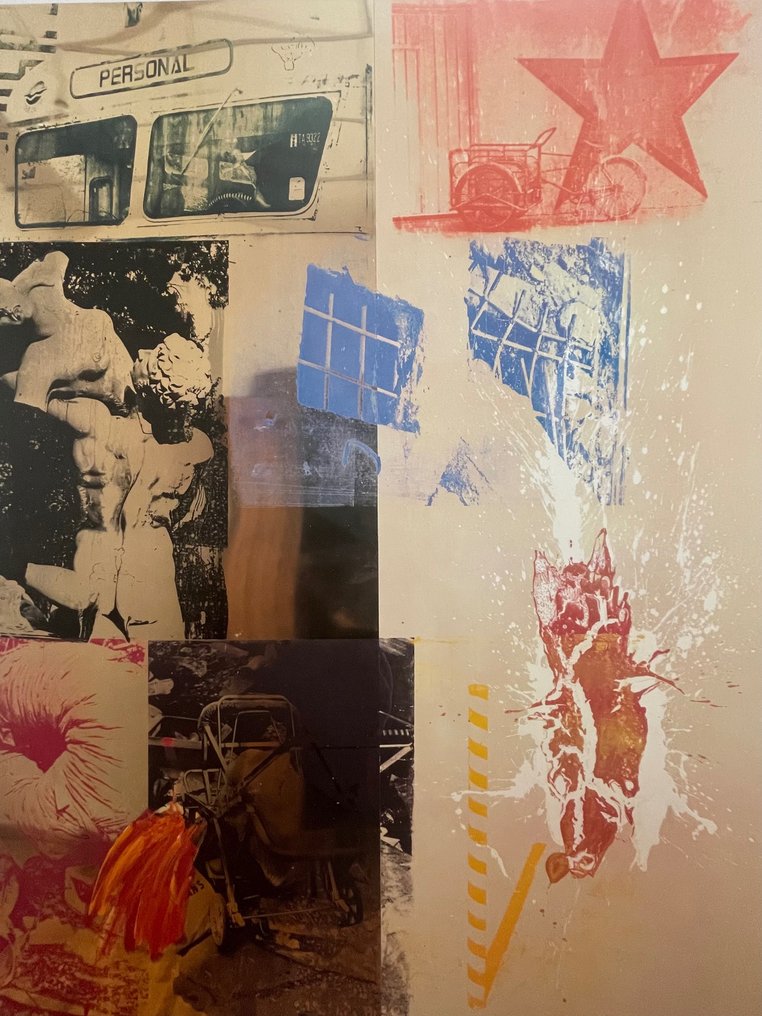
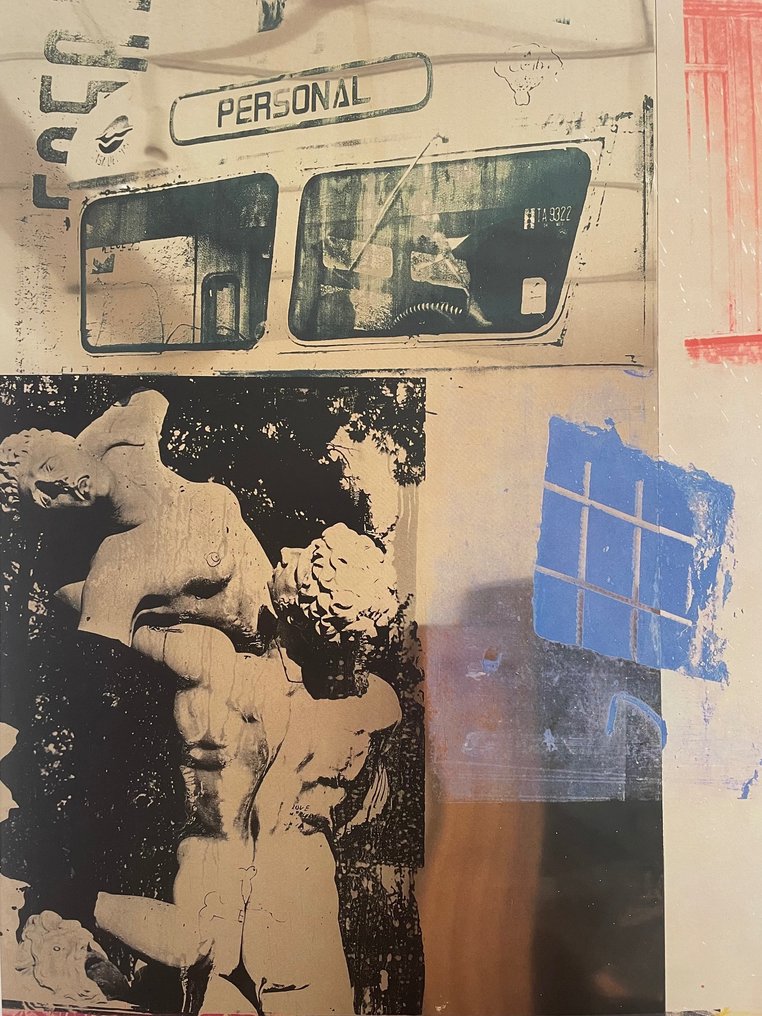
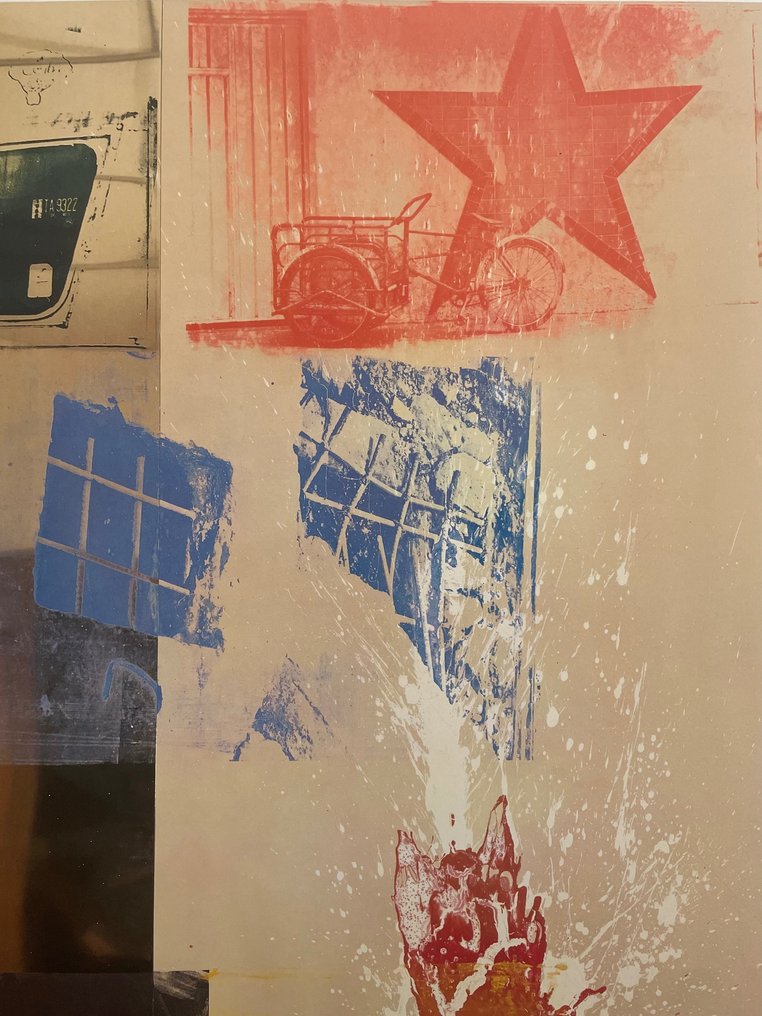
Robert Rauschenberg (after) - Favor Rites (Urban Bourbon Series) - Offset Lithography - Achenbach licensed print - 1994
00
days
23
hours
24
minutes
45
seconds
Current bid
€ 1
Reserve price not met

Expert
Selected by Juan Antonio Rodríguez
Eight years experience valuing posters, previously valuer at Balclis, Barcelona.
Estimate € 150 - € 200
14 other people are watching this object
 Bidder 4294 Bidder 4294 | €1 |
|---|
Catawiki Buyer Protection
Your payment’s safe with us until you receive your object.View details
Trustpilot 4.4 | 123779 reviews
Rated Excellent on Trustpilot.
Description from the seller
Offset lithograph after Robert Rauschenberg (*)
Reproduction of the work 'Favor Rites,' created by Rauschenberg in 1988.
Published by Achenbach Art Edition, Düsseldorf.
Authorized print with copyright and legal serial number.
Large Format
Sheet dimensions: 70.5 x 90 cm
Year: 1994
Condition: Excellent (this artwork has never been framed or exhibited, always kept in a professional art folder, and therefore remains in perfect condition).
Provenance: Private collection.
The item will be carefully handled and packaged in a reinforced cardboard box. The shipment will be certified with a tracking number.
The shipment will also include transport insurance for the final value of the artwork with full reimbursement in case of loss or damage, at no cost to the buyer.
By the late 1950s, Robert Rauschenberg, along with Jasper Johns, played a leading role in the revival of the Dada spirit in the United States. A multidisciplinary artist with a critical spirit, he constantly sought new forms of artistic expression, which made him one of the key figures in the evolution of art during the last decades of the 20th century.
He studied pharmacy at the University of Texas and, between 1946 and 1947, art history, sculpture, and music at the Kansas City Art Institute. Shortly after, he entered the Académie Julian in Paris and later became a student of Josef Albers and Jack Tworkov at the prestigious Black Mountain College in North Carolina, where he befriended John Cage. In 1952, he traveled through Italy, France, and Spain accompanied by Cy Twombly.
In the early 1950s, he developed a monochromatic abstract painting based on white, red, or black colors, studying different textures. From his friendship with Jasper Johns, which lasted from 1954 to 1962, arose an artistic collaboration that led both to experiment beyond the dominant abstract expressionism. Rauschenberg and Johns served as a link between the older generation of abstract artists and the young pop artists. By the mid-1950s, he began producing his Combine Paintings, in which he combined painting, assemblages, and collages of photographs with found objects, usually from consumer society. Moreover, his encounter with Marcel Duchamp was decisive for the revival of Dadaist methods and the incorporation of collage into his work.
In 1962, under the influence of Andy Warhol, he began experimenting with a new type of artistic technique that became the foundation of his work in the following years: serigraphy. This method allowed him to incorporate photographic images printed on silk panels, which he then transferred to his canvases, overlaying and blending them in a collage-like manner. Finally, he completed the piece with oil paint.
Rauschenberg was a restless and highly versatile artist who, throughout his life, participated in a large number of initiatives of very diverse kinds. Notably, he collaborated intensely with his friend, the musician John Cage, and between 1955 and 1965, he served as a stage director for the Merce Cunningham dance company. In 1966, he, along with several scientists, created an art and technology experimentation group aimed at applying the latest technical advances in art.
Seller's Story
EsKobARTE carefully selects artworks and posters from recognized and emerging artists worldwide to offer them here at affordable prices.*** AUTHENTIC WORKS *** We only sell genuine artworks and posters, as well as officially authorized prints.*** WE ARE PROFESSIONALS *** You can bid on your items with complete confidence. Over 1,000 positive reviews from our clients attest to our experience and professionalism on Catawiki.*** PROTECTED, CERTIFIED, AND INSURED SHIPPING *** All our items are carefully packaged in eco-friendly cardboard packaging. We work with the best shipping companies (UPS-DPD-DHL-FEDEX) to ensure the best service and tracking. Additionally, our shipments include insurance against damage or loss at no cost to the buyer.*** IF YOU PURCHASE MORE THAN ONE ITEM, WE COMBINE SHIPPING *** Even if they come from different auctions, you'll only have to pay the shipping cost for a single item.*** ANY QUESTIONS? CONTACT US *** You can use the chat to talk to us; we will be happy to assist you as soon as possible.*** THANK YOU AND GOOD LUCK WITH YOUR BIDS! ***
Translated by Google TranslateOffset lithograph after Robert Rauschenberg (*)
Reproduction of the work 'Favor Rites,' created by Rauschenberg in 1988.
Published by Achenbach Art Edition, Düsseldorf.
Authorized print with copyright and legal serial number.
Large Format
Sheet dimensions: 70.5 x 90 cm
Year: 1994
Condition: Excellent (this artwork has never been framed or exhibited, always kept in a professional art folder, and therefore remains in perfect condition).
Provenance: Private collection.
The item will be carefully handled and packaged in a reinforced cardboard box. The shipment will be certified with a tracking number.
The shipment will also include transport insurance for the final value of the artwork with full reimbursement in case of loss or damage, at no cost to the buyer.
By the late 1950s, Robert Rauschenberg, along with Jasper Johns, played a leading role in the revival of the Dada spirit in the United States. A multidisciplinary artist with a critical spirit, he constantly sought new forms of artistic expression, which made him one of the key figures in the evolution of art during the last decades of the 20th century.
He studied pharmacy at the University of Texas and, between 1946 and 1947, art history, sculpture, and music at the Kansas City Art Institute. Shortly after, he entered the Académie Julian in Paris and later became a student of Josef Albers and Jack Tworkov at the prestigious Black Mountain College in North Carolina, where he befriended John Cage. In 1952, he traveled through Italy, France, and Spain accompanied by Cy Twombly.
In the early 1950s, he developed a monochromatic abstract painting based on white, red, or black colors, studying different textures. From his friendship with Jasper Johns, which lasted from 1954 to 1962, arose an artistic collaboration that led both to experiment beyond the dominant abstract expressionism. Rauschenberg and Johns served as a link between the older generation of abstract artists and the young pop artists. By the mid-1950s, he began producing his Combine Paintings, in which he combined painting, assemblages, and collages of photographs with found objects, usually from consumer society. Moreover, his encounter with Marcel Duchamp was decisive for the revival of Dadaist methods and the incorporation of collage into his work.
In 1962, under the influence of Andy Warhol, he began experimenting with a new type of artistic technique that became the foundation of his work in the following years: serigraphy. This method allowed him to incorporate photographic images printed on silk panels, which he then transferred to his canvases, overlaying and blending them in a collage-like manner. Finally, he completed the piece with oil paint.
Rauschenberg was a restless and highly versatile artist who, throughout his life, participated in a large number of initiatives of very diverse kinds. Notably, he collaborated intensely with his friend, the musician John Cage, and between 1955 and 1965, he served as a stage director for the Merce Cunningham dance company. In 1966, he, along with several scientists, created an art and technology experimentation group aimed at applying the latest technical advances in art.
Seller's Story
EsKobARTE carefully selects artworks and posters from recognized and emerging artists worldwide to offer them here at affordable prices.*** AUTHENTIC WORKS *** We only sell genuine artworks and posters, as well as officially authorized prints.*** WE ARE PROFESSIONALS *** You can bid on your items with complete confidence. Over 1,000 positive reviews from our clients attest to our experience and professionalism on Catawiki.*** PROTECTED, CERTIFIED, AND INSURED SHIPPING *** All our items are carefully packaged in eco-friendly cardboard packaging. We work with the best shipping companies (UPS-DPD-DHL-FEDEX) to ensure the best service and tracking. Additionally, our shipments include insurance against damage or loss at no cost to the buyer.*** IF YOU PURCHASE MORE THAN ONE ITEM, WE COMBINE SHIPPING *** Even if they come from different auctions, you'll only have to pay the shipping cost for a single item.*** ANY QUESTIONS? CONTACT US *** You can use the chat to talk to us; we will be happy to assist you as soon as possible.*** THANK YOU AND GOOD LUCK WITH YOUR BIDS! ***
Translated by Google TranslateDetails
Era
1900-2000
Designer/Artist
Robert Rauschenberg (after)
Poster title
Favor Rites (Urban Bourbon Series) - Offset Lithography - Achenbach licensed print - 1994
Subject
Art
Country of Origin
Germany
Condition
A (excellent - mint condition)
Height
91 cm
Width
70 cm