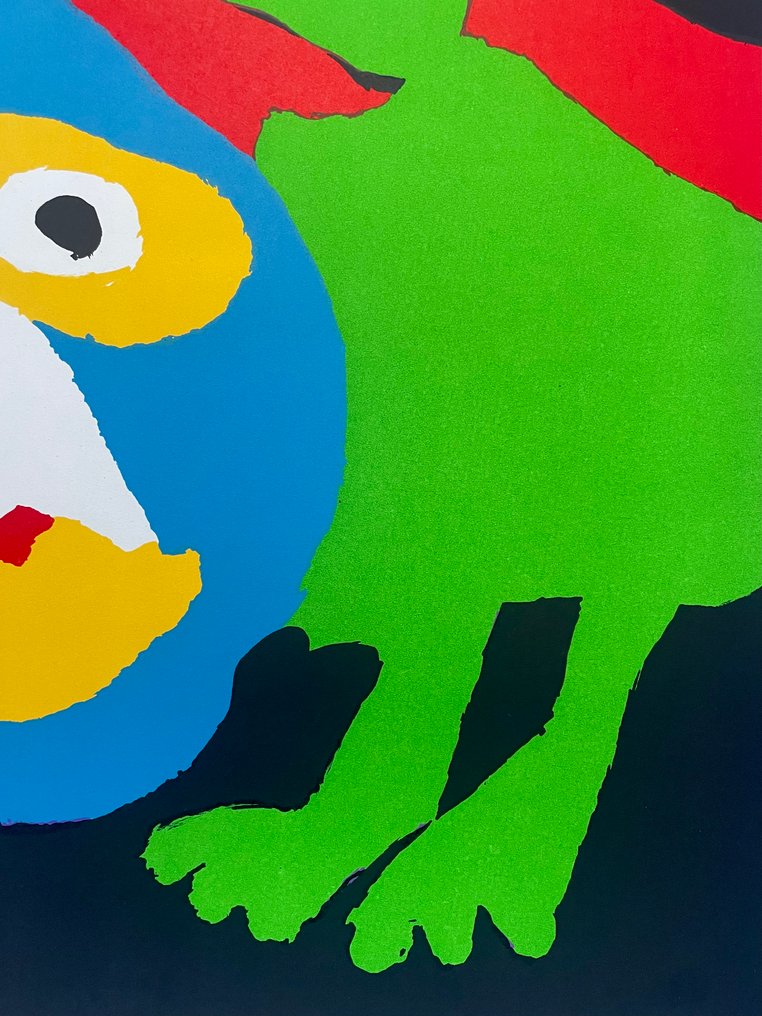
Karel Appel (1921-2006) - Galérie Ariel 1974 ** ORIGINAL LITHOGRAPHIC PRINT **


01
day
10
hours
28
minutes
48
seconds
Current bid
€ 70
Reserve price not met

Expert
Selected by Juan Antonio Rodríguez
Eight years experience valuing posters, previously valuer at Balclis, Barcelona.
Estimate € 150 - € 200
21 other people are watching this object
 Bidder 9598 Bidder 9598 | €70 | |
|---|---|---|
| Bidder 1516 | €65 | |
| Bidder 4344 | €55 | |
Catawiki Buyer Protection
Your payment’s safe with us until you receive your object.View details
Trustpilot 4.4 | 123718 reviews
Rated Excellent on Trustpilot.
Description from the seller
Original lithographic poster by Karel Appel (*)
Edited on the occasion of the artist's solo exhibition at Galérie Ariel, in 1974.
Printed by Arte Paris
Made on cotton Vellum paper.
Specifications
Support dimensions: 76 x 55 cm
Year 1974
- Edition: 1000ex.
Condition: Excellent (this artwork has never been framed or exhibited, and has always been kept in a professional art folder, thus it is offered in perfect condition).
The item will be carefully handled and packaged in a reinforced flat cardboard box. The shipment will be certified with a tracking number.
The shipment will also include full insurance for the final value of the work with full reimbursement in case of loss or damage, at no cost to the buyer.
‘If I paint like a barbarian, it is because we live in an era of barbarians,’ said the Dutch artist Karel Appel about his own work immersed in the informalism currents that proliferated after the end of World War II.
During his student years at the Rijksakademie between 1940 and 1943, Appel was attracted to the material force of the German expressionists and Van Gogh. He created works that were aggressive and provocative in nature, yet at the same time simple and linked to the childish, which seemed connected to the transgressive spirit of the Surrealists. He met Constant and Corneille, with whom he founded the Experimentele Groep in July 1948. That same year, in Paris, he signed the manifesto La Cause est entendue, along with Asger Jorn, Joseph Noiret, and Christian Dotremont, advocating for spontaneous, rule-free art, akin to the way children or the mad create, which gave rise to the CoBrA movement. A few months later, on the occasion of the group's first exhibition in Amsterdam, Appel created a mural in the city hall cafeteria titled Children Asking Questions, which caused such a scandal in the city that it was covered for the next ten years.
In 1950, Appel moved to Paris where, thanks to Michel Tapié's support, he was able to work with better materials. The areas of turbulent, mass-loaded painting gained prominence over the figurative motifs of animals and people that had previously dominated his work. In 1957, he traveled to New York for the first time, and since then, he alternated his stays in France, in a castle he bought in 1964 in Molesmes, with long periods in the United States. Simultaneously, his work began to receive widespread international recognition and was periodically exhibited at Martha Jackson's gallery in New York or at the Studio Facchetti in Paris.
Appel was a tireless artist who explored multiple languages, from sculpture, ceramics, mural painting, stained glass, to engraving. Throughout his long artistic career, he received numerous recognitions and collaborated with artists from other disciplines such as poet Allen Ginsberg and choreographer Min Tanaka.
Seller's Story
EsKobARTE carefully selects artworks and posters from recognized and emerging artists worldwide to offer them here at affordable prices.*** AUTHENTIC WORKS *** We only sell genuine artworks and posters, as well as officially authorized prints.*** WE ARE PROFESSIONALS *** You can bid on your items with complete confidence. Over 1,000 positive reviews from our clients attest to our experience and professionalism on Catawiki.*** PROTECTED, CERTIFIED, AND INSURED SHIPPING *** All our items are carefully packaged in eco-friendly cardboard packaging. We work with the best shipping companies (UPS-DPD-DHL-FEDEX) to ensure the best service and tracking. Additionally, our shipments include insurance against damage or loss at no cost to the buyer.*** IF YOU PURCHASE MORE THAN ONE ITEM, WE COMBINE SHIPPING *** Even if they come from different auctions, you'll only have to pay the shipping cost for a single item.*** ANY QUESTIONS? CONTACT US *** You can use the chat to talk to us; we will be happy to assist you as soon as possible.*** THANK YOU AND GOOD LUCK WITH YOUR BIDS! ***
Translated by Google TranslateOriginal lithographic poster by Karel Appel (*)
Edited on the occasion of the artist's solo exhibition at Galérie Ariel, in 1974.
Printed by Arte Paris
Made on cotton Vellum paper.
Specifications
Support dimensions: 76 x 55 cm
Year 1974
- Edition: 1000ex.
Condition: Excellent (this artwork has never been framed or exhibited, and has always been kept in a professional art folder, thus it is offered in perfect condition).
The item will be carefully handled and packaged in a reinforced flat cardboard box. The shipment will be certified with a tracking number.
The shipment will also include full insurance for the final value of the work with full reimbursement in case of loss or damage, at no cost to the buyer.
‘If I paint like a barbarian, it is because we live in an era of barbarians,’ said the Dutch artist Karel Appel about his own work immersed in the informalism currents that proliferated after the end of World War II.
During his student years at the Rijksakademie between 1940 and 1943, Appel was attracted to the material force of the German expressionists and Van Gogh. He created works that were aggressive and provocative in nature, yet at the same time simple and linked to the childish, which seemed connected to the transgressive spirit of the Surrealists. He met Constant and Corneille, with whom he founded the Experimentele Groep in July 1948. That same year, in Paris, he signed the manifesto La Cause est entendue, along with Asger Jorn, Joseph Noiret, and Christian Dotremont, advocating for spontaneous, rule-free art, akin to the way children or the mad create, which gave rise to the CoBrA movement. A few months later, on the occasion of the group's first exhibition in Amsterdam, Appel created a mural in the city hall cafeteria titled Children Asking Questions, which caused such a scandal in the city that it was covered for the next ten years.
In 1950, Appel moved to Paris where, thanks to Michel Tapié's support, he was able to work with better materials. The areas of turbulent, mass-loaded painting gained prominence over the figurative motifs of animals and people that had previously dominated his work. In 1957, he traveled to New York for the first time, and since then, he alternated his stays in France, in a castle he bought in 1964 in Molesmes, with long periods in the United States. Simultaneously, his work began to receive widespread international recognition and was periodically exhibited at Martha Jackson's gallery in New York or at the Studio Facchetti in Paris.
Appel was a tireless artist who explored multiple languages, from sculpture, ceramics, mural painting, stained glass, to engraving. Throughout his long artistic career, he received numerous recognitions and collaborated with artists from other disciplines such as poet Allen Ginsberg and choreographer Min Tanaka.
Seller's Story
EsKobARTE carefully selects artworks and posters from recognized and emerging artists worldwide to offer them here at affordable prices.*** AUTHENTIC WORKS *** We only sell genuine artworks and posters, as well as officially authorized prints.*** WE ARE PROFESSIONALS *** You can bid on your items with complete confidence. Over 1,000 positive reviews from our clients attest to our experience and professionalism on Catawiki.*** PROTECTED, CERTIFIED, AND INSURED SHIPPING *** All our items are carefully packaged in eco-friendly cardboard packaging. We work with the best shipping companies (UPS-DPD-DHL-FEDEX) to ensure the best service and tracking. Additionally, our shipments include insurance against damage or loss at no cost to the buyer.*** IF YOU PURCHASE MORE THAN ONE ITEM, WE COMBINE SHIPPING *** Even if they come from different auctions, you'll only have to pay the shipping cost for a single item.*** ANY QUESTIONS? CONTACT US *** You can use the chat to talk to us; we will be happy to assist you as soon as possible.*** THANK YOU AND GOOD LUCK WITH YOUR BIDS! ***
Translated by Google TranslateDetails
Artist
Karel Appel (1921-2006)
Sold by
Gallery
Edition
Limited edition
Title of artwork
Galérie Ariel 1974 ** ORIGINAL LITHOGRAPHIC PRINT **
Technique
Lithograph
Signature
Not signed
Country of Origin
France
Condition
Excellent condition
Height
76 cm
Width
55 cm
Style
Abstract
Period
2000-2010
Sold with frame
No