Van Wieringen, Wim (Marten Toonder Studio's) - 2 Original strip - Simpelman - (jaren 1950)



06
days
02
hours
19
minutes
40
seconds

No bids placed
Catawiki Buyer Protection
Your payment’s safe with us until you receive your object.View details
Trustpilot 4.4 | 122529 reviews
Rated Excellent on Trustpilot.
Two original Simpelman strips by Wim van Wieringen (Marten Toonder Studio's), titled '(jaren 1950)', inked and in excellent condition, each measuring 42 cm by 13 cm.
AI-assisted summary
Description from the seller
Wim van Wieringen was a Dutch cartoonist and photographer, who published under the names 'Wim de Mooij', 'Wim van Wieringen', or simply 'Wim'. He is best remembered for his pantomime comic strip 'Simpelman' (1947-1968).
Willem de Mooij Wieringen was born in 1915 in Amsterdam but spent his youth in many cities, including Nijmegen, Noordwijk, Den Helder, Haarlem, and Zandvoort. His first job was at a linoleum cliché factory in Haarlem, where he occasionally worked until 1942. He also created layouts for the weekly magazines of Strengholt in Amsterdam while attending evening courses with graphic artist Evert Mölenkamp at the School of Applied Arts in Amsterdam between 1932 and 1936.
Van Wieringen focused on cartoons and had his first work published in De Telegraaf (one cartoon in 1936) and De Tijd (a series of caricatures). In 1942, he found a job at an advertising agency in Heemstede, and the following year, he became an illustrator for the weekly magazine Cinema and Theater published by De Opbouw in Amsterdam. His career as a cartoonist took off after World War II. He gained fame through his political drawings for the leftist socialist weekly De Vlam between 1945 and 1953. A book titled '5 Jaar Indonesia Merdeka' was published in 1951 by the publisher of the magazine De Vonk and mainly collected drawings by Van Wieringen. He also published his work in De Groene Amsterdammer (drawings of theater premieres), Het Parool, Het Vrije Volk, Vrij Nederland, Sportief, and especially in the comic magazine Mandril.
Van Wieringen was involved in the underground newspaper Metro in the early post-war years, which led him to join the Marten Toonder Studios. He worked in the animation department and wrote scripts for comic series such as 'Fiedel Flier' by Ben van 't Klooster and 'Robby' by Hans G. Kresse. However, Van Wieringen's most famous creation was 'Simpelman', who first appeared in Tom Poes Weekblad in 1947. The absurd daily adventures of 'Simpelman' later appeared in newspapers in Copenhagen (Dagens Nyheter) and Paris (France Soir). In the 1960s, the comic was a regular feature in regional papers like Het Parool (1963-1968) and Limburgsch Dagblad. By then, Van Wieringen had already left the Toonder Studios. He married Margje Herblot, the ex-wife of Jan Gerhard Toonder. 'Simpelman' was subsequently distributed in newspapers by Ton de Zwaan's Swan Features Syndicate. In total, more than 3,000 'Simpelman' strips have been created, almost all of which are part of the collection at the Allard Pierson Museum. There are virtually no original strips in circulation.
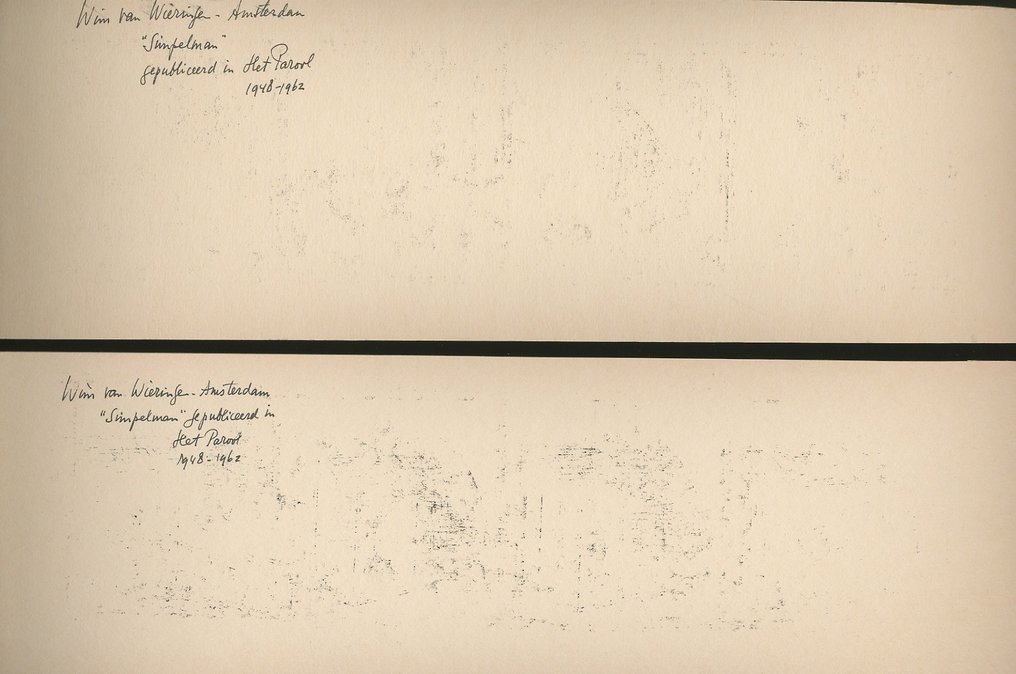
This lot contains two strips by van Wieringen with ink-updated Simpelman strips (prints) that were used for publications. The strips are signed, and van Wieringen wrote on the back what these strips were intended for. Two special items.
See also the photos that are part of the description. The two strips are well packed and sent by registered mail.
Wim van Wieringen was a Dutch cartoonist and photographer, who published under the names 'Wim de Mooij', 'Wim van Wieringen', or simply 'Wim'. He is best remembered for his pantomime comic strip 'Simpelman' (1947-1968).
Willem de Mooij Wieringen was born in 1915 in Amsterdam but spent his youth in many cities, including Nijmegen, Noordwijk, Den Helder, Haarlem, and Zandvoort. His first job was at a linoleum cliché factory in Haarlem, where he occasionally worked until 1942. He also created layouts for the weekly magazines of Strengholt in Amsterdam while attending evening courses with graphic artist Evert Mölenkamp at the School of Applied Arts in Amsterdam between 1932 and 1936.
Van Wieringen focused on cartoons and had his first work published in De Telegraaf (one cartoon in 1936) and De Tijd (a series of caricatures). In 1942, he found a job at an advertising agency in Heemstede, and the following year, he became an illustrator for the weekly magazine Cinema and Theater published by De Opbouw in Amsterdam. His career as a cartoonist took off after World War II. He gained fame through his political drawings for the leftist socialist weekly De Vlam between 1945 and 1953. A book titled '5 Jaar Indonesia Merdeka' was published in 1951 by the publisher of the magazine De Vonk and mainly collected drawings by Van Wieringen. He also published his work in De Groene Amsterdammer (drawings of theater premieres), Het Parool, Het Vrije Volk, Vrij Nederland, Sportief, and especially in the comic magazine Mandril.
Van Wieringen was involved in the underground newspaper Metro in the early post-war years, which led him to join the Marten Toonder Studios. He worked in the animation department and wrote scripts for comic series such as 'Fiedel Flier' by Ben van 't Klooster and 'Robby' by Hans G. Kresse. However, Van Wieringen's most famous creation was 'Simpelman', who first appeared in Tom Poes Weekblad in 1947. The absurd daily adventures of 'Simpelman' later appeared in newspapers in Copenhagen (Dagens Nyheter) and Paris (France Soir). In the 1960s, the comic was a regular feature in regional papers like Het Parool (1963-1968) and Limburgsch Dagblad. By then, Van Wieringen had already left the Toonder Studios. He married Margje Herblot, the ex-wife of Jan Gerhard Toonder. 'Simpelman' was subsequently distributed in newspapers by Ton de Zwaan's Swan Features Syndicate. In total, more than 3,000 'Simpelman' strips have been created, almost all of which are part of the collection at the Allard Pierson Museum. There are virtually no original strips in circulation.
This lot contains two strips by van Wieringen with ink-updated Simpelman strips (prints) that were used for publications. The strips are signed, and van Wieringen wrote on the back what these strips were intended for. Two special items.
See also the photos that are part of the description. The two strips are well packed and sent by registered mail.
Details
Item
Original strip
No. of items
2
Series
Simpelman
Condition
Excellent condition
Artist
Van Wieringen, Wim (Marten Toonder Studio's)
Title of artwork
(jaren 1950)
Width
42 cm
Height
13 cm