Johannes Trithemius - Libri Polygraphiae VI (Okkultismus, Kryptographie, Astrologie) - 1613


Opens 11:00
Starting bid
€ 1
Add to your favourites to get an alert when the auction starts.

Expert
Selected by Volker Riepenhausen
Specialist in travel literature and pre-1600 rare prints with 28 years experience.
Estimate € 550 - € 1,000
Catawiki Buyer Protection
Your payment’s safe with us until you receive your object.View details
Trustpilot 4.4 | 122910 reviews
Rated Excellent on Trustpilot.
Description from the seller
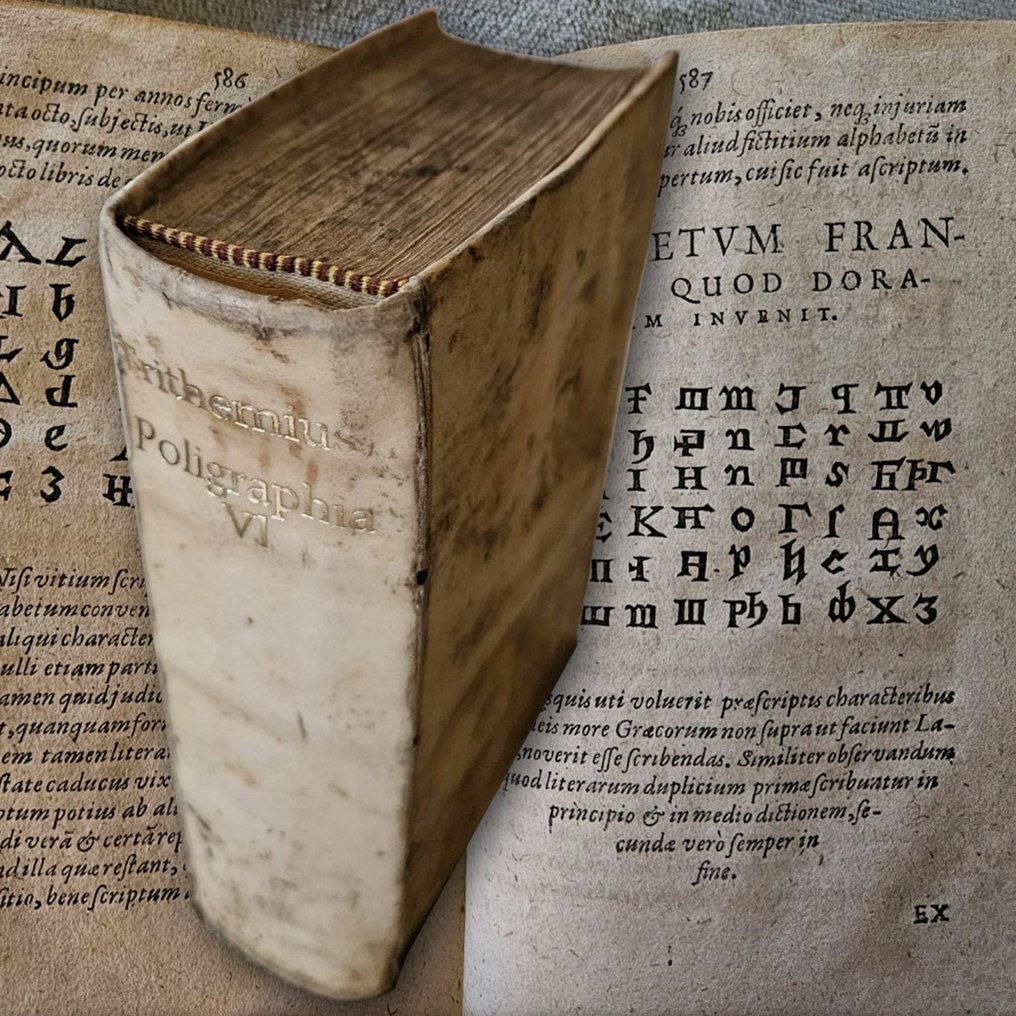
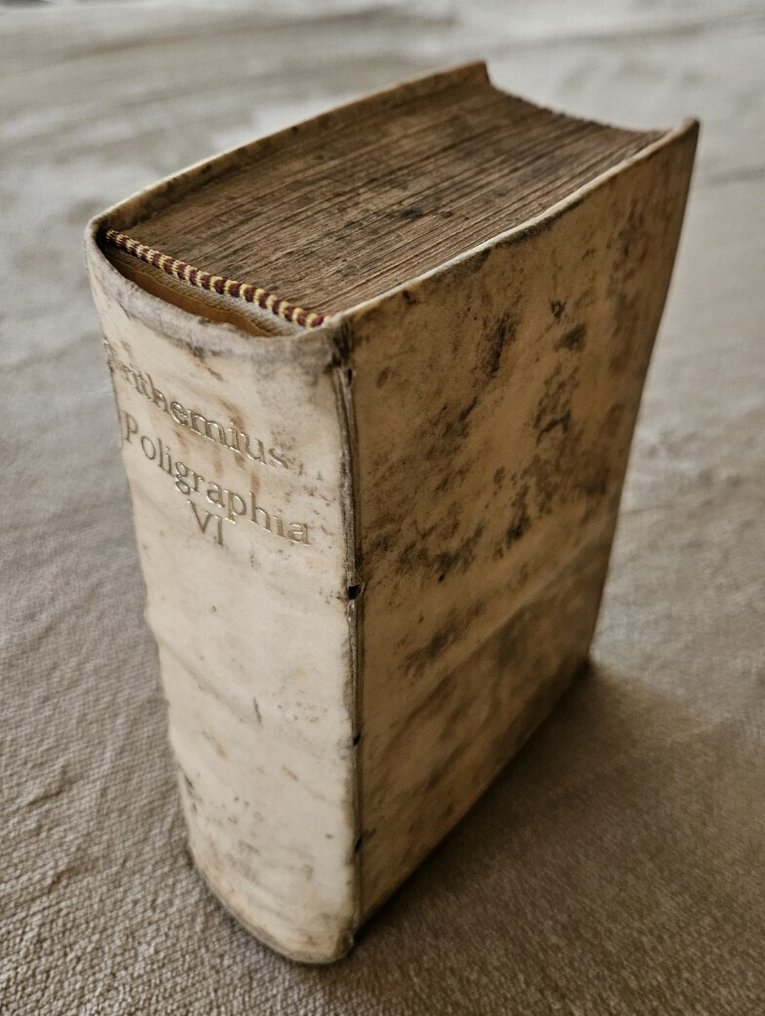
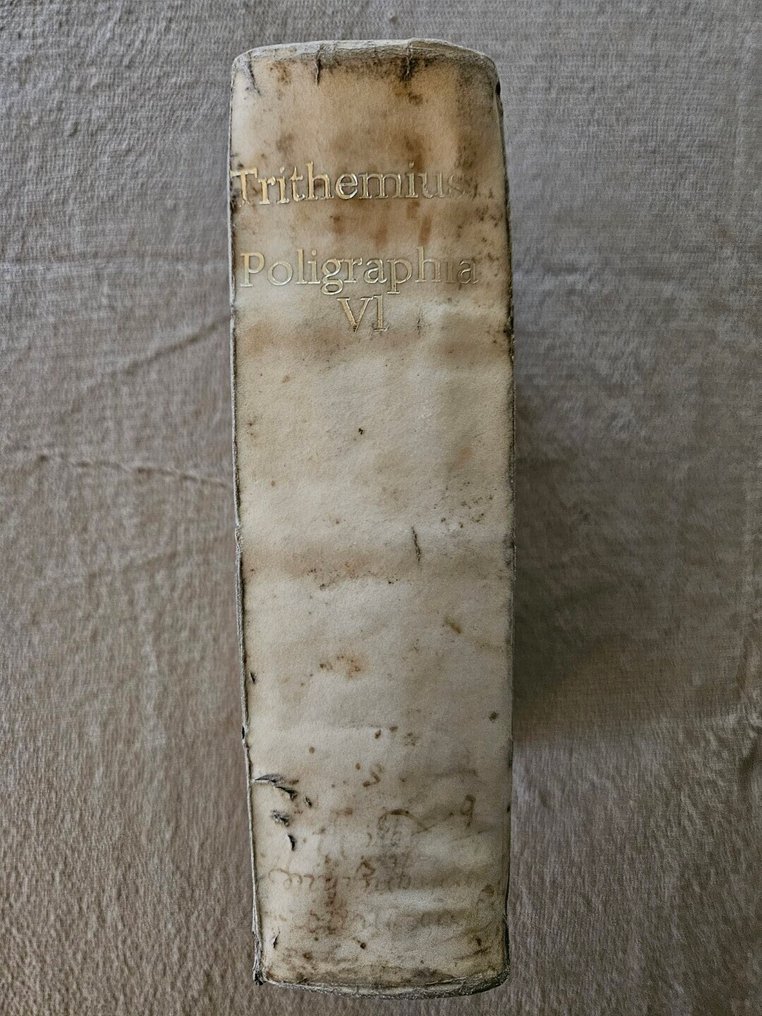
Johannes Trithemius: Books of Polygraphiae VI, with notes and observations by Adolphus à Glauburg of Frankfurt. Added is a recent work by the same author, a small book on the seven secundes.
Strasbourg, L. Zexner, 1613.
612, 2, 90 S. Pgt. of the Zt. on wooden.
Graesse VII, 204. Rosenthal 6099. Arnold 246/7. - EA 1518.
This much-praised work went through multiple editions and translations. 'It should also be mentioned that Trithem was not only the first author to write a comprehensive treatise on cryptography, the Polygraphia, a work that served as a foundation for many later authors, but also that he possessed such a good knowledge of the Tyronian notes that Dom Tassin and Dom Toustain, the authors of the Noveau Traité de Diplomatique, honored him by being the first to publish and interpret some of these notes.' (Galland, p. 184). De septem secundeis: 'This work about the seven secondary gods or intelligences or spirits that move the celestial bodies, ... traces the history of the world from creation until the year 1879 AD, by linking successive periods of 354 Arabic or 343 Christian years with the spirits of the seven planets...'
Johannes Trithemius, originally Johannes von Heidenberg, from Trirenheim near Trier, (1462-1516), was a universal scholar and Benedictine abbot. He was said to be especially knowledgeable in the 'secret sciences' and to have quoted the late wife of Emperor Maximilian in 1482. Such deathly conjurations, which were repeatedly attributed to him, are believed to have been feigned by Trithemius using optical tricks (camera obscura, mirrors). Together with his student Cornelius Agrippa of Nettesheim, he is said to have altered the consciousness of a certain Anna Sidow through 'magical experiments' to such an extent that she could predict deaths in the electoral court. Among his writings are works on talismans and, like the present one, on secret scripts.
Johannes Trithemius: Books of Polygraphiae VI, with notes and observations by Adolphus à Glauburg of Frankfurt. Added is a recent work by the same author, a small book on the seven secundes.
Strasbourg, L. Zexner, 1613.
612, 2, 90 S. Pgt. of the Zt. on wooden.
Graesse VII, 204. Rosenthal 6099. Arnold 246/7. - EA 1518.
This much-praised work went through multiple editions and translations. 'It should also be mentioned that Trithem was not only the first author to write a comprehensive treatise on cryptography, the Polygraphia, a work that served as a foundation for many later authors, but also that he possessed such a good knowledge of the Tyronian notes that Dom Tassin and Dom Toustain, the authors of the Noveau Traité de Diplomatique, honored him by being the first to publish and interpret some of these notes.' (Galland, p. 184). De septem secundeis: 'This work about the seven secondary gods or intelligences or spirits that move the celestial bodies, ... traces the history of the world from creation until the year 1879 AD, by linking successive periods of 354 Arabic or 343 Christian years with the spirits of the seven planets...'
Johannes Trithemius, originally Johannes von Heidenberg, from Trirenheim near Trier, (1462-1516), was a universal scholar and Benedictine abbot. He was said to be especially knowledgeable in the 'secret sciences' and to have quoted the late wife of Emperor Maximilian in 1482. Such deathly conjurations, which were repeatedly attributed to him, are believed to have been feigned by Trithemius using optical tricks (camera obscura, mirrors). Together with his student Cornelius Agrippa of Nettesheim, he is said to have altered the consciousness of a certain Anna Sidow through 'magical experiments' to such an extent that she could predict deaths in the electoral court. Among his writings are works on talismans and, like the present one, on secret scripts.
Details
Number of Books
1
Subject
Astrology, Esotericism, Fine Bindings, History, Linguistics, Natural History, Nature, Philosophy, Physics, Politics, Religion, Science, Technology, War history
Book Title
Libri Polygraphiae VI (Okkultismus, Kryptographie, Astrologie)
Author/ Illustrator
Johannes Trithemius
Condition
Very good
Publication year oldest item
1613
Height
15 cm
Edition
1st Edition Thus
Width
10 cm
Language
Latin
Original language
Yes
Publisher
Straßburg, L. Zexner
Binding/ Material
Leather
Number of pages
612
