Jinks Kunst - La cène - Fromat 65 X 65 cm


02
days
04
hours
35
minutes
39
seconds
Current bid
€ 170
Reserve price not met

Expert
Selected by Itziar Ramos
Holds a bachelor’s degree in art history and led modern and contemporary post-war art at Bonhams.
Gallery Estimate € 800 - € 1,000
32 other people are watching this object
 Bidder 1050 Bidder 1050 | €170 | |
|---|---|---|
| Bidder 1050 | €160 | |
| Bidder 1050 | €150 | |
Catawiki Buyer Protection
Your payment’s safe with us until you receive your object.View details
Trustpilot 4.4 | 123234 reviews
Rated Excellent on Trustpilot.
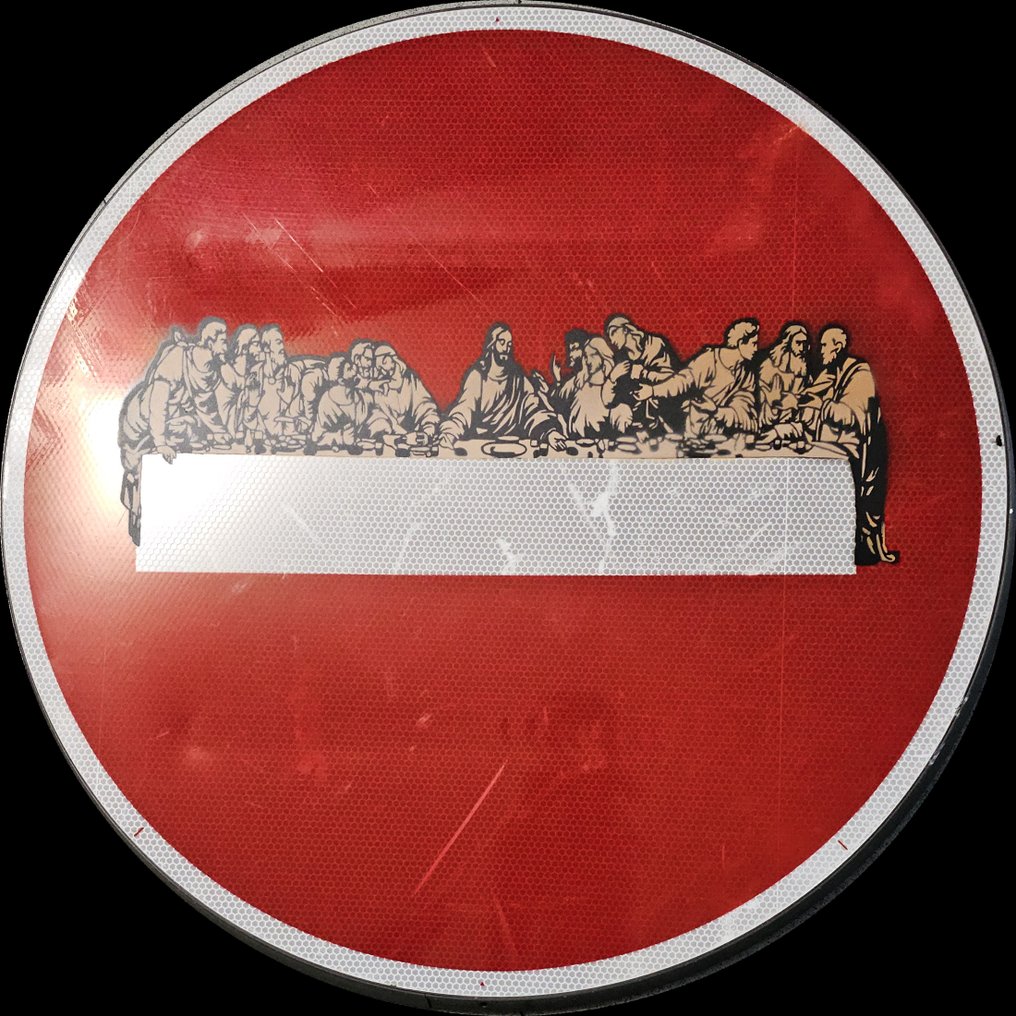
Original aerosol painting, La cène - Format 65 x 65 cm, created in 2025 in France, hand-signed, in excellent condition, depicting a religious scene in red.
AI-assisted summary
Description from the seller
This striking and paradoxical work subverts a "No Entry" sign to incorporate a stencil representation of Leonardo da Vinci's "The Last Supper." Produced on a large circular panel measuring 65 cm in diameter, it creates a powerful visual and conceptual contrast between the authority of the ban and the iconic religious scene.
The background of the work is a round traffic sign, dominated by a large red circle crossed by a white horizontal bar. This universal symbol of prohibition forms the unexpected backdrop to the religious scene.
The panel's own characteristics (reflective material, possible scratches or signs of wear) contribute to the raw and urban appearance of the work, contrasting with the classical nature of the representation.
The famous fresco is transposed into a monochrome stencil image, probably black or dark in tone, superimposed on the white bar of the panel.
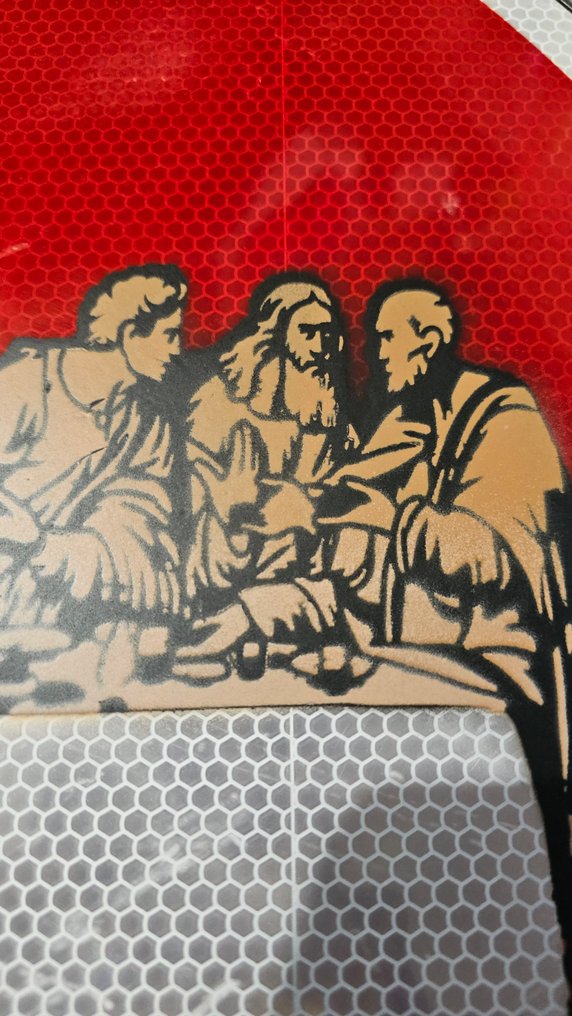
Despite the simplification inherent in the stencil technique, we recognize the figures of Jesus in the center, surrounded by his disciples arranged on either side of the long table.
The artist probably selected the most recognizable elements of the composition to make the work identifiable despite the stylization. The attitudes and groupings of the figures can be suggested by the contours and flat areas of the stencil.
The contrast between the solemnity of the religious scene and the imperative of the prohibition creates an intriguing narrative tension. One might ask what is "forbidden" here: access, participation, understanding?
The precision of the contours of the figures and the table demonstrates the artist's mastery of the stencil technique. The artist has succeeded in translating a complex work into a stylized yet recognizable form.
The imposing size of the panel reinforces the visual impact of the diversion, making the juxtaposition of the prohibition and the religious scene all the more striking.
The work exudes an atmosphere that is both surprising and contemplative. The contrast between the profane (the road sign) and the sacred (The Last Supper) invites unexpected reflection. The prohibition, a symbol of restriction and limitation, is paired with a scene of sharing and the last meal. This juxtaposition can raise questions about authority, faith, exclusion, and inclusion. The work, through its bold reinterpretation, forces the viewer to a new reading of familiar symbols and a possible subversive interpretation.
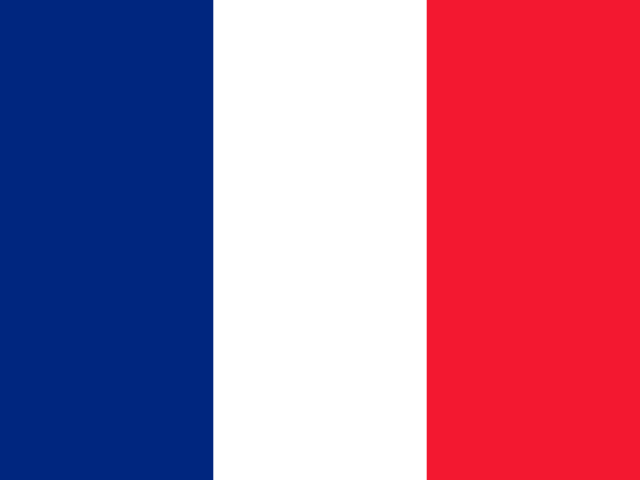
For this diversion, Jinks used a French sign.
Each work is signed, dated 2025, and provided with a certificate of authenticity, ensuring its provenance and authenticity.
Don't miss this unique opportunity to acquire a one-of-a-kind work!
You can find my creations on the streets of over 30 countries (Mali, Turkey, Morocco, Thailand, Iraq, Nepal...).
Artist listed on Artsper and Artprice.
You can discover on my Facebook page a map that geolocates my creations in over 30 countries.
I particularly like the work of Jef Aérosol, Fin Dac, Invader, Goin, Icy & Sot, Miss Van, Fafi, Logan Hicks, Speedy Graphito, Dan Kitchener, JonOne, Kaws, Blek the Rat, Shepard Fairey / Obey, Dran, Trust.Icon, Dondi, Basquiat...
IMPORTANT: The items are shipped carefully, with insurance. Upon receiving the package, please check if everything is intact. If not, refuse the package. Otherwise, I will not be able to process the insurance. If you do not, there is a risk that I will not be able to do anything in case of a dispute. It will be your responsibility.
Biography
Jinks Kunst is a French-Swiss urban artist born in 1976. He lives and works in Nantes.
His adolescence was marked by hip-hop culture and skateboarding. Magazines, fanzines, and record covers led him to discover graffiti and illustrations by artists like Lazoo and Mode 2.
He first experimented with graffiti lettering, then in 2006, he ventured into stenciling. It was a true revelation and a consuming passion that never left him. All these works are handmade. Armed with a cutter, he meticulously carves out life-sized pieces for hours.
In January 2008, he began diverting traffic signs in Nantes, then around the world. Intervening in streets across the globe is a necessity for Jinks Kunst. His creations are visible in over 30 countries.
These trips are always an opportunity for long walks to discover the right walls, the right signs. They are rich in encounters with local populations. For Jinks Kunst, urban art is a way to create connections with the inhabitants of the countries he explores, to engage in activities (often volunteer-based) with audiences (slums, refugee camps, working-class neighborhoods, schools) who have little or no access to this form of cultural expression, notably by organizing stencil creation workshops.
Seller's Story
Jinks Kunst: The Revelation of Urban Stenciling
Born in 1976, Jinks Kunst is a renowned Franco-Swiss artist whose creative trajectory is rooted in the vibrant cultures of hip-hop and skateboarding from the 1990s. Residing and working in Nantes, his journey is a constant exploration of mediums and techniques, making him an essential figure in the contemporary street art scene.
From the Street to the Stencil, an Artistic Revelation
His early graffiti lettering quickly evolved into a multidisciplinary practice, incorporating collage, painting, and the détournement of urban objects. It was in 2006 that Jinks Kunst discovered stenciling, a technique that became an all-consuming passion. Armed with a cutter, he manually sculpts his creations, infusing them with exceptional precision and meticulousness. His works, often life-sized, draw inspiration from a keen analysis of current events, politics, literature, as well as urban cultures and the animal world.
A Nomadic Artist, a Citizen of the World
Since 2008, he has been pursuing a signature approach by diverting traffic signs, initially in Nantes and then worldwide (more than 40 countries). His stencils, posters, and stickers adorn the walls of countries across Europe, Africa, Asia, and South America. These journeys are not just aesthetic quests; they are at the heart of his humanist approach. Jinks Kunst uses urban art as a means of social connection, volunteering with marginalized populations to organize creative and sharing workshops.
Reconnaissance and Major Projects
Jinks Kunst's work benefits from increasing visibility and international recognition. Exhibited in France and abroad, his works are part of leading private collections and are regularly reproduced in specialized publications on street art. In 2021, he was selected among 76 finalists for the prestigious Prix du graffiti et du street art de Paris.
Among his most significant projects, one can mention:
The creation of a mural in the Sidi Moumen slum in Casablanca, depicting a scene of Moroccan life.
A collaboration on the Prasad project in Nepal, resulting in a monumental mural in tribute to Mahabir Pun, a pioneer of connectivity in the Himalayas.
The volunteer project organization 'Djiguene & Goor' across five countries in West Africa.
Participation in renowned exhibitions, notably at Strokar in Brussels and Studio 49 in Geneva, alongside legends such as Andy Warhol, Banksy, and Jean-Michel Basquiat.
The creation of a tribute work to the film 'Les Pépites' in Phnom Penh, which captured the attention of the director.
The volunteer project organization 'Alibi' in 2019 in the refugee camps of Iraqi Kurdistan and Lebanon.
Jinks Kunst has created several hundred stencils, reappropriated over a thousand traffic signs, and customized dozens of skateboards and vinyl records. His art, both aesthetic and engaged, is a constant invitation to reflect on our world.
Translated by Google TranslateThis striking and paradoxical work subverts a "No Entry" sign to incorporate a stencil representation of Leonardo da Vinci's "The Last Supper." Produced on a large circular panel measuring 65 cm in diameter, it creates a powerful visual and conceptual contrast between the authority of the ban and the iconic religious scene.
The background of the work is a round traffic sign, dominated by a large red circle crossed by a white horizontal bar. This universal symbol of prohibition forms the unexpected backdrop to the religious scene.
The panel's own characteristics (reflective material, possible scratches or signs of wear) contribute to the raw and urban appearance of the work, contrasting with the classical nature of the representation.
The famous fresco is transposed into a monochrome stencil image, probably black or dark in tone, superimposed on the white bar of the panel.
Despite the simplification inherent in the stencil technique, we recognize the figures of Jesus in the center, surrounded by his disciples arranged on either side of the long table.
The artist probably selected the most recognizable elements of the composition to make the work identifiable despite the stylization. The attitudes and groupings of the figures can be suggested by the contours and flat areas of the stencil.
The contrast between the solemnity of the religious scene and the imperative of the prohibition creates an intriguing narrative tension. One might ask what is "forbidden" here: access, participation, understanding?
The precision of the contours of the figures and the table demonstrates the artist's mastery of the stencil technique. The artist has succeeded in translating a complex work into a stylized yet recognizable form.
The imposing size of the panel reinforces the visual impact of the diversion, making the juxtaposition of the prohibition and the religious scene all the more striking.
The work exudes an atmosphere that is both surprising and contemplative. The contrast between the profane (the road sign) and the sacred (The Last Supper) invites unexpected reflection. The prohibition, a symbol of restriction and limitation, is paired with a scene of sharing and the last meal. This juxtaposition can raise questions about authority, faith, exclusion, and inclusion. The work, through its bold reinterpretation, forces the viewer to a new reading of familiar symbols and a possible subversive interpretation.
For this diversion, Jinks used a French sign.
Each work is signed, dated 2025, and provided with a certificate of authenticity, ensuring its provenance and authenticity.
Don't miss this unique opportunity to acquire a one-of-a-kind work!
You can find my creations on the streets of over 30 countries (Mali, Turkey, Morocco, Thailand, Iraq, Nepal...).
Artist listed on Artsper and Artprice.
You can discover on my Facebook page a map that geolocates my creations in over 30 countries.
I particularly like the work of Jef Aérosol, Fin Dac, Invader, Goin, Icy & Sot, Miss Van, Fafi, Logan Hicks, Speedy Graphito, Dan Kitchener, JonOne, Kaws, Blek the Rat, Shepard Fairey / Obey, Dran, Trust.Icon, Dondi, Basquiat...
IMPORTANT: The items are shipped carefully, with insurance. Upon receiving the package, please check if everything is intact. If not, refuse the package. Otherwise, I will not be able to process the insurance. If you do not, there is a risk that I will not be able to do anything in case of a dispute. It will be your responsibility.
Biography
Jinks Kunst is a French-Swiss urban artist born in 1976. He lives and works in Nantes.
His adolescence was marked by hip-hop culture and skateboarding. Magazines, fanzines, and record covers led him to discover graffiti and illustrations by artists like Lazoo and Mode 2.
He first experimented with graffiti lettering, then in 2006, he ventured into stenciling. It was a true revelation and a consuming passion that never left him. All these works are handmade. Armed with a cutter, he meticulously carves out life-sized pieces for hours.
In January 2008, he began diverting traffic signs in Nantes, then around the world. Intervening in streets across the globe is a necessity for Jinks Kunst. His creations are visible in over 30 countries.
These trips are always an opportunity for long walks to discover the right walls, the right signs. They are rich in encounters with local populations. For Jinks Kunst, urban art is a way to create connections with the inhabitants of the countries he explores, to engage in activities (often volunteer-based) with audiences (slums, refugee camps, working-class neighborhoods, schools) who have little or no access to this form of cultural expression, notably by organizing stencil creation workshops.
Seller's Story
Jinks Kunst: The Revelation of Urban Stenciling
Born in 1976, Jinks Kunst is a renowned Franco-Swiss artist whose creative trajectory is rooted in the vibrant cultures of hip-hop and skateboarding from the 1990s. Residing and working in Nantes, his journey is a constant exploration of mediums and techniques, making him an essential figure in the contemporary street art scene.
From the Street to the Stencil, an Artistic Revelation
His early graffiti lettering quickly evolved into a multidisciplinary practice, incorporating collage, painting, and the détournement of urban objects. It was in 2006 that Jinks Kunst discovered stenciling, a technique that became an all-consuming passion. Armed with a cutter, he manually sculpts his creations, infusing them with exceptional precision and meticulousness. His works, often life-sized, draw inspiration from a keen analysis of current events, politics, literature, as well as urban cultures and the animal world.
A Nomadic Artist, a Citizen of the World
Since 2008, he has been pursuing a signature approach by diverting traffic signs, initially in Nantes and then worldwide (more than 40 countries). His stencils, posters, and stickers adorn the walls of countries across Europe, Africa, Asia, and South America. These journeys are not just aesthetic quests; they are at the heart of his humanist approach. Jinks Kunst uses urban art as a means of social connection, volunteering with marginalized populations to organize creative and sharing workshops.
Reconnaissance and Major Projects
Jinks Kunst's work benefits from increasing visibility and international recognition. Exhibited in France and abroad, his works are part of leading private collections and are regularly reproduced in specialized publications on street art. In 2021, he was selected among 76 finalists for the prestigious Prix du graffiti et du street art de Paris.
Among his most significant projects, one can mention:
The creation of a mural in the Sidi Moumen slum in Casablanca, depicting a scene of Moroccan life.
A collaboration on the Prasad project in Nepal, resulting in a monumental mural in tribute to Mahabir Pun, a pioneer of connectivity in the Himalayas.
The volunteer project organization 'Djiguene & Goor' across five countries in West Africa.
Participation in renowned exhibitions, notably at Strokar in Brussels and Studio 49 in Geneva, alongside legends such as Andy Warhol, Banksy, and Jean-Michel Basquiat.
The creation of a tribute work to the film 'Les Pépites' in Phnom Penh, which captured the attention of the director.
The volunteer project organization 'Alibi' in 2019 in the refugee camps of Iraqi Kurdistan and Lebanon.
Jinks Kunst has created several hundred stencils, reappropriated over a thousand traffic signs, and customized dozens of skateboards and vinyl records. His art, both aesthetic and engaged, is a constant invitation to reflect on our world.
Translated by Google TranslateDetails
Artist
Jinks Kunst
Edition
Original
Sold by
Direct from the artist
Sold with frame
No
Title of artwork
La cène - Fromat 65 X 65 cm
Technique
Spray paint
Signature
Hand signed
Country of Origin
France
Year
2025
Condition
Excellent condition
Colour
Red
Height
65 cm
Width
65 cm
Weight
6 kg
Depiction/Theme
Religion
Style
Street art
Period
2020+
Sold by
