US Army M-1938 Lensatic Compass - working - Infantry - Airborne - Militaire uitrusting



06
dagen
13
uren
59
minuten
38
seconden

6 andere personen volgen dit object
 Bieder 0192 Bieder 0192 | € 1 |
|---|
Catawiki Kopersbescherming
Je betaling is veilig bij ons totdat je het object hebt ontvangen.Bekijk details
Trustpilot 4.4 | 122910 reviews
Beoordeeld als "Uitstekend" op Trustpilot.
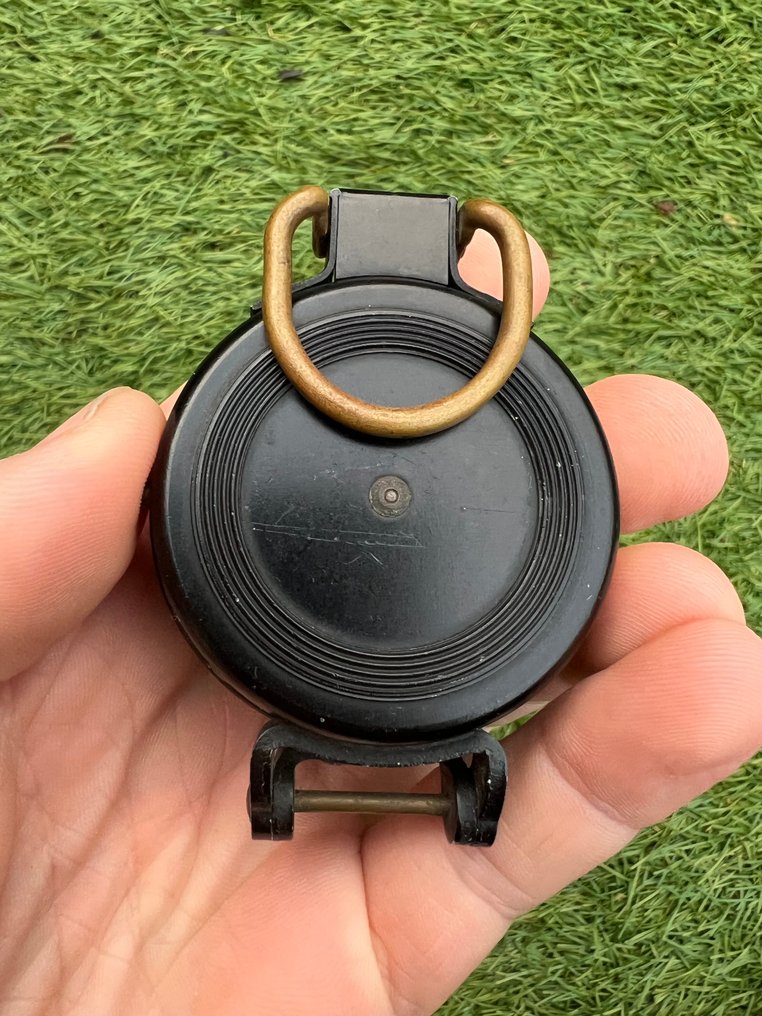
US Army M-1938 lensatic kompas, origineel, in goede conditie en werkend, gebruikt door infanterie- en airborne-eenheden tijdens de Tweede Wereldoorlog.
AI-gegenereerde samenvatting
Beschrijving van de verkoper
Offered for auction is a very nice early war (1940-1943) US Army WW2 M-1938 lensatic compass, as used by officers and lowers ranks during WW2. This compass was made by the Troy and Gurle company. It functions as it should and is in very good condition for its age. It is nicely marked on the compass tiself. A very nice compass for your collection. The lens works and the compas freely moves., and the wire is present and not damaged - in very good condition!
Great and rare 100% original item from WW2! See also our other interesting military books and militaria for sale!
History of the The M-1938 Lensatic Compass
Undoubtedly, U. S. Army service personnel became aware of the Verner prismatic compasses while serving with their British counterparts in World War I. The Army authorized research and development projects to develop a new compass at the request of the U. S. Army’s Infantry School in Fort Benning. The first of these R&D projects for a new compass was issued on March 21, 1928. The agency responsible for the research and development of compasses for the U.S. Army, at that time, was The Engineering and Topographic Laboratories at Fort Belvoir, Virginia. Additional research projects were issued until 1938. Special Project 280 (SP-280) was authorized on October 21, 1938, to find a suitable commercial lensatic compass for the Infantry that met the Infantry School’s requirements. The Engineer Board did not discover a commercial compass that met the standards published by the Infantry School. However, two companies, The W. &L. E. Gurley Company and The Taylor Instrument Company offered to make new compass prototypes based on the Infantry School’s requirements. After the testing and modifications of their compasses, they were recommended for procurement in 1940. Both manufacturers supplied compasses to the U. S. Army during World War II. Their compasses were designated as the M-1938 Lensatic Compass.
The U. S. Army continued to suggest improvements to the M-1938 lensatic compass throughout World War II. For example, there were several attempts to solve the mechanical dampening problem with the lensatic compass. In short, they were attempting to find ways to keep the compass needle from oscillating when taking a bearing. Reducing oscillation of the needle helps to gain a more accurate reading when taking an azimuth and bearing for land navigation. A liquid was commonly used for dampening in the lensatic compasses through most of World War II. The use of liquid dampening was a better option for the technology of the times. However, experimentation with the dampening process continued throughout the war.
De verkoper stelt zich voor
Wij zijn gespecialiseerd in de verkoop van professionele militaire voorschriften, vakliteratuur en overige militaria met ruim 20 jaar ervaring. Met een zorgvuldig geselecteerd assortiment bedienen wij verzamelaars, historici, defensieprofessionals en liefhebbers van militaire geschiedenis. Onze producten bieden betrouwbare en authentieke informatie en zijn van hoge kwaliteit. Wij staan voor expertise, betrouwbaarheid en een passie voor militair erfgoed.
Offered for auction is a very nice early war (1940-1943) US Army WW2 M-1938 lensatic compass, as used by officers and lowers ranks during WW2. This compass was made by the Troy and Gurle company. It functions as it should and is in very good condition for its age. It is nicely marked on the compass tiself. A very nice compass for your collection. The lens works and the compas freely moves., and the wire is present and not damaged - in very good condition!
Great and rare 100% original item from WW2! See also our other interesting military books and militaria for sale!
History of the The M-1938 Lensatic Compass
Undoubtedly, U. S. Army service personnel became aware of the Verner prismatic compasses while serving with their British counterparts in World War I. The Army authorized research and development projects to develop a new compass at the request of the U. S. Army’s Infantry School in Fort Benning. The first of these R&D projects for a new compass was issued on March 21, 1928. The agency responsible for the research and development of compasses for the U.S. Army, at that time, was The Engineering and Topographic Laboratories at Fort Belvoir, Virginia. Additional research projects were issued until 1938. Special Project 280 (SP-280) was authorized on October 21, 1938, to find a suitable commercial lensatic compass for the Infantry that met the Infantry School’s requirements. The Engineer Board did not discover a commercial compass that met the standards published by the Infantry School. However, two companies, The W. &L. E. Gurley Company and The Taylor Instrument Company offered to make new compass prototypes based on the Infantry School’s requirements. After the testing and modifications of their compasses, they were recommended for procurement in 1940. Both manufacturers supplied compasses to the U. S. Army during World War II. Their compasses were designated as the M-1938 Lensatic Compass.
The U. S. Army continued to suggest improvements to the M-1938 lensatic compass throughout World War II. For example, there were several attempts to solve the mechanical dampening problem with the lensatic compass. In short, they were attempting to find ways to keep the compass needle from oscillating when taking a bearing. Reducing oscillation of the needle helps to gain a more accurate reading when taking an azimuth and bearing for land navigation. A liquid was commonly used for dampening in the lensatic compasses through most of World War II. The use of liquid dampening was a better option for the technology of the times. However, experimentation with the dampening process continued throughout the war.
De verkoper stelt zich voor
Wij zijn gespecialiseerd in de verkoop van professionele militaire voorschriften, vakliteratuur en overige militaria met ruim 20 jaar ervaring. Met een zorgvuldig geselecteerd assortiment bedienen wij verzamelaars, historici, defensieprofessionals en liefhebbers van militaire geschiedenis. Onze producten bieden betrouwbare en authentieke informatie en zijn van hoge kwaliteit. Wij staan voor expertise, betrouwbaarheid en een passie voor militair erfgoed.
Details
Era
1900-2000
Legereenheid
US Army M-1938 Lensatic Compass - working - Infantry - Airborne
Staat
Goed
Origineel / Replica
Origineel
Met certificaat van echtheid
Nee
Verkocht door