1st issue US M1 Carbine Ordnance Maintenance Manual - infantry - Airborne - beautiful plates, all technical details - 1942



07
dagen
07
uren
15
minuten
55
seconden

10 andere personen volgen dit object
 Bieder 3339 Bieder 3339 | € 1 |
|---|
Catawiki Kopersbescherming
Je betaling is veilig bij ons totdat je het object hebt ontvangen.Bekijk details
Trustpilot 4.4 | 122529 reviews
Beoordeeld als "Uitstekend" op Trustpilot.
1942 gedateerde Amerikaanse strijdkrachten onderhoudsmanual voor de M1 Carbine, 70 pagina’s, Engels, eerste druk in dit formaat, redelijk tot goede staat met enige slijtage.
AI-gegenereerde samenvatting
Beschrijving van de verkoper
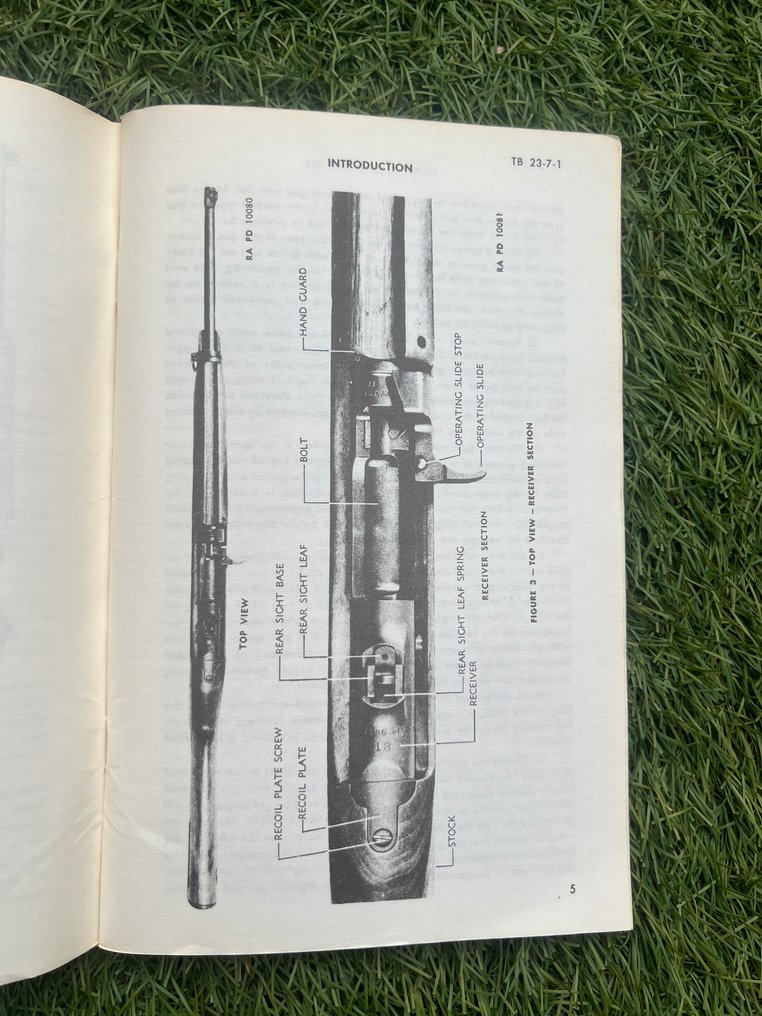
Nice 1942 dated U.S.A official army manual related to SPECIFICALLY the infamous M1 Carbine - this is the first, by my knowledge, technical manual of the M1 Carbine published as a technical bulletin - it was published in march 1942, just before the m1 carbine was officially introduced in mid 1942. Over 60!!! pages of very interesting information and abundant photo's and plates; maintenance, use, ammunition, parts, drawings and many photo's. Great and highly illustrative for your WW2 usa collection, in reasonable condition for its age, but here and there some wear.
History of the M1 Carbine
The M1 carbine with its reduced-power .30 cartridge was not originally intended to serve as a primary weapon for combat infantrymen, nor was it comparable to more powerful assault rifles developed late in the war. However, it was markedly superior to the .45 caliber submachineguns in use at the time in both accuracy and penetration,[10] and its lighter .30 caliber cartridge allowed soldiers to carry more ammunition. As a result, the carbine was soon widely issued to infantry officers, American paratroopers, non-commissioned officers, ammunition bearers, forward artillery observers, and other frontline troops.[35] The first M1 carbines were delivered in mid-1942, with initial priority given to troops in the European Theater of Operations (ETO).[10]
During World War II a standard U.S. Army infantry company was issued a total of 28 M1 carbines.[36] The company headquarters was issued nine carbines (for the company commander, executive officer, first sergeant, mess sergeant, supply sergeant, bugler, and three messengers), the weapons platoon was issued sixteen carbines (for the platoon leader, platoon sergeant, two platoon messengers in the platoon headquarters, one messenger in each of the two mortar and machine gun section headquarters, and ten for the mortar and machine gun ammunition bearers), and the three rifle platoons were issued one each (for the platoon commander).[36]
The M1 carbine gained generally high praise for its small size, light weight and firepower, especially by those troops who were unable to use a full-size rifle as their primary weapon.[21][37] However, its reputation in front-line combat was mixed and negative reports began to surface with airborne operations in Sicily in 1943,[38] and increased during the fall and winter of 1944.[39]
In the Asiatic-Pacific Theater, soldiers and guerrilla forces operating in heavy jungle with only occasional enemy contact praised the carbine for its small size, light weight, and firepower.[40] However, soldiers and Marines engaged in frequent daily firefights (particularly those serving in the Philippines) found the weapon to have insufficient penetration and stopping power.[20][41] While carbine bullets would easily penetrate the front and back of steel helmets, as well as the body armor used by Japanese forces of the era[42][43] reports of the carbine's failure to stop enemy soldiers, sometimes after multiple hits, appeared in individual after-action reports, postwar evaluations, and service histories of both the U.S. Army and the U.S. Marine Corps.[20][41]
The carbine's exclusive use of non-corrosive-primer ammunition was found to be ideal by troops and ordnance personnel serving in the Pacific, where barrel corrosion was a significant issue with the corrosive primers used in .30-06 caliber weapons.[20] However, in the European theatre, some soldiers reported misfires attributed to moisture ingress of the non-corrosive primer compound.
De verkoper stelt zich voor
Wij zijn gespecialiseerd in de verkoop van professionele militaire voorschriften, vakliteratuur en overige militaria met ruim 20 jaar ervaring. Met een zorgvuldig geselecteerd assortiment bedienen wij verzamelaars, historici, defensieprofessionals en liefhebbers van militaire geschiedenis. Onze producten bieden betrouwbare en authentieke informatie en zijn van hoge kwaliteit. Wij staan voor expertise, betrouwbaarheid en een passie voor militair erfgoed.
Nice 1942 dated U.S.A official army manual related to SPECIFICALLY the infamous M1 Carbine - this is the first, by my knowledge, technical manual of the M1 Carbine published as a technical bulletin - it was published in march 1942, just before the m1 carbine was officially introduced in mid 1942. Over 60!!! pages of very interesting information and abundant photo's and plates; maintenance, use, ammunition, parts, drawings and many photo's. Great and highly illustrative for your WW2 usa collection, in reasonable condition for its age, but here and there some wear.
History of the M1 Carbine
The M1 carbine with its reduced-power .30 cartridge was not originally intended to serve as a primary weapon for combat infantrymen, nor was it comparable to more powerful assault rifles developed late in the war. However, it was markedly superior to the .45 caliber submachineguns in use at the time in both accuracy and penetration,[10] and its lighter .30 caliber cartridge allowed soldiers to carry more ammunition. As a result, the carbine was soon widely issued to infantry officers, American paratroopers, non-commissioned officers, ammunition bearers, forward artillery observers, and other frontline troops.[35] The first M1 carbines were delivered in mid-1942, with initial priority given to troops in the European Theater of Operations (ETO).[10]
During World War II a standard U.S. Army infantry company was issued a total of 28 M1 carbines.[36] The company headquarters was issued nine carbines (for the company commander, executive officer, first sergeant, mess sergeant, supply sergeant, bugler, and three messengers), the weapons platoon was issued sixteen carbines (for the platoon leader, platoon sergeant, two platoon messengers in the platoon headquarters, one messenger in each of the two mortar and machine gun section headquarters, and ten for the mortar and machine gun ammunition bearers), and the three rifle platoons were issued one each (for the platoon commander).[36]
The M1 carbine gained generally high praise for its small size, light weight and firepower, especially by those troops who were unable to use a full-size rifle as their primary weapon.[21][37] However, its reputation in front-line combat was mixed and negative reports began to surface with airborne operations in Sicily in 1943,[38] and increased during the fall and winter of 1944.[39]
In the Asiatic-Pacific Theater, soldiers and guerrilla forces operating in heavy jungle with only occasional enemy contact praised the carbine for its small size, light weight, and firepower.[40] However, soldiers and Marines engaged in frequent daily firefights (particularly those serving in the Philippines) found the weapon to have insufficient penetration and stopping power.[20][41] While carbine bullets would easily penetrate the front and back of steel helmets, as well as the body armor used by Japanese forces of the era[42][43] reports of the carbine's failure to stop enemy soldiers, sometimes after multiple hits, appeared in individual after-action reports, postwar evaluations, and service histories of both the U.S. Army and the U.S. Marine Corps.[20][41]
The carbine's exclusive use of non-corrosive-primer ammunition was found to be ideal by troops and ordnance personnel serving in the Pacific, where barrel corrosion was a significant issue with the corrosive primers used in .30-06 caliber weapons.[20] However, in the European theatre, some soldiers reported misfires attributed to moisture ingress of the non-corrosive primer compound.
De verkoper stelt zich voor
Wij zijn gespecialiseerd in de verkoop van professionele militaire voorschriften, vakliteratuur en overige militaria met ruim 20 jaar ervaring. Met een zorgvuldig geselecteerd assortiment bedienen wij verzamelaars, historici, defensieprofessionals en liefhebbers van militaire geschiedenis. Onze producten bieden betrouwbare en authentieke informatie en zijn van hoge kwaliteit. Wij staan voor expertise, betrouwbaarheid en een passie voor militair erfgoed.
Details
Aantal boeken
1
Onderwerp
Krijgsgeschiedenis, Militair, Wapenkunde
Boektitel
infantry - Airborne - beautiful plates, all technical details
Auteur/ Illustrator
1st issue US M1 Carbine Ordnance Maintenance Manual
Staat
Redelijk
Publicatiejaar oudste item
1942
Editie
Eerste druk in dit formaat
Taal
Engels
Oorspronkelijke taal
Ja
Aantal pagina‘s.
70
Verkocht door