N.º 100195460

Já não está disponível
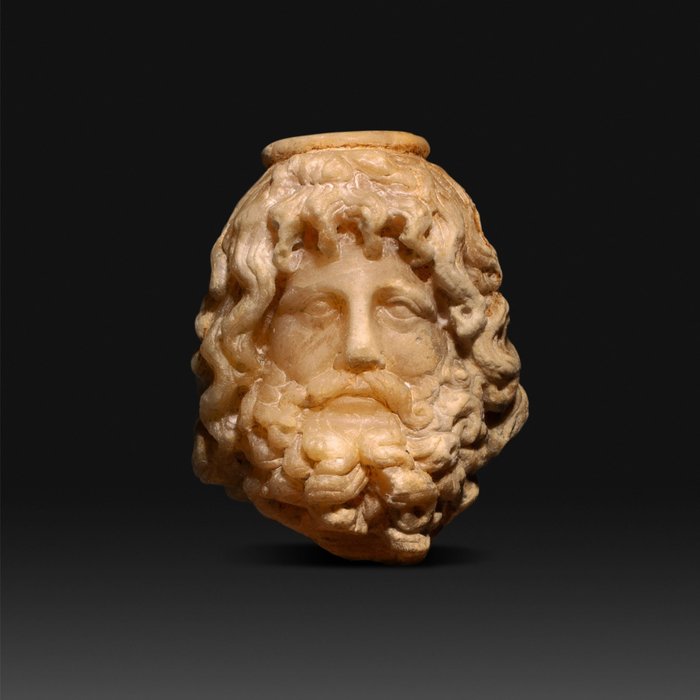
Roma Antiga Alabastro Cabeça de Serapis. Séculos I - II d.C. 9,5 cm de altura. Licença de Exportação Espanhola.
Licitação fechada
Há 1 dia

Roma Antiga Alabastro Cabeça de Serapis. Séculos I - II d.C. 9,5 cm de altura. Licença de Exportação Espanhola.

Serapis Head. Ancient Roman, 1st - 2nd century AD. Alabaster. Height 9.5 cm and 20 cm with the stand. PROVENANCE: Private collection, France. Acquired by family inheritance. 1970. CONDITION: In a good state of preservation. DESCRIPTION: A beautiful head that belonged to a bust or sculpture, sculpted in translucent alabaster, of the syncretic Egyptian-Roman deity Serapis. It was probably intended to be placed on a private altar or as decoration in a room of a Roman domus. Similar examples have been found in both Egypt and Rome, as well as in other cities on the Italian peninsula. Its sculptural style suggests that it may well have been made in Egypt. This deity is depicted in its most common form: an adult male with long hair and beard. The essential attribute that distinguished the images of Serapis from those of other similar gods is the calathus or modius, the sacred basket of the mysteries, symbol of abundance, which would have been made piece by piece. It unites the concepts of agricultural fertility, life and death; it was used in the art of Ancient Egypt and in the Greco-Roman world. It resembles the bun that was worn on the head to carry something heavy. Its name was given by scholars because of its resemblance to the Roman modius, an utensil used as a unit of measurement for grain capacity. Ptolemy I, the first Greek ruler of Egypt after the death of Alexander the Great, declared Serapis to be the patron saint of Alexandria and the official god of Egypt and Greece, thus linking the two peoples. Ptolemy's intention was probably to find a deity who would command the respect and veneration of the Hellenes and the intensely traditionalist Egyptians alike. It is unlikely that the Greeks would have accepted a zoocephalous deity, in the Egyptian manner, whereas the Egyptians would have been more willing to accept any aspect for this god. A typical Greek icon was therefore chosen, which was proclaimed to be the anthropomorphic equivalent of a much revered Egyptian divinity, the ox Apis, assimilated to Osiris. Serapis is thus a syncretic divinity in which cultic practices of different origins are synthesised in a new image. Notes: The piece includes authenticity certificate. The piece includes Spanish Export License (Passport for European Union) - If the piece is destined outside the European Union a substitution of the export permit should be requested. This process could take between 1 and 2 months. #MasterpiecesW39

N.º 100195460

Já não está disponível
Roma Antiga Alabastro Cabeça de Serapis. Séculos I - II d.C. 9,5 cm de altura. Licença de Exportação Espanhola.

Roma Antiga Alabastro Cabeça de Serapis. Séculos I - II d.C. 9,5 cm de altura. Licença de Exportação Espanhola.

Serapis Head.

Ancient Roman, 1st - 2nd century AD.

Alabaster.

Height 9.5 cm and 20 cm with the stand.

PROVENANCE: Private collection, France. Acquired by family inheritance. 1970.

CONDITION: In a good state of preservation.

DESCRIPTION:

A beautiful head that belonged to a bust or sculpture, sculpted in translucent alabaster, of the syncretic Egyptian-Roman deity Serapis. It was probably intended to be placed on a private altar or as decoration in a room of a Roman domus. Similar examples have been found in both Egypt and Rome, as well as in other cities on the Italian peninsula. Its sculptural style suggests that it may well have been made in Egypt.

This deity is depicted in its most common form: an adult male with long hair and beard. The essential attribute that distinguished the images of Serapis from those of other similar gods is the calathus or modius, the sacred basket of the mysteries, symbol of abundance, which would have been made piece by piece. It unites the concepts of agricultural fertility, life and death; it was used in the art of Ancient Egypt and in the Greco-Roman world. It resembles the bun that was worn on the head to carry something heavy. Its name was given by scholars because of its resemblance to the Roman modius, an utensil used as a unit of measurement for grain capacity.

Ptolemy I, the first Greek ruler of Egypt after the death of Alexander the Great, declared Serapis to be the patron saint of Alexandria and the official god of Egypt and Greece, thus linking the two peoples. Ptolemy's intention was probably to find a deity who would command the respect and veneration of the Hellenes and the intensely traditionalist Egyptians alike. It is unlikely that the Greeks would have accepted a zoocephalous deity, in the Egyptian manner, whereas the Egyptians would have been more willing to accept any aspect for this god. A typical Greek icon was therefore chosen, which was proclaimed to be the anthropomorphic equivalent of a much revered Egyptian divinity, the ox Apis, assimilated to Osiris. Serapis is thus a syncretic divinity in which cultic practices of different origins are synthesised in a new image.


Notes:

The piece includes authenticity certificate.
The piece includes Spanish Export License (Passport for European Union) - If the piece is destined outside the European Union a substitution of the export permit should be requested. This process could take between 1 and 2 months.
#MasterpiecesW39


Licitação fechada
Ruth Garrido Vila
Especialista
Estimativa  € 12.000 - € 15.000

Objetos semelhantes

Para si em

Arqueologia

Definir um alerta de pesquisa
Defina um alerta de pesquisa para ser notificado quando surgirem novos resultados.

Este objeto foi mostrado em


Como comprar na Catawiki

Saber mais sobre a nossa proteção do comprador

      1. Descubra algo especial

      Navegue por milhares de objetos especiais selecionados por especialistas. Veja as fotos, os detalhes e o valor estimado de cada objeto especial. 

      2. Faça a licitação vencedora

      Encontre algo que adora e faça a licitação vencedora. Pode acompanhar o leilão até ao fim ou deixar o nosso sistema licitar por si. Apenas tem de definir o valor máximo que está disposto a pagar. 

      3. Faça um pagamento seguro

      Pague o seu objeto especial e mantemos o seu pagamento seguro até o seu objeto chegar são e salvo. Utilizamos um sistema de pagamento confiável para processar todas as transações. 

Tem algo parecido para vender?

Quer tenha entrado agora no mundo dos leilões online ou venda a título profissional, podemos ajudá-lo a ganhar mais pelos seus objetos especiais.

Venda o seu objeto
