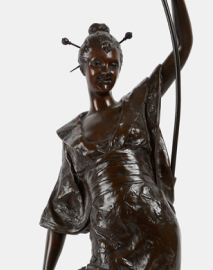
Statue, Icarus - 50 cm - Bronze


01
Tag
23
Stunden
07
Minuten
10
Sekunden
Aktuelles Gebot
€ 190
Mindestpreis nicht erreicht

15 andere Benutzer beobachten dieses Objekt
 Bieter 4106 Bieter 4106 | 190 € |
|---|
Käuferschutz auf Catawiki
Ihre Zahlung wird von uns sicher verwahrt, bis Sie Ihr Objekt erhalten.Details ansehen
Trustpilot 4.4 | 127451 Bewertungen
Auf Trustpilot als hervorragend bewertet.
Icarus ist eine Bronzeskulptur in der Lost-Wax-Technik im Stil von Otto Schmidt Hofer (Deutschland), eine flügelgestützte Athletendarstellung auf einem sphärischen Marmorsockel, Maße ca. 40 cm Breite, 50 cm Höhe, 30 cm Tiefe, unsigniert, Offen Edition und europäischer Ursprung.
KI-gestützte Zusammenfassung
Vom Verkäufer bereitgestellte Beschreibung
Icarus, stylish Art Deco sculpture of a winged athlete in the style of Otto Schmidt Hofer Germany,
The figure is mounted on s spheric marble base.
Bronze made in the lost wax process.
Lost Wax Casting Process Most detailed are cast using the “Lost Wax” process. This is the most precise metal casting technique in existence, ensuring accurate reproductions of the original sculpture and exquisite detail. All bronze pieces are cast from a wax model regardless of the original material the model was sculpted in usually in clay or wax. “Lost wax” casting method was found in thousand years ago.
In Greek mythology, Icarus (/ˈɪkərəs/; Ancient Greek: Ἴκαρος, romanized: Íkaros, pronounced [ǐːkaros]) was the son of the master craftsman Daedalus, the architect of the labyrinth of Crete. After Theseus, king of Athens and enemy of Minos, escaped from the labyrinth, King Minos suspected that Icarus and Daedalus had revealed the labyrinth's secrets and imprisoned them—either in a large tower overlooking the ocean or the labyrinth itself, depending upon the account.[1][2] Icarus and Daedalus escaped using wings Daedalus constructed from feathers, threads from blankets, clothes, and beeswax.[3] Daedalus warned Icarus first of complacency and then of hubris, instructing him to fly neither too low nor too high, lest the sea's dampness clog his wings or the sun's heat melt them.[3] Icarus ignored Daedalus’s instructions not to fly too close to the sun, causing the beeswax in his wings to melt. Icarus fell from the sky, plunged into the sea, and drowned. The myth gave rise to the idiom, "fly too close to the sun."
We ship UPS or DHL track and trace.
Icarus, stylish Art Deco sculpture of a winged athlete in the style of Otto Schmidt Hofer Germany,
The figure is mounted on s spheric marble base.
Bronze made in the lost wax process.
Lost Wax Casting Process Most detailed are cast using the “Lost Wax” process. This is the most precise metal casting technique in existence, ensuring accurate reproductions of the original sculpture and exquisite detail. All bronze pieces are cast from a wax model regardless of the original material the model was sculpted in usually in clay or wax. “Lost wax” casting method was found in thousand years ago.
In Greek mythology, Icarus (/ˈɪkərəs/; Ancient Greek: Ἴκαρος, romanized: Íkaros, pronounced [ǐːkaros]) was the son of the master craftsman Daedalus, the architect of the labyrinth of Crete. After Theseus, king of Athens and enemy of Minos, escaped from the labyrinth, King Minos suspected that Icarus and Daedalus had revealed the labyrinth's secrets and imprisoned them—either in a large tower overlooking the ocean or the labyrinth itself, depending upon the account.[1][2] Icarus and Daedalus escaped using wings Daedalus constructed from feathers, threads from blankets, clothes, and beeswax.[3] Daedalus warned Icarus first of complacency and then of hubris, instructing him to fly neither too low nor too high, lest the sea's dampness clog his wings or the sun's heat melt them.[3] Icarus ignored Daedalus’s instructions not to fly too close to the sun, causing the beeswax in his wings to melt. Icarus fell from the sky, plunged into the sea, and drowned. The myth gave rise to the idiom, "fly too close to the sun."
We ship UPS or DHL track and trace.
Details
Epoche
1900-2000
Herkunftsland
Europa
Material
Bronze
Titel des Kunstwerks
Icarus
Signatur
Nicht signiert
Auflage
Open
Zustand
exzellenter Zustand
Höhe
50 cm
Breite
40 cm
Tiefe
30 cm
Verkauft von