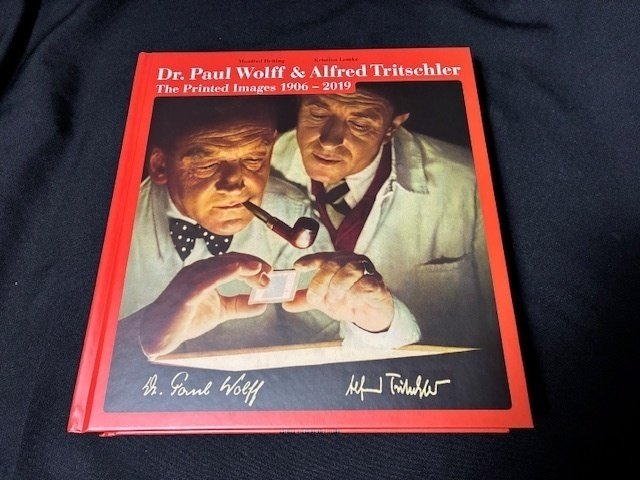
Dr. Paul Wolff & Alfred Tritschler - The Printed Images 1906-2019 (BOOK ON PHOTOBOOKS, MINT CONDITION) - 2021


02
Tage
07
Stunden
39
Minuten
09
Sekunden

30 andere Benutzer beobachten dieses Objekt
 Bieter 3276 Bieter 3276 | 31 € | |
|---|---|---|
 Bieter 5281 Bieter 5281 | 26 € | |
 Bieter 5175 Bieter 5175 | 17 € | |
Käuferschutz auf Catawiki
Ihre Zahlung wird von uns sicher verwahrt, bis Sie Ihr Objekt erhalten.Details ansehen
Trustpilot 4.4 | 122290 Bewertungen
Auf Trustpilot als hervorragend bewertet.
The Printed Images 1906-2019 (BOOK ON PHOTOBOOKS, MINT CONDITION) von Dr. Paul Wolff & Alfred Tritschler, Erstausgabe als Hardcover, Steidl, Göttingen 2021, 600 Seiten.
KI-gestützte Zusammenfassung
Vom Verkäufer bereitgestellte Beschreibung
THIS IS THE LAST EXCLUSIVE PHOTOBOOK AUCTION by 5Uhr30.com in 2025 -
with more than 100 great lots from my personal collection and from recent acquisitions.
GREAT OPPORTUNITY to purchase this FANTASTIC BOOK, showing all the publications by German Dr. Paul Wolff and Alfred Tritschler between 1906 and 2019 - in BRANDNEW CONDITION.
MUST-HAVE SECONDARY LITERATURE BOOK ABOUT PHOTOBOOKS:
Daniel Blaize, Anatole Desachy, Jean-Marie Donat, "The book of books on photobooks", pages 336-339.
Like always 5Uhr30.com guarantees detailed and accurate descriptions, 100% transport protection, 100% transport insurance, and of course, combined shipping - worldwide.
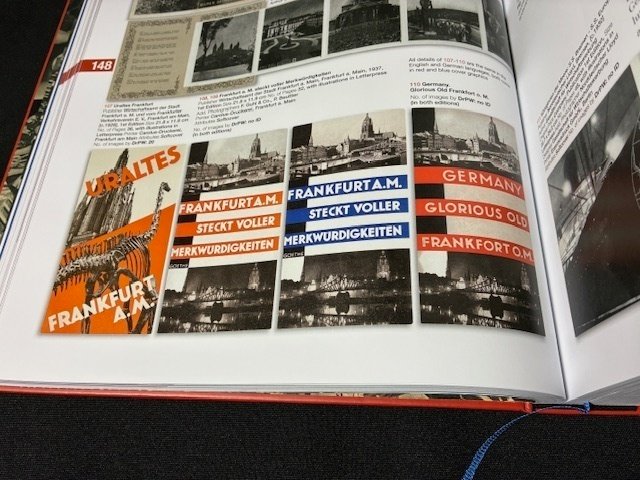
600 (!) PAGES. 2.980 (!) PHOTOS.
BREATH-TAKING BOOK PROJECT AND OBJECT.
New, mint, unread; still originally shrink-wrapped in publisher's plastic foil.
COLLECTOR'S COPY.
"This book presents the publications of Dr. Paul Wolff and Alfred Tritschler, revealing both their extraordinary technical and artistic abilities as well as their successful business acumen. The multifaceted work of Dr. Paul Wolff & Tritschler encompasses industrial reportages, social documentaries, news coverage, sports and leisure photography, advertising campaigns, and promotional films. The volume brings together more than 1,000 well-known photobooks in addition to their extensive magazine contributions, and it highlights Wolff’s pioneering achievements in 35mm Leica photography—both in black-and-white and, for the first time, in color.
Using the photographic publications of Dr. Paul Wolff & Tritschler, this book convincingly shows for the first time how 35mm Leica photography—and the development of color photography—transformed society and the “new” consumer during the Weimar Republic and the “Third Reich,” and what leading role Dr. Paul Wolff & Tritschler played in this process. Their success was closely tied to the rise of visual media and advertising, as well as their misuse for ideological purposes. In the context of their concrete applications—especially in the 1930s—the photographic publications of Dr. Paul Wolff & Tritschler thus take on political significance. By examining for the first time the many publications of this photographic duo both in Germany and abroad, this book becomes the definitive overview of their multifaceted work."
(from the publisher)
5Uhr30.com says MANY THANKS FOR YOUR SUPPORT THIS YEAR -
making our single-seller photobook auctions on Catawiki so successful.
Ecki Heuser & team are wishing ALL THE BEST TO YOU AND YOURS for 2026.
Steidl, Göttingen. 2021. First edition, first printing.
Hardcover (as issued). 266 x 288 mm. 600 pages. 2980 photos. Edited by Manfred Heiting and Kristina Lemke. Text in English and German.
EXHAUSTIVE, HIGHLY IMPRESSIVE COLLECTION of publications by Dr. Paul Wolff and Alfred Tritschler - in perfect condition.
'Paul Wolff (1887-1951) was a German photographer and a pioneer in the field of 35mm photography. In recognition of his photographic achievements as a pioneer of Leica photography, he received the two hundred thousandth Leica from the Ernst Leitz company in 1936.
As a twelve-year-old, he was already enthusiastic about taking photographs with a plate camera. However, after leaving school, he first studied medicine, qualified as a doctor in Strasbourg in 1914, became an assistant doctor and was called up for military service in 1914. After the First World War, he was expelled from Strasbourg, which now belonged to France again, in 1919. He moved to Frankfurt am Main. There he initially worked in the copying plant of a financially weak film company. Using a film camera he had bought himself, he initially began to work on commissions for the film company, but soon became self-employed.
He produced films and photographed the housing estates for the New Frankfurt project. Paul Wolff switched from moving images back to photography. He worked with an 18 × 24 cm plate camera and had plenty of commissions. In 1926, he won his first Leica at the International Photo Exhibition in Frankfurt: it was to have a lasting influence on the rest of his life. Initially, he used the Leica to take "incidental" photos of small, pleasant scenes at markets, in alleyways and along paths after his work with the large-format camera was done. He improved his technique and soon caused a sensation in the magazines with his lively 35mm photos. The dynamic style of the unleashed 35mm camera was born. In 1927, he was looking for the ideal collaborator and found him in his business partner Alfred Tritschler.
The two then founded the company Dr Paul Wolff & Tritschler in Frankfurt am Main. Paul Wolff's breakthrough as a photographer came in 1933, when the Leitz company ordered 100 enlargements in 40 × 60 cm format from him for the exhibition Die Kamera, which subsequently travelled around the world as a touring exhibition. The first edition of Meine Erfahrungen mit der Leica was published in 1934. Translated into four languages, this book became one of the standard works of photography. In the same year, Paul Wolff travelled to what was then the Saar region. On this occasion, he took gripping pictures of people, everyday life, landscapes and industrial plants such as the Völklingen Ironworks. In 1936, Paul Wolff and his colleague Alfred Tritschler photographed the Summer Olympics and subsequently published the book Was ich bei den Olympischen Spielen 1936 sah, which appeared in four languages.
Wolff not only photographed with the Leica, but also continued to use large-format cameras, preferably in 9 × 12 cm format with a Schneider Angulon 120 mm wide-angle lens for outdoor shots.
In 1940, Paul Wolff published the first German industrial photo book in colour. Im Kraftfeld von Rüsselsheim was published with a print run of 55,000 copies; in the same year he published the first edition of Meine Erfahrungen mit der Leica in colour.
In 1944, his house in Frankfurt was destroyed in a bombing raid and large parts of his archive of plate images were destroyed; only the archive of small images, which had been stored away, survived. The Frankfurt Institute for City History preserves an extensive collection of photographs taken between 1927 and 1943 of Frankfurt's historic city centre, which was destroyed in 1944. In 1949-50, he photographed the illustrated book Deutschland - ein Bildband von deutscher Landschaft, ihren Städten, Dörfern und Menschen for the Umschau publishing house, in which Alsfeld is shown, among other places.
After his death, his co-managing director Alfred Tritschler continued to run the Dr Paul Wolff & Tritschler picture archive. In 1963, it was taken over by Alfred Tritschler's nephew, Robert Sommer in Offenburg, who continued to run it successfully and handed it over to his son Thomas Sommer in 1979. Today, the photo archive covers the period from 1927 to 1970 and has a stock of around 500,000 negatives.
Wolff's grave is located in Frankfurt's main cemetery, Gewann II GG 17a.
Paul Wolff's first marriage was to Helene Dörr (1887-1959). Their son Klaus Heinrich Wolff was born in Strasbourg on 1 May 1916 (died 1988). Wolff's second son Stephan Wolff (born 1943) was the result of a second marriage to Annette Beiger (1906-2002).
Wolff had a warm friendship with the designer of the Leica, Oscar Barnack. He was also personally connected to the head of Leitzwerke Ernst Leitz.
in Königstein i. Ts. in 1929 as part of the Blue Books series, quickly achieved several large print runs. With Wolff's project "botanical photographic studies", which he immediately proposed to the publisher Langewiesche in 1929 and which appeared in 1931 under the title Formen des Lebens (Forms of Life), he consciously engaged with the protagonists of New Vision such as Karl Bloßfeldt, Ernst Fuhrmann and Albert Renger-Patzsch. In his book Sonne über See und Strand (Sun over Sea and Beach), he mainly photographed people and created a beautiful contemporary document of fashion in the 1940s. It is interesting to note that the captions are printed in three languages.
Wolff and Tritschler's agency photographs covered a wide range of subjects that catered to mass tastes: from fashion, advertising and still lifes to architectural, industrial and landscape photography, travel reports and sports shots. They used the stylistic devices of New Objectivity, gained experience with the aesthetics of National Socialism and documented bombed-out Frankfurt from a distance.'
(Wikipedia)
Der Verkäufer stellt sich vor
welcome to 5uhr30.
5Uhr30 is based in ehrenfeld, the trendiest neighborhood in cologne - with a shop and with a showroom for photography.
5Uhr30 offers very rare, very beautiful, very special photobooks - sold-out, modern-antiquarian and antiquarian. we are offering also photo inviation cards, film- and photo posters, photo catalogues and original photo prints.
5Uhr30 is specialized on german photo publications,
but also has an exciting range of photo books from all over europe, japan, north and south america. travel brochures, children's books, company brochures...everything that has to do with photography in the narrower or broader sense inspires us. please visit us, if you are in cologne or the surrounding area. You will not regret it! :)
5Uhr30 always tries to offer the best condition.
5Uhr30 is shipping worldwide, fast and safe -
with 100% protection, with full insurance and with tracking number.
please contact us by email, if you have any questions or if you are looking for something special, cause only a part of our offers are online.
thanks for your interest.
ecki heuser and team
THIS IS THE LAST EXCLUSIVE PHOTOBOOK AUCTION by 5Uhr30.com in 2025 -
with more than 100 great lots from my personal collection and from recent acquisitions.
GREAT OPPORTUNITY to purchase this FANTASTIC BOOK, showing all the publications by German Dr. Paul Wolff and Alfred Tritschler between 1906 and 2019 - in BRANDNEW CONDITION.
MUST-HAVE SECONDARY LITERATURE BOOK ABOUT PHOTOBOOKS:
Daniel Blaize, Anatole Desachy, Jean-Marie Donat, "The book of books on photobooks", pages 336-339.
Like always 5Uhr30.com guarantees detailed and accurate descriptions, 100% transport protection, 100% transport insurance, and of course, combined shipping - worldwide.
600 (!) PAGES. 2.980 (!) PHOTOS.
BREATH-TAKING BOOK PROJECT AND OBJECT.
New, mint, unread; still originally shrink-wrapped in publisher's plastic foil.
COLLECTOR'S COPY.
"This book presents the publications of Dr. Paul Wolff and Alfred Tritschler, revealing both their extraordinary technical and artistic abilities as well as their successful business acumen. The multifaceted work of Dr. Paul Wolff & Tritschler encompasses industrial reportages, social documentaries, news coverage, sports and leisure photography, advertising campaigns, and promotional films. The volume brings together more than 1,000 well-known photobooks in addition to their extensive magazine contributions, and it highlights Wolff’s pioneering achievements in 35mm Leica photography—both in black-and-white and, for the first time, in color.
Using the photographic publications of Dr. Paul Wolff & Tritschler, this book convincingly shows for the first time how 35mm Leica photography—and the development of color photography—transformed society and the “new” consumer during the Weimar Republic and the “Third Reich,” and what leading role Dr. Paul Wolff & Tritschler played in this process. Their success was closely tied to the rise of visual media and advertising, as well as their misuse for ideological purposes. In the context of their concrete applications—especially in the 1930s—the photographic publications of Dr. Paul Wolff & Tritschler thus take on political significance. By examining for the first time the many publications of this photographic duo both in Germany and abroad, this book becomes the definitive overview of their multifaceted work."
(from the publisher)
5Uhr30.com says MANY THANKS FOR YOUR SUPPORT THIS YEAR -
making our single-seller photobook auctions on Catawiki so successful.
Ecki Heuser & team are wishing ALL THE BEST TO YOU AND YOURS for 2026.
Steidl, Göttingen. 2021. First edition, first printing.
Hardcover (as issued). 266 x 288 mm. 600 pages. 2980 photos. Edited by Manfred Heiting and Kristina Lemke. Text in English and German.
EXHAUSTIVE, HIGHLY IMPRESSIVE COLLECTION of publications by Dr. Paul Wolff and Alfred Tritschler - in perfect condition.
'Paul Wolff (1887-1951) was a German photographer and a pioneer in the field of 35mm photography. In recognition of his photographic achievements as a pioneer of Leica photography, he received the two hundred thousandth Leica from the Ernst Leitz company in 1936.
As a twelve-year-old, he was already enthusiastic about taking photographs with a plate camera. However, after leaving school, he first studied medicine, qualified as a doctor in Strasbourg in 1914, became an assistant doctor and was called up for military service in 1914. After the First World War, he was expelled from Strasbourg, which now belonged to France again, in 1919. He moved to Frankfurt am Main. There he initially worked in the copying plant of a financially weak film company. Using a film camera he had bought himself, he initially began to work on commissions for the film company, but soon became self-employed.
He produced films and photographed the housing estates for the New Frankfurt project. Paul Wolff switched from moving images back to photography. He worked with an 18 × 24 cm plate camera and had plenty of commissions. In 1926, he won his first Leica at the International Photo Exhibition in Frankfurt: it was to have a lasting influence on the rest of his life. Initially, he used the Leica to take "incidental" photos of small, pleasant scenes at markets, in alleyways and along paths after his work with the large-format camera was done. He improved his technique and soon caused a sensation in the magazines with his lively 35mm photos. The dynamic style of the unleashed 35mm camera was born. In 1927, he was looking for the ideal collaborator and found him in his business partner Alfred Tritschler.
The two then founded the company Dr Paul Wolff & Tritschler in Frankfurt am Main. Paul Wolff's breakthrough as a photographer came in 1933, when the Leitz company ordered 100 enlargements in 40 × 60 cm format from him for the exhibition Die Kamera, which subsequently travelled around the world as a touring exhibition. The first edition of Meine Erfahrungen mit der Leica was published in 1934. Translated into four languages, this book became one of the standard works of photography. In the same year, Paul Wolff travelled to what was then the Saar region. On this occasion, he took gripping pictures of people, everyday life, landscapes and industrial plants such as the Völklingen Ironworks. In 1936, Paul Wolff and his colleague Alfred Tritschler photographed the Summer Olympics and subsequently published the book Was ich bei den Olympischen Spielen 1936 sah, which appeared in four languages.
Wolff not only photographed with the Leica, but also continued to use large-format cameras, preferably in 9 × 12 cm format with a Schneider Angulon 120 mm wide-angle lens for outdoor shots.
In 1940, Paul Wolff published the first German industrial photo book in colour. Im Kraftfeld von Rüsselsheim was published with a print run of 55,000 copies; in the same year he published the first edition of Meine Erfahrungen mit der Leica in colour.
In 1944, his house in Frankfurt was destroyed in a bombing raid and large parts of his archive of plate images were destroyed; only the archive of small images, which had been stored away, survived. The Frankfurt Institute for City History preserves an extensive collection of photographs taken between 1927 and 1943 of Frankfurt's historic city centre, which was destroyed in 1944. In 1949-50, he photographed the illustrated book Deutschland - ein Bildband von deutscher Landschaft, ihren Städten, Dörfern und Menschen for the Umschau publishing house, in which Alsfeld is shown, among other places.
After his death, his co-managing director Alfred Tritschler continued to run the Dr Paul Wolff & Tritschler picture archive. In 1963, it was taken over by Alfred Tritschler's nephew, Robert Sommer in Offenburg, who continued to run it successfully and handed it over to his son Thomas Sommer in 1979. Today, the photo archive covers the period from 1927 to 1970 and has a stock of around 500,000 negatives.
Wolff's grave is located in Frankfurt's main cemetery, Gewann II GG 17a.
Paul Wolff's first marriage was to Helene Dörr (1887-1959). Their son Klaus Heinrich Wolff was born in Strasbourg on 1 May 1916 (died 1988). Wolff's second son Stephan Wolff (born 1943) was the result of a second marriage to Annette Beiger (1906-2002).
Wolff had a warm friendship with the designer of the Leica, Oscar Barnack. He was also personally connected to the head of Leitzwerke Ernst Leitz.
in Königstein i. Ts. in 1929 as part of the Blue Books series, quickly achieved several large print runs. With Wolff's project "botanical photographic studies", which he immediately proposed to the publisher Langewiesche in 1929 and which appeared in 1931 under the title Formen des Lebens (Forms of Life), he consciously engaged with the protagonists of New Vision such as Karl Bloßfeldt, Ernst Fuhrmann and Albert Renger-Patzsch. In his book Sonne über See und Strand (Sun over Sea and Beach), he mainly photographed people and created a beautiful contemporary document of fashion in the 1940s. It is interesting to note that the captions are printed in three languages.
Wolff and Tritschler's agency photographs covered a wide range of subjects that catered to mass tastes: from fashion, advertising and still lifes to architectural, industrial and landscape photography, travel reports and sports shots. They used the stylistic devices of New Objectivity, gained experience with the aesthetics of National Socialism and documented bombed-out Frankfurt from a distance.'
(Wikipedia)
Der Verkäufer stellt sich vor
welcome to 5uhr30.
5Uhr30 is based in ehrenfeld, the trendiest neighborhood in cologne - with a shop and with a showroom for photography.
5Uhr30 offers very rare, very beautiful, very special photobooks - sold-out, modern-antiquarian and antiquarian. we are offering also photo inviation cards, film- and photo posters, photo catalogues and original photo prints.
5Uhr30 is specialized on german photo publications,
but also has an exciting range of photo books from all over europe, japan, north and south america. travel brochures, children's books, company brochures...everything that has to do with photography in the narrower or broader sense inspires us. please visit us, if you are in cologne or the surrounding area. You will not regret it! :)
5Uhr30 always tries to offer the best condition.
5Uhr30 is shipping worldwide, fast and safe -
with 100% protection, with full insurance and with tracking number.
please contact us by email, if you have any questions or if you are looking for something special, cause only a part of our offers are online.
thanks for your interest.
ecki heuser and team
Details
Anzahl der Bücher
1
Thema
Fotografie, Kunst
Buchtitel
The Printed Images 1906-2019 (BOOK ON PHOTOBOOKS, MINT CONDITION)
Autor/ Illustrator
Dr. Paul Wolff & Alfred Tritschler
Zustand
Wie neu
Erscheinungsjahr (ältestes Objekt)
2021
Höhe
288 mm
Auflage
Erstauflage
Breite
266 mm
Sprache
Deutsch, Englisch
Originalsprache
Ja
Verlag
Steidl, Göttingen
Bindung
Gebundene Ausgabe
Anzahl der Seiten
600
Verkauft von
DeutschlandVerifiziert
protop
Rechtliche Informationen des Verkäufers
- Unternehmen:
- 5Uhr30.com
- Repräsentant:
- Ecki Heuser
- Adresse:
- 5Uhr30.com
Thebäerstr. 34
50823 Köln
GERMANY - Telefonnummer:
- +491728184000
- Email:
- photobooks@5Uhr30.com
- USt-IdNr.:
- DE154811593
AGB
AGB des Verkäufers. Mit einem Gebot auf dieses Los akzeptieren Sie ebenfalls die AGB des Verkäufers.
Widerrufsbelehrung
- Frist: 14 Tage sowie gemäß den hier angegebenen Bedingungen
- Rücksendkosten: Käufer trägt die unmittelbaren Kosten der Rücksendung der Ware
- Vollständige Widerrufsbelehrung