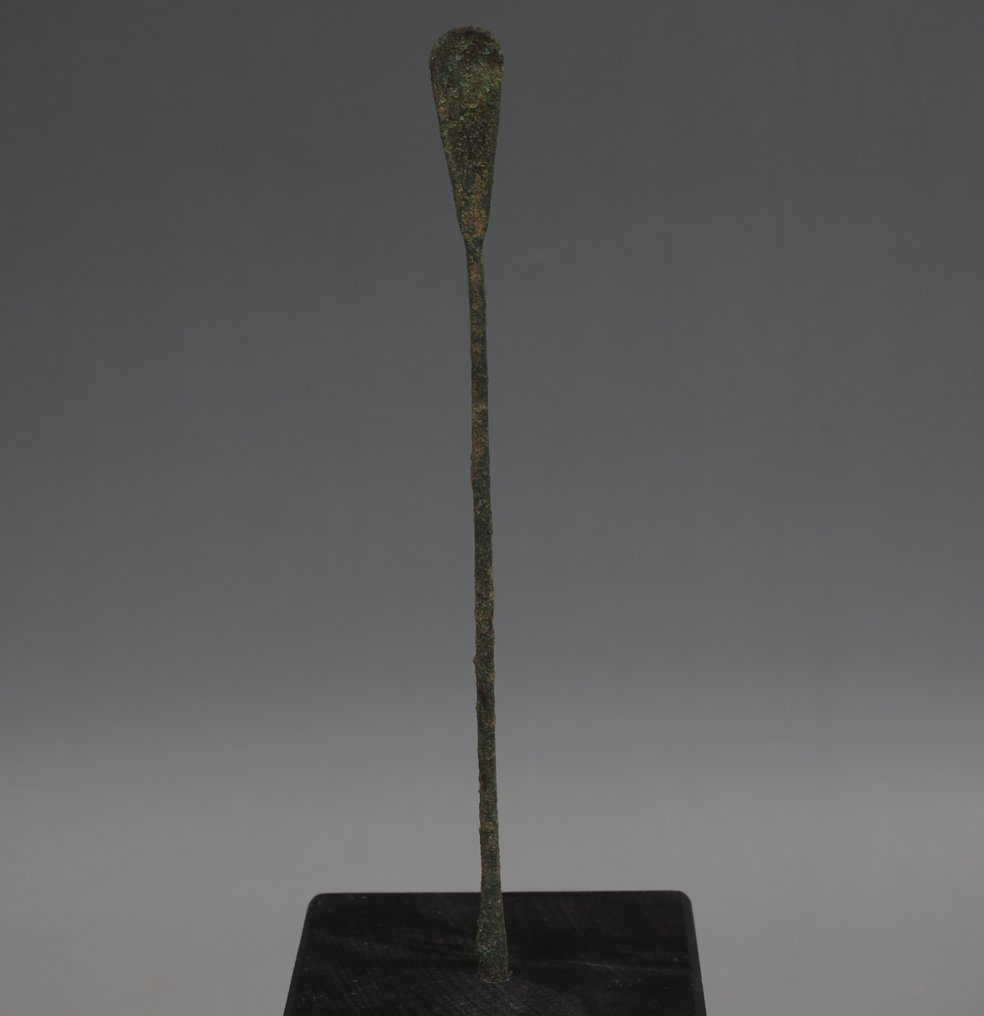
Römisches Reich Bronze Medizinisches Instrument, Spatel, Ex MUSEUM (Ohne Mindestpreis)


01
Tag
23
Stunden
48
Minuten
29
Sekunden
Aktuelles Gebot
€ 25
Ohne Mindestpreis

Experte
Von Ruth Garrido Vila ausgewählt
Leitete das Ifergan Collection Museum, spezialisiert auf phönizische Archäologie.
Schätzung € 150 - € 200
21 andere Benutzer beobachten dieses Objekt
 Bieter 2578 Bieter 2578 | 25 € | |
|---|---|---|
 Bieter 1040 Bieter 1040 | 20 € | |
| Bieter 2578 | 15 € | |
Käuferschutz auf Catawiki
Ihre Zahlung wird von uns sicher verwahrt, bis Sie Ihr Objekt erhalten.Details ansehen
Trustpilot 4.4 | 121899 Bewertungen
Auf Trustpilot als hervorragend bewertet.
Diese römische Bronze Spatel aus dem 1. bis 3. Jahrhundert n. Chr. zeigt authentische antike medizinische Handwerkskunst mit Museum Provenienz.
KI-gestützte Zusammenfassung
Vom Verkäufer bereitgestellte Beschreibung
ITEM: Medical instrument, Spatula
MATERIAL: Bronze
CULTURE: Roman
PERIOD: 1st - 3rd Century A.D
DIMENSIONS: 140 mm x 10 mm
CONDITION: Good condition
PROVENANCE: Ex Museum für Asiatische Kunst, Ex Galerie Hardt, Germany, acquired between 1970 - 2010
Roman bronze medical instruments, meticulously fashioned with skill and care, epitomize the sophistication of ancient healthcare. These robust implements, encompassing scalpels, forceps, and probes, manifest the Romans’ dedication to surgical precision and patient well-being. These tools played pivotal roles in an array of medical procedures, from intricate surgeries to wound management, underscoring the Romans’ unwavering commitment to the practice and science of healing. In contemporary times, these relics remain enduring symbols of the enduring influence of Roman medicine and surgical prowess.
The Spatula probe consists of a long thin handle and tends to range in size from roughly 6 to 15 centimetres with a spatula on one end of its handle and an olivary probe on its other end, indicating its multifunctionality. The spatula is usually leaf-shaped and tends to be flat on one side and slightly rounded on the other. Some spatula ends are quite thin, perhaps five or six millimetres in width, whilst others are short and blunt. Some have more of a rectangular shape to them and others have a spatulat blade on both ends. It could be used for spreading medicaments on infected areas of the body as well as mixing medicines on an ointment pallet. Sometimes the spatula could be used as a cautery, as Soranus mentions using it on the umbilical cord (Gyn 3. 27, Milne 1907: 60). It could also be used as a tongue depressor and as a blunt dissector (Milne 1907: 59-60). The olivary end could be used in the same way as many already suggested for the double-ended olivary probe.
Comes with Certificate of Authenticity and Export license
If you bid outside the European Union and win the item, we will have to apply for an export licence for your country and shipping will take 3 to 5 weeks.
The Seller can prove that the lot was obtained legally , provenance statement seen by Catawiki.
Der Verkäufer stellt sich vor
Ihr Antiquar bietet antike Kunst und antike Münzen. Unser Hauptziel ist es, höchste Qualität zum besten Preis anzubieten und dabei die Gesetze zum Schutz des kulturellen Erbes und die Normen des UNESCO-Weltkulturerbes zu respektieren und strikt einzuhalten. Daher stammen alle veröffentlichten Stücke aus Privatsammlungen, in denen die Provenienz überprüft werden kann, oder aus internationalen Auktionen. Allen unseren Antiquitäten und Münzen liegt ein Echtheitszertifikat bei. Wir haben ein uneingeschränktes 90-tägiges Rückgaberecht. Bei Your Antiquarian engagieren wir uns dafür, benachteiligten Gruppen zu helfen. Aus diesem Grund wird ein Teil jedes Kaufs an Wohltätigkeitsorganisationen gespendet, um Menschen in Not zu helfen.
Übersetzt mit Google ÜbersetzerITEM: Medical instrument, Spatula
MATERIAL: Bronze
CULTURE: Roman
PERIOD: 1st - 3rd Century A.D
DIMENSIONS: 140 mm x 10 mm
CONDITION: Good condition
PROVENANCE: Ex Museum für Asiatische Kunst, Ex Galerie Hardt, Germany, acquired between 1970 - 2010
Roman bronze medical instruments, meticulously fashioned with skill and care, epitomize the sophistication of ancient healthcare. These robust implements, encompassing scalpels, forceps, and probes, manifest the Romans’ dedication to surgical precision and patient well-being. These tools played pivotal roles in an array of medical procedures, from intricate surgeries to wound management, underscoring the Romans’ unwavering commitment to the practice and science of healing. In contemporary times, these relics remain enduring symbols of the enduring influence of Roman medicine and surgical prowess.
The Spatula probe consists of a long thin handle and tends to range in size from roughly 6 to 15 centimetres with a spatula on one end of its handle and an olivary probe on its other end, indicating its multifunctionality. The spatula is usually leaf-shaped and tends to be flat on one side and slightly rounded on the other. Some spatula ends are quite thin, perhaps five or six millimetres in width, whilst others are short and blunt. Some have more of a rectangular shape to them and others have a spatulat blade on both ends. It could be used for spreading medicaments on infected areas of the body as well as mixing medicines on an ointment pallet. Sometimes the spatula could be used as a cautery, as Soranus mentions using it on the umbilical cord (Gyn 3. 27, Milne 1907: 60). It could also be used as a tongue depressor and as a blunt dissector (Milne 1907: 59-60). The olivary end could be used in the same way as many already suggested for the double-ended olivary probe.
Comes with Certificate of Authenticity and Export license
If you bid outside the European Union and win the item, we will have to apply for an export licence for your country and shipping will take 3 to 5 weeks.
The Seller can prove that the lot was obtained legally , provenance statement seen by Catawiki.
Der Verkäufer stellt sich vor
Ihr Antiquar bietet antike Kunst und antike Münzen. Unser Hauptziel ist es, höchste Qualität zum besten Preis anzubieten und dabei die Gesetze zum Schutz des kulturellen Erbes und die Normen des UNESCO-Weltkulturerbes zu respektieren und strikt einzuhalten. Daher stammen alle veröffentlichten Stücke aus Privatsammlungen, in denen die Provenienz überprüft werden kann, oder aus internationalen Auktionen. Allen unseren Antiquitäten und Münzen liegt ein Echtheitszertifikat bei. Wir haben ein uneingeschränktes 90-tägiges Rückgaberecht. Bei Your Antiquarian engagieren wir uns dafür, benachteiligten Gruppen zu helfen. Aus diesem Grund wird ein Teil jedes Kaufs an Wohltätigkeitsorganisationen gespendet, um Menschen in Not zu helfen.
Übersetzt mit Google ÜbersetzerDetails
Kultur
Römisches Reich
Jahrhundert/ Zeitraum
1st - 3rd Century A.D
Name of object
Medical instrument, Spatula, Ex MUSEUM
Erworben von
Privatsammlung
Jahr des Erwerbs
2025
Material
Bronze
Erwerbsland
Österreich
Zustand
Gut
Vorbesitzer erworben von
Antikmarkt
Vorbesitzer – Jahr des Erwerbs
1976
Vorbesitzer – Erwerbsland
Deutschland
Ich bestätige, dass ich dieses Objekt legal erworben habe und berechtigt bin, es zu verkaufen.
Ja
Verkauft von
Disclaimer
Der Verkäufer wurde von Catawiki über die Anforderungen an die Dokumentation informiert und garantiert Folgendes: - Das Objekt wurde rechtmäßig erworben. - Der Verkäufer hat das Recht, das Objekt zu verkaufen und/oder zu exportieren (sofern zutreffend). - Der Verkäufer wird die erforderlichen Herkunftsinformationen bereitstellen und die notwendigen Dokumente sowie Genehmigungen bzw. Lizenzen besorgen (soweit zutreffend und gemäß den örtlichen Gesetzen geboten). - Der Verkäufer wird den Käufer über etwaige Verzögerungen bei der Erlangung von Genehmigungen bzw. Lizenzen informieren. Mit der Abgabe eines Gebots erkennen Sie an, dass je nach Ihrem Wohnsitzland Importdokumente erforderlich sein können und die Beschaffung von Genehmigungen bzw. Lizenzen zu Verzögerungen bei der Lieferung Ihres Objekts führen kann.
Der Verkäufer wurde von Catawiki über die Anforderungen an die Dokumentation informiert und garantiert Folgendes: - Das Objekt wurde rechtmäßig erworben. - Der Verkäufer hat das Recht, das Objekt zu verkaufen und/oder zu exportieren (sofern zutreffend). - Der Verkäufer wird die erforderlichen Herkunftsinformationen bereitstellen und die notwendigen Dokumente sowie Genehmigungen bzw. Lizenzen besorgen (soweit zutreffend und gemäß den örtlichen Gesetzen geboten). - Der Verkäufer wird den Käufer über etwaige Verzögerungen bei der Erlangung von Genehmigungen bzw. Lizenzen informieren. Mit der Abgabe eines Gebots erkennen Sie an, dass je nach Ihrem Wohnsitzland Importdokumente erforderlich sein können und die Beschaffung von Genehmigungen bzw. Lizenzen zu Verzögerungen bei der Lieferung Ihres Objekts führen kann.
