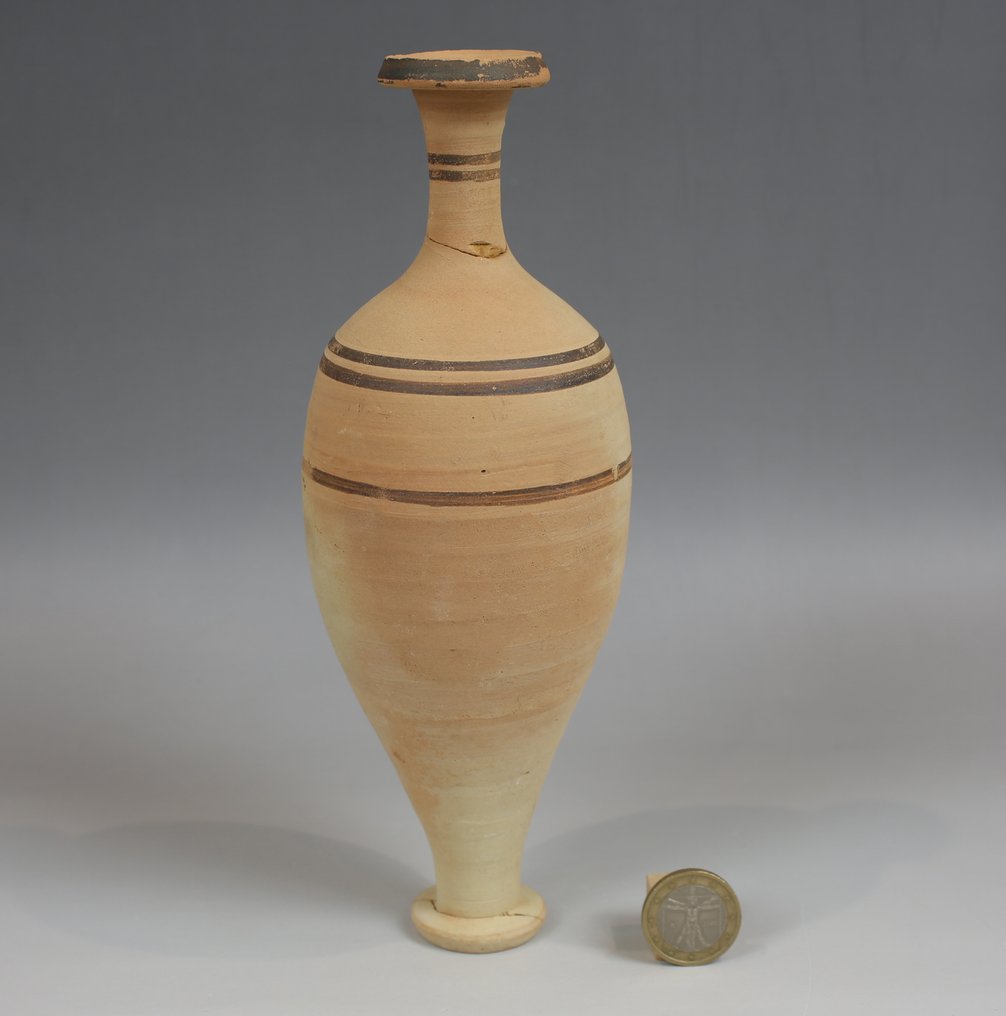
Altgriechisch Töpferware Unguentarium, RIESIG (Ohne Mindestpreis)



01
Tag
14
Stunden
35
Minuten
03
Sekunden
Aktuelles Gebot
€ 170
Ohne Mindestpreis

Experte
Von Ruth Garrido Vila ausgewählt
Leitete das Ifergan Collection Museum, spezialisiert auf phönizische Archäologie.
Schätzung € 400 - € 500
25 andere Benutzer beobachten dieses Objekt
 Bieter 5405 Bieter 5405 | 170 € | |
|---|---|---|
 Bieter 6655 Bieter 6655 | 160 € | |
| Bieter 5405 | 150 € | |
Käuferschutz auf Catawiki
Ihre Zahlung wird von uns sicher verwahrt, bis Sie Ihr Objekt erhalten.Details ansehen
Trustpilot 4.4 | 121899 Bewertungen
Auf Trustpilot als hervorragend bewertet.
Hellenistische Tonware Unguentarium aus griechischer Kultur, 3. Jh. v. Chr., 206 mm × 77 mm, in gutem Zustand mit Reparaturen, Herkunft Ex Deutsche Private Collection (F.B.), erworben in europäischen Antiquitätenauktionen zwischen 2000–2009, mit Echtheitszertifikat und EU-Ausfuhrgenehmigung.
KI-gestützte Zusammenfassung
Vom Verkäufer bereitgestellte Beschreibung
ITEM: Unguentarium
MATERIAL: Pottery
CULTURE: Greek
PERIOD: 3rd Century B.C
DIMENSIONS: 206 mm x 77 mm
CONDITION: Good condition, repaired
PROVENANCE: Ex German private collection, F.B., acquired in European antiquities auctions between 2000 - 2009.
Hellenistic pottery refers to ceramic artifacts produced during the Hellenistic period, which spanned from the death of Alexander the Great in 323 BCE to the emergence of the Roman Empire in the 1st century BCE. This era witnessed a remarkable fusion of artistic influences from the Greek world, the Near East, and Egypt, leading to a diverse range of pottery styles and forms. Hellenistic pottery was characterized by its innovation and experimentation, often departing from the classical Greek aesthetics. Common decorative motifs included intricate painted designs, such as floral patterns, mythological scenes, and genre scenes, which reflected the eclectic nature of the period. Hellenistic pottery was also known for its production of utilitarian wares, such as cooking vessels, storage containers, and tableware, which were created in various shapes and sizes to meet the diverse needs of the time. The Hellenistic period's pottery not only served practical purposes but also acted as a canvas for artistic expression and cultural exchange.
One of the most notable developments in Hellenistic pottery was the emergence of three distinct regional styles: the Hellenistic Greek style, which retained some elements of classical Greek pottery but incorporated new elements; the Eastern Mediterranean style, heavily influenced by the rich artistic traditions of the Near East and Persia; and the Egyptian style, characterized by its colorful and intricate decoration.
Comes with Certificate of Authenticity and European Union export license
If you bid outside European Union and win the item, we must request a new export license to your country and the shipment will delay between 3 - 5 weeks
Der Verkäufer stellt sich vor
Ihr Antiquar bietet antike Kunst und antike Münzen. Unser Hauptziel ist es, höchste Qualität zum besten Preis anzubieten und dabei die Gesetze zum Schutz des kulturellen Erbes und die Normen des UNESCO-Weltkulturerbes zu respektieren und strikt einzuhalten. Daher stammen alle veröffentlichten Stücke aus Privatsammlungen, in denen die Provenienz überprüft werden kann, oder aus internationalen Auktionen. Allen unseren Antiquitäten und Münzen liegt ein Echtheitszertifikat bei. Wir haben ein uneingeschränktes 90-tägiges Rückgaberecht. Bei Your Antiquarian engagieren wir uns dafür, benachteiligten Gruppen zu helfen. Aus diesem Grund wird ein Teil jedes Kaufs an Wohltätigkeitsorganisationen gespendet, um Menschen in Not zu helfen.
Übersetzt mit Google ÜbersetzerITEM: Unguentarium
MATERIAL: Pottery
CULTURE: Greek
PERIOD: 3rd Century B.C
DIMENSIONS: 206 mm x 77 mm
CONDITION: Good condition, repaired
PROVENANCE: Ex German private collection, F.B., acquired in European antiquities auctions between 2000 - 2009.
Hellenistic pottery refers to ceramic artifacts produced during the Hellenistic period, which spanned from the death of Alexander the Great in 323 BCE to the emergence of the Roman Empire in the 1st century BCE. This era witnessed a remarkable fusion of artistic influences from the Greek world, the Near East, and Egypt, leading to a diverse range of pottery styles and forms. Hellenistic pottery was characterized by its innovation and experimentation, often departing from the classical Greek aesthetics. Common decorative motifs included intricate painted designs, such as floral patterns, mythological scenes, and genre scenes, which reflected the eclectic nature of the period. Hellenistic pottery was also known for its production of utilitarian wares, such as cooking vessels, storage containers, and tableware, which were created in various shapes and sizes to meet the diverse needs of the time. The Hellenistic period's pottery not only served practical purposes but also acted as a canvas for artistic expression and cultural exchange.
One of the most notable developments in Hellenistic pottery was the emergence of three distinct regional styles: the Hellenistic Greek style, which retained some elements of classical Greek pottery but incorporated new elements; the Eastern Mediterranean style, heavily influenced by the rich artistic traditions of the Near East and Persia; and the Egyptian style, characterized by its colorful and intricate decoration.
Comes with Certificate of Authenticity and European Union export license
If you bid outside European Union and win the item, we must request a new export license to your country and the shipment will delay between 3 - 5 weeks
Der Verkäufer stellt sich vor
Ihr Antiquar bietet antike Kunst und antike Münzen. Unser Hauptziel ist es, höchste Qualität zum besten Preis anzubieten und dabei die Gesetze zum Schutz des kulturellen Erbes und die Normen des UNESCO-Weltkulturerbes zu respektieren und strikt einzuhalten. Daher stammen alle veröffentlichten Stücke aus Privatsammlungen, in denen die Provenienz überprüft werden kann, oder aus internationalen Auktionen. Allen unseren Antiquitäten und Münzen liegt ein Echtheitszertifikat bei. Wir haben ein uneingeschränktes 90-tägiges Rückgaberecht. Bei Your Antiquarian engagieren wir uns dafür, benachteiligten Gruppen zu helfen. Aus diesem Grund wird ein Teil jedes Kaufs an Wohltätigkeitsorganisationen gespendet, um Menschen in Not zu helfen.
Übersetzt mit Google ÜbersetzerDetails
Kultur
Altgriechisch
Jahrhundert/ Zeitraum
3rd Century B.C
Name of object
HUGE, Unguentarium
Erworben von
Privatsammlung
Jahr des Erwerbs
2025
Material
Töpferware
Erwerbsland
Deutschland
Zustand
Gut
Vorbesitzer erworben von
Antikmarkt
Vorbesitzer – Jahr des Erwerbs
1980
Vorbesitzer – Erwerbsland
Deutschland
Ich bestätige, dass ich dieses Objekt legal erworben habe und berechtigt bin, es zu verkaufen.
Ja
Verkauft von
Disclaimer
Der Verkäufer wurde von Catawiki über die Anforderungen an die Dokumentation informiert und garantiert Folgendes: - Das Objekt wurde rechtmäßig erworben. - Der Verkäufer hat das Recht, das Objekt zu verkaufen und/oder zu exportieren (sofern zutreffend). - Der Verkäufer wird die erforderlichen Herkunftsinformationen bereitstellen und die notwendigen Dokumente sowie Genehmigungen bzw. Lizenzen besorgen (soweit zutreffend und gemäß den örtlichen Gesetzen geboten). - Der Verkäufer wird den Käufer über etwaige Verzögerungen bei der Erlangung von Genehmigungen bzw. Lizenzen informieren. Mit der Abgabe eines Gebots erkennen Sie an, dass je nach Ihrem Wohnsitzland Importdokumente erforderlich sein können und die Beschaffung von Genehmigungen bzw. Lizenzen zu Verzögerungen bei der Lieferung Ihres Objekts führen kann.
Der Verkäufer wurde von Catawiki über die Anforderungen an die Dokumentation informiert und garantiert Folgendes: - Das Objekt wurde rechtmäßig erworben. - Der Verkäufer hat das Recht, das Objekt zu verkaufen und/oder zu exportieren (sofern zutreffend). - Der Verkäufer wird die erforderlichen Herkunftsinformationen bereitstellen und die notwendigen Dokumente sowie Genehmigungen bzw. Lizenzen besorgen (soweit zutreffend und gemäß den örtlichen Gesetzen geboten). - Der Verkäufer wird den Käufer über etwaige Verzögerungen bei der Erlangung von Genehmigungen bzw. Lizenzen informieren. Mit der Abgabe eines Gebots erkennen Sie an, dass je nach Ihrem Wohnsitzland Importdokumente erforderlich sein können und die Beschaffung von Genehmigungen bzw. Lizenzen zu Verzögerungen bei der Lieferung Ihres Objekts führen kann.
