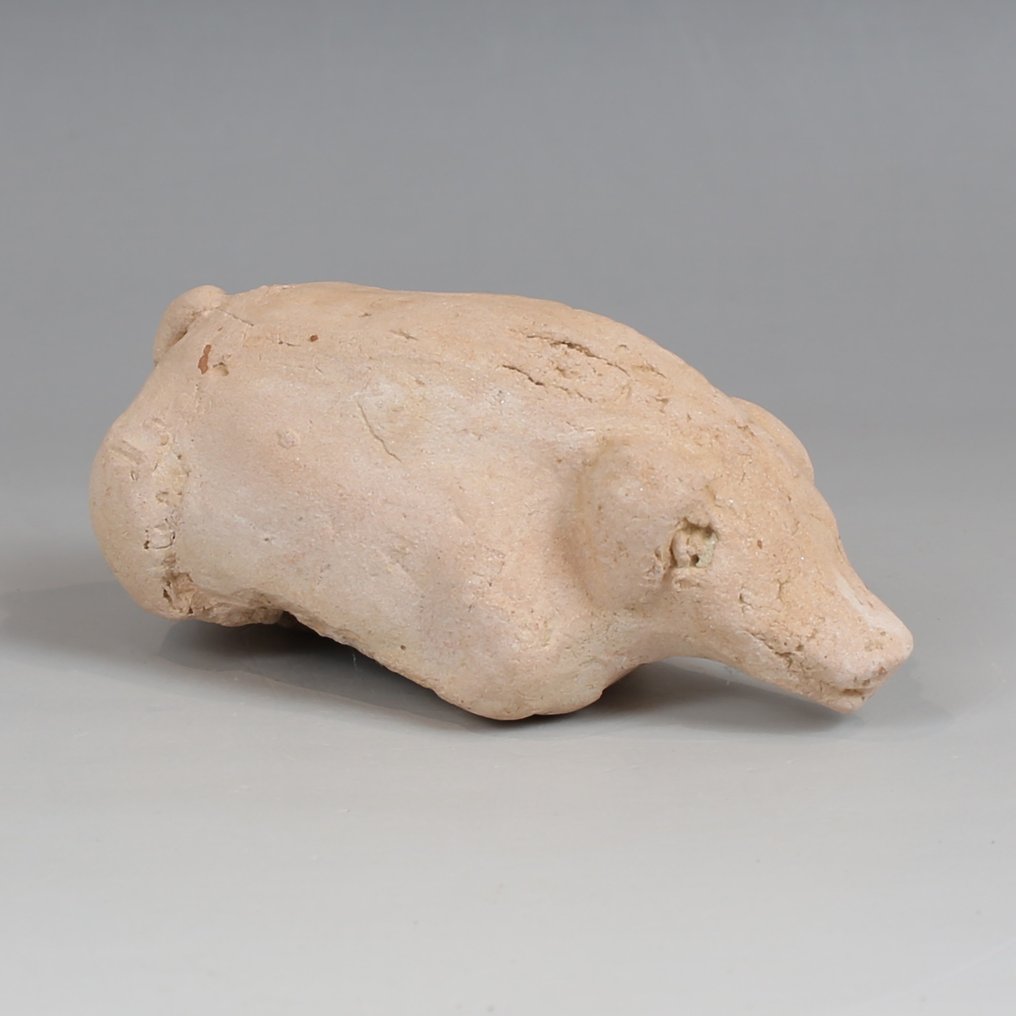
Altchinesisch- Tang-Dynastie Töpferware Statuette eines Schweinchens (Ohne Mindestpreis)


01
Tag
15
Stunden
31
Minuten
35
Sekunden
Aktuelles Gebot
€ 35
Ohne Mindestpreis

Experte
Von Ruth Garrido Vila ausgewählt
Leitete das Ifergan Collection Museum, spezialisiert auf phönizische Archäologie.
Schätzung € 330 - € 400
14 andere Benutzer beobachten dieses Objekt
 Bieter 3578 Bieter 3578 | 35 € | |
|---|---|---|
 Bieter 3735 Bieter 3735 | 30 € | |
| Bieter 3578 | 30 € | |
Käuferschutz auf Catawiki
Ihre Zahlung wird von uns sicher verwahrt, bis Sie Ihr Objekt erhalten.Details ansehen
Trustpilot 4.4 | 121899 Bewertungen
Auf Trustpilot als hervorragend bewertet.
Statuette eines Schweinchens, chinesische Tonfigur aus der Tang-Dynastie (45 mm × 45 mm × 94 mm), 2025 aus einer deutschen Privatsammlung erworben, guter Zustand, mit Echtheitszertifikat und EU-Ausfuhrgenehmigung.
KI-gestützte Zusammenfassung
Vom Verkäufer bereitgestellte Beschreibung
ITEM: Statuette of a piggy
MATERIAL: Pottery
CULTURE: Chinese
PERIOD: Tang dynasty, 618 - 907 A.D
DIMENSIONS: 45 mm x 45 mm x 94 mm
CONDITION: Good condition
PROVENANCE: Ex German private collection, F.B., acquired in European antiquities auctions between 2000 - 2009.
Comes with Certificate of Authenticity and European Union export license
If you bid outside European Union and win the item, we must request a new export license to your country and the shipment will delay between 3 - 5 weeks.
The Tang Dynasty (618–907 CE) succeeded the brief Sui Dynasty and is universally regarded as a Golden Age and a zenith of Chinese civilization, characterized by extraordinary political stability, economic prosperity, and cultural flourishing. Founded by Emperor Gaozu and solidified by his son, Emperor Taizong, the Tang state successfully refined the centralized bureaucracy and legal code inherited from the Sui, establishing a powerful and efficient government that would serve as a model for subsequent dynasties. The capital, Chang’an (modern Xi'an) , became the largest and most cosmopolitan city in the world, a vibrant hub of international exchange where merchants, clerics, and envoys from Central Asia, Persia, India, and Japan mingled freely.
The Tang era is best known for an unparalleled bloom in arts and literature. It is considered the classical age of Chinese poetry, producing masters like Li Bai and Du Fu, whose approximately 50,000 surviving works captured both the courtly splendor and the hardships of the time. The dynasty also saw significant technological advancements, including the widespread adoption of woodblock printing, which facilitated greater literacy and the circulation of texts, including the world's oldest dated complete printed book, the Diamond Sutra (868 CE). Other innovations, such as the initial development of gunpowder (initially for fireworks) and sophisticated clockwork mechanisms, cemented China's position as a technological leader.
The dynasty reached its territorial and cultural height under Emperor Xuanzong in the early 8th century, a period of peace and prosperity that was famously interrupted by the An Lushan Rebellion (755–763 CE). This devastating civil war severely weakened the central government, leading to the rise of powerful, semi-autonomous regional military governors (jiedushi). Although the Tang was restored, the dynasty never fully recovered its former power. The ensuing decline saw the increasing influence of court eunuchs and a series of rebellions, culminating in its final collapse in 907 CE. Despite its eventual end, the Tang left an enduring legacy, profoundly shaping the legal, administrative, and cultural norms of East Asia, including Japan and Korea.
Catawiki disclaimer: This piece has been dated based on style by the seller . No further tests, such as, a TL test, analysis of metals(XRF-test), lapidary tests, analysis of pigments or radiography scans have been conducted to check the integrity of the piece.
Der Verkäufer stellt sich vor
Ihr Antiquar bietet antike Kunst und antike Münzen. Unser Hauptziel ist es, höchste Qualität zum besten Preis anzubieten und dabei die Gesetze zum Schutz des kulturellen Erbes und die Normen des UNESCO-Weltkulturerbes zu respektieren und strikt einzuhalten. Daher stammen alle veröffentlichten Stücke aus Privatsammlungen, in denen die Provenienz überprüft werden kann, oder aus internationalen Auktionen. Allen unseren Antiquitäten und Münzen liegt ein Echtheitszertifikat bei. Wir haben ein uneingeschränktes 90-tägiges Rückgaberecht. Bei Your Antiquarian engagieren wir uns dafür, benachteiligten Gruppen zu helfen. Aus diesem Grund wird ein Teil jedes Kaufs an Wohltätigkeitsorganisationen gespendet, um Menschen in Not zu helfen.
Übersetzt mit Google ÜbersetzerITEM: Statuette of a piggy
MATERIAL: Pottery
CULTURE: Chinese
PERIOD: Tang dynasty, 618 - 907 A.D
DIMENSIONS: 45 mm x 45 mm x 94 mm
CONDITION: Good condition
PROVENANCE: Ex German private collection, F.B., acquired in European antiquities auctions between 2000 - 2009.
Comes with Certificate of Authenticity and European Union export license
If you bid outside European Union and win the item, we must request a new export license to your country and the shipment will delay between 3 - 5 weeks.
The Tang Dynasty (618–907 CE) succeeded the brief Sui Dynasty and is universally regarded as a Golden Age and a zenith of Chinese civilization, characterized by extraordinary political stability, economic prosperity, and cultural flourishing. Founded by Emperor Gaozu and solidified by his son, Emperor Taizong, the Tang state successfully refined the centralized bureaucracy and legal code inherited from the Sui, establishing a powerful and efficient government that would serve as a model for subsequent dynasties. The capital, Chang’an (modern Xi'an) , became the largest and most cosmopolitan city in the world, a vibrant hub of international exchange where merchants, clerics, and envoys from Central Asia, Persia, India, and Japan mingled freely.
The Tang era is best known for an unparalleled bloom in arts and literature. It is considered the classical age of Chinese poetry, producing masters like Li Bai and Du Fu, whose approximately 50,000 surviving works captured both the courtly splendor and the hardships of the time. The dynasty also saw significant technological advancements, including the widespread adoption of woodblock printing, which facilitated greater literacy and the circulation of texts, including the world's oldest dated complete printed book, the Diamond Sutra (868 CE). Other innovations, such as the initial development of gunpowder (initially for fireworks) and sophisticated clockwork mechanisms, cemented China's position as a technological leader.
The dynasty reached its territorial and cultural height under Emperor Xuanzong in the early 8th century, a period of peace and prosperity that was famously interrupted by the An Lushan Rebellion (755–763 CE). This devastating civil war severely weakened the central government, leading to the rise of powerful, semi-autonomous regional military governors (jiedushi). Although the Tang was restored, the dynasty never fully recovered its former power. The ensuing decline saw the increasing influence of court eunuchs and a series of rebellions, culminating in its final collapse in 907 CE. Despite its eventual end, the Tang left an enduring legacy, profoundly shaping the legal, administrative, and cultural norms of East Asia, including Japan and Korea.
Catawiki disclaimer: This piece has been dated based on style by the seller . No further tests, such as, a TL test, analysis of metals(XRF-test), lapidary tests, analysis of pigments or radiography scans have been conducted to check the integrity of the piece.
Der Verkäufer stellt sich vor
Ihr Antiquar bietet antike Kunst und antike Münzen. Unser Hauptziel ist es, höchste Qualität zum besten Preis anzubieten und dabei die Gesetze zum Schutz des kulturellen Erbes und die Normen des UNESCO-Weltkulturerbes zu respektieren und strikt einzuhalten. Daher stammen alle veröffentlichten Stücke aus Privatsammlungen, in denen die Provenienz überprüft werden kann, oder aus internationalen Auktionen. Allen unseren Antiquitäten und Münzen liegt ein Echtheitszertifikat bei. Wir haben ein uneingeschränktes 90-tägiges Rückgaberecht. Bei Your Antiquarian engagieren wir uns dafür, benachteiligten Gruppen zu helfen. Aus diesem Grund wird ein Teil jedes Kaufs an Wohltätigkeitsorganisationen gespendet, um Menschen in Not zu helfen.
Übersetzt mit Google ÜbersetzerDetails
Kultur
Altchinesisch- Tang-Dynastie
Jahrhundert/ Zeitraum
618 - 907 A.D
Name of object
Statuette of a piggy
Erworben von
Privatsammlung
Jahr des Erwerbs
2025
Material
Töpferware
Erwerbsland
Deutschland
Zustand
Gut
Vorbesitzer erworben von
Antikmarkt
Vorbesitzer – Jahr des Erwerbs
2000
Vorbesitzer – Erwerbsland
Deutschland
Ich bestätige, dass ich dieses Objekt legal erworben habe und berechtigt bin, es zu verkaufen.
Ja
Verkauft von
Disclaimer
Der Verkäufer wurde von Catawiki über die Anforderungen an die Dokumentation informiert und garantiert Folgendes: - Das Objekt wurde rechtmäßig erworben. - Der Verkäufer hat das Recht, das Objekt zu verkaufen und/oder zu exportieren (sofern zutreffend). - Der Verkäufer wird die erforderlichen Herkunftsinformationen bereitstellen und die notwendigen Dokumente sowie Genehmigungen bzw. Lizenzen besorgen (soweit zutreffend und gemäß den örtlichen Gesetzen geboten). - Der Verkäufer wird den Käufer über etwaige Verzögerungen bei der Erlangung von Genehmigungen bzw. Lizenzen informieren. Mit der Abgabe eines Gebots erkennen Sie an, dass je nach Ihrem Wohnsitzland Importdokumente erforderlich sein können und die Beschaffung von Genehmigungen bzw. Lizenzen zu Verzögerungen bei der Lieferung Ihres Objekts führen kann.
Der Verkäufer wurde von Catawiki über die Anforderungen an die Dokumentation informiert und garantiert Folgendes: - Das Objekt wurde rechtmäßig erworben. - Der Verkäufer hat das Recht, das Objekt zu verkaufen und/oder zu exportieren (sofern zutreffend). - Der Verkäufer wird die erforderlichen Herkunftsinformationen bereitstellen und die notwendigen Dokumente sowie Genehmigungen bzw. Lizenzen besorgen (soweit zutreffend und gemäß den örtlichen Gesetzen geboten). - Der Verkäufer wird den Käufer über etwaige Verzögerungen bei der Erlangung von Genehmigungen bzw. Lizenzen informieren. Mit der Abgabe eines Gebots erkennen Sie an, dass je nach Ihrem Wohnsitzland Importdokumente erforderlich sein können und die Beschaffung von Genehmigungen bzw. Lizenzen zu Verzögerungen bei der Lieferung Ihres Objekts führen kann.
