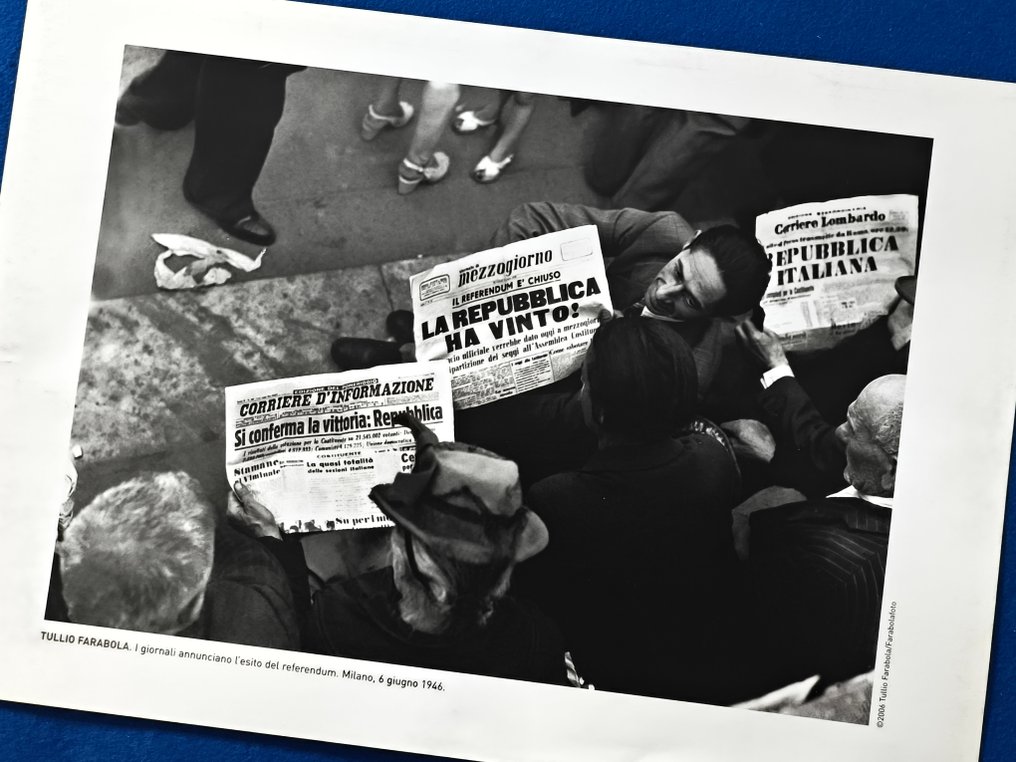
Tullio Farabola - I giornali annunciano l'esito del referendum. Milano, 6 giugno 1946
00
Tage
15
Stunden
20
Minuten
03
Sekunden

7 andere Benutzer beobachten dieses Objekt
 Bieter 8030 Bieter 8030 | 1 € |
|---|
Käuferschutz auf Catawiki
Ihre Zahlung wird von uns sicher verwahrt, bis Sie Ihr Objekt erhalten.Details ansehen
Trustpilot 4.4 | 121798 Bewertungen
Auf Trustpilot als hervorragend bewertet.
Vom Verkäufer bereitgestellte Beschreibung
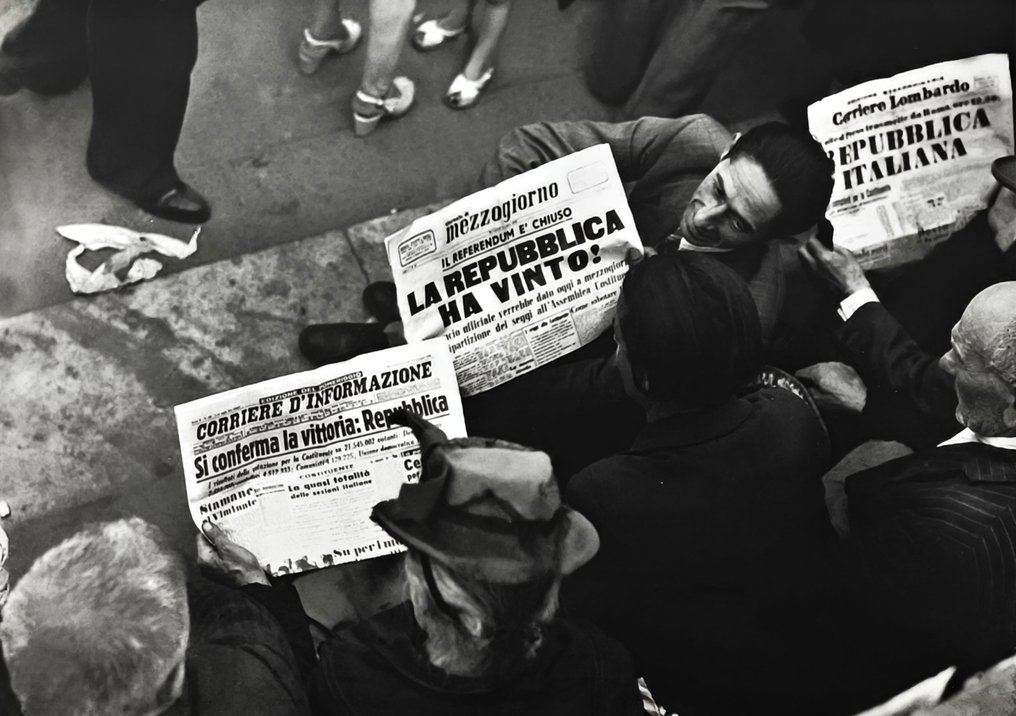
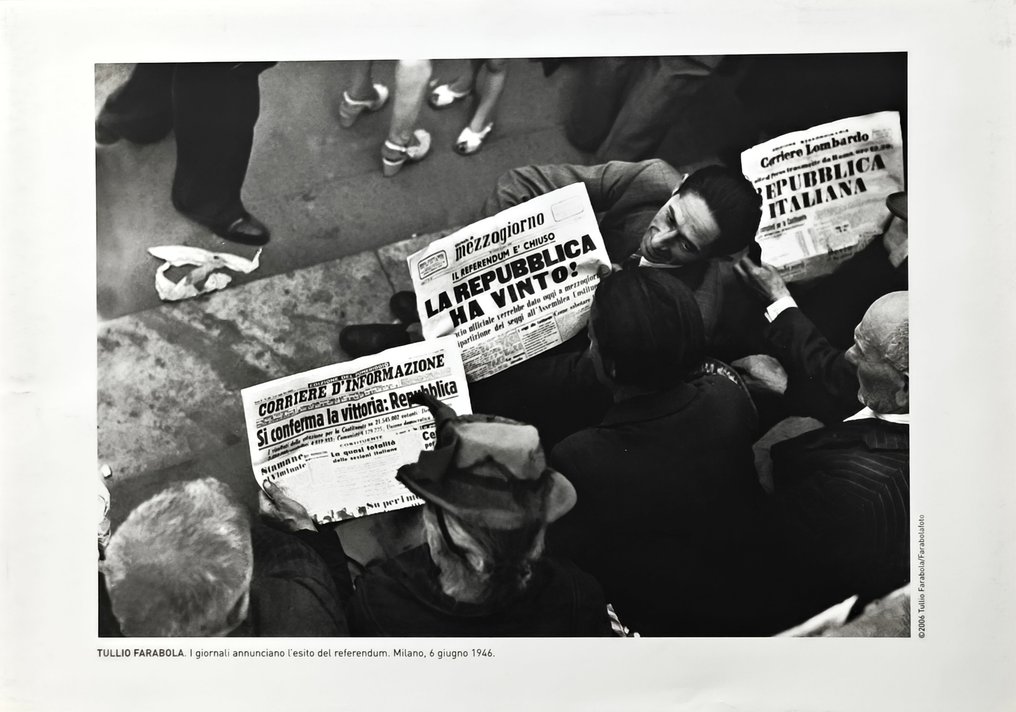
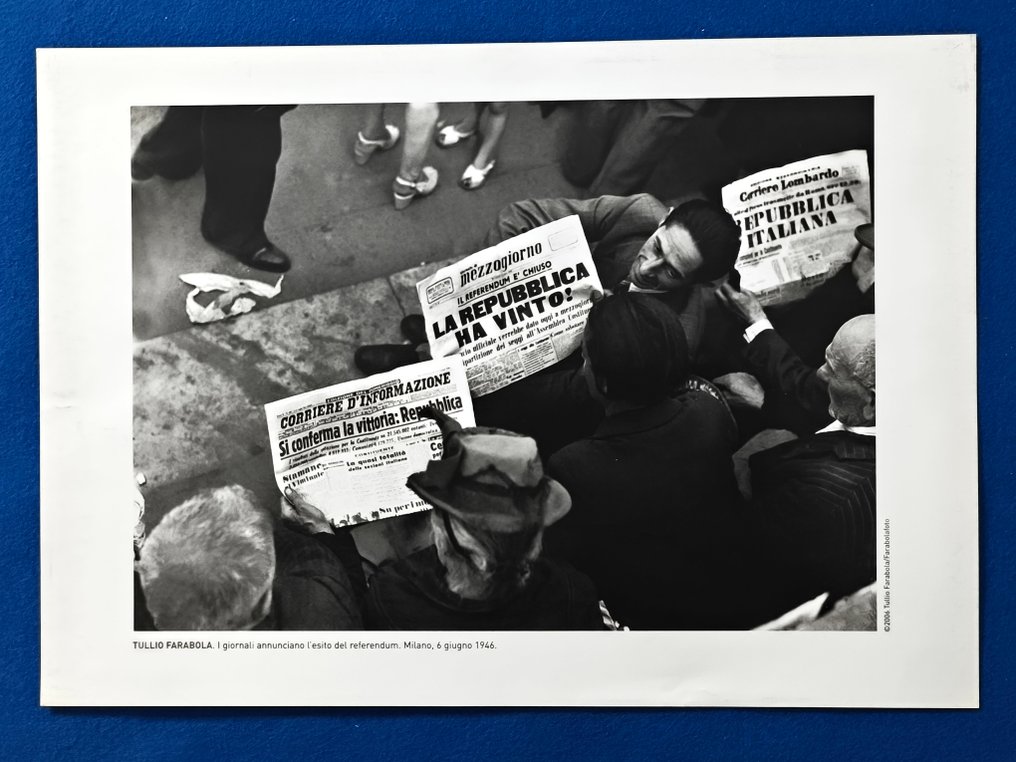
Tullio Farabola. I giornali annunciano l'esito del referendum. Milano, 6 giugno 1946.
'Copyright 2006 Tullio Farabola / Farabolafoto' at the lower right corner. Total dimensions: 42,0 x 29,7 cm on semi-gloss paper. Good condition. Printed Lated, 2000's.
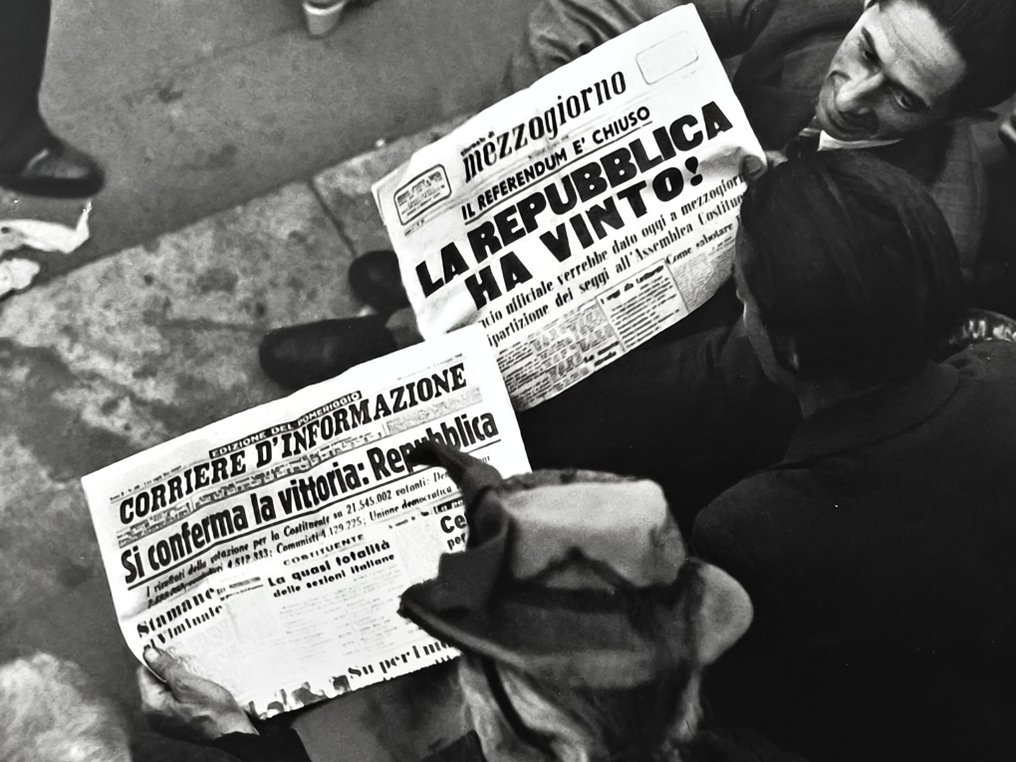
In this historic 1946 photograph, Tullio Farabola captures the precise moment Italy learns its fate. Newspapers hot off the press announce the results of the institutional referendum: the monarchy falls, the Republic is born. Gathered in the streets of Milan, men cluster around the headlines, their faces a mixture of disbelief, anticipation, and the fragile exhilaration of a country reinventing itself.
Farabola frames the scene from above, transforming the crowd into a vortex of bodies, hats, and newspapers, each headline radiating like an electric pulse through postwar Italy. The fallen king, the end of an era, the beginning of another —everything is contained in those sheets of inked paper passed from hand to hand.
A central figure in mid-century Italian photojournalism, Tullio Farabola documented the nation’s transformation from the rubble of World War II to the dawn of modern democracy. His imagery combines documentary rigor with cinematic intuition, capturing not just events but their psychological temperature. This photograph stands as one of his quintessential works: the choreography of a country catching its breath after decades of dictatorship and devastation.
Farabola’s name sits comfortably beside that of Federico Patellani, Mario De Biasi, Gianni Berengo Gardin, and Henri Cartier-Bresson —photographers who understood that history often reveals itself in the gestures and glances of ordinary people.
A compelling piece for collectors of historical, political, and documentary photography —a visual testament to the birth of the Italian Republic, suspended in the charged stillness of a single, transformative morning.
Tullio Farabola. I giornali annunciano l'esito del referendum. Milano, 6 giugno 1946.
'Copyright 2006 Tullio Farabola / Farabolafoto' at the lower right corner. Total dimensions: 42,0 x 29,7 cm on semi-gloss paper. Good condition. Printed Lated, 2000's.
In this historic 1946 photograph, Tullio Farabola captures the precise moment Italy learns its fate. Newspapers hot off the press announce the results of the institutional referendum: the monarchy falls, the Republic is born. Gathered in the streets of Milan, men cluster around the headlines, their faces a mixture of disbelief, anticipation, and the fragile exhilaration of a country reinventing itself.
Farabola frames the scene from above, transforming the crowd into a vortex of bodies, hats, and newspapers, each headline radiating like an electric pulse through postwar Italy. The fallen king, the end of an era, the beginning of another —everything is contained in those sheets of inked paper passed from hand to hand.
A central figure in mid-century Italian photojournalism, Tullio Farabola documented the nation’s transformation from the rubble of World War II to the dawn of modern democracy. His imagery combines documentary rigor with cinematic intuition, capturing not just events but their psychological temperature. This photograph stands as one of his quintessential works: the choreography of a country catching its breath after decades of dictatorship and devastation.
Farabola’s name sits comfortably beside that of Federico Patellani, Mario De Biasi, Gianni Berengo Gardin, and Henri Cartier-Bresson —photographers who understood that history often reveals itself in the gestures and glances of ordinary people.
A compelling piece for collectors of historical, political, and documentary photography —a visual testament to the birth of the Italian Republic, suspended in the charged stillness of a single, transformative morning.
Details
Künstler
Tullio Farabola
Verkauft von
Eigentümer oder Wiederverkäufer
Titel des Kunstwerks
I giornali annunciano l'esito del referendum. Milano, 6 giugno 1946
Zustand
Guter Zustand
Technik
Photolithographie
Höhe
420 mm
Auflage
2006 Tullio Farabola / Farabolafoto
Breite
297 mm
Signatur
Nicht signiert
Genre
Fotojournalismus
Verkauft von