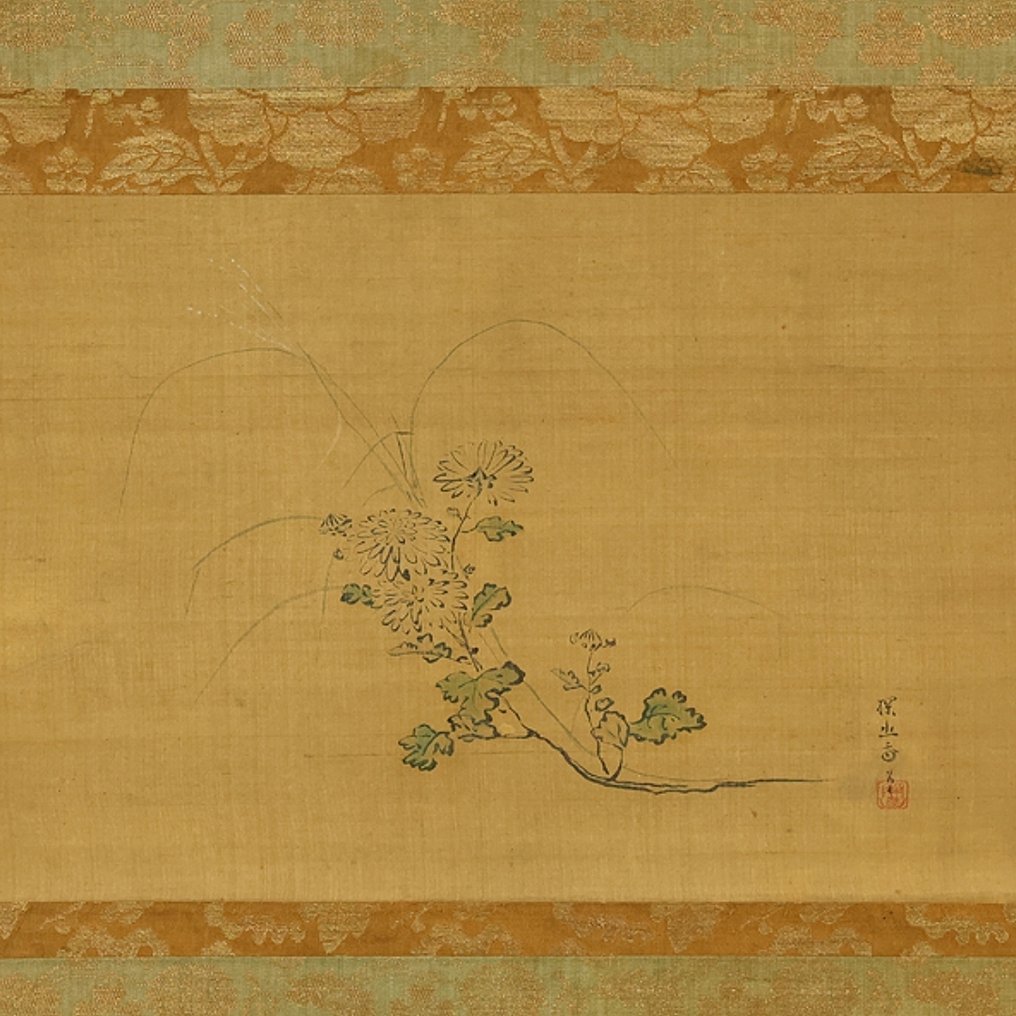
Wild Chrysanthemum - Beauty of Simplicity and Blank with Box - Attributed to Kano Tan'yū 狩野探幽 (1602-1674) - Japan - Frühe Edo-Zeit (Ohne Mindestpreis)


01
Tag
23
Stunden
59
Minuten
15
Sekunden
Aktuelles Gebot
€ 140
Ohne Mindestpreis

Experte
Von Giovanni Bottero ausgewählt
Verfügt über einen Master in japanischer Kunstgeschichte und mehr als 10 Jahre Erfahrung.
Schätzung € 400 - € 500
37 andere Benutzer beobachten dieses Objekt
 Bieter 1281 Bieter 1281 | 140 € | |
|---|---|---|
| Bieter 8175 | 130 € | |
| Bieter 1281 | 110 € | |
Käuferschutz auf Catawiki
Ihre Zahlung wird von uns sicher verwahrt, bis Sie Ihr Objekt erhalten.Details ansehen
Trustpilot 4.4 | 121899 Bewertungen
Auf Trustpilot als hervorragend bewertet.
Eine verfeinerte Kakejiku, Kano Tan’yū aus dem 17. Jahrhundert, handgemalt mit wilden Chrysanthemen und eine minimalistische Komposition lädt zur ruhigen Betrachtung ein.
KI-gestützte Zusammenfassung
Vom Verkäufer bereitgestellte Beschreibung
狩野探幽 Kano Tanyu (1602-1674)
Painter of the early Edo period and establisher of Edo Kano school. The eldest son of 狩野孝信 Kano Takanobu (1751-1618) and grandson of Kano Eitoku (1543-1590). Founder of the Kajibashi Kano school. He is said to be a precocious genius and is praised as the second coming of Eitoku. His wide range of works includes Sansui landscapes, figures, flowers, and birds. Tanyu's elegant new style, which made use of marginal spaces, was called the Edo Kano style, and it was inherited as the standard of the Kano school thereafter. He was active in the paintings of castles such as Nijo Castle, Osaka Castle, Nagoya Castle, and Edo Castle, as well as in the painting of the inner court. He was also in charge of the decoration of the Tokugawa family mausoleums such as Nikko Toshogu, Zojoji, Kan-eiji, and Edo Castle's Momijiyama.
with signature 'Tanyusai hitsu' 探幽斎筆 and seal 'Tanyu' 探幽
A refined Japanese hanging scroll attributed to Kanō Tan’yū (狩野探幽), a leading master of the early Edo period and one of the most influential painters of the Kanō school. The artwork presents a delicate rendering of wild chrysanthemums (nogiku), executed in subtle ink and color with a minimalist composition. In Japanese aesthetics, wild chrysanthemums symbolize modesty, transience, and seasonal change. Their understated beauty reflects the principles of wabi (quiet elegance) and kanso (simplicity), while the use of blank space (ma) invites contemplation and emotional resonance. Tan’yū’s botanical works are known for their poetic restraint and refined brushwork, capturing nature’s essence with minimal means. The scroll is accompanied by a preservation box. Likely produced in the mid-17th century, it embodies the philosophical depth and visual clarity of classical Japanese painting.
Attributed to 狩野探幽 Kano Tan'yū (1602-1674) Japanese antique art kakejiku kakemono wall hanging scroll / Wild Chrysanthemum - Beauty of Simplicity and Blank with Box
Whole dimensions: 20.3" W x 41.5" H / 51.6cm x 105.5cm
Inside dimensions: 14" W x 8.8" H / 35.6cm x 22.5cm
Material: Silk
Technique: Handpainted
Roller ends: Bone
Weight: 580g including Box
Condition
Antique items have originally crease, stain, damage, and more. I would like you to refer to the listing photos, but please understand that it's difficult to show all conditions by the photos. Special notes: STAIN, CREASE, DAMAGE a little, FOLD, STAIN in the back of the mounting.
Shipping
"FREE SHIPPING" all over the world by Registered Airmail, EMS, or DHL.
Der Verkäufer stellt sich vor
Reiwa Antiques ist ein offiziell lizenzierter Antiquitätenhändler mit Sitz in Japan, der eine Reihe authentischer japanischer Antiquitäten anbietet, darunter traditionelle Gemälde, exquisite Kalligraphie und wunderschöne Teeutensilien. Unser Ziel ist es, Ihnen weiterhin ein angenehmes Einkaufserlebnis zu bieten. Um Ihre Mehrwertsteuer- und Einfuhrsteuerbelastung so weit wie möglich zu reduzieren, bieten wir Ihnen kostenlosen Versand an. Wir befassen uns seit mehr als 10 Jahren mit Auslandstransaktionen. Seien Sie versichert, dass wir Ihre Artikel immer sorgfältig verpacken und unser Bestes tun, um Ihre Artikel sicher zu liefern. Die üblichen Versandmethoden sind Einschreiben per Luftpost, EMS (Postal Express) oder DHL. Bitte zögern Sie nicht, mir Bescheid zu geben, wenn Sie Fragen haben oder Hilfe benötigen.
Herzlichen Gruss,
Reiwa-Antiquitäten
Übersetzt mit Google Übersetzer狩野探幽 Kano Tanyu (1602-1674)
Painter of the early Edo period and establisher of Edo Kano school. The eldest son of 狩野孝信 Kano Takanobu (1751-1618) and grandson of Kano Eitoku (1543-1590). Founder of the Kajibashi Kano school. He is said to be a precocious genius and is praised as the second coming of Eitoku. His wide range of works includes Sansui landscapes, figures, flowers, and birds. Tanyu's elegant new style, which made use of marginal spaces, was called the Edo Kano style, and it was inherited as the standard of the Kano school thereafter. He was active in the paintings of castles such as Nijo Castle, Osaka Castle, Nagoya Castle, and Edo Castle, as well as in the painting of the inner court. He was also in charge of the decoration of the Tokugawa family mausoleums such as Nikko Toshogu, Zojoji, Kan-eiji, and Edo Castle's Momijiyama.
with signature 'Tanyusai hitsu' 探幽斎筆 and seal 'Tanyu' 探幽
A refined Japanese hanging scroll attributed to Kanō Tan’yū (狩野探幽), a leading master of the early Edo period and one of the most influential painters of the Kanō school. The artwork presents a delicate rendering of wild chrysanthemums (nogiku), executed in subtle ink and color with a minimalist composition. In Japanese aesthetics, wild chrysanthemums symbolize modesty, transience, and seasonal change. Their understated beauty reflects the principles of wabi (quiet elegance) and kanso (simplicity), while the use of blank space (ma) invites contemplation and emotional resonance. Tan’yū’s botanical works are known for their poetic restraint and refined brushwork, capturing nature’s essence with minimal means. The scroll is accompanied by a preservation box. Likely produced in the mid-17th century, it embodies the philosophical depth and visual clarity of classical Japanese painting.
Attributed to 狩野探幽 Kano Tan'yū (1602-1674) Japanese antique art kakejiku kakemono wall hanging scroll / Wild Chrysanthemum - Beauty of Simplicity and Blank with Box
Whole dimensions: 20.3" W x 41.5" H / 51.6cm x 105.5cm
Inside dimensions: 14" W x 8.8" H / 35.6cm x 22.5cm
Material: Silk
Technique: Handpainted
Roller ends: Bone
Weight: 580g including Box
Condition
Antique items have originally crease, stain, damage, and more. I would like you to refer to the listing photos, but please understand that it's difficult to show all conditions by the photos. Special notes: STAIN, CREASE, DAMAGE a little, FOLD, STAIN in the back of the mounting.
Shipping
"FREE SHIPPING" all over the world by Registered Airmail, EMS, or DHL.
Der Verkäufer stellt sich vor
Reiwa Antiques ist ein offiziell lizenzierter Antiquitätenhändler mit Sitz in Japan, der eine Reihe authentischer japanischer Antiquitäten anbietet, darunter traditionelle Gemälde, exquisite Kalligraphie und wunderschöne Teeutensilien. Unser Ziel ist es, Ihnen weiterhin ein angenehmes Einkaufserlebnis zu bieten. Um Ihre Mehrwertsteuer- und Einfuhrsteuerbelastung so weit wie möglich zu reduzieren, bieten wir Ihnen kostenlosen Versand an. Wir befassen uns seit mehr als 10 Jahren mit Auslandstransaktionen. Seien Sie versichert, dass wir Ihre Artikel immer sorgfältig verpacken und unser Bestes tun, um Ihre Artikel sicher zu liefern. Die üblichen Versandmethoden sind Einschreiben per Luftpost, EMS (Postal Express) oder DHL. Bitte zögern Sie nicht, mir Bescheid zu geben, wenn Sie Fragen haben oder Hilfe benötigen.
Herzlichen Gruss,
Reiwa-Antiquitäten
Übersetzt mit Google ÜbersetzerDetails
Künstler
Attributed to Kano Tan'yū 狩野探幽 (1602-1674)
Zuschreibung
Zuschreibung:
Titel des Kunstwerks
Wild Chrysanthemum - Beauty of Simplicity and Blank with Box
Signatur
Handsigniert
Herkunftsland
Japan
Zustand
Guter Zustand
Höhe
105,5 cm
Breite
51,6 cm
Gewicht
580 g
Darstellung/Thema
Pflanzen und Blumen
Stil
Klassik
Periode
17. Jahrhundert
Dynastischer Stil/Epoche
Frühe Edo-Zeit
Herkunft
Galerie/Antiquitätenhändler
Verkauft von
