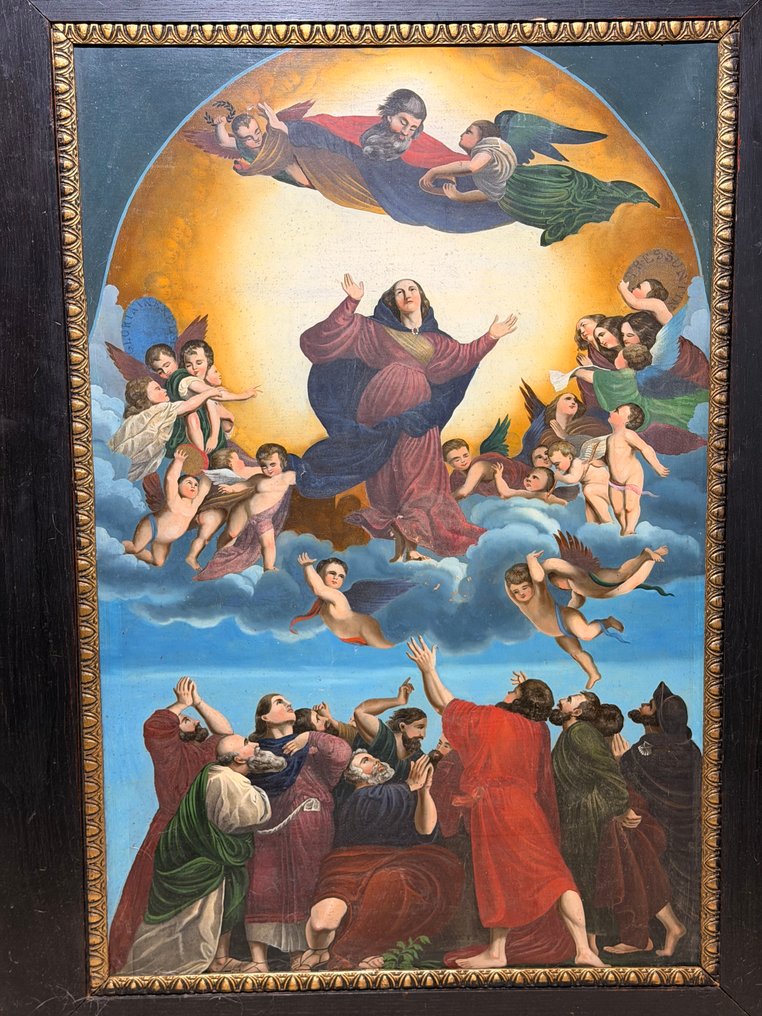
Lebhafte Darstellung der Mariä Himmelfahrt NO RESERVE - Antik - Holz, Papier, Leinen - 1850-1900 - Maria Himmelfahrt


07
Tage
18
Stunden
03
Minuten
31
Sekunden

Es wurden keine Gebote abgegeben
Käuferschutz auf Catawiki
Ihre Zahlung wird von uns sicher verwahrt, bis Sie Ihr Objekt erhalten.Details ansehen
Trustpilot 4.4 | 122529 Bewertungen
Auf Trustpilot als hervorragend bewertet.
Antikes Barock-Stil Ölgemälde aus der italienischen Schule, ca. 1850–1900, auf Leinwand mit möglicherweise Papierunterlage und gerahmt in Holzrahmen (95,2 × 69,3 cm inkl. Rahmen; 88,2 × 52,5 cm ohne), in gutem Zustand mit altersbedingten Gebrauchserscheinungen.
KI-gestützte Zusammenfassung
Vom Verkäufer bereitgestellte Beschreibung
Ölgemälde, Italienische Schule, 19. Jh., Werkstatt/Schule; nicht signiert
Unbekannte Darstellung der Mariä Himmelfahrt
Öl auf Leinwand, Darstellung: Mariä Himmelfahrt. Unsigniert. Vermutlich italienische Werkstatt der 2. Hälfte 19. Jahrhunderts. Zustand: restaurierungsbedürftig (punktuelle Farbabplatzungen, leichte Verschmutzung).
Maße inklusive Rahmen:
H 95,2cm
B 69,3cm
Maße exklusive Rahmen:
H 88,2cm
B 52,5cm
1. Kurzbefund (auf einen Blick)
• Werk: Mariä Himmelfahrt (darstellungsbezogenes Sakralbild: Maria im Himmel, umgeben von Engeln; Apostel unten)
• Technik: Öl auf Leinwand oder möglicherweise anderer Träger, Papier auf Leinwand kaschiert ist möglich, in dekorativem schwarz/goldrahmen (Holzrahmen mit innerem Goldprofil).
• Zustand (Kurz): Gebrauchs-/Altersspuren; lokaler Farbverlust, kleine Abschürfungen, leichte Verschmutzung, Rahmen altersbedingt beschädigt; Rückseite: sichtbare Holzsteg-Konstruktion, keine deutlich lesbare Signatur vorn, leichte Bleistiftinschrift auf Rahmenunterleiste an der Rückseite.
• Vermutung Stil / Datierung: Italienische Schule, 2. Hälfte 19. Jh. (wahrscheinlich Werk einer Werkstatt / eines regionalen Altars- bzw. Devotionsmalers, evtl. Kopie/Variation eines bekannten Bildtyps).
• Signatur: nicht sichtbar auf der Bildvorderseit
• Provenienz / Echtheitsgrad: Nicht nachweisbar, erscheint autorenschaftlich nicht als Werk eines bekannten Meisters (werkstatt-/volkskünstlerischer Charakter).
2. Detaillierte Beschreibung des Bildes
Ikonographie
• Zentral: Maria in halbaufgerichteter Körperhaltung, Arme erhoben — klassische Ikone der Himmelfahrt/Assumptio.
• Oben: Gottvater/Heilige Dreifaltigkeit-Insinuation (älterer, bärtiger Herr), flankiert von Engeln. Großer goldener Aureolenbereich (Mandorla) bildet himmlische Sphäre.
• Mittig/Unten: Gruppe von Engeln/Putten in Wolken; darunter die versammelten Apostel, einige mit Gebetsgesten, ein Apostel in rotem Gewand mit erhobenen Armen als Blickfang.
• Farben: kräftige, aber flächige Farbaufträge (v. a. Blau, Rot, Gold), vereinfachte Modellierung (wenig fein zeichnerische Modellierung wie bei akademischen Meisterwerken).
Malweise / Ausführung
• Flächige, saubere Pinselzüge, relativ glatte Lasuren; Details (Gesichter, Hände) sorgsam, aber mit vereinfachter Zeichnung.
• Schatten/Modellierung vorhanden, jedoch ohne komplexe Schichtpastosität oder sehr feine Retuschen, eher akademisch/wiederholbar — typisch für Werkstattproduktion oder für großformatige Kirchenbilder/Kuplungen.
• Randbereiche: Bild endet an einem goldenen Innenfries — möglicherweise späterer Rahmen oder Ziereinlage.
3. Materialbefund und Aufbau
• Träger: Öl auf Papier auf Leinen kaschiert oder nur Öl auf Leinwand auf Holzkeilrahmen / Rahmenkonstruktion. Auf der Rückseite sieht man einen einfachen, vermutlich neueren Rahmen (keine alten Handgenagelungen erkennbar auf Fotos).
• Keilleisten/Leisten: An den Bildern sind einfache rechteckige Streben sichtbar; Eckkeile (oder Dreiecksverstärkungen) sind am Außengestell vorhanden — lässt auf 19.–20. Jh. Montage schließen.
• Befestigung: moderne Aufhängung (Draht / Haken) vorhanden; spricht für museumshistorische Hängung oder private Hängung.
• Rückseitige Inschriften: schwache Bleistift-/Graphitinschrift am unteren Innenholz (auf Foto erkennbar) — kann Inventarnummer, Eigentümerhinweis oder kurze Provenienznotiz sein; nicht entschlüsselt.
Zustand
Befundpunkt nach Bereich
• Vorderseite (Malschicht):
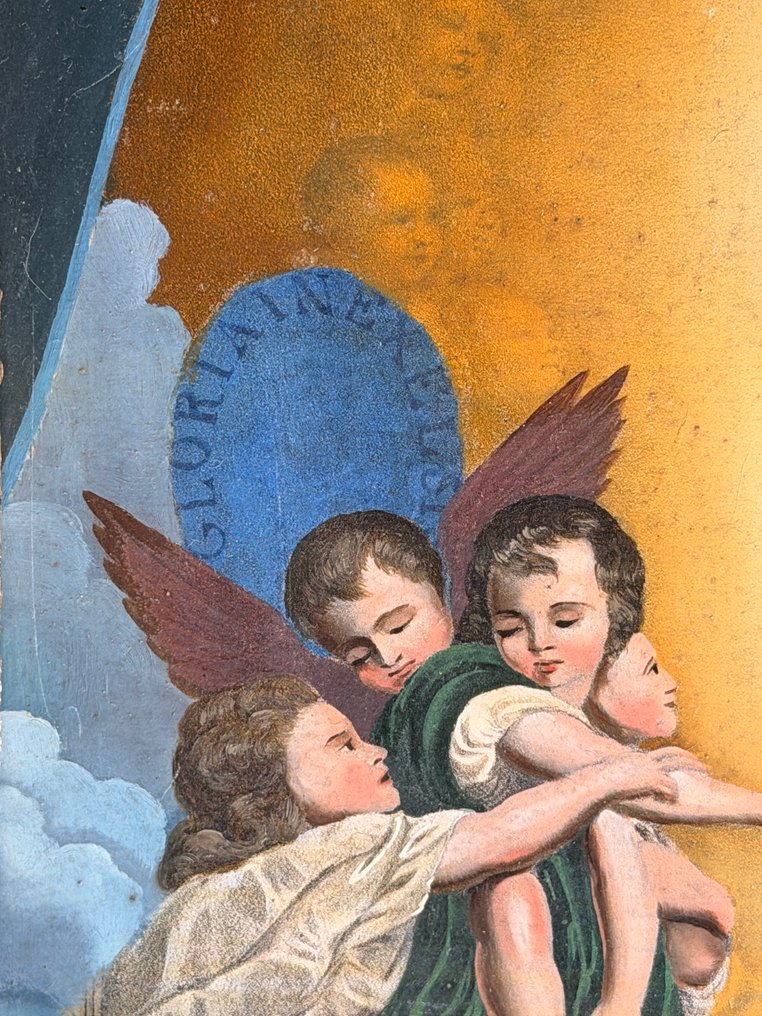
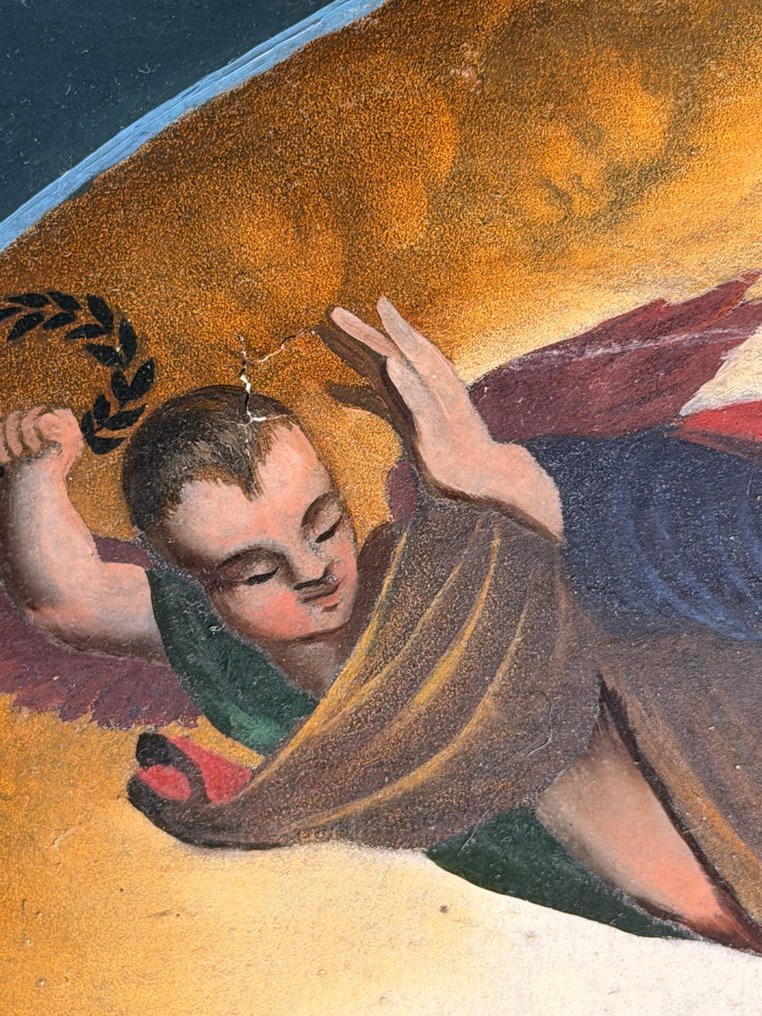
• Kleine bis mittlere Abschürfungen / Farbabplatzungen (insbesondere in Wolken- bzw. roten Gewandpartien — siehe Detailfoto mit Cherub und Aposteln). Stellenweise Blattvergoldungsreste oder goldpigment-Ablösung im Aureolenbereich.
• Punktuelle Kratzer/Schürfungen (links unten Rahmenrand, untere Bildpartien).
• Vereinzelte kleine dunkle Flecken (Schmutzeinschlüsse oder Oxidationen).
• Mögliche minime Krakeleebildung in Bildfläche
• Leinwand / Aufhängung:
• Leinwand wirkt relativ eben und straff — keine ausgeprägten Verformungen oder großflächiges Durchhängen sichtbar.
• Keine klar sichtbaren Durchstiche oder große Risse auf Fotos.
• Rahmen:
• Holzrahmen mit schwarzer Oberfläche (bemalt) zeigt Gebrauchsspuren: Schrammen, abgeschabte Ecken, lose Stellen an den Verbindungen; inneres Goldprofil mit partiellen Fehlstellen.
• Rückseitig Pappel-/Fichtenholzleisten; an einer unteren Ecke Spuren von Wurmlöchern oder Farbklecksen sichtbar.
Restauratorische Empfehlungen (Kurz)
• Reinigung der Oberfläche (oberflächliche Schmutzentfernung UV-gestützt).
• Festigung abstehender Farbpartien und Nachfassung/Retusche der lokalen Abplatzungen.
• Prüfung auf alte Retuschen (UV-Licht) vor Retusche; ggf. Entfernen schadhafter Übermalungen.
• Rahmenstabilisierung (Verleimung, ggf. ergänzen der Falzleiste), Schonung/Erhalt des Originalbefundes.
Stilistische Einordnung & Datierung
• Die Komposition, Figurenstellung und der dezidierte Goldhintergrund/Mandorla entsprechen dem typischen Heiligenbild der katholischen Volks- und Kirchenproduktion des 19. Jahrhunderts.
• Die farbliche Direktheit und die leichte Tendenz zur Ornamentik (Engelsgruppen als dekoratives Element) stützen eine Einordnung in die italienische Schule, Mitte bis Ende 19. Jh..
• Möglich: Werk einer regionalen Werkstatt, die populäre Ikonographien für Kirchen, Kapellen oder private Devotionsräume produzierte.
Künstlerische Qualität / Zuschreibung
• Keine Signatur vorne erkennbar. Auf Fotos keine typische Signaturspur. Rückseitige Bleistiftinschrift kann Hinweis sein; diese sollte leserlich fotografiert/transkribiert werden.
• Die malerische Qualität ist teils sehr gut.
• Zuschreibung: „Italienische Schule, 19. Jh., Werkstatt/Schule; nicht signiert“
Vergleich & Marktpositionierung
• Vergleichswerke (19. Jh. Sakralbilder) werden in regionalen Auktionshäusern, Antiquitätengeschäften oder bei spezialisierten religiösen Kunsthändlern angeboten.
• Der Markt für nicht-signierte, qualitätsvolle Werkstattbilder aus dem 19. Jh. ist moderat: Sammler für religiöse Volkskunst, Kirchenerhaltungsprojekte, Einrichter für historische Interieurs und Museen für regionale Kunst.
• Wenn das Werk eine bekannte Vorlage kopiert (z. B. eine Reproduktion eines barocken Originals), ist der Marktwert abhängig vom Zustand und vom Interesse an dieser Ikonographie.
Wertermittlung
Alle Werte sind Schätzwerte, basierend auf visueller Ferneinschätzung, ohne Laborbefunde oder Provenienz. Regionale Märkte schwanken stark.
• Galerie / Fachhandel (Verkauf auf Kommission): €600 – €2.500 (Provision, Präsentation, Käuferkreis berücksichtigt).
• Falls Zuschreibung an einen bekannten Namen gelingt: Werte könnten deutlich steigen.
Abschließende Bewertung (fachlich und persönlich)
Das vorgelegte Bild ist ein attraktives Beispiel populärer sakraler Malerei des 19. Jahrhunderts: dekorativ, wirkungsvoll in Farben und Komposition, offensichtlich für Andacht und Kirchengebrauch gedacht. Eine professionelle konservatorische Sichtung und eventuell eine einfache Reinigung würden das Erscheinungsbild deutlich aufwerten und sind aus konservatorischer Sicht empfehlenswert. Ob es sich um einen übermalten Druck handelt, kann nicht zweifelsfrei beurteilt werden. Es gibt die Vermutung, dass es ein Druck auf Papier sein könnte (da die Engeln im Hintergrund sehr fein wirken), welcher in besonderer Manier übermalt wurde und dann auf eine Leinwand aufgebracht wurde.
Beschreibung wurde nach bestem Wissen gemacht, es gelten aber die Fotos für die Beschreibung als maßgeblich. Bitte bieten Sie verantwortungsvoll und nur wenn Sie sich anhand der Fotos überzeugt haben.
Die Fotos sind farbecht und wurden nicht bearbeitet!
Italiano
Dipinto a olio, scuola italiana, XIX secolo, bottega/scuola; non firmato
Rappresentazione sconosciuta dell’Assunzione di Maria
Olio su tela, rappresentazione: Assunzione di Maria. Non firmato. Presumibilmente bottega italiana della seconda metà del XIX secolo. Condizione: da restaurare (perdite puntuali di colore, leggero sporco).
Misure con cornice:
H 95,2 cm
L 69,3 cm
Misure senza cornice:
H 88,2 cm
L 52,5 cm
1. Referto breve (a colpo d’occhio)
• Opera: Assunzione di Maria (immagine sacra legata alla rappresentazione: Maria in cielo, circondata da angeli; apostoli in basso)
• Tecnica: olio su tela o possibilmente altro supporto, carta su tela è possibile, in una cornice decorativa nero/oro (cornice in legno con profilo interno dorato).
• Condizione (breve): tracce d’uso/età; perdita locale di colore, piccole abrasioni, leggero sporco, cornice danneggiata per età; retro: visibile costruzione a listelli di legno, nessuna firma chiaramente leggibile sul fronte, leggera iscrizione a matita sulla traversa inferiore della cornice sul retro.
• Presunta stile / datazione: scuola italiana, seconda metà del XIX secolo (probabilmente opera di bottega / pittore regionale d’altare o da devozione, eventualmente copia/variazione di un tipo iconografico conosciuto).
• Firma: non visibile sulla parte frontale del dipinto
• Provenienza / grado di autenticità: non documentabile, appare non come opera autoriale di un maestro noto (carattere di bottega / arte popolare).
⸻
2. Descrizione dettagliata dell’opera
Iconografia
• Centrale: Maria in posizione semi-eretta, braccia sollevate — classica icona dell’Assunzione.
• In alto: Dio Padre / insinuazione della Santa Trinità (anziano con barba), affiancato da angeli. Ampia area aureolare dorata (mandorla) che crea la sfera celeste.
• Parte centrale/inferiore: gruppo di angeli/putti tra le nuvole; sotto gli apostoli riuniti, alcuni in gesto di preghiera, un apostolo in veste rossa con braccia sollevate come punto di richiamo.
• Colori: applicazioni forti ma uniformi (soprattutto blu, rosso, oro), modellazione semplificata (poca resa fine dei dettagli rispetto alle opere accademiche).
Modo pittorico / Esecuzione
• Pennellate pulite, abbastanza uniformi, relativamente lisce; dettagli (volti, mani) curati ma con disegno semplificato.
• Ombreggiatura presente ma senza complessità di impasto o ritocchi fini, più accademica / riproducibile — tipica della produzione di bottega.
• Aree di bordo: il dipinto termina su una cornice interna dorata.
⸻
3. Struttura materiale e costruzione
• Supporto: olio su carta applicata su tela oppure olio su tela su telaio in legno. Sul retro si vede telaio semplice; nessuna chiodatura antica riconoscibile nelle foto.
• Traverse e rinforzi laterali visibili.
• Sistema di sospensione moderno (filo metallico / gancio).
• Sul retro iscrizione leggera a matita sulla parte inferiore interna in legno — non decifrata.
⸻
Condizione
Parte frontale (strato pittorico)
• Piccole e medie perdite di colore / abrasioni (specialmente nelle parti delle nuvole e nelle vesti rosse).
• Graffi e abrasioni localizzate (parte bassa, vicino al bordo).
• Isolate piccole macchie scure.
• Possibile minima craquelure.
Tela / montaggio
• Tela piuttosto uniforme e tesa — nessuna deformazione marcata o cedimento evidente.
• Nessuna grande lacerazione visibile nelle foto.
Cornice
• Cornice in legno con superficie nera (dipinta) presenta segni d’uso: graffi, angoli consumati, piccole parti allentate; profilo interno dorato con lacune parziali.
• Sul retro listelli in legno chiaro; tracce di piccoli fori di tarlo o macchie di vernice.
⸻
Raccomandazioni di restauro (breve)
• Pulizia superficiale (rimozione dello sporco superficiale).
• Consolidamento delle aree con sollevamento della pittura e ritocco locale.
• Controllo con luce UV per eventuali vecchi ritocchi.
• Stabilizzazione della cornice (incollaggio, eventuali integrazioni).
⸻
Classificazione stilistica e datazione
• La composizione, la disposizione delle figure e l’aureola dorata/mandorla corrispondono alla tipica pittura sacra cattolica devozionale del XIX secolo.
• L’uso diretto del colore e la leggera tendenza all’ornamento supportano una collocazione nella scuola italiana della metà — fine XIX secolo.
• Possibile: opera di bottega regionale prodotta per chiese, cappelle o devozione privata.
⸻
Qualità artistica / attribuzione
• Nessuna firma visibile sul fronte.
• Nessun segno evidente di firma nelle foto.
• La qualità pittorica è in parte molto buona.
• Attribuzione: “Scuola italiana, XIX secolo, bottega/scuola; non firmato”.
⸻
Confronto & posizionamento sul mercato
• Opere analoghe (pittura sacra XIX secolo) si trovano in case d’asta regionali, negozi di antiquariato e commercio specializzato in arte religiosa.
• Il mercato per opere non firmate di buona qualità di bottega del XIX secolo è moderato.
⸻
Valutazione finale (tecnica e personale)
L’opera presentata è un esempio interessante di pittura sacra popolare del XIX secolo: decorativa, efficace nei colori e nella composizione, chiaramente destinata alla devozione o all’uso in chiesa. Una pulitura e una semplice stabilizzazione migliorerebbero chiaramente l’aspetto esterno dell’opera.
La descrizione è stata realizzata secondo scienza e coscienza, ma sono le fotografie a fare fede. Per favore fate offerte con consapevolezza e solo se convinti dalle immagini.
Le fotografie sono fedeli ai colori e non sono state modificate.
English
Oil painting, Italian School, 19th century, workshop/school; not signed
Unknown depiction of the Assumption of Mary
Oil on canvas, depiction: Assumption of Mary. Unsigned. Presumably Italian workshop of the 2nd half of the 19th century. Condition: in need of restoration (partial paint losses, slight dirt).
Measurements including frame:
H 95.2 cm
W 69.3 cm
Measurements excluding frame:
H 88.2 cm
W 52.5 cm
⸻
1. Short report (at a glance)
• Work: Assumption of Mary (subject-related sacred image: Mary in heaven, surrounded by angels; Apostles below)
• Technique: oil on canvas or possibly another support, paper mounted on canvas is possible, in decorative black/gold frame (wooden frame with inner gold profile).
• Condition (short): traces of use/age; local paint loss, small abrasions, slight dirt, frame age-related damage; back: visible wooden stretcher construction, no clearly readable signature on the front, light pencil inscription on the lower crossbar of the frame on the back.
• Presumed style / dating: Italian school, 2nd half of the 19th century (probably work of a workshop / regional altar or devotional painter, possibly copy/variation of a known image type).
• Signature: not visible on the front of the painting
• Provenance / degree of authenticity: not verifiable, does not appear to be the authored work of a known master (workshop / folk-art character).
⸻
2. Detailed description of the painting
Iconography
• Central: Mary in semi-upright body position, arms raised — classic icon of the Assumption.
• Upper: God the Father / Holy Trinity suggestion (elderly bearded man), flanked by angels. Large golden aureole area (mandorla) forming the heavenly sphere.
• Middle/lower: group of angels/putti in clouds; below them the gathered Apostles, some with gestures of prayer, one Apostle in red robe with raised arms as focal point.
• Colours: strong but flat colour application (mainly blue, red, gold), simplified modelling (little fine drawing as in academic masterpieces).
Painting style / execution
• Flat, clean brushstrokes, relatively smooth glaze; details (faces, hands) careful but with simplified drawing.
• Shading/modelling present, but without complex pastosity or very fine retouching, rather academic/reproducible — typical of workshop production or large-format church paintings.
• Edge areas: painting ends at a golden inner border — possibly later frame or decorative insert.
⸻
3. Material condition and structure
• Support: oil on paper mounted on canvas or only oil on canvas on wooden stretcher. A simple stretcher is visible at the back; no old hand-nailing visible in photos.
• Stretcher bars and central crossbars visible.
• Modern hanging system (wire / hook) present.
• Back inscription: light pencil/graphite inscription on lower inner wood (visible in photo) — could be inventory number, owner’s note or short provenance remark; not deciphered.
⸻
Condition
Front (paint layer)
• Small to medium abrasions / paint losses (especially in cloud or red garment areas — see detail photo with cherub and Apostles).
• Local scratches/abrasions (lower left frame edge, lower paint sections).
• Individual small dark spots (dirt inclusions or oxidation).
• Possible minimal craquelure in the surface.
Canvas / mounting
• Canvas appears relatively even and taut — no pronounced deformations or sagging visible.
• No clearly visible punctures or large tears on photos.
Frame
• Wooden frame with black painted surface shows signs of use: scratches, rubbed corners, loose joints; inner gold profile with partial losses.
• Back: poplar/spruce wood bars; traces of wormholes or paint spots visible on one lower corner.
⸻
Restoration recommendations (short)
• Cleaning of the surface (removal of superficial dirt, UV-assisted).
• Consolidation of lifting paint and retouching of local losses.
• Examination for old retouching (UV light) before retouch; possibly removal of defective overpainting.
• Frame stabilisation (gluing, possibly supplementing the rebate), preservation of original condition.
⸻
Stylistic classification & dating
• The composition, the positioning of the figures and the gold halo/mandorla correspond to typical sacred images of Catholic devotional painting of the 19th century.
• The direct use of colour and the slight tendency to ornamentation (angel groups as decorative element) support a classification within the Italian school, mid to late 19th century.
• Possible: work of a regional workshop that produced popular iconographies for churches, chapels or private devotional rooms.
⸻
Artistic quality / attribution
• No signature visible on the front.
• No typical signature trace identifiable from photos.
• Light pencil inscription on the reverse may be a clue; it should be photographed/transcribed.
• The painting quality is partly very good.
• Attribution: “Italian School, 19th century, workshop/school; unsigned”.
⸻
Comparison & market positioning
• Comparable works (19th-century sacred paintings) are offered in regional auction houses, antique shops or specialised dealers in religious art.
• The market for unsigned good-quality workshop paintings from the 19th century is moderate: collectors of religious folk-art, church preservation projects, decorators for historical interiors and regional museums.
⸻
Final assessment (technical and personal)
The presented painting is an attractive example of popular sacred painting of the 19th century: decorative, effective in colours and composition, clearly intended for devotion and church use. A professional conservative inspection and a simple cleaning would noticeably improve the visible condition and are recommended from a conservation point of view.
Whether it is an overpainted print cannot be determined with certainty. There is a suspicion that it could be a print on paper (because the angels in the background appear very fine) which was painted over in a particular manner and then mounted on a canvas.
The description has been made to the best of knowledge, but the photos are decisive for the description. Please bid responsibly and only if convinced by the photos.
The photos are colour-true and have not been edited.
Ölgemälde, Italienische Schule, 19. Jh., Werkstatt/Schule; nicht signiert
Unbekannte Darstellung der Mariä Himmelfahrt
Öl auf Leinwand, Darstellung: Mariä Himmelfahrt. Unsigniert. Vermutlich italienische Werkstatt der 2. Hälfte 19. Jahrhunderts. Zustand: restaurierungsbedürftig (punktuelle Farbabplatzungen, leichte Verschmutzung).
Maße inklusive Rahmen:
H 95,2cm
B 69,3cm
Maße exklusive Rahmen:
H 88,2cm
B 52,5cm
1. Kurzbefund (auf einen Blick)
• Werk: Mariä Himmelfahrt (darstellungsbezogenes Sakralbild: Maria im Himmel, umgeben von Engeln; Apostel unten)
• Technik: Öl auf Leinwand oder möglicherweise anderer Träger, Papier auf Leinwand kaschiert ist möglich, in dekorativem schwarz/goldrahmen (Holzrahmen mit innerem Goldprofil).
• Zustand (Kurz): Gebrauchs-/Altersspuren; lokaler Farbverlust, kleine Abschürfungen, leichte Verschmutzung, Rahmen altersbedingt beschädigt; Rückseite: sichtbare Holzsteg-Konstruktion, keine deutlich lesbare Signatur vorn, leichte Bleistiftinschrift auf Rahmenunterleiste an der Rückseite.
• Vermutung Stil / Datierung: Italienische Schule, 2. Hälfte 19. Jh. (wahrscheinlich Werk einer Werkstatt / eines regionalen Altars- bzw. Devotionsmalers, evtl. Kopie/Variation eines bekannten Bildtyps).
• Signatur: nicht sichtbar auf der Bildvorderseit
• Provenienz / Echtheitsgrad: Nicht nachweisbar, erscheint autorenschaftlich nicht als Werk eines bekannten Meisters (werkstatt-/volkskünstlerischer Charakter).
2. Detaillierte Beschreibung des Bildes
Ikonographie
• Zentral: Maria in halbaufgerichteter Körperhaltung, Arme erhoben — klassische Ikone der Himmelfahrt/Assumptio.
• Oben: Gottvater/Heilige Dreifaltigkeit-Insinuation (älterer, bärtiger Herr), flankiert von Engeln. Großer goldener Aureolenbereich (Mandorla) bildet himmlische Sphäre.
• Mittig/Unten: Gruppe von Engeln/Putten in Wolken; darunter die versammelten Apostel, einige mit Gebetsgesten, ein Apostel in rotem Gewand mit erhobenen Armen als Blickfang.
• Farben: kräftige, aber flächige Farbaufträge (v. a. Blau, Rot, Gold), vereinfachte Modellierung (wenig fein zeichnerische Modellierung wie bei akademischen Meisterwerken).
Malweise / Ausführung
• Flächige, saubere Pinselzüge, relativ glatte Lasuren; Details (Gesichter, Hände) sorgsam, aber mit vereinfachter Zeichnung.
• Schatten/Modellierung vorhanden, jedoch ohne komplexe Schichtpastosität oder sehr feine Retuschen, eher akademisch/wiederholbar — typisch für Werkstattproduktion oder für großformatige Kirchenbilder/Kuplungen.
• Randbereiche: Bild endet an einem goldenen Innenfries — möglicherweise späterer Rahmen oder Ziereinlage.
3. Materialbefund und Aufbau
• Träger: Öl auf Papier auf Leinen kaschiert oder nur Öl auf Leinwand auf Holzkeilrahmen / Rahmenkonstruktion. Auf der Rückseite sieht man einen einfachen, vermutlich neueren Rahmen (keine alten Handgenagelungen erkennbar auf Fotos).
• Keilleisten/Leisten: An den Bildern sind einfache rechteckige Streben sichtbar; Eckkeile (oder Dreiecksverstärkungen) sind am Außengestell vorhanden — lässt auf 19.–20. Jh. Montage schließen.
• Befestigung: moderne Aufhängung (Draht / Haken) vorhanden; spricht für museumshistorische Hängung oder private Hängung.
• Rückseitige Inschriften: schwache Bleistift-/Graphitinschrift am unteren Innenholz (auf Foto erkennbar) — kann Inventarnummer, Eigentümerhinweis oder kurze Provenienznotiz sein; nicht entschlüsselt.
Zustand
Befundpunkt nach Bereich
• Vorderseite (Malschicht):
• Kleine bis mittlere Abschürfungen / Farbabplatzungen (insbesondere in Wolken- bzw. roten Gewandpartien — siehe Detailfoto mit Cherub und Aposteln). Stellenweise Blattvergoldungsreste oder goldpigment-Ablösung im Aureolenbereich.
• Punktuelle Kratzer/Schürfungen (links unten Rahmenrand, untere Bildpartien).
• Vereinzelte kleine dunkle Flecken (Schmutzeinschlüsse oder Oxidationen).
• Mögliche minime Krakeleebildung in Bildfläche
• Leinwand / Aufhängung:
• Leinwand wirkt relativ eben und straff — keine ausgeprägten Verformungen oder großflächiges Durchhängen sichtbar.
• Keine klar sichtbaren Durchstiche oder große Risse auf Fotos.
• Rahmen:
• Holzrahmen mit schwarzer Oberfläche (bemalt) zeigt Gebrauchsspuren: Schrammen, abgeschabte Ecken, lose Stellen an den Verbindungen; inneres Goldprofil mit partiellen Fehlstellen.
• Rückseitig Pappel-/Fichtenholzleisten; an einer unteren Ecke Spuren von Wurmlöchern oder Farbklecksen sichtbar.
Restauratorische Empfehlungen (Kurz)
• Reinigung der Oberfläche (oberflächliche Schmutzentfernung UV-gestützt).
• Festigung abstehender Farbpartien und Nachfassung/Retusche der lokalen Abplatzungen.
• Prüfung auf alte Retuschen (UV-Licht) vor Retusche; ggf. Entfernen schadhafter Übermalungen.
• Rahmenstabilisierung (Verleimung, ggf. ergänzen der Falzleiste), Schonung/Erhalt des Originalbefundes.
Stilistische Einordnung & Datierung
• Die Komposition, Figurenstellung und der dezidierte Goldhintergrund/Mandorla entsprechen dem typischen Heiligenbild der katholischen Volks- und Kirchenproduktion des 19. Jahrhunderts.
• Die farbliche Direktheit und die leichte Tendenz zur Ornamentik (Engelsgruppen als dekoratives Element) stützen eine Einordnung in die italienische Schule, Mitte bis Ende 19. Jh..
• Möglich: Werk einer regionalen Werkstatt, die populäre Ikonographien für Kirchen, Kapellen oder private Devotionsräume produzierte.
Künstlerische Qualität / Zuschreibung
• Keine Signatur vorne erkennbar. Auf Fotos keine typische Signaturspur. Rückseitige Bleistiftinschrift kann Hinweis sein; diese sollte leserlich fotografiert/transkribiert werden.
• Die malerische Qualität ist teils sehr gut.
• Zuschreibung: „Italienische Schule, 19. Jh., Werkstatt/Schule; nicht signiert“
Vergleich & Marktpositionierung
• Vergleichswerke (19. Jh. Sakralbilder) werden in regionalen Auktionshäusern, Antiquitätengeschäften oder bei spezialisierten religiösen Kunsthändlern angeboten.
• Der Markt für nicht-signierte, qualitätsvolle Werkstattbilder aus dem 19. Jh. ist moderat: Sammler für religiöse Volkskunst, Kirchenerhaltungsprojekte, Einrichter für historische Interieurs und Museen für regionale Kunst.
• Wenn das Werk eine bekannte Vorlage kopiert (z. B. eine Reproduktion eines barocken Originals), ist der Marktwert abhängig vom Zustand und vom Interesse an dieser Ikonographie.
Wertermittlung
Alle Werte sind Schätzwerte, basierend auf visueller Ferneinschätzung, ohne Laborbefunde oder Provenienz. Regionale Märkte schwanken stark.
• Galerie / Fachhandel (Verkauf auf Kommission): €600 – €2.500 (Provision, Präsentation, Käuferkreis berücksichtigt).
• Falls Zuschreibung an einen bekannten Namen gelingt: Werte könnten deutlich steigen.
Abschließende Bewertung (fachlich und persönlich)
Das vorgelegte Bild ist ein attraktives Beispiel populärer sakraler Malerei des 19. Jahrhunderts: dekorativ, wirkungsvoll in Farben und Komposition, offensichtlich für Andacht und Kirchengebrauch gedacht. Eine professionelle konservatorische Sichtung und eventuell eine einfache Reinigung würden das Erscheinungsbild deutlich aufwerten und sind aus konservatorischer Sicht empfehlenswert. Ob es sich um einen übermalten Druck handelt, kann nicht zweifelsfrei beurteilt werden. Es gibt die Vermutung, dass es ein Druck auf Papier sein könnte (da die Engeln im Hintergrund sehr fein wirken), welcher in besonderer Manier übermalt wurde und dann auf eine Leinwand aufgebracht wurde.
Beschreibung wurde nach bestem Wissen gemacht, es gelten aber die Fotos für die Beschreibung als maßgeblich. Bitte bieten Sie verantwortungsvoll und nur wenn Sie sich anhand der Fotos überzeugt haben.
Die Fotos sind farbecht und wurden nicht bearbeitet!
Italiano
Dipinto a olio, scuola italiana, XIX secolo, bottega/scuola; non firmato
Rappresentazione sconosciuta dell’Assunzione di Maria
Olio su tela, rappresentazione: Assunzione di Maria. Non firmato. Presumibilmente bottega italiana della seconda metà del XIX secolo. Condizione: da restaurare (perdite puntuali di colore, leggero sporco).
Misure con cornice:
H 95,2 cm
L 69,3 cm
Misure senza cornice:
H 88,2 cm
L 52,5 cm
1. Referto breve (a colpo d’occhio)
• Opera: Assunzione di Maria (immagine sacra legata alla rappresentazione: Maria in cielo, circondata da angeli; apostoli in basso)
• Tecnica: olio su tela o possibilmente altro supporto, carta su tela è possibile, in una cornice decorativa nero/oro (cornice in legno con profilo interno dorato).
• Condizione (breve): tracce d’uso/età; perdita locale di colore, piccole abrasioni, leggero sporco, cornice danneggiata per età; retro: visibile costruzione a listelli di legno, nessuna firma chiaramente leggibile sul fronte, leggera iscrizione a matita sulla traversa inferiore della cornice sul retro.
• Presunta stile / datazione: scuola italiana, seconda metà del XIX secolo (probabilmente opera di bottega / pittore regionale d’altare o da devozione, eventualmente copia/variazione di un tipo iconografico conosciuto).
• Firma: non visibile sulla parte frontale del dipinto
• Provenienza / grado di autenticità: non documentabile, appare non come opera autoriale di un maestro noto (carattere di bottega / arte popolare).
⸻
2. Descrizione dettagliata dell’opera
Iconografia
• Centrale: Maria in posizione semi-eretta, braccia sollevate — classica icona dell’Assunzione.
• In alto: Dio Padre / insinuazione della Santa Trinità (anziano con barba), affiancato da angeli. Ampia area aureolare dorata (mandorla) che crea la sfera celeste.
• Parte centrale/inferiore: gruppo di angeli/putti tra le nuvole; sotto gli apostoli riuniti, alcuni in gesto di preghiera, un apostolo in veste rossa con braccia sollevate come punto di richiamo.
• Colori: applicazioni forti ma uniformi (soprattutto blu, rosso, oro), modellazione semplificata (poca resa fine dei dettagli rispetto alle opere accademiche).
Modo pittorico / Esecuzione
• Pennellate pulite, abbastanza uniformi, relativamente lisce; dettagli (volti, mani) curati ma con disegno semplificato.
• Ombreggiatura presente ma senza complessità di impasto o ritocchi fini, più accademica / riproducibile — tipica della produzione di bottega.
• Aree di bordo: il dipinto termina su una cornice interna dorata.
⸻
3. Struttura materiale e costruzione
• Supporto: olio su carta applicata su tela oppure olio su tela su telaio in legno. Sul retro si vede telaio semplice; nessuna chiodatura antica riconoscibile nelle foto.
• Traverse e rinforzi laterali visibili.
• Sistema di sospensione moderno (filo metallico / gancio).
• Sul retro iscrizione leggera a matita sulla parte inferiore interna in legno — non decifrata.
⸻
Condizione
Parte frontale (strato pittorico)
• Piccole e medie perdite di colore / abrasioni (specialmente nelle parti delle nuvole e nelle vesti rosse).
• Graffi e abrasioni localizzate (parte bassa, vicino al bordo).
• Isolate piccole macchie scure.
• Possibile minima craquelure.
Tela / montaggio
• Tela piuttosto uniforme e tesa — nessuna deformazione marcata o cedimento evidente.
• Nessuna grande lacerazione visibile nelle foto.
Cornice
• Cornice in legno con superficie nera (dipinta) presenta segni d’uso: graffi, angoli consumati, piccole parti allentate; profilo interno dorato con lacune parziali.
• Sul retro listelli in legno chiaro; tracce di piccoli fori di tarlo o macchie di vernice.
⸻
Raccomandazioni di restauro (breve)
• Pulizia superficiale (rimozione dello sporco superficiale).
• Consolidamento delle aree con sollevamento della pittura e ritocco locale.
• Controllo con luce UV per eventuali vecchi ritocchi.
• Stabilizzazione della cornice (incollaggio, eventuali integrazioni).
⸻
Classificazione stilistica e datazione
• La composizione, la disposizione delle figure e l’aureola dorata/mandorla corrispondono alla tipica pittura sacra cattolica devozionale del XIX secolo.
• L’uso diretto del colore e la leggera tendenza all’ornamento supportano una collocazione nella scuola italiana della metà — fine XIX secolo.
• Possibile: opera di bottega regionale prodotta per chiese, cappelle o devozione privata.
⸻
Qualità artistica / attribuzione
• Nessuna firma visibile sul fronte.
• Nessun segno evidente di firma nelle foto.
• La qualità pittorica è in parte molto buona.
• Attribuzione: “Scuola italiana, XIX secolo, bottega/scuola; non firmato”.
⸻
Confronto & posizionamento sul mercato
• Opere analoghe (pittura sacra XIX secolo) si trovano in case d’asta regionali, negozi di antiquariato e commercio specializzato in arte religiosa.
• Il mercato per opere non firmate di buona qualità di bottega del XIX secolo è moderato.
⸻
Valutazione finale (tecnica e personale)
L’opera presentata è un esempio interessante di pittura sacra popolare del XIX secolo: decorativa, efficace nei colori e nella composizione, chiaramente destinata alla devozione o all’uso in chiesa. Una pulitura e una semplice stabilizzazione migliorerebbero chiaramente l’aspetto esterno dell’opera.
La descrizione è stata realizzata secondo scienza e coscienza, ma sono le fotografie a fare fede. Per favore fate offerte con consapevolezza e solo se convinti dalle immagini.
Le fotografie sono fedeli ai colori e non sono state modificate.
English
Oil painting, Italian School, 19th century, workshop/school; not signed
Unknown depiction of the Assumption of Mary
Oil on canvas, depiction: Assumption of Mary. Unsigned. Presumably Italian workshop of the 2nd half of the 19th century. Condition: in need of restoration (partial paint losses, slight dirt).
Measurements including frame:
H 95.2 cm
W 69.3 cm
Measurements excluding frame:
H 88.2 cm
W 52.5 cm
⸻
1. Short report (at a glance)
• Work: Assumption of Mary (subject-related sacred image: Mary in heaven, surrounded by angels; Apostles below)
• Technique: oil on canvas or possibly another support, paper mounted on canvas is possible, in decorative black/gold frame (wooden frame with inner gold profile).
• Condition (short): traces of use/age; local paint loss, small abrasions, slight dirt, frame age-related damage; back: visible wooden stretcher construction, no clearly readable signature on the front, light pencil inscription on the lower crossbar of the frame on the back.
• Presumed style / dating: Italian school, 2nd half of the 19th century (probably work of a workshop / regional altar or devotional painter, possibly copy/variation of a known image type).
• Signature: not visible on the front of the painting
• Provenance / degree of authenticity: not verifiable, does not appear to be the authored work of a known master (workshop / folk-art character).
⸻
2. Detailed description of the painting
Iconography
• Central: Mary in semi-upright body position, arms raised — classic icon of the Assumption.
• Upper: God the Father / Holy Trinity suggestion (elderly bearded man), flanked by angels. Large golden aureole area (mandorla) forming the heavenly sphere.
• Middle/lower: group of angels/putti in clouds; below them the gathered Apostles, some with gestures of prayer, one Apostle in red robe with raised arms as focal point.
• Colours: strong but flat colour application (mainly blue, red, gold), simplified modelling (little fine drawing as in academic masterpieces).
Painting style / execution
• Flat, clean brushstrokes, relatively smooth glaze; details (faces, hands) careful but with simplified drawing.
• Shading/modelling present, but without complex pastosity or very fine retouching, rather academic/reproducible — typical of workshop production or large-format church paintings.
• Edge areas: painting ends at a golden inner border — possibly later frame or decorative insert.
⸻
3. Material condition and structure
• Support: oil on paper mounted on canvas or only oil on canvas on wooden stretcher. A simple stretcher is visible at the back; no old hand-nailing visible in photos.
• Stretcher bars and central crossbars visible.
• Modern hanging system (wire / hook) present.
• Back inscription: light pencil/graphite inscription on lower inner wood (visible in photo) — could be inventory number, owner’s note or short provenance remark; not deciphered.
⸻
Condition
Front (paint layer)
• Small to medium abrasions / paint losses (especially in cloud or red garment areas — see detail photo with cherub and Apostles).
• Local scratches/abrasions (lower left frame edge, lower paint sections).
• Individual small dark spots (dirt inclusions or oxidation).
• Possible minimal craquelure in the surface.
Canvas / mounting
• Canvas appears relatively even and taut — no pronounced deformations or sagging visible.
• No clearly visible punctures or large tears on photos.
Frame
• Wooden frame with black painted surface shows signs of use: scratches, rubbed corners, loose joints; inner gold profile with partial losses.
• Back: poplar/spruce wood bars; traces of wormholes or paint spots visible on one lower corner.
⸻
Restoration recommendations (short)
• Cleaning of the surface (removal of superficial dirt, UV-assisted).
• Consolidation of lifting paint and retouching of local losses.
• Examination for old retouching (UV light) before retouch; possibly removal of defective overpainting.
• Frame stabilisation (gluing, possibly supplementing the rebate), preservation of original condition.
⸻
Stylistic classification & dating
• The composition, the positioning of the figures and the gold halo/mandorla correspond to typical sacred images of Catholic devotional painting of the 19th century.
• The direct use of colour and the slight tendency to ornamentation (angel groups as decorative element) support a classification within the Italian school, mid to late 19th century.
• Possible: work of a regional workshop that produced popular iconographies for churches, chapels or private devotional rooms.
⸻
Artistic quality / attribution
• No signature visible on the front.
• No typical signature trace identifiable from photos.
• Light pencil inscription on the reverse may be a clue; it should be photographed/transcribed.
• The painting quality is partly very good.
• Attribution: “Italian School, 19th century, workshop/school; unsigned”.
⸻
Comparison & market positioning
• Comparable works (19th-century sacred paintings) are offered in regional auction houses, antique shops or specialised dealers in religious art.
• The market for unsigned good-quality workshop paintings from the 19th century is moderate: collectors of religious folk-art, church preservation projects, decorators for historical interiors and regional museums.
⸻
Final assessment (technical and personal)
The presented painting is an attractive example of popular sacred painting of the 19th century: decorative, effective in colours and composition, clearly intended for devotion and church use. A professional conservative inspection and a simple cleaning would noticeably improve the visible condition and are recommended from a conservation point of view.
Whether it is an overpainted print cannot be determined with certainty. There is a suspicion that it could be a print on paper (because the angels in the background appear very fine) which was painted over in a particular manner and then mounted on a canvas.
The description has been made to the best of knowledge, but the photos are decisive for the description. Please bid responsibly and only if convinced by the photos.
The photos are colour-true and have not been edited.
Details
Epoche
1400-1900
Object name
Vivid depiction of Mariä Himmelfahrt NO RESERVE
Stil-Untertyp
Barock-Stil
Zusätzliche Informationen zum Titel
Assumption of Mary
Anzahl der Objekte
1
Material
Holz, Leinen, Papier
Herkunftsland
Österreich
Höhe
95,2 cm
Breite
69,3 cm
Tiefe
3,5 cm
Zustand
Guter Zustand - gebraucht, mit geringfügigen Altersspuren & Mängeln
Stil
Antik
Geschätzter Zeitraum
1850-1900
Verkauft von