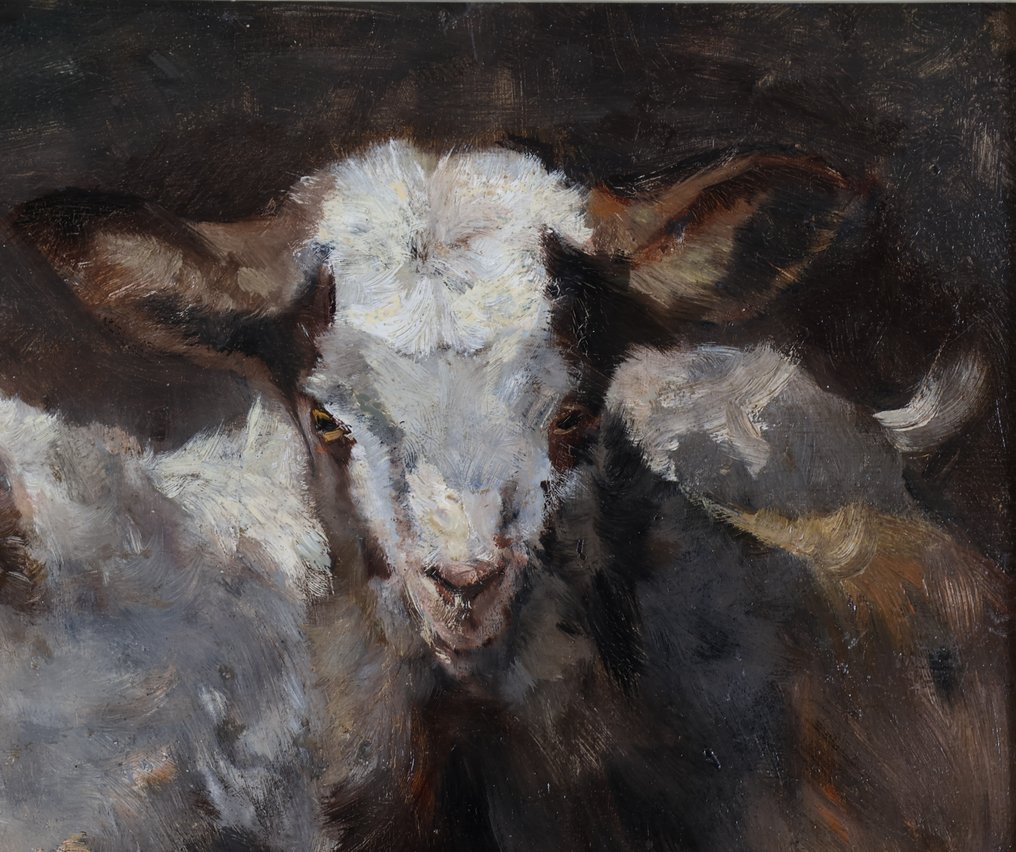
Willem Hendrik van der Nat (1864–1929) - Twee kleine geiten / Bloemstilleven




08
days
02
hours
09
minutes
14
seconds
Starting bid
€ 1
Reserve price not met

Expert
Selected by Leo Setz
Over 30 years’ experience as art dealer, appraiser and restorer.
Estimate € 1,100 - € 1,300
No bids placed
Catawiki Buyer Protection
Your payment’s safe with us until you receive your object.View details
Trustpilot 4.4 | 122813 reviews
Rated Excellent on Trustpilot.
Twee kleine geiten / Bloemstilleven is an oil painting from the 19th century in the Netherlands, executed in the Impressionism style and sold with its frame.
AI-assisted summary
Description from the seller
This is a special work, as it actually consists of two pieces. On the front of the panel, two baby goats are depicted, skillfully painted. You can almost touch them — so realistically is their soft, furry coat rendered. On the back of the panel, a surprise awaits: a beautiful still life with a subtle interplay between dark and light tulips.
Dimensions: 30 cm x 40 cm
Dimensions with frame: 45 cm x 54 cm
The work is in a beautiful frame, finished with gold leaf.
Willem Hendrik van der Nat (Leiden, 1864–1929) was a versatile artist: painter, draftsman, watercolorist, sculptor, etcher, illustrator, and lithographer. He received his first drawing lessons at a young age and later studied in The Hague and Leiden, where he became friends with artist Floris Verster and art critic H.P. Bremmer.
Initially, Van der Nat worked as an illustrator and lithographer, but around 1900 he fully dedicated himself to painting. His style evolved from the influence of the Hague School to a more expressive, colorful approach, partly inspired by Van Gogh and Millet. He gained fame with his paintings of sheep and goats, often created during his stays in Drenthe, but he also painted still lifes, landscapes, and Spanish scenes.
Van der Nat was a co-founder of the Leiden artists' association De Kunst om De Kunst and is considered part of the core of the so-called Leiden Impressionists—a group of painters distinguished by their loose brushwork and vivid use of color. They painted in and around the city of Leiden. The movement is related to the Hague School. His work is represented in the collections of several museums, such as the Stedelijk Museum De Lakenhal in Leiden and the Kröller-Müller Museum in Otterloo.
Seller's Story
Over Art Dumay
Art Dumay in Nuenen is much more than just a gallery. It is a versatile art enterprise that brings together modern and classical art under one roof. From our gallery for contemporary painting and our art dealership with classical works, we are engaged in evaluating, purchasing, and selling art. We do this both directly and through carefully organized art auctions for modern and classical art.
Our selection is broad and varied — from modern Dutch artists to renowned masters from the past.
With more than 25 years of experience, we successfully guide purchase and sale processes for individuals, companies, governments, and institutions.
Art Dumay has an extensive regional, national, and international network of buyers and collectors.
In addition to our sales activities, we also provide professional appraisals, restorations, and repair work in-house. Thanks to our effective auction methodology, we are able to reach a large international audience, while our art collections are safely stored and insured in our 1,000 m² building in Nuenen.
At Art Dumay, expertise, a passion for art, and personal attention are at the core — each day again.
Translated by Google TranslateThis is a special work, as it actually consists of two pieces. On the front of the panel, two baby goats are depicted, skillfully painted. You can almost touch them — so realistically is their soft, furry coat rendered. On the back of the panel, a surprise awaits: a beautiful still life with a subtle interplay between dark and light tulips.
Dimensions: 30 cm x 40 cm
Dimensions with frame: 45 cm x 54 cm
The work is in a beautiful frame, finished with gold leaf.
Willem Hendrik van der Nat (Leiden, 1864–1929) was a versatile artist: painter, draftsman, watercolorist, sculptor, etcher, illustrator, and lithographer. He received his first drawing lessons at a young age and later studied in The Hague and Leiden, where he became friends with artist Floris Verster and art critic H.P. Bremmer.
Initially, Van der Nat worked as an illustrator and lithographer, but around 1900 he fully dedicated himself to painting. His style evolved from the influence of the Hague School to a more expressive, colorful approach, partly inspired by Van Gogh and Millet. He gained fame with his paintings of sheep and goats, often created during his stays in Drenthe, but he also painted still lifes, landscapes, and Spanish scenes.
Van der Nat was a co-founder of the Leiden artists' association De Kunst om De Kunst and is considered part of the core of the so-called Leiden Impressionists—a group of painters distinguished by their loose brushwork and vivid use of color. They painted in and around the city of Leiden. The movement is related to the Hague School. His work is represented in the collections of several museums, such as the Stedelijk Museum De Lakenhal in Leiden and the Kröller-Müller Museum in Otterloo.
Seller's Story
Over Art Dumay
Art Dumay in Nuenen is much more than just a gallery. It is a versatile art enterprise that brings together modern and classical art under one roof. From our gallery for contemporary painting and our art dealership with classical works, we are engaged in evaluating, purchasing, and selling art. We do this both directly and through carefully organized art auctions for modern and classical art.
Our selection is broad and varied — from modern Dutch artists to renowned masters from the past.
With more than 25 years of experience, we successfully guide purchase and sale processes for individuals, companies, governments, and institutions.
Art Dumay has an extensive regional, national, and international network of buyers and collectors.
In addition to our sales activities, we also provide professional appraisals, restorations, and repair work in-house. Thanks to our effective auction methodology, we are able to reach a large international audience, while our art collections are safely stored and insured in our 1,000 m² building in Nuenen.
At Art Dumay, expertise, a passion for art, and personal attention are at the core — each day again.
Translated by Google TranslateDetails
Artist
Willem Hendrik van der Nat (1864–1929)
Sold with frame
Yes
Title of artwork
Twee kleine geiten / Bloemstilleven
Technique
Oil painting
Signature
Not signed
Country of Origin
Netherlands
Condition
Good condition
Height
45 cm
Width
54 cm
Style
Impressionism
Period
19th century
