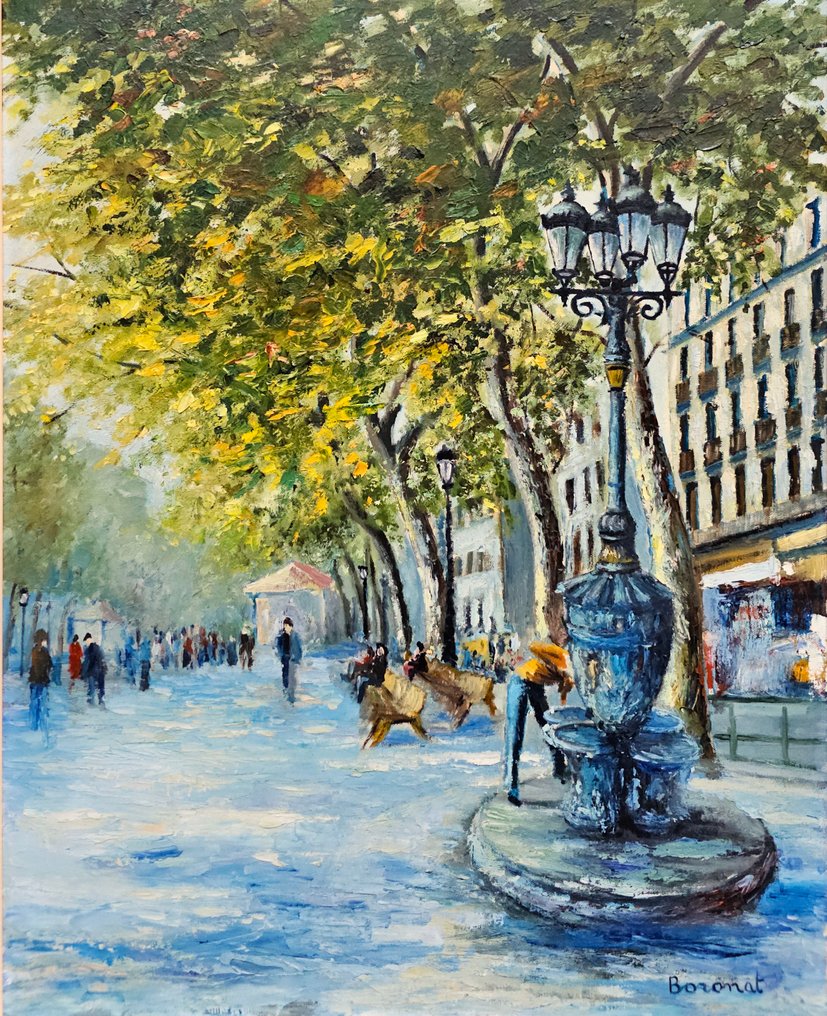
Antoni Boronat (1936) - Light on the Rambla in Barcelona


08
days
08
hours
23
minutes
40
seconds
Starting bid
€ 1
Reserve price not met

No bids placed
Catawiki Buyer Protection
Your payment’s safe with us until you receive your object.View details
Trustpilot 4.4 | 123053 reviews
Rated Excellent on Trustpilot.
Antoni Boronat (born 1936) painted Light on the Rambla in Barcelona, an oil on canvas from the 1960s in Spain; original edition, hand-signed, sold with a frame, 92 × 76 cm, weight 5 kg.
AI-assisted summary
Description from the seller
Walkway Light on La Rambla
Technical sheet
Author: Antoni Boronat (Barcelona, 1936)
Chronology: second half of the 20th century
Technique: oil on canvas
Measurements: 81 × 65 cm
Measurements with frame: 92 × 76 cm
Signature: signed 'Boronat' in the lower corner.
Condition: very good
Marco: high-quality wooden frame, wide molding in a patinated greenish tone with a gold inner edge, of a classic-contemporary character that enhances the chromatic depth of the set.
2. Compositional and iconographic description
The work depicts a lively urban stroll, probably along La Rambla in Barcelona, articulated through a perspective that leads the eye toward the boulevard's background. The focus is on the iconic fountain and central lamp post, rendered with a thick, vibrant brushstroke, contrasting with the atmospheric fluidity of the surroundings.
Lively human figures sketched with ease bring dynamism and everyday life, while the lushness of the trees filters the light and creates a play of greens, yellows, and blues that envelops the scene in a luminous and serene atmosphere. Urban iconography here becomes a pretext for a painting of sensations, more than of descriptive detail.
3. Style, School, and Comparative Valuation
Antoni Boronat is part of the tradition of the Catalan school of urban landscape, with a language close to Mediterranean post-impressionism. His loose and material brushwork, as well as his interest in changing light and city life, connect him with artists like Joaquim Mir, Eliseu Meifrèn, or, on a more international level, with urban scenes by Camille Pissarro and Jean-François Raffaëlli, who are now highly valued in the market.
This work stands out for its balance between compositional structure and gestural spontaneity, offering a poetic and recognizable view of the city. It is a highly attractive decorative piece, with pictorial skill and a marked collectible character within the artist's mature production.
Seller's Story
At Barcelona Art Gallery, we are a large family of art collectors in Barcelona who have been acquiring all kinds of paintings for 2 centuries.
Headquartered in the Les Corts neighborhood of Barcelona.
We offer part of our private collection for auction: high period and modern paintings that we have been acquiring over time, mainly from art galleries, antique dealers, auctions, private collections and very diverse origins.
Translated by Google TranslateWalkway Light on La Rambla
Technical sheet
Author: Antoni Boronat (Barcelona, 1936)
Chronology: second half of the 20th century
Technique: oil on canvas
Measurements: 81 × 65 cm
Measurements with frame: 92 × 76 cm
Signature: signed 'Boronat' in the lower corner.
Condition: very good
Marco: high-quality wooden frame, wide molding in a patinated greenish tone with a gold inner edge, of a classic-contemporary character that enhances the chromatic depth of the set.
2. Compositional and iconographic description
The work depicts a lively urban stroll, probably along La Rambla in Barcelona, articulated through a perspective that leads the eye toward the boulevard's background. The focus is on the iconic fountain and central lamp post, rendered with a thick, vibrant brushstroke, contrasting with the atmospheric fluidity of the surroundings.
Lively human figures sketched with ease bring dynamism and everyday life, while the lushness of the trees filters the light and creates a play of greens, yellows, and blues that envelops the scene in a luminous and serene atmosphere. Urban iconography here becomes a pretext for a painting of sensations, more than of descriptive detail.
3. Style, School, and Comparative Valuation
Antoni Boronat is part of the tradition of the Catalan school of urban landscape, with a language close to Mediterranean post-impressionism. His loose and material brushwork, as well as his interest in changing light and city life, connect him with artists like Joaquim Mir, Eliseu Meifrèn, or, on a more international level, with urban scenes by Camille Pissarro and Jean-François Raffaëlli, who are now highly valued in the market.
This work stands out for its balance between compositional structure and gestural spontaneity, offering a poetic and recognizable view of the city. It is a highly attractive decorative piece, with pictorial skill and a marked collectible character within the artist's mature production.
Seller's Story
At Barcelona Art Gallery, we are a large family of art collectors in Barcelona who have been acquiring all kinds of paintings for 2 centuries.
Headquartered in the Les Corts neighborhood of Barcelona.
We offer part of our private collection for auction: high period and modern paintings that we have been acquiring over time, mainly from art galleries, antique dealers, auctions, private collections and very diverse origins.
Translated by Google TranslateDetails
Artist
Antoni Boronat (1936)
Sold with frame
Yes
Sold by
Gallery
Edition
Original
Title of artwork
Light on the Rambla in Barcelona
Technique
Oil painting
Signature
Hand signed
Country of Origin
Spain
Condition
Excellent condition
Height
92 cm
Width
76 cm
Weight
5 kg
Style
Post-Impressionism
Period
1960-1970
Sold by
