Santi Moix Sala (1960) - Circle Of - Still Life in Balance



09
days
20
hours
47
minutes
17
seconds
Starting bid
€ 1
Reserve price not met

No bids placed
Catawiki Buyer Protection
Your payment’s safe with us until you receive your object.View details
Trustpilot 4.4 | 122910 reviews
Rated Excellent on Trustpilot.
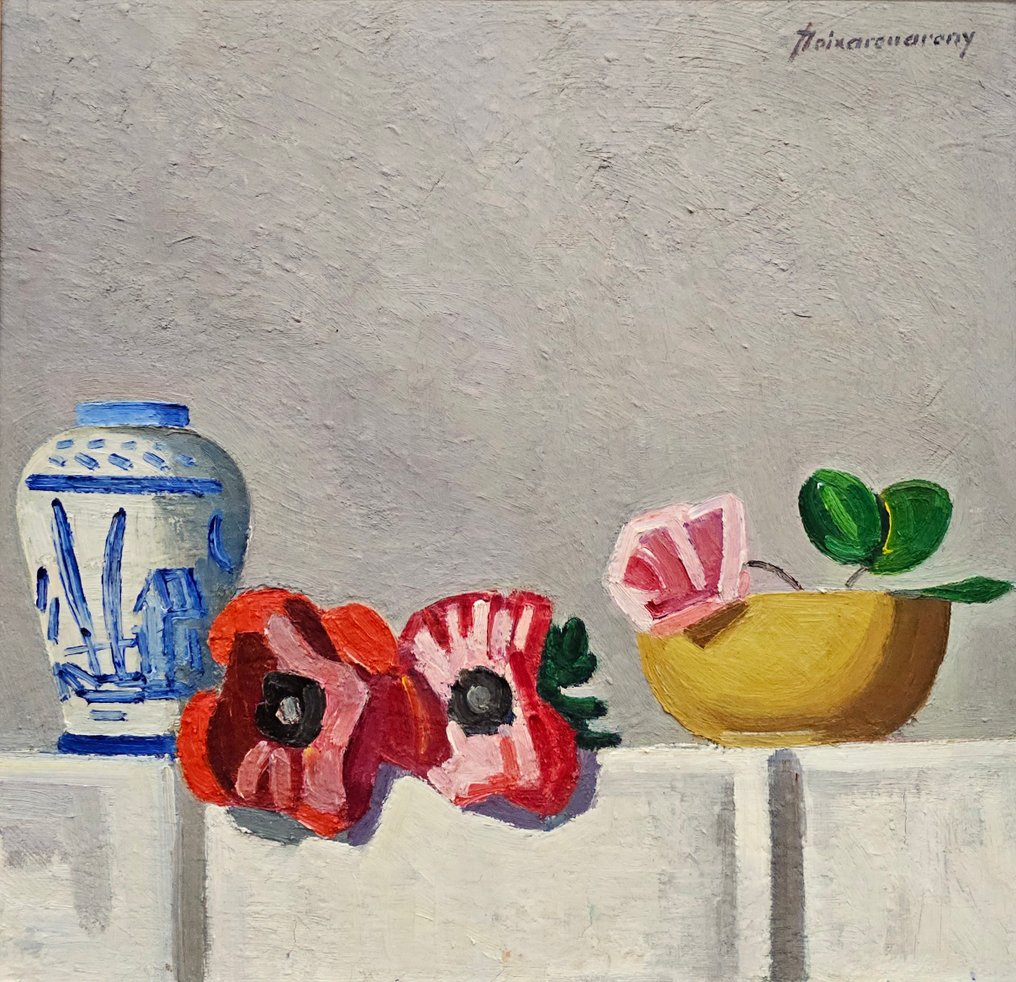
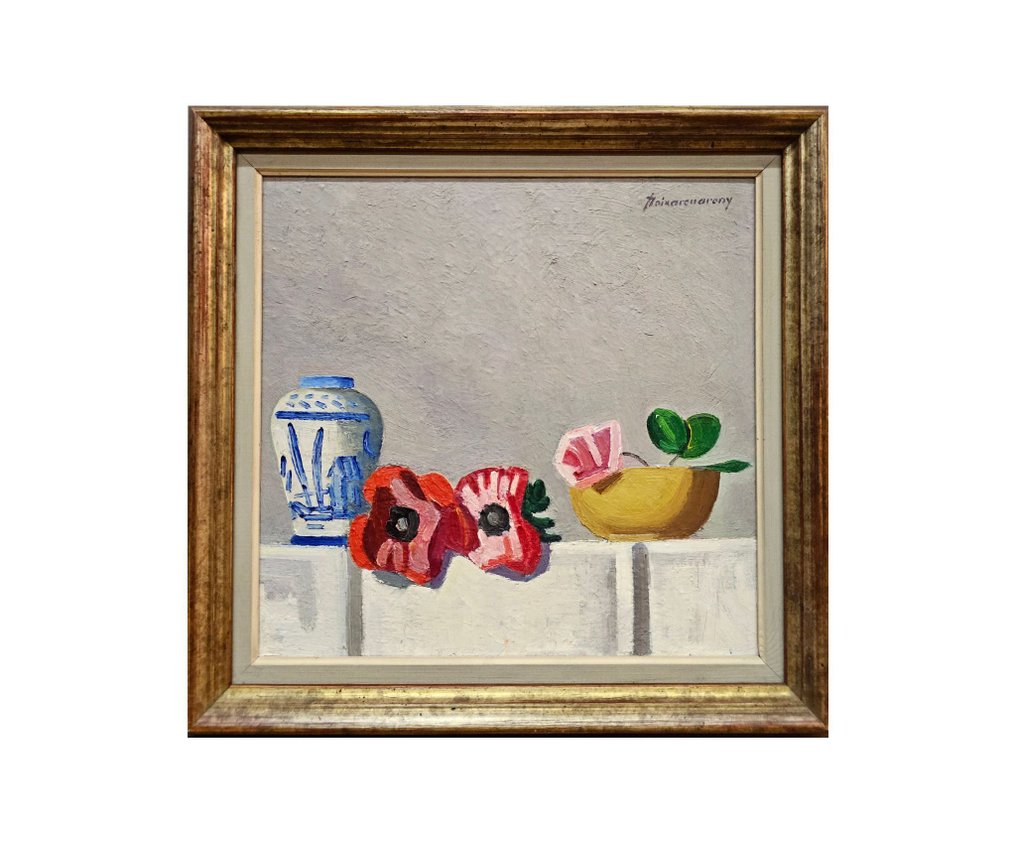
Still Life in Balance is an original oil painting on panel from Spain, dated 1990–2000, attributed to Circulo de Santi Moix Sala, hand-signed, sold with frame, measuring 52 × 54 cm.
AI-assisted summary
Description from the seller
Still Life in Balance
Technical sheet
Author: Circulo de Santi Moix Sala (Barcelona, 1960)
Chronology: 1991 (date inscribed on the back)
Oil on panel
Measurements: 41 × 43 cm
Measurements with frame: 52 × 54 cm
Company: pictorial inscription 'Moix areu areny' in the upper right corner; handwritten inscription and date on the back.
Condition: very good
Marco: high-quality wooden frame, sober molding with a warm patina and a light inner filet, with a contemporary character, correctly proportioned and respectful of the artwork.
2. Compositional and iconographic description
The work presents a still life with a horizontal composition, articulated on a white shelf that acts as a structural axis. On the left, a blue ceramic jar with oriental resonances; in the center, two open red flowers, treated with direct and expressive brushstrokes; on the right, a yellow bowl with a cut fruit and green leaves.
The neutral background, worked with a matte and enveloping texture, creates a silent space where objects float with precarious balance. Iconographically, the scene alludes to everyday life reinterpreted from a poetic perspective, where domestic elements acquire an almost symbolic presence, detached from the traditional narrative of the classical still life.
3. Style, School, and Comparative Valuation
From a stylistic perspective, the work is situated within a contemporary figurative art of postmodern origin, with clear echoes of lyrical neo-expressionism developed in Catalonia at the end of the 20th century.
The synthetic brushstroke, compositional frontalidad, and deliberate use of color convincingly refer to the universe of Santi Moix, especially his early still lifes, although the signature does not fully match the most well-known scripts of the artist, so the attribution should be approached with cautious reasoning.
In a broader context, the piece dialogues with languages present in authors such as Giorgio Morandi (for formal restraint), Miquel Barceló (for material and gesture), or Philip Guston in his most intimate aspect, artists of high international standing.
It is a suggestive work, with a strong personality, that gains interest precisely in the realm of open attribution and authorial mystery, adding discursive and collector's value.
Seller's Story
At Barcelona Art Gallery, we are a large family of art collectors in Barcelona who have been acquiring all kinds of paintings for 2 centuries.
Headquartered in the Les Corts neighborhood of Barcelona.
We offer part of our private collection for auction: high period and modern paintings that we have been acquiring over time, mainly from art galleries, antique dealers, auctions, private collections and very diverse origins.
Translated by Google TranslateStill Life in Balance
Technical sheet
Author: Circulo de Santi Moix Sala (Barcelona, 1960)
Chronology: 1991 (date inscribed on the back)
Oil on panel
Measurements: 41 × 43 cm
Measurements with frame: 52 × 54 cm
Company: pictorial inscription 'Moix areu areny' in the upper right corner; handwritten inscription and date on the back.
Condition: very good
Marco: high-quality wooden frame, sober molding with a warm patina and a light inner filet, with a contemporary character, correctly proportioned and respectful of the artwork.
2. Compositional and iconographic description
The work presents a still life with a horizontal composition, articulated on a white shelf that acts as a structural axis. On the left, a blue ceramic jar with oriental resonances; in the center, two open red flowers, treated with direct and expressive brushstrokes; on the right, a yellow bowl with a cut fruit and green leaves.
The neutral background, worked with a matte and enveloping texture, creates a silent space where objects float with precarious balance. Iconographically, the scene alludes to everyday life reinterpreted from a poetic perspective, where domestic elements acquire an almost symbolic presence, detached from the traditional narrative of the classical still life.
3. Style, School, and Comparative Valuation
From a stylistic perspective, the work is situated within a contemporary figurative art of postmodern origin, with clear echoes of lyrical neo-expressionism developed in Catalonia at the end of the 20th century.
The synthetic brushstroke, compositional frontalidad, and deliberate use of color convincingly refer to the universe of Santi Moix, especially his early still lifes, although the signature does not fully match the most well-known scripts of the artist, so the attribution should be approached with cautious reasoning.
In a broader context, the piece dialogues with languages present in authors such as Giorgio Morandi (for formal restraint), Miquel Barceló (for material and gesture), or Philip Guston in his most intimate aspect, artists of high international standing.
It is a suggestive work, with a strong personality, that gains interest precisely in the realm of open attribution and authorial mystery, adding discursive and collector's value.
Seller's Story
At Barcelona Art Gallery, we are a large family of art collectors in Barcelona who have been acquiring all kinds of paintings for 2 centuries.
Headquartered in the Les Corts neighborhood of Barcelona.
We offer part of our private collection for auction: high period and modern paintings that we have been acquiring over time, mainly from art galleries, antique dealers, auctions, private collections and very diverse origins.
Translated by Google TranslateDetails
Artist
Santi Moix Sala (1960) - Circle Of
Sold with frame
Yes
Sold by
Gallery
Edition
Original
Title of artwork
Still Life in Balance
Technique
Oil painting
Signature
Hand signed
Country of Origin
Spain
Condition
Excellent condition
Height
52 cm
Width
54 cm
Weight
4 kg
Depiction/Theme
Still life
Style
Post-Impressionism
Period
1990-2000
Sold by