Byōbu folding screen - A Japanese six-panel Byōbu 屏風 with turtles, peonies, deer, pheasants, fish and a Manchurian Crane - (Eishunsai) Mori Yōshin 永春斎森陽信 (1736-1808) - Japan - 1805 (Bunka 2)


05
days
21
hours
24
minutes
35
seconds
Starting bid
€ 1
Reserve price not met

Expert
Selected by Giovanni Bottero
Holds a master’s in Japanese art history with over 10 years’ expertise in Asian art.
Estimate € 1,900 - € 2,100
No bids placed
Catawiki Buyer Protection
Your payment’s safe with us until you receive your object.View details
Trustpilot 4.4 | 123077 reviews
Rated Excellent on Trustpilot.
A Japanese six-panel byōbu attributed to Eishunsai Mori Yōshin (1736–1808), dating to around 1800–1850 Bunka era, with a silver and gold leaf ground depicting turtles, peonies, deer, pheasants, fish and a Manchurian crane, mounted in a lacquered wooden frame and in good condition with craquelure and stains; includes an original certificate of authenticity.
AI-assisted summary
Description from the seller
A six-panel screen with paper applied over a ground of silver and gold leaf, depicting six subjects from Japanese symbolic tradition.
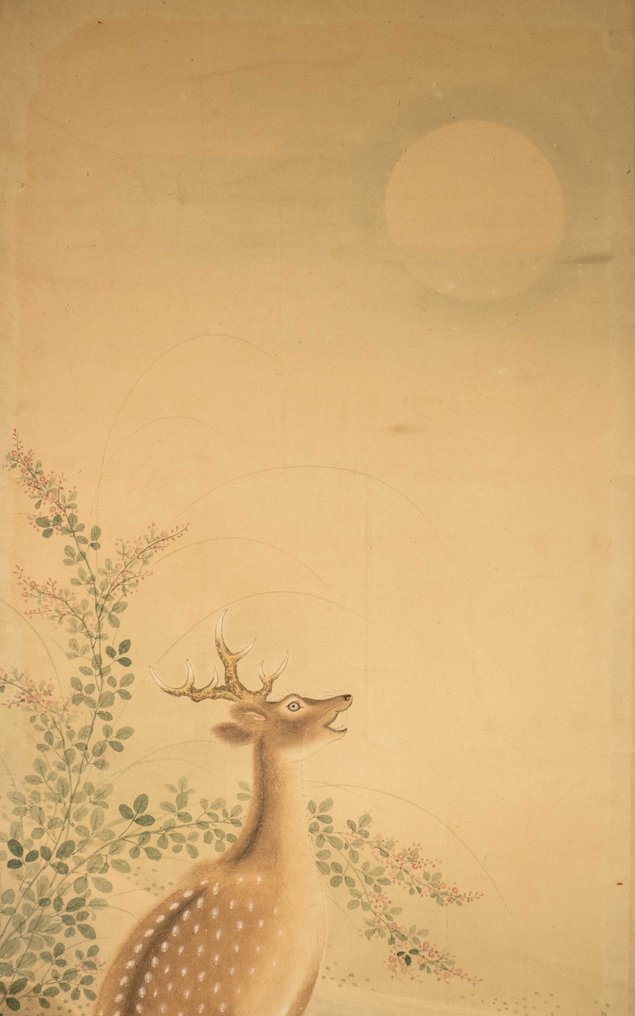
From left to right: turtles (亀) along a stream, symbols of longevity and good fortune; peonies (牡丹) with butterflies (蝶) in flight, emblem of prosperity and elegance; a deer (鹿) beneath the moon (月) beside a stream, sign of peace and renewal; pheasants (雉) perched on a pine tree (松), associated with vitality and fidelity; fish (魚) swimming upstream, an allegory of perseverance and, finally, a Manchurian crane (鶴) next to the artist’s long signature on the right panel, symbol of longevity and auspiciousness.
The panels are surrounded by two splendid silk borders, while a lacquered wooden frame completes and protects the screen.
The screen can also be easily mounted on a wall or used as a room divider.
Byōbu (屏風), literally “wind protection screens,” are traditional Japanese folding screens originally created to divide spaces and today appreciated above all as striking wall-mounted paintings.
--- The byobu is in good condition. Paper shows craquelure along the joints and the decoration, with stains visible along the silk frame. Please refer to the pictures for further details.
The item will be carefully packed and shipped via DHL or FedEx, accompanied by the original certificate of authenticity issued by Mastromauro Japanese art gallery based in Milan, Italy.
390
Seller's Story
Mastromauro Arte Giapponese, based in Milan, specializes in Japanese art, with particular attention to the Edo (1603–1868) and Meiji (1868–1912) periods, while also maintaining an open perspective on more contemporary works.
Here on Catawiki, they offer a part of their collection in every weekly auction.
Translated by Google TranslateA six-panel screen with paper applied over a ground of silver and gold leaf, depicting six subjects from Japanese symbolic tradition.
From left to right: turtles (亀) along a stream, symbols of longevity and good fortune; peonies (牡丹) with butterflies (蝶) in flight, emblem of prosperity and elegance; a deer (鹿) beneath the moon (月) beside a stream, sign of peace and renewal; pheasants (雉) perched on a pine tree (松), associated with vitality and fidelity; fish (魚) swimming upstream, an allegory of perseverance and, finally, a Manchurian crane (鶴) next to the artist’s long signature on the right panel, symbol of longevity and auspiciousness.
The panels are surrounded by two splendid silk borders, while a lacquered wooden frame completes and protects the screen.
The screen can also be easily mounted on a wall or used as a room divider.
Byōbu (屏風), literally “wind protection screens,” are traditional Japanese folding screens originally created to divide spaces and today appreciated above all as striking wall-mounted paintings.
--- The byobu is in good condition. Paper shows craquelure along the joints and the decoration, with stains visible along the silk frame. Please refer to the pictures for further details.
The item will be carefully packed and shipped via DHL or FedEx, accompanied by the original certificate of authenticity issued by Mastromauro Japanese art gallery based in Milan, Italy.
390
Seller's Story
Mastromauro Arte Giapponese, based in Milan, specializes in Japanese art, with particular attention to the Edo (1603–1868) and Meiji (1868–1912) periods, while also maintaining an open perspective on more contemporary works.
Here on Catawiki, they offer a part of their collection in every weekly auction.
Translated by Google TranslateDetails
Era
1400-1900
Country of Origin
Japan
Material
A Japanese six-panel Byōbu 屏風 with turtles, peonies, deer, pheasants, fish and a Manchurian Crane
Dynastic Style/Period
1805 (Bunka 2)
Artist
(Eishunsai) Mori Yōshin 永春斎森陽信 (1736-1808)
Condition
Good condition - used with small signs of aging & blemishes
Height
173 cm
Width
368.5 cm
Depth
2 cm
Estimated period
1800-1850
Sold by
