Alfredo Palmero de Gregorio (1901–1991), Atribuido a - Horses in the Shade



06
days
08
hours
00
minutes
00
seconds
Current bid
€ 40
Reserve price not met

6 other people are watching this object
 Bidder 9107 Bidder 9107 | €40 | |
|---|---|---|
| Bidder 9107 | €35 | |
| Bidder 9107 | €20 | |
Catawiki Buyer Protection
Your payment’s safe with us until you receive your object.View details
Trustpilot 4.4 | 123113 reviews
Rated Excellent on Trustpilot.
Horses in the Shade is an oil painting from Spain dating to 1980–1990.
AI-assisted summary
Description from the seller
Horses in the Shade
Technical sheet
Author: attributed to Alfredo Palmero de Gregorio (1901–1991)
Chronology: circa 1980
Technique: oil on canvas
Style: Lyric figurative expressionism.
Pictorial School: Spanish postwar school
Measurements: 68 × 82 cm
Measurements with frame: 86 × 100 cm
Condition: good, with slight losses that do not affect the overall condition.
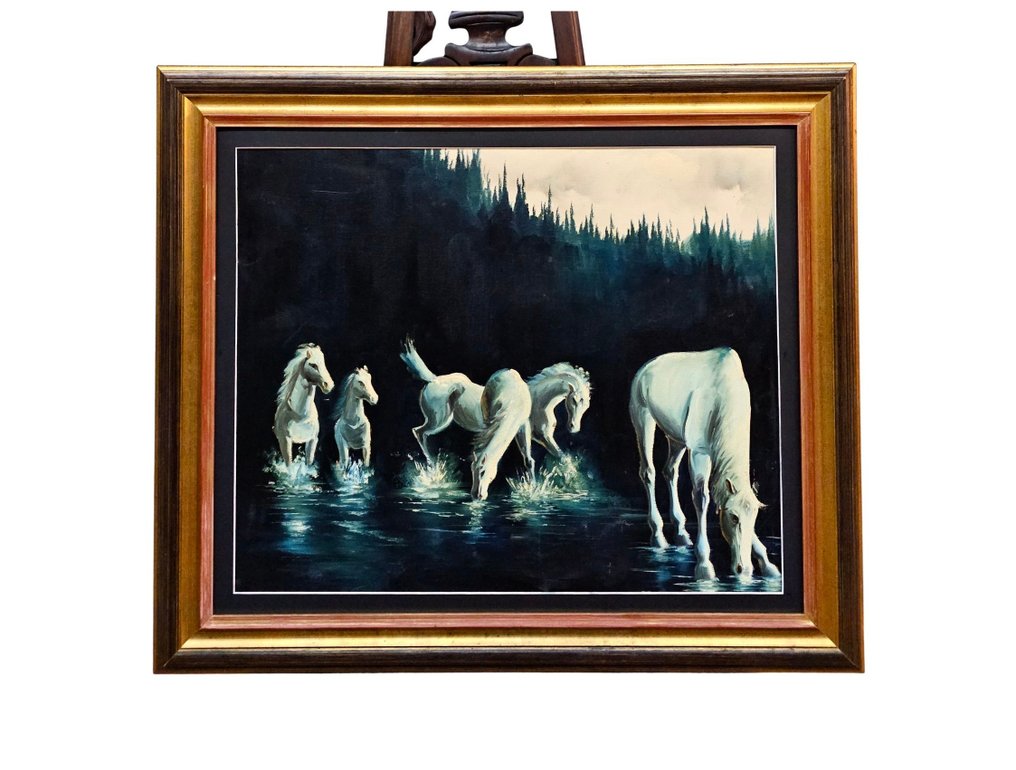
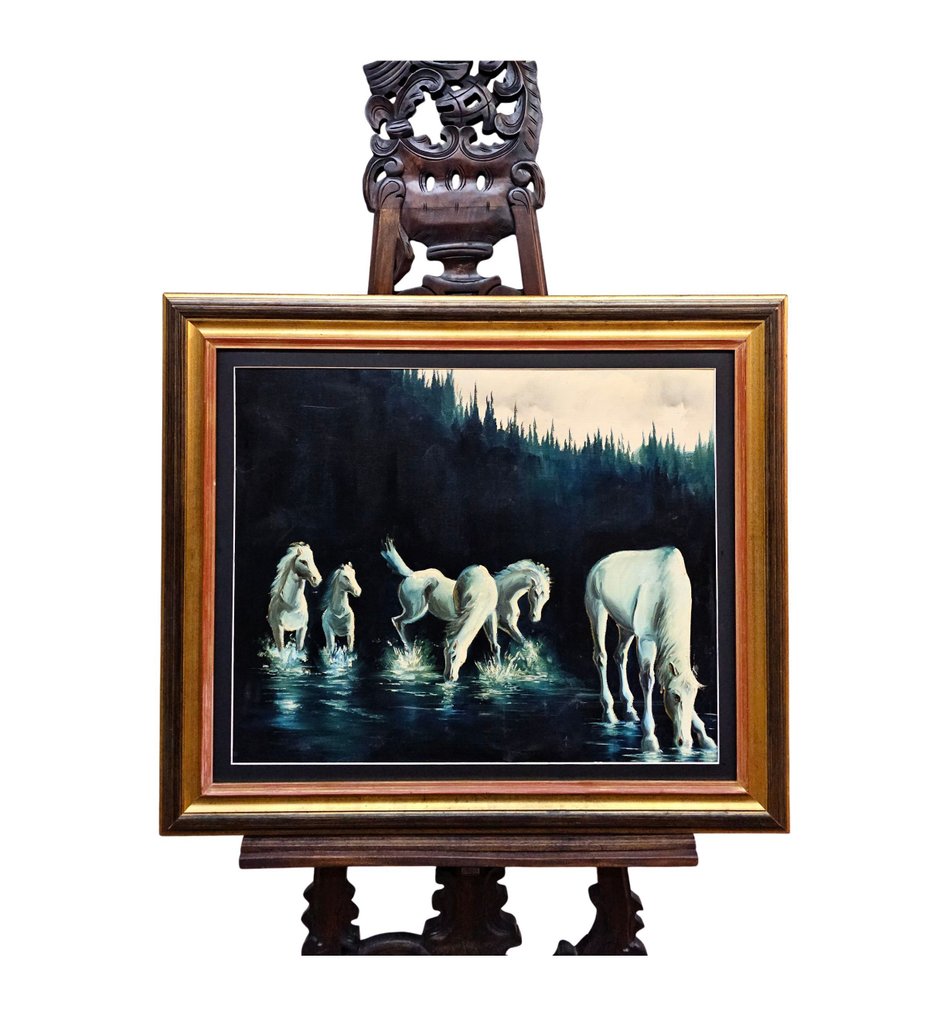
Marco: high-quality wooden frame with molding, featuring a combination of satin gold and dark patinated tones, with a black inner mat that enhances the contrast and depth of the scene.
2. Compositional and iconographic description
The work depicts a group of white horses advancing and drinking from a water sheet, arranged in a horizontal frieze against a forested background with a nocturnal atmosphere. The composition is built from the strong contrast between the luminous figures of the animals and the dark, enveloping landscape.
The brushstroke is broad, thickened, and energetic, especially on the bodies of the horses, treated with synthetic gestures that reinforce their physical power and movement.
Iconographically, the horse acts as a symbol of freedom, strength, and untamed nature, a recurring theme in 20th-century Spanish painting with readings both poetic and existential.
3. Style, School, and Comparative Valuation
From a stylistic point of view, the work confidently aligns with lyric figurative expressionism, characteristic of Alfredo Palmero de Gregorio, where form is subordinated to emotion and visual impact.
The reduced palette, lighting dramatism, and pictorial material connect with authors such as Zoran Mušič, Georges Rouault, or certain figurative registers of Antoni Tàpies in their most symbolic aspect, all of them of high international valuation.
It is a work of great theatrical impact and notable pictorial quality, very representative of the taste and sensitivity of post-war Spain.
Its format, theme, and setting make it an especially attractive piece for collectors and for contemporary artistic spaces.
Seller's Story
At Barcelona Art Gallery, we are a large family of art collectors in Barcelona who have been acquiring all kinds of paintings for 2 centuries.
Headquartered in the Les Corts neighborhood of Barcelona.
We offer part of our private collection for auction: high period and modern paintings that we have been acquiring over time, mainly from art galleries, antique dealers, auctions, private collections and very diverse origins.
Translated by Google Translate
Horses in the Shade
Technical sheet
Author: attributed to Alfredo Palmero de Gregorio (1901–1991)
Chronology: circa 1980
Technique: oil on canvas
Style: Lyric figurative expressionism.
Pictorial School: Spanish postwar school
Measurements: 68 × 82 cm
Measurements with frame: 86 × 100 cm
Condition: good, with slight losses that do not affect the overall condition.
Marco: high-quality wooden frame with molding, featuring a combination of satin gold and dark patinated tones, with a black inner mat that enhances the contrast and depth of the scene.
2. Compositional and iconographic description
The work depicts a group of white horses advancing and drinking from a water sheet, arranged in a horizontal frieze against a forested background with a nocturnal atmosphere. The composition is built from the strong contrast between the luminous figures of the animals and the dark, enveloping landscape.
The brushstroke is broad, thickened, and energetic, especially on the bodies of the horses, treated with synthetic gestures that reinforce their physical power and movement.
Iconographically, the horse acts as a symbol of freedom, strength, and untamed nature, a recurring theme in 20th-century Spanish painting with readings both poetic and existential.
3. Style, School, and Comparative Valuation
From a stylistic point of view, the work confidently aligns with lyric figurative expressionism, characteristic of Alfredo Palmero de Gregorio, where form is subordinated to emotion and visual impact.
The reduced palette, lighting dramatism, and pictorial material connect with authors such as Zoran Mušič, Georges Rouault, or certain figurative registers of Antoni Tàpies in their most symbolic aspect, all of them of high international valuation.
It is a work of great theatrical impact and notable pictorial quality, very representative of the taste and sensitivity of post-war Spain.
Its format, theme, and setting make it an especially attractive piece for collectors and for contemporary artistic spaces.
Seller's Story
At Barcelona Art Gallery, we are a large family of art collectors in Barcelona who have been acquiring all kinds of paintings for 2 centuries.
Headquartered in the Les Corts neighborhood of Barcelona.
We offer part of our private collection for auction: high period and modern paintings that we have been acquiring over time, mainly from art galleries, antique dealers, auctions, private collections and very diverse origins.
Translated by Google TranslateDetails
Artist
Alfredo Palmero de Gregorio (1901–1991), Atribuido a
Sold with frame
No
Sold by
Gallery
Edition
Original
Title of artwork
Horses in the Shade
Technique
Oil painting
Signature
Not signed
Country of Origin
Spain
Condition
Good condition
Height
86 cm
Width
100 cm
Weight
6 kg
Depiction/Theme
Animals and wildlife
Style
Expressionism
Period
1980-1990
Sold by
