J. Ritter (XIX-XX) - NO RESERVE - Trees in inner Vibration



09
days
16
hours
16
minutes
45
seconds

No bids placed
Catawiki Buyer Protection
Your payment’s safe with us until you receive your object.View details
Trustpilot 4.4 | 122910 reviews
Rated Excellent on Trustpilot.
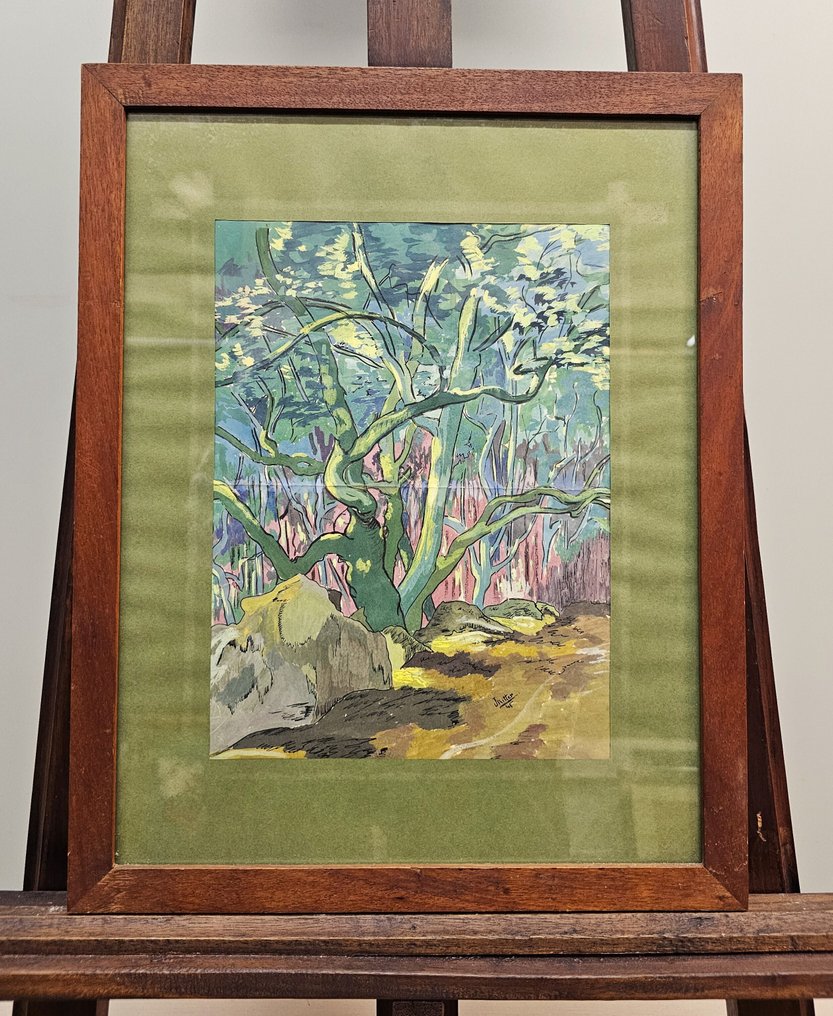
NO RESERVE - Trees in inner Vibration, 1940-1950, mixed media, Spain, sold with frame.
AI-assisted summary
Description from the seller
Proposed title: Trees in Inner Vibration
Technical sheet
Author: J. RITTER
Chronology: mid-20th century
Technique: mixed media on paper (watercolor, ink, and oil pencil)
Measurements: 31 × 23 cm (artwork) · 47 × 38 cm (framed)
Style: Lyrical Expressionism
Painting school: Modern European school of landscape
Condition: good; shows a slight horizontal fold typical of paper supports, stable and non-invasive.
Marco: solid wood quality frame, straight and sober molding, with an antique olive green mat, very well chosen and harmonious with the artwork's color palette.
2. Compositional and iconographic description
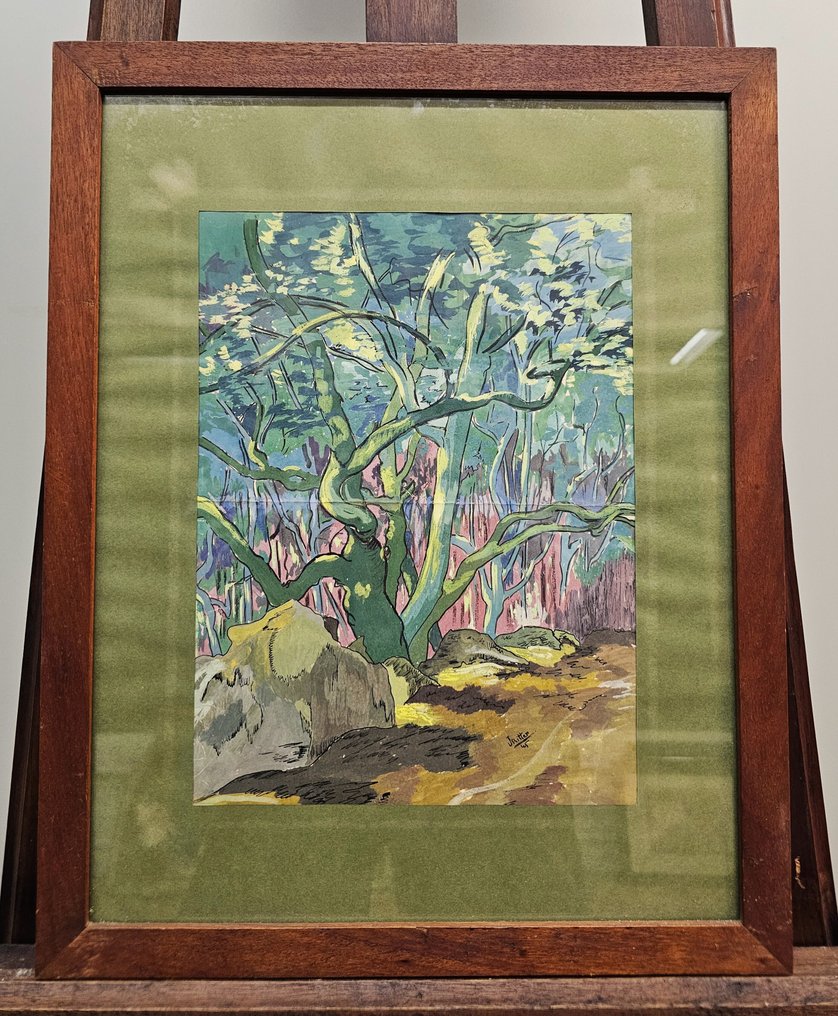
The work depicts a forest of twisted trunks and tensioned branches, articulated around a powerful central arboreal axis that dominates the composition.
Space is constructed through overlapping chromatic planes—greens, blues, ochres, and pinks—that create depth without relying on traditional academic perspective.
The black stroke, nervous and deliberately visible, delineates the shapes and reinforces the internal rhythm of the landscape.
Iconographically, the tree acts as a vital and organic symbol, almost anthropomorphic, evoking inner strength, growth, and resilience, in a nature interpreted more through emotion than literal observation.
3. Style, School, and Comparative Valuation
This work clearly aligns with a lyrical expressionism of Central European origin, where color and gesture construct the landscape as a subjective experience. Julián Ritter's language dialogues with artists like Oskar Kokoschka, Emil Nolde, or certain landscapes by Chaïm Soutine, all highly regarded references of European expressionism.
The combination of mixed media, structural drawing, and vibrant color confers the work with notable plastic intensity and a strong decorative character.
It is a very representative piece of mid-20th-century modern sensibility, appealing both to collectors of works on paper and to lovers of expressive landscapes with personality and a solid artistic discourse.
Seller's Story
At Barcelona Art Gallery, we are a large family of art collectors in Barcelona who have been acquiring all kinds of paintings for 2 centuries.
Headquartered in the Les Corts neighborhood of Barcelona.
We offer part of our private collection for auction: high period and modern paintings that we have been acquiring over time, mainly from art galleries, antique dealers, auctions, private collections and very diverse origins.
Translated by Google TranslateProposed title: Trees in Inner Vibration
Technical sheet
Author: J. RITTER
Chronology: mid-20th century
Technique: mixed media on paper (watercolor, ink, and oil pencil)
Measurements: 31 × 23 cm (artwork) · 47 × 38 cm (framed)
Style: Lyrical Expressionism
Painting school: Modern European school of landscape
Condition: good; shows a slight horizontal fold typical of paper supports, stable and non-invasive.
Marco: solid wood quality frame, straight and sober molding, with an antique olive green mat, very well chosen and harmonious with the artwork's color palette.
2. Compositional and iconographic description
The work depicts a forest of twisted trunks and tensioned branches, articulated around a powerful central arboreal axis that dominates the composition.
Space is constructed through overlapping chromatic planes—greens, blues, ochres, and pinks—that create depth without relying on traditional academic perspective.
The black stroke, nervous and deliberately visible, delineates the shapes and reinforces the internal rhythm of the landscape.
Iconographically, the tree acts as a vital and organic symbol, almost anthropomorphic, evoking inner strength, growth, and resilience, in a nature interpreted more through emotion than literal observation.
3. Style, School, and Comparative Valuation
This work clearly aligns with a lyrical expressionism of Central European origin, where color and gesture construct the landscape as a subjective experience. Julián Ritter's language dialogues with artists like Oskar Kokoschka, Emil Nolde, or certain landscapes by Chaïm Soutine, all highly regarded references of European expressionism.
The combination of mixed media, structural drawing, and vibrant color confers the work with notable plastic intensity and a strong decorative character.
It is a very representative piece of mid-20th-century modern sensibility, appealing both to collectors of works on paper and to lovers of expressive landscapes with personality and a solid artistic discourse.
Seller's Story
At Barcelona Art Gallery, we are a large family of art collectors in Barcelona who have been acquiring all kinds of paintings for 2 centuries.
Headquartered in the Les Corts neighborhood of Barcelona.
We offer part of our private collection for auction: high period and modern paintings that we have been acquiring over time, mainly from art galleries, antique dealers, auctions, private collections and very diverse origins.
Translated by Google TranslateDetails
Artist
J. Ritter (XIX-XX)
Sold with frame
Yes
Sold by
Gallery
Edition
Original
Title of artwork
NO RESERVE - Trees in inner Vibration
Technique
Mixed media
Signature
Hand signed
Country of Origin
Spain
Condition
Good condition
Height
47 cm
Width
38 cm
Weight
2 kg
Depiction/Theme
Landscape
Style
Impressionism
Period
1940-1950
Sold by
