Luis Derqui (1883-1956) - Portrait of a Bullfighter


09
days
10
hours
20
minutes
27
seconds
Starting bid
€ 1
Reserve price not met

No bids placed
Catawiki Buyer Protection
Your payment’s safe with us until you receive your object.View details
Trustpilot 4.4 | 122910 reviews
Rated Excellent on Trustpilot.
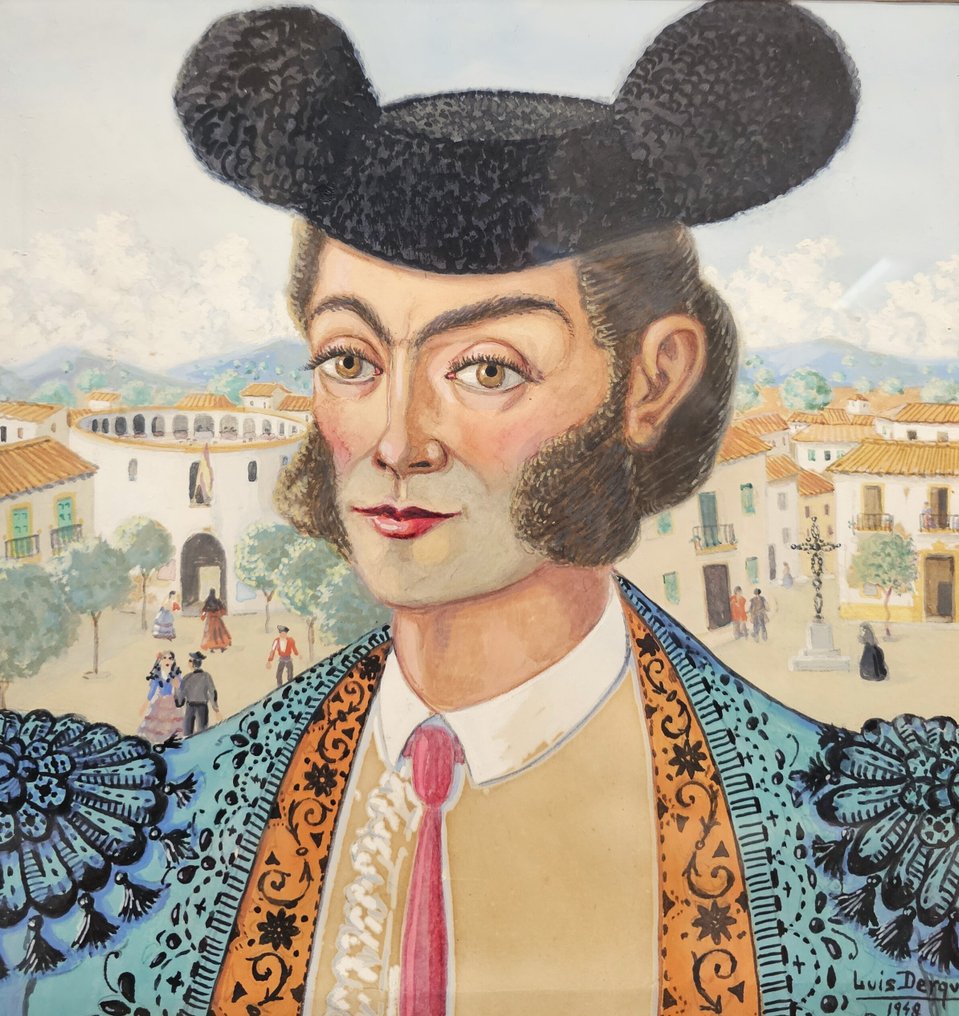
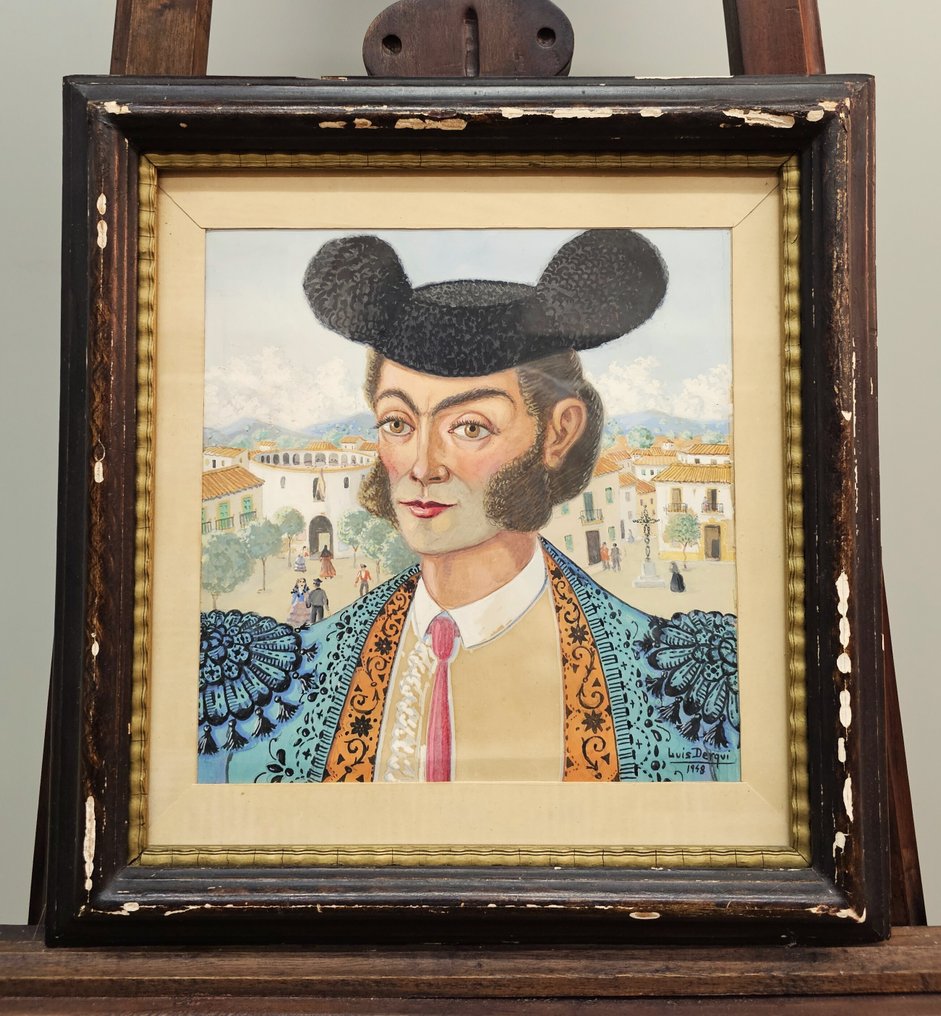
Portrait of a Bullfighter, a 1948 Spanish gouache and pastel portrait, framed, 42 × 41 cm.
AI-assisted summary
Description from the seller
Technical sheet
Author: Derqui, Luis (Ceuta, 1883 — Palma de Mallorca, 1956)
Portrait of a bullfighter in front of a Mediterranean plaza
Chronology: 1948 (dated and signed)
Technique: Mixed media drawing on paper (watercolor, gouache, and ink)
Measurements: 27 × 26 cm (artwork) · 42 × 41 cm (framed)
Marco: Antique dark wood frame with gilded interior molding; original period set, handcrafted quality (It is sent as a gift).
Condition: Good; slight signs of aging typical of the paper and the original assembly.
2. Compositional and iconographic description
The work presents an idealized frontal portrait of a bullfighter, with a direct gaze and serene expression, dressed in a richly ornamented suit and a black montera. The bust is firmly outlined against an Andalusian urban landscape, where a porticoed square, whitewashed houses, and a central cross are recognizable, animated by small popular figures.
The treatment of the face combines gentle volume and expressive lines, while the costume is enriched with an elaborate decorative work inspired by popular and ornamental motifs. The palette is luminous, dominated by blues, ochres, and Mediterranean greens, with a balance between narrative innocence and formal precision.
Iconographically, the work celebrates the figure of the torero as a cultural symbol, integrating it into an everyday scene that reinforces its social and customary dimension.
3. Style, School, and Comparative Valuation
The work is rooted in Spanish modern figurative art with a costumbrista origin, clearly linked to cultured naive art and Mediterranean poetic realism.
The use of the black line, the simplification of volumes, and the scenic narrative recall artists such as José Gutiérrez Solana (in a gentle tone), Mariano Bertuchi, or certain popular portraits by Vázquez Díaz and late noucentisme.
Luis Derqui develops here a personal, elegant, and recognizable language, where tradition, fantasy, and decorative sensitivity coexist. It is an attractive work, well signed and dated, with strong aesthetic and collectible value, especially interesting within the Spanish figurative drawing market of the 20th century.
Seller's Story
At Barcelona Art Gallery, we are a large family of art collectors in Barcelona who have been acquiring all kinds of paintings for 2 centuries.
Headquartered in the Les Corts neighborhood of Barcelona.
We offer part of our private collection for auction: high period and modern paintings that we have been acquiring over time, mainly from art galleries, antique dealers, auctions, private collections and very diverse origins.
Translated by Google TranslateTechnical sheet
Author: Derqui, Luis (Ceuta, 1883 — Palma de Mallorca, 1956)
Portrait of a bullfighter in front of a Mediterranean plaza
Chronology: 1948 (dated and signed)
Technique: Mixed media drawing on paper (watercolor, gouache, and ink)
Measurements: 27 × 26 cm (artwork) · 42 × 41 cm (framed)
Marco: Antique dark wood frame with gilded interior molding; original period set, handcrafted quality (It is sent as a gift).
Condition: Good; slight signs of aging typical of the paper and the original assembly.
2. Compositional and iconographic description
The work presents an idealized frontal portrait of a bullfighter, with a direct gaze and serene expression, dressed in a richly ornamented suit and a black montera. The bust is firmly outlined against an Andalusian urban landscape, where a porticoed square, whitewashed houses, and a central cross are recognizable, animated by small popular figures.
The treatment of the face combines gentle volume and expressive lines, while the costume is enriched with an elaborate decorative work inspired by popular and ornamental motifs. The palette is luminous, dominated by blues, ochres, and Mediterranean greens, with a balance between narrative innocence and formal precision.
Iconographically, the work celebrates the figure of the torero as a cultural symbol, integrating it into an everyday scene that reinforces its social and customary dimension.
3. Style, School, and Comparative Valuation
The work is rooted in Spanish modern figurative art with a costumbrista origin, clearly linked to cultured naive art and Mediterranean poetic realism.
The use of the black line, the simplification of volumes, and the scenic narrative recall artists such as José Gutiérrez Solana (in a gentle tone), Mariano Bertuchi, or certain popular portraits by Vázquez Díaz and late noucentisme.
Luis Derqui develops here a personal, elegant, and recognizable language, where tradition, fantasy, and decorative sensitivity coexist. It is an attractive work, well signed and dated, with strong aesthetic and collectible value, especially interesting within the Spanish figurative drawing market of the 20th century.
Seller's Story
At Barcelona Art Gallery, we are a large family of art collectors in Barcelona who have been acquiring all kinds of paintings for 2 centuries.
Headquartered in the Les Corts neighborhood of Barcelona.
We offer part of our private collection for auction: high period and modern paintings that we have been acquiring over time, mainly from art galleries, antique dealers, auctions, private collections and very diverse origins.
Translated by Google TranslateDetails
Artist
Luis Derqui (1883-1956)
Sold with frame
Yes
Sold by
Gallery
Edition
Original
Title of artwork
Portrait of a Bullfighter
Technique
Gouache, Pastel
Signature
Hand signed
Country of Origin
Spain
Year
1948
Condition
Good condition
Height
42 cm
Width
41 cm
Weight
2 kg
Depiction/Theme
Portrait
Style
Impressionism
Period
1940-1950
Sold by
