Lídia Vives - Morphology of Forgetting



05
days
00
hours
13
minutes
35
seconds
Current bid
€ 100
Reserve price not met

Expert
Selected by Elena Vaninetti
Has over ten years of experience in art, specialising in post-war photography and contemporary art.
Estimate € 1,300 - € 1,600
12 other people are watching this object
 Bidder 6094 Bidder 6094 | €100 |
|---|
Catawiki Buyer Protection
Your payment’s safe with us until you receive your object.View details
Trustpilot 4.4 | 123294 reviews
Rated Excellent on Trustpilot.
Description from the seller
Lídia Vives, Lleida (Spain), 1991.
Self-portrait
Morphology of Forgetting, produced and printed in 2025.
Printed on Hahnemühle Fine Art Baryta paper with a super glossy finish.
Edition 1/3
The actual size of the photograph is 67x100cm; including the mat and frame, the overall dimensions are 122.5x91.6cm.
Quality frame with mat and museum glass.
Work signed on the back of the paper and the frame.
Directly from the artist.
Includes a certificate of authenticity.
The artwork is shipped with corner protectors, bubble wrap, and cardboard wrapping to ensure maximum protection. Shipping is carried out via DHL Express and includes insurance.
Along with the shipment, a signed postcard with a personal note from the author and a pair of cotton gloves to handle the artwork are included.
This artwork was exhibited at the Affordable Art Fair in Amsterdam.
ABOUT THE WORK
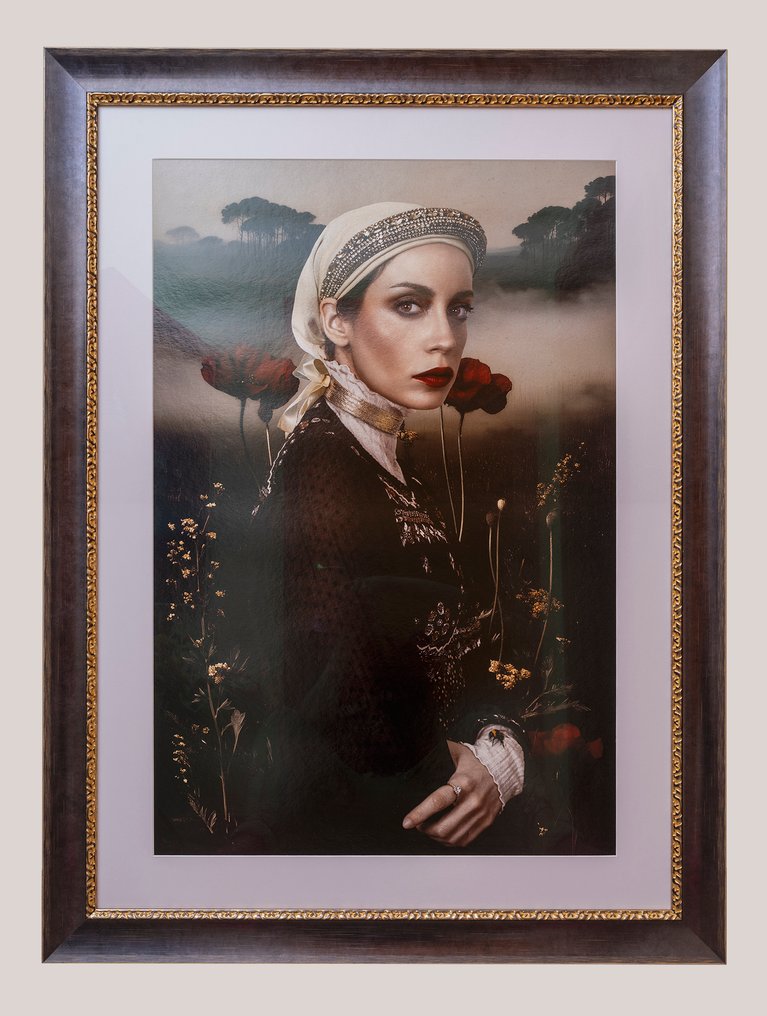
In Morphology of Forgetting, the symbols emerge with a contained strength, exploring the relationship between memory and forgetting through an image imbued with stillness and emotional resonance.
The female figure, with a gaze that mixes distance and melancholy, is surrounded by poppies (flowers traditionally associated with sleep, forgetfulness, and the threshold between life and death). Without resorting to literalism, the photograph evokes the latent form in which memories endure: not as clear scenes, but as silent presences that continue to surface from within.
Inspired by classical iconography, the scene creates a suspended, almost ritualistic atmosphere. The costume, light, and composition dialogue with pictorial tradition, but from a contemporary perspective that places the symbolic at the center of the visual.
More than representing, the image suggests. It invites us to think of memory not as an archive, but as an emotional landscape: a territory where what we believed forgotten still blooms, even if only in shadow.
About the artist:
Lídia Vives (1991) is a photographer and visual artist based in Barcelona. Her work has been published in Vogue Italia, Esquire, and exhibited at museums such as the Louvre (Paris) and the Saatchi Gallery (London).
Internationally recognized for her pictorial and narrative style, Lídia creates images that combine symbolism, color, and emotion, often hiding small 'easter eggs' that invite a deeper look.
Seller's Story
Lídia Vives is a visual artist and fine art photographer born in Lleida and based in Barcelona. Her work fuses pictorial tradition, symbolic storytelling and contemporary fashion aesthetics, creating images that go beyond visual beauty to reveal hidden layers of meaning.
She is known for hiding secrets in her photographs — enigmatic symbols, subtle narrative details, and recurring elements such as bees. These visual mysteries have become her signature, offering viewers the chance to decode personal and universal themes embedded in each composition.
With influences from Renaissance and Baroque painting, Vives constructs her photographs with meticulous art direction, often integrating custom-made props, mixed media, and self-portraiture. Her imagery balances the timeless and the surreal, evoking a sense of suspended reality.
Her work has been exhibited in museums, galleries, and international art fairs, and featured in publications including Vogue Italia and Esquire. She has collaborated with institutions and brands such as RTVE and Penguin Random House, and her pieces are part of private collections around the world.
Lídia Vives, Lleida (Spain), 1991.
Self-portrait
Morphology of Forgetting, produced and printed in 2025.
Printed on Hahnemühle Fine Art Baryta paper with a super glossy finish.
Edition 1/3
The actual size of the photograph is 67x100cm; including the mat and frame, the overall dimensions are 122.5x91.6cm.
Quality frame with mat and museum glass.
Work signed on the back of the paper and the frame.
Directly from the artist.
Includes a certificate of authenticity.
The artwork is shipped with corner protectors, bubble wrap, and cardboard wrapping to ensure maximum protection. Shipping is carried out via DHL Express and includes insurance.
Along with the shipment, a signed postcard with a personal note from the author and a pair of cotton gloves to handle the artwork are included.
This artwork was exhibited at the Affordable Art Fair in Amsterdam.
ABOUT THE WORK
In Morphology of Forgetting, the symbols emerge with a contained strength, exploring the relationship between memory and forgetting through an image imbued with stillness and emotional resonance.
The female figure, with a gaze that mixes distance and melancholy, is surrounded by poppies (flowers traditionally associated with sleep, forgetfulness, and the threshold between life and death). Without resorting to literalism, the photograph evokes the latent form in which memories endure: not as clear scenes, but as silent presences that continue to surface from within.
Inspired by classical iconography, the scene creates a suspended, almost ritualistic atmosphere. The costume, light, and composition dialogue with pictorial tradition, but from a contemporary perspective that places the symbolic at the center of the visual.
More than representing, the image suggests. It invites us to think of memory not as an archive, but as an emotional landscape: a territory where what we believed forgotten still blooms, even if only in shadow.
About the artist:
Lídia Vives (1991) is a photographer and visual artist based in Barcelona. Her work has been published in Vogue Italia, Esquire, and exhibited at museums such as the Louvre (Paris) and the Saatchi Gallery (London).
Internationally recognized for her pictorial and narrative style, Lídia creates images that combine symbolism, color, and emotion, often hiding small 'easter eggs' that invite a deeper look.
Seller's Story
Lídia Vives is a visual artist and fine art photographer born in Lleida and based in Barcelona. Her work fuses pictorial tradition, symbolic storytelling and contemporary fashion aesthetics, creating images that go beyond visual beauty to reveal hidden layers of meaning.
She is known for hiding secrets in her photographs — enigmatic symbols, subtle narrative details, and recurring elements such as bees. These visual mysteries have become her signature, offering viewers the chance to decode personal and universal themes embedded in each composition.
With influences from Renaissance and Baroque painting, Vives constructs her photographs with meticulous art direction, often integrating custom-made props, mixed media, and self-portraiture. Her imagery balances the timeless and the surreal, evoking a sense of suspended reality.
Her work has been exhibited in museums, galleries, and international art fairs, and featured in publications including Vogue Italia and Esquire. She has collaborated with institutions and brands such as RTVE and Penguin Random House, and her pieces are part of private collections around the world.
Details
Date of print
2025
Artist
Lídia Vives
Sold by
Direct from the artist
Title of artwork
Morphology of Forgetting
Condition
Extremely fine
Technique
Digital print
Height
122.5 cm
Edition
1/3
Width
91.6 cm
Signature
Signed
Genre
Portrait
Sold by