Folding screen - Tigers, Chinese Figures, and Pavilion - Japan - Edo Period (1600-1868)


05
days
02
hours
07
minutes
57
seconds
Current bid
€ 1
Reserve price not met

Expert
Selected by Giovanni Bottero
Holds a master’s in Japanese art history with over 10 years’ expertise in Asian art.
Estimate € 550 - € 650
5 other people are watching this object
 Bidder 3157 Bidder 3157 | €1 |
|---|
Catawiki Buyer Protection
Your payment’s safe with us until you receive your object.View details
Trustpilot 4.4 | 123113 reviews
Rated Excellent on Trustpilot.
Description from the seller
【Important notes】
・International buyers are responsible for any import duties, taxes, and charges not included in the item price or shipping cost. Please note that VAT paid to Catawiki is separate from and does not cover import duties or customs charges in your country. You may still be required to pay additional fees upon delivery, as determined by your local customs authorities.
・Shipping Details: Most items are shipped via Japan Post EMS (airmail). If you are in a hurry, we can arrange shipping via DHL or FedEx upon request for an additional fee.
・Damage and Issues: If you receive a damaged item, please contact us immediately. The damage must be reported to your local post office within 7 days of delivery, and promptly to us and Catawiki support.
【Product details】
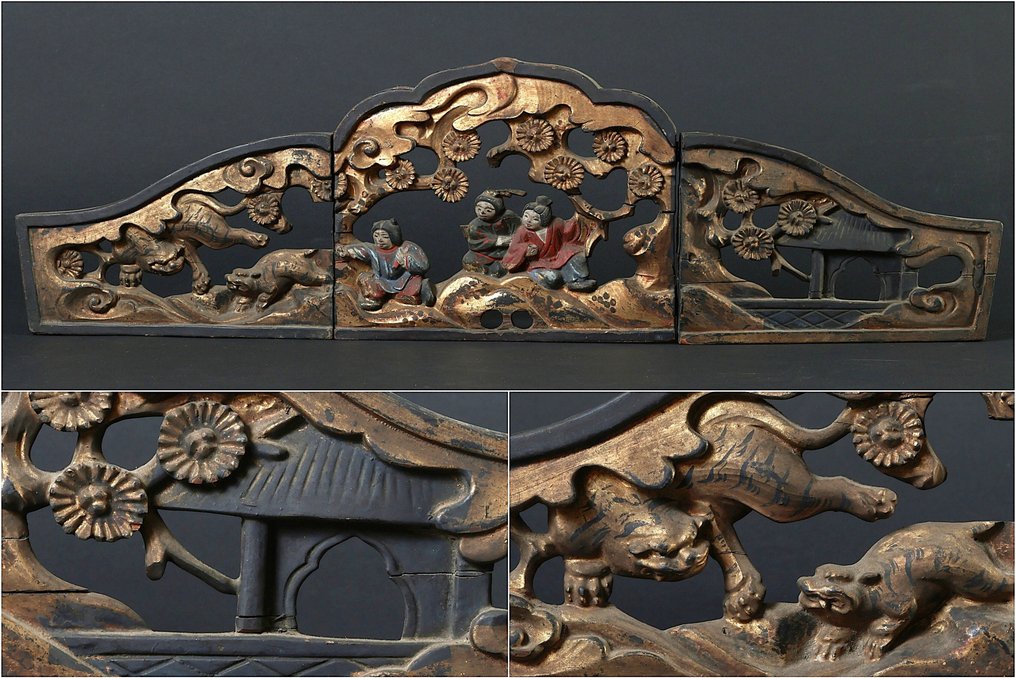
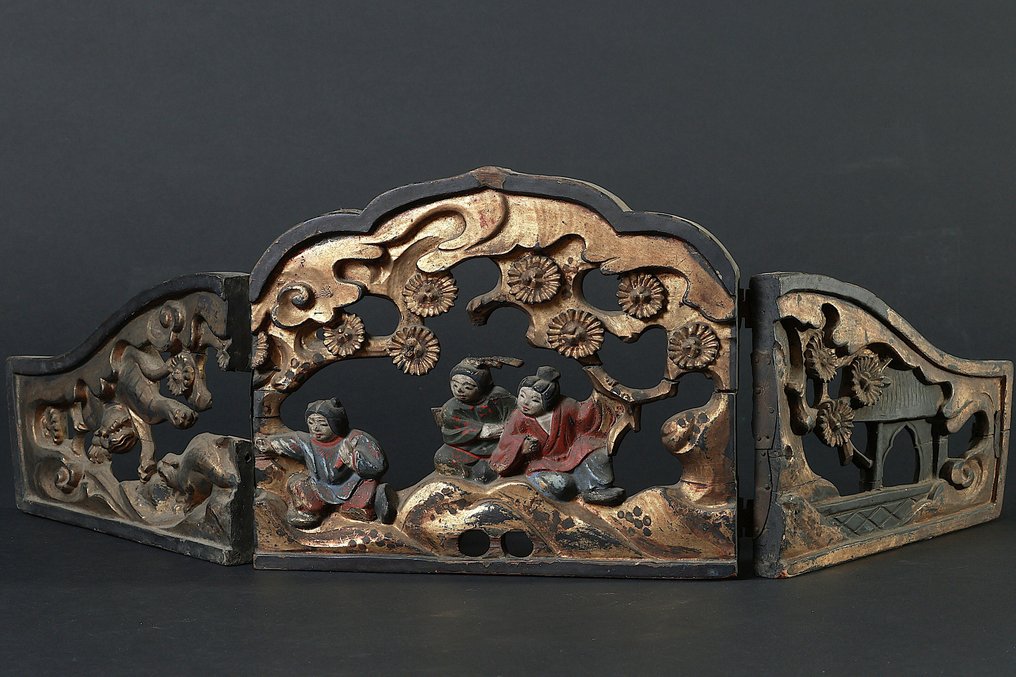
A small three-panel folding screen (byobu) from the Edo period, hand-carved in wood using an openwork (pierced) technique and richly decorated with lacquer and gold. The arched form is connected by hinges, allowing it to be displayed either folded or extended.
The left panel depicts a tigress with her cub, embodying strength, courage, and protection. Tigers in East Asian art are often regarded as guardian beasts, warding off evil spirits and symbolising natural power. The central panel shows three Chinese figures in brightly painted robes beneath a flowering tree. Such depictions of Chinese figures reflect Japan’s fascination with continental culture, often symbolising wisdom, exotic refinement, and scholarly ideals. The right panel features an architectural pavilion, suggesting cultural exchange and harmony. Decorative blossoms frame the scene throughout, enhancing the lively narrative. The gold areas are created with lacquer mixed with gold powder, giving a luminous finish.
This openwork carving combines animal symbolism, cultural motifs, and architectural imagery, reflecting the eclectic artistic influences of the Edo period.
Condition: Signs of age and wear, with scuffs, scratches, flaking and cracks in the lacquer, wood losses, discolouration, dirt, missing metal fittings, and surface deterioration. Some sections of wood show splits and breaks with a few repaired areas. Metal fittings show rust, and there is accumulated dust. Please check the photos carefully for details of the condition.
Dimensions: approx. H 19 cm W 66 cm D 2 cm
・Please make sure to review all the provided information and images before placing your bid.
・We make every effort to accurately represent the product's colors and textures in our photos. However, due to differences in monitors and device displays, as well as photographic conditions, slight color variations between the photos and the actual product may occur. We ask for your understanding in advance.
Thank you for your interest, and happy bidding!
Seller's Story
Welcome to Yorozuya Arinsu!
We are an antique shop based on the outskirts of Tokyo, originally focusing on the Japanese market but proudly expanding to serve international customers. In August 2023, we became a pro seller on Catawiki, and since then, we’ve enjoyed sharing our passion for Japanese art and antiques with collectors worldwide.
Our collection includes a diverse range of items, from genuine antiques to contemporary art pieces. We take pride in offering unique, high-quality objects that reflect Japan’s rich cultural heritage as well as modern creativity. If there’s something specific you’re looking for, feel free to reach out to us on Instagram: 【yorozuya_arinsu】
Thank you for visiting our shop, and we look forward to helping you find your next special piece!
【Important notes】
・International buyers are responsible for any import duties, taxes, and charges not included in the item price or shipping cost. Please note that VAT paid to Catawiki is separate from and does not cover import duties or customs charges in your country. You may still be required to pay additional fees upon delivery, as determined by your local customs authorities.
・Shipping Details: Most items are shipped via Japan Post EMS (airmail). If you are in a hurry, we can arrange shipping via DHL or FedEx upon request for an additional fee.
・Damage and Issues: If you receive a damaged item, please contact us immediately. The damage must be reported to your local post office within 7 days of delivery, and promptly to us and Catawiki support.
【Product details】
A small three-panel folding screen (byobu) from the Edo period, hand-carved in wood using an openwork (pierced) technique and richly decorated with lacquer and gold. The arched form is connected by hinges, allowing it to be displayed either folded or extended.
The left panel depicts a tigress with her cub, embodying strength, courage, and protection. Tigers in East Asian art are often regarded as guardian beasts, warding off evil spirits and symbolising natural power. The central panel shows three Chinese figures in brightly painted robes beneath a flowering tree. Such depictions of Chinese figures reflect Japan’s fascination with continental culture, often symbolising wisdom, exotic refinement, and scholarly ideals. The right panel features an architectural pavilion, suggesting cultural exchange and harmony. Decorative blossoms frame the scene throughout, enhancing the lively narrative. The gold areas are created with lacquer mixed with gold powder, giving a luminous finish.
This openwork carving combines animal symbolism, cultural motifs, and architectural imagery, reflecting the eclectic artistic influences of the Edo period.
Condition: Signs of age and wear, with scuffs, scratches, flaking and cracks in the lacquer, wood losses, discolouration, dirt, missing metal fittings, and surface deterioration. Some sections of wood show splits and breaks with a few repaired areas. Metal fittings show rust, and there is accumulated dust. Please check the photos carefully for details of the condition.
Dimensions: approx. H 19 cm W 66 cm D 2 cm
・Please make sure to review all the provided information and images before placing your bid.
・We make every effort to accurately represent the product's colors and textures in our photos. However, due to differences in monitors and device displays, as well as photographic conditions, slight color variations between the photos and the actual product may occur. We ask for your understanding in advance.
Thank you for your interest, and happy bidding!
Seller's Story
Welcome to Yorozuya Arinsu!
We are an antique shop based on the outskirts of Tokyo, originally focusing on the Japanese market but proudly expanding to serve international customers. In August 2023, we became a pro seller on Catawiki, and since then, we’ve enjoyed sharing our passion for Japanese art and antiques with collectors worldwide.
Our collection includes a diverse range of items, from genuine antiques to contemporary art pieces. We take pride in offering unique, high-quality objects that reflect Japan’s rich cultural heritage as well as modern creativity. If there’s something specific you’re looking for, feel free to reach out to us on Instagram: 【yorozuya_arinsu】
Thank you for visiting our shop, and we look forward to helping you find your next special piece!
Details
Era
1400-1900
Over 200 years old
Yes
Country of Origin
Japan
Material
Tigers, Chinese Figures, and Pavilion
Dynastic Style/Period
Edo Period (1600-1868)
Condition
Fair condition - heavily used & with possibly minor parts missing
Height
19 cm
Width
66 cm
Depth
2 cm
Estimated period
Antique
Sold by
