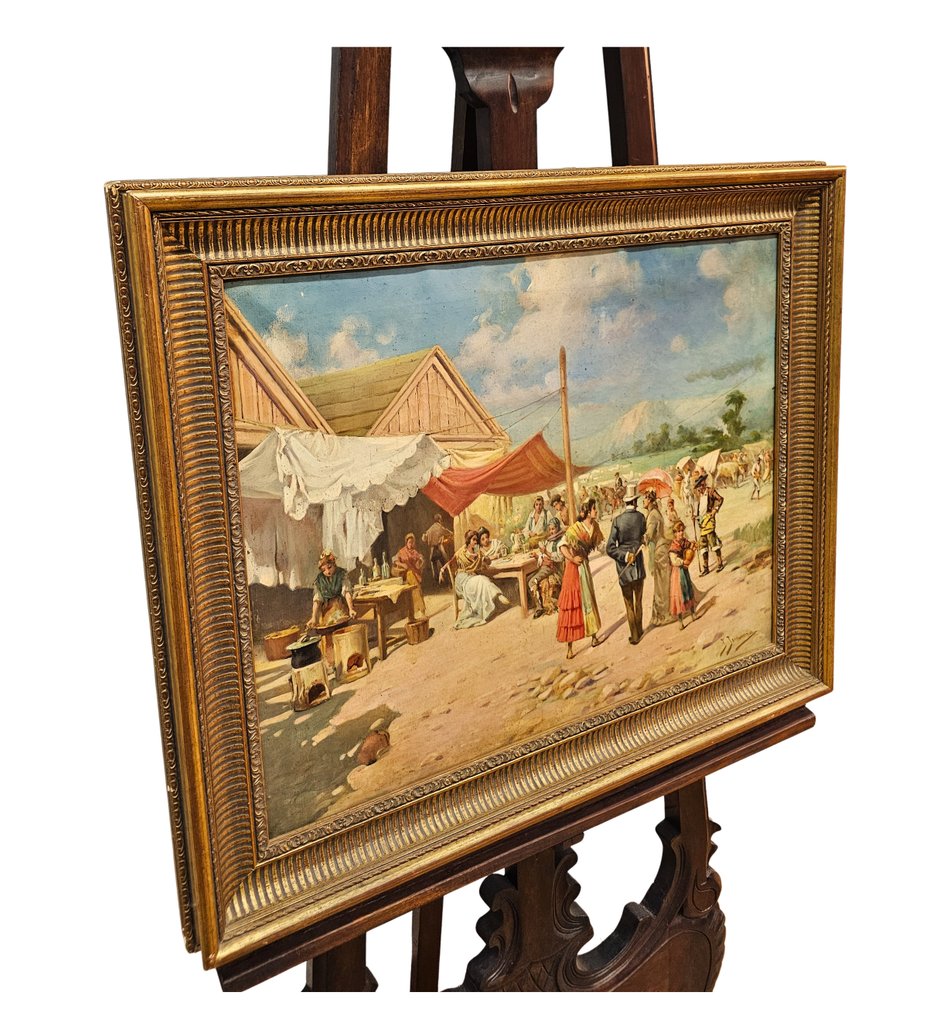
Spanish school (XIX) - Scene of popular celebration


05
days
13
hours
21
minutes
08
seconds
Current bid
€ 100
Reserve price not met

12 other people are watching this object
 Bidder 5112 Bidder 5112 | €100 | |
|---|---|---|
 Bidder 5270 Bidder 5270 | €1 |
Catawiki Buyer Protection
Your payment’s safe with us until you receive your object.View details
Trustpilot 4.4 | 123113 reviews
Rated Excellent on Trustpilot.
Oil on canvas titled Scene of popular celebration, from the Spanish school (19th century), circa 1880–1900; signed J Juncosa; framed with the original carved gilt frame; in good condition with fine craquelure; canvas measures 62 × 73 cm (frame 62 × 76 cm).
AI-assisted summary
Description from the seller
Scene of a popular fair
Style: Costumbrist realism with luminist sensibility.
Pictorial School: Spanish School of the late 19th century.
Technical sheet
Author: Spanish school (19th) - J Juncosa (signed)
Chronology: c. 1880–1900
Technique: oil on canvas
Measurements: 48.5 × 62 cm (artwork) · 62 × 76 cm (framed)
Condition: Good, with fine craquelure and a homogeneous patina of age.
Original vintage frame in carved and gilded wood, with a fluted profile and a molded inner border, of notable artisanal quality.
2. Compositional and iconographic description
The work depicts a lively scene of a fair or popular outdoor market, structured in a broad horizontal plane that allows for the collective depiction of figures.
First and foremost, characters of different ages interact naturally: women with mantons and traditional skirts, men with jackets and hats, children, and street vendors.
The composition is articulated through an effective play of diagonals — tables, awnings, paths, and figures in movement — that guide the eye towards the background, where a luminous landscape opens up with livestock, carts, and riverside vegetation.
The palette is warm and earthy, animated by accents of color in reds, yellows, and blues, and treated with loose but descriptive brushwork, especially on faces and attitudes.
3. Style, School, and Comparative Valuation
The painting is fully aligned with late 19th-century Spanish genre realism, close to Fortuny's narrative style and the Valencian and Catalan schools in the treatment of light and color.
Affinities are appreciated with the works of José Benlliure, Francisco Domingo Marqués, or certain passages by Joaquín Sorolla early on, especially in the depiction of popular life and the vibrant atmosphere.
The quality of the drawing, the richness of the iconography, and the compositional balance make the work a solid and attractive example of the genre, with a marked decorative and collectible value.
Its original frame reinforces the authenticity and historical character of the set, providing aesthetic coherence and added value to the piece.
Seller's Story
At Barcelona Art Gallery, we are a large family of art collectors in Barcelona who have been acquiring all kinds of paintings for 2 centuries.
Headquartered in the Les Corts neighborhood of Barcelona.
We offer part of our private collection for auction: high period and modern paintings that we have been acquiring over time, mainly from art galleries, antique dealers, auctions, private collections and very diverse origins.
Translated by Google TranslateScene of a popular fair
Style: Costumbrist realism with luminist sensibility.
Pictorial School: Spanish School of the late 19th century.
Technical sheet
Author: Spanish school (19th) - J Juncosa (signed)
Chronology: c. 1880–1900
Technique: oil on canvas
Measurements: 48.5 × 62 cm (artwork) · 62 × 76 cm (framed)
Condition: Good, with fine craquelure and a homogeneous patina of age.
Original vintage frame in carved and gilded wood, with a fluted profile and a molded inner border, of notable artisanal quality.
2. Compositional and iconographic description
The work depicts a lively scene of a fair or popular outdoor market, structured in a broad horizontal plane that allows for the collective depiction of figures.
First and foremost, characters of different ages interact naturally: women with mantons and traditional skirts, men with jackets and hats, children, and street vendors.
The composition is articulated through an effective play of diagonals — tables, awnings, paths, and figures in movement — that guide the eye towards the background, where a luminous landscape opens up with livestock, carts, and riverside vegetation.
The palette is warm and earthy, animated by accents of color in reds, yellows, and blues, and treated with loose but descriptive brushwork, especially on faces and attitudes.
3. Style, School, and Comparative Valuation
The painting is fully aligned with late 19th-century Spanish genre realism, close to Fortuny's narrative style and the Valencian and Catalan schools in the treatment of light and color.
Affinities are appreciated with the works of José Benlliure, Francisco Domingo Marqués, or certain passages by Joaquín Sorolla early on, especially in the depiction of popular life and the vibrant atmosphere.
The quality of the drawing, the richness of the iconography, and the compositional balance make the work a solid and attractive example of the genre, with a marked decorative and collectible value.
Its original frame reinforces the authenticity and historical character of the set, providing aesthetic coherence and added value to the piece.
Seller's Story
At Barcelona Art Gallery, we are a large family of art collectors in Barcelona who have been acquiring all kinds of paintings for 2 centuries.
Headquartered in the Les Corts neighborhood of Barcelona.
We offer part of our private collection for auction: high period and modern paintings that we have been acquiring over time, mainly from art galleries, antique dealers, auctions, private collections and very diverse origins.
Translated by Google TranslateDetails
Artist
Spanish school (XIX)
Sold with frame
Yes
Title of artwork
Scene of popular celebration
Technique
Oil painting
Signature
Signed
Country of Origin
Spain
Condition
Good condition
Height
62 cm
Width
73 cm
Weight
5 kg
Depiction/Theme
Day scene
Style
Realism
Period
19th century
Sold by
