Byôbu 屏風 (folding screen) - Gold leaf, Wood, Silk, Paper - Japan - Second half Edo period (18th century / First half 19th century)




05
days
19
hours
43
minutes
19
seconds
Current bid
€ 1
Reserve price not met

Expert
Selected by Giovanni Bottero
Holds a master’s in Japanese art history with over 10 years’ expertise in Asian art.
Estimate € 2,400 - € 2,700
10 other people are watching this object
 Bidder 0840 Bidder 0840 | €1 |
|---|
Catawiki Buyer Protection
Your payment’s safe with us until you receive your object.View details
Trustpilot 4.4 | 123077 reviews
Rated Excellent on Trustpilot.
A Japanese six-panel byôbu folding screen from the second half of the Edo period, with Genji Monogatari scenes rendered in natural pigments and gold leaf on paper, framed by a blue silk border and a black lacquered wooden frame, measuring 281.2 cm wide by 137.2 cm high, in very good condition with restorations mainly along the hinges and a certificate of authenticity included.
AI-assisted summary
Description from the seller
A beautiful medium-size six-panel byôbu 屏風 (folding screen) showcasing a refined painting illustrating different scenes from The Tale of Genji 源氏物語 (Genji Monogatari).
In the upper right corner, the artwork illustrates a scene from Chapter 34, “Early Spring Greens: Part 1” 若菜上 (Wakana jō).
The narrative unfolds: Amid the spring blossoms at Rokujô Estate, Kashiwagi 柏木, son of Tô no Chûjô 頭中将, plays kemari (court football) with three other courtiers, including Yûgiri 夕霧, the son of Genji and his first wife Aoi 葵. When an untamed cat runs out from beneath the blinds and exposes Genji’s new wife, the Third Princess. Kashiwagi glimpses her and becomes obsessed with the young woman.
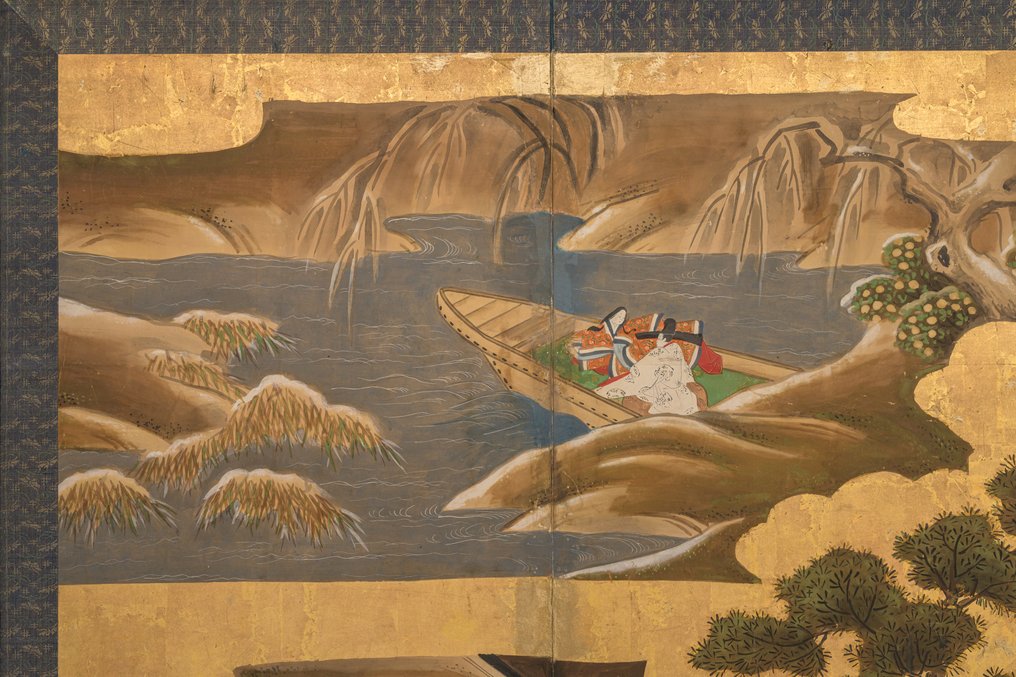
In the upper left corner, the artwork presents a scene from Chapter 51, “A Boat Cast Adrift” 浮舟 (Ukifune).
This passage tells of how Prince Niou no Miya 匂宮 - son of the reigning emperor and Genji’s daughter, the Empress Akashi-, finds Ukifune 浮舟 - a daughter of the Eighth Prince Hachinomiya 八宮 - in Uji and takes her by boat to an empty house across the river. On the way, he proclaims his love to be as steadfast as the evergreens on the Isle of Orange Trees, while Ukifune likens herself to a “boat adrift” 浮舟 (ukifune), unmoored and without a home.
The scenes are interwoven with dense gold leaf clouds.
Rendered in natural pigments and ink om paper heightened with gold leaf accents. Framed by a blue silk border. The screen is further enclosed by a black lacquered wooden frame.
Period: Japan – Second half Edo period (18th century / First half 19th century)
Dimensions:
Total width: 281.2 cm (2 x 48.2 cm, 4 x 46.2 cm), Height: 137.2 cm
Considering its age, the screen is in a very good condition, with several restorations mainly along the hinges, and traces of wear consistent with age. The reverse shows a few repapered patches. For a clear condition reference, please refer to the photos.
This folding screen is ideal for mounting flat on a wall and displaying as a single work of art.
When shipped, we will include a certificate of authenticity.
Please note: Due to the holidays, shipping and handling times may be longer. Thank you for your understanding.
Seller's Story
Since 1996, Japanese Antique Store has been importing Japanese antiques directly from Japan.
We travel several times a year through Japan and visit auctions, shows, dealers, and collectors.
Besides our physical store in Amsterdam, we are also active on Catawiki. We specialize in Samoeraipantser (Yoroi) and objects, lacquerware, screens, paintings, Buddhist images, and many more Japanese artifacts!
Translated by Google TranslateA beautiful medium-size six-panel byôbu 屏風 (folding screen) showcasing a refined painting illustrating different scenes from The Tale of Genji 源氏物語 (Genji Monogatari).
In the upper right corner, the artwork illustrates a scene from Chapter 34, “Early Spring Greens: Part 1” 若菜上 (Wakana jō).
The narrative unfolds: Amid the spring blossoms at Rokujô Estate, Kashiwagi 柏木, son of Tô no Chûjô 頭中将, plays kemari (court football) with three other courtiers, including Yûgiri 夕霧, the son of Genji and his first wife Aoi 葵. When an untamed cat runs out from beneath the blinds and exposes Genji’s new wife, the Third Princess. Kashiwagi glimpses her and becomes obsessed with the young woman.
In the upper left corner, the artwork presents a scene from Chapter 51, “A Boat Cast Adrift” 浮舟 (Ukifune).
This passage tells of how Prince Niou no Miya 匂宮 - son of the reigning emperor and Genji’s daughter, the Empress Akashi-, finds Ukifune 浮舟 - a daughter of the Eighth Prince Hachinomiya 八宮 - in Uji and takes her by boat to an empty house across the river. On the way, he proclaims his love to be as steadfast as the evergreens on the Isle of Orange Trees, while Ukifune likens herself to a “boat adrift” 浮舟 (ukifune), unmoored and without a home.
The scenes are interwoven with dense gold leaf clouds.
Rendered in natural pigments and ink om paper heightened with gold leaf accents. Framed by a blue silk border. The screen is further enclosed by a black lacquered wooden frame.
Period: Japan – Second half Edo period (18th century / First half 19th century)
Dimensions:
Total width: 281.2 cm (2 x 48.2 cm, 4 x 46.2 cm), Height: 137.2 cm
Considering its age, the screen is in a very good condition, with several restorations mainly along the hinges, and traces of wear consistent with age. The reverse shows a few repapered patches. For a clear condition reference, please refer to the photos.
This folding screen is ideal for mounting flat on a wall and displaying as a single work of art.
When shipped, we will include a certificate of authenticity.
Please note: Due to the holidays, shipping and handling times may be longer. Thank you for your understanding.
Seller's Story
Since 1996, Japanese Antique Store has been importing Japanese antiques directly from Japan.
We travel several times a year through Japan and visit auctions, shows, dealers, and collectors.
Besides our physical store in Amsterdam, we are also active on Catawiki. We specialize in Samoeraipantser (Yoroi) and objects, lacquerware, screens, paintings, Buddhist images, and many more Japanese artifacts!
Translated by Google TranslateDetails
Dynastic Style/Period
Second half Edo period (18th century / First half 19th century)
No. of items
1
Country of Origin
Japan
Attribution
Original
Material
Gold leaf, Wood, Silk, Paper
Height
137.2 cm
Width
281.2 cm
Title of artwork
Byôbu 屏風 (folding screen)
Depth
1.7 cm
Condition
Excellent condition
Sold by
