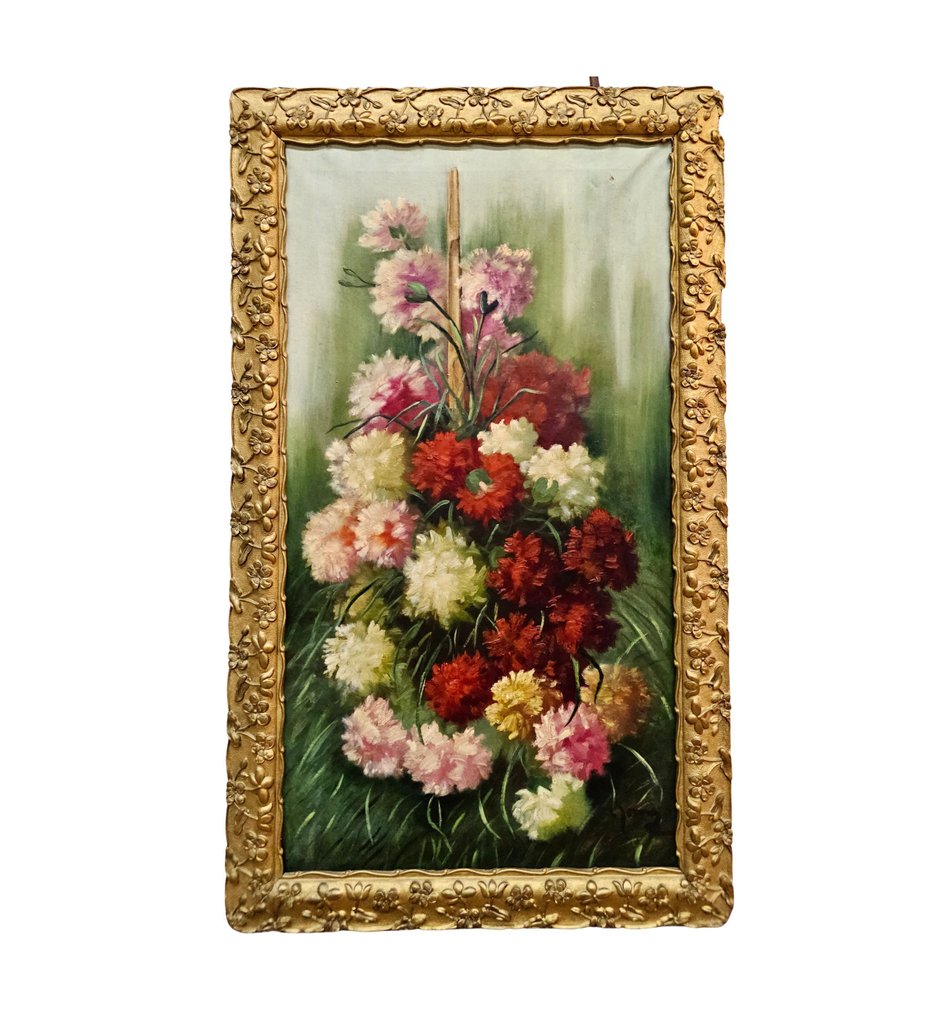
Miguel Parra (1780–1846), Circle of - Carnations in ceremonial repose



07
days
08
hours
19
minutes
56
seconds
Starting bid
€ 1
Reserve price not met

No bids placed
Catawiki Buyer Protection
Your payment’s safe with us until you receive your object.View details
Trustpilot 4.4 | 123077 reviews
Rated Excellent on Trustpilot.
Oil on canvas painting titled 'Carnations in ceremonial repose', attributed to Circulo de Miguel Parra (1780–1846), Spain, 19th century, 60 × 40 cm (frame included), in good condition, hand signed.
AI-assisted summary
Description from the seller
Technical sheet
Carnations in ceremonial resting
Author: Attributed to the circle of Miguel Parra (Valencia, 1780 – 1846)
Chronology: circa 1825–1845
Valencian School / Style: Academic floral still life transitioning between late Neoclassicism and early Romanticism.
Technique: oil on canvas
Measures
75 × 40 cm (frameless)
85 × 50 cm (with frame)
Support: fine weave canvas, traditional preparation
Marco: An extraordinary antique handcrafted frame, richly molded, gilded, and hand-painted, of great decorative quality and perfectly suited historically to the work.
Condition: Very good; stable pictorial layer, homogeneous ancient patina, slight wear consistent with age, and it has restorations.
2. Compositional and iconographic description
The work presents a vertical bouquet of carnations arranged with almost architectural balance, rising from the base towards a softly blurred green background, treated as an atmospheric space rather than a descriptive one.
The carnations — deep reds, creamy whites, dusty pinks, and warm yellows — are created with a contained yet lively brushstroke, with particular attention to the volume of the petals and the chromatic vibrancy of their edges.
The stems, long and flexible, generate a sinuous rhythm that adds elegance and lightness to the whole.
Iconographically, the carnation alludes both to Spanish popular tradition and to symbolic values of constancy, affection, and fleetingness. It is not merely a botanical description but a contemplative still life, where the flower takes on an almost emotional and silent presence.
3. Style, School, Attribution, and Valuation
From a stylistic point of view, the work fits with notable coherence within the sphere of Miguel Parra, one of the great masters of Valencian floral still life in the first third of the 19th century.
The compositional order, the clarity of the background, the chromatic nobility, and the absence of Baroque artificery directly refer to his pictorial language and that of his immediate circle.
The comparison is particularly relevant when considering the late vases by Parra preserved in institutional collections, where the flower is presented isolated, dignified, and treated with a sensitivity that already anticipates a more intimate and modern perspective.
In this sense, the work dialogues —at a distance— with the European tradition of the genre, from Jan van Huysum to the 19th-century French vases, while maintaining a sober and refined Spanish character.
We are faced with a highly exclusive piece, not only because of its pictorial quality but also due to its uncommon format, its magnificent original frame, and its plausible attribution to a well-defined artistic environment.
A work of great appeal for collectors of still life paintings, 19th-century Spanish art, or lovers of still life with identity and mystery.
Seller's Story
At Barcelona Art Gallery, we are a large family of art collectors in Barcelona who have been acquiring all kinds of paintings for 2 centuries.
Headquartered in the Les Corts neighborhood of Barcelona.
We offer part of our private collection for auction: high period and modern paintings that we have been acquiring over time, mainly from art galleries, antique dealers, auctions, private collections and very diverse origins.
Translated by Google TranslateTechnical sheet
Carnations in ceremonial resting
Author: Attributed to the circle of Miguel Parra (Valencia, 1780 – 1846)
Chronology: circa 1825–1845
Valencian School / Style: Academic floral still life transitioning between late Neoclassicism and early Romanticism.
Technique: oil on canvas
Measures
75 × 40 cm (frameless)
85 × 50 cm (with frame)
Support: fine weave canvas, traditional preparation
Marco: An extraordinary antique handcrafted frame, richly molded, gilded, and hand-painted, of great decorative quality and perfectly suited historically to the work.
Condition: Very good; stable pictorial layer, homogeneous ancient patina, slight wear consistent with age, and it has restorations.
2. Compositional and iconographic description
The work presents a vertical bouquet of carnations arranged with almost architectural balance, rising from the base towards a softly blurred green background, treated as an atmospheric space rather than a descriptive one.
The carnations — deep reds, creamy whites, dusty pinks, and warm yellows — are created with a contained yet lively brushstroke, with particular attention to the volume of the petals and the chromatic vibrancy of their edges.
The stems, long and flexible, generate a sinuous rhythm that adds elegance and lightness to the whole.
Iconographically, the carnation alludes both to Spanish popular tradition and to symbolic values of constancy, affection, and fleetingness. It is not merely a botanical description but a contemplative still life, where the flower takes on an almost emotional and silent presence.
3. Style, School, Attribution, and Valuation
From a stylistic point of view, the work fits with notable coherence within the sphere of Miguel Parra, one of the great masters of Valencian floral still life in the first third of the 19th century.
The compositional order, the clarity of the background, the chromatic nobility, and the absence of Baroque artificery directly refer to his pictorial language and that of his immediate circle.
The comparison is particularly relevant when considering the late vases by Parra preserved in institutional collections, where the flower is presented isolated, dignified, and treated with a sensitivity that already anticipates a more intimate and modern perspective.
In this sense, the work dialogues —at a distance— with the European tradition of the genre, from Jan van Huysum to the 19th-century French vases, while maintaining a sober and refined Spanish character.
We are faced with a highly exclusive piece, not only because of its pictorial quality but also due to its uncommon format, its magnificent original frame, and its plausible attribution to a well-defined artistic environment.
A work of great appeal for collectors of still life paintings, 19th-century Spanish art, or lovers of still life with identity and mystery.
Seller's Story
At Barcelona Art Gallery, we are a large family of art collectors in Barcelona who have been acquiring all kinds of paintings for 2 centuries.
Headquartered in the Les Corts neighborhood of Barcelona.
We offer part of our private collection for auction: high period and modern paintings that we have been acquiring over time, mainly from art galleries, antique dealers, auctions, private collections and very diverse origins.
Translated by Google TranslateDetails
Artist
Miguel Parra (1780–1846)
Sold with frame
Yes
Attribution
Circle of
Title of artwork
Carnations in ceremonial repose
Technique
Oil painting
Signature
Hand signed
Country of Origin
Spain
Condition
Good condition
Height
60 cm
Width
40 cm
Weight
4 kg
Style
Realism
Period
19th century
Sold by
