After Paul Gauguin (1848–1903) - Tahitian maternity among palm trees



09
days
17
hours
31
minutes
33
seconds
Starting bid
€ 1
Reserve price not met

No bids placed
Catawiki Buyer Protection
Your payment’s safe with us until you receive your object.View details
Trustpilot 4.4 | 122910 reviews
Rated Excellent on Trustpilot.
Description from the seller
Tahitian motherhood among palms
Symbolic Post-Impressionism / Modern Primitivism
Painting school: French school of the late century – Circle of Paul Gauguin
Technical sheet
Author: Anonymous, after Paul Gauguin (1848–1903)
Chronology: 20th century, first half
Technique: Oil on canvas
Measurements: 62 × 54 cm
Measurements with frame: 80 × 72 cm
Company: Not visible
Condition: Good, with natural patina of time and slight fold on the right part of the fabric.
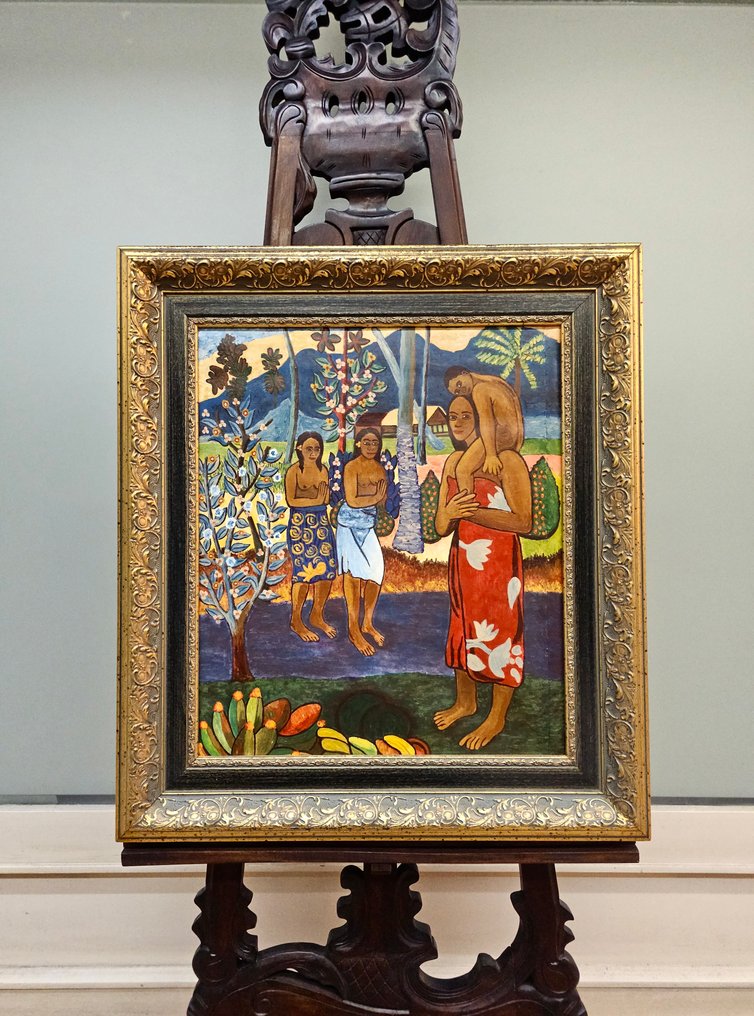
Marco: Carved and gilded wooden frame, inspired by historicism, with a floral relief border and a dark inner frame that enhances the chromatic depth of the scene.
2. Compositional and iconographic description
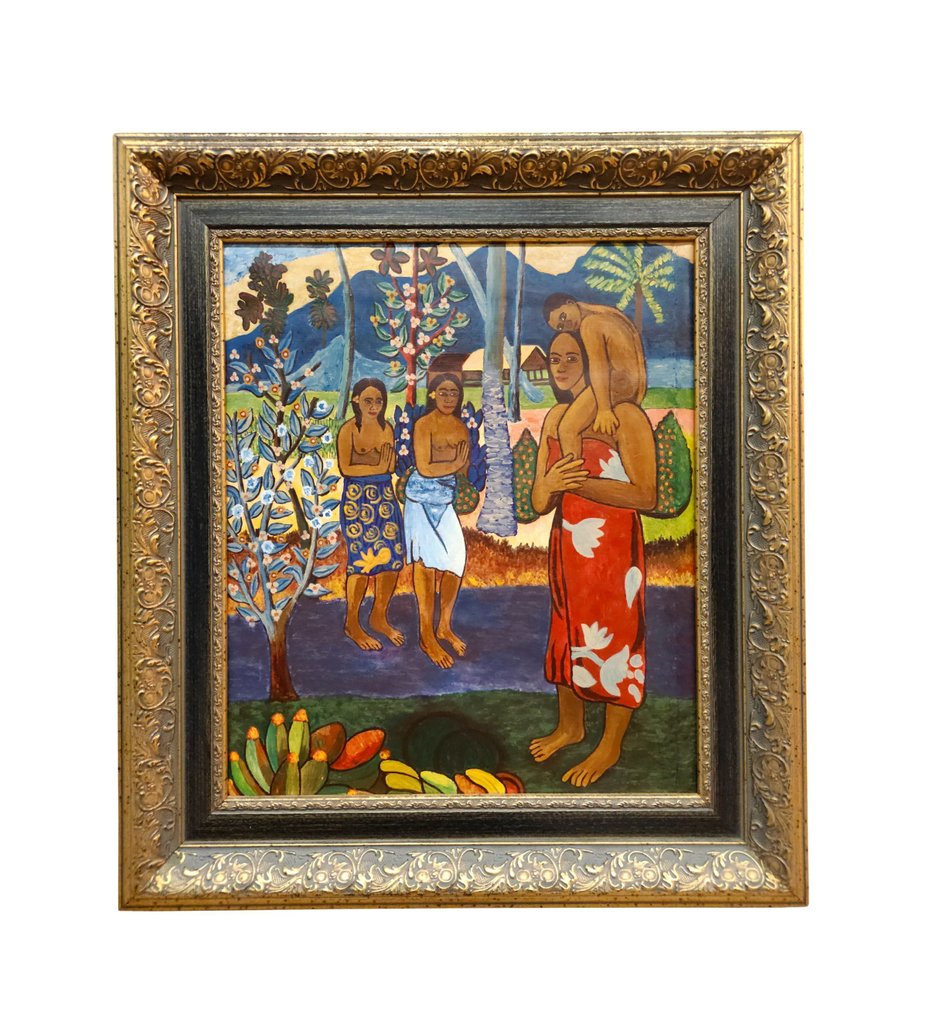
The work depicts a Tahitian scene with female and maternal figures arranged in an idealized landscape, dominated by lush vegetation and flat colors of great intensity.
In the foreground, a female figure holding a child is highlighted, a clear allusion to the theme of sacred and earthly motherhood, recurring in Gauguin's iconography.
The figures appear hieratic, with marked contours and simplified volumes, integrated into a space without academic perspective.
The color — reds, ultramarine blues, greens, and ochres — is used more for its symbolic value than for naturalism, reinforcing the spiritual and timeless dimension of the scene.
The landscape acts as a mythical setting, not a descriptive one, evoking a pristine Arcadia.
3. Style, School, and Comparative Valuation
This painting clearly falls within symbolic Post-Impressionism, directly following the trail of Paul Gauguin and his primitivist language developed in Brittany and, especially, in Tahiti.
The work dialogues with emblematic compositions such as Maternidad or Where Do We Come From? What Are We? Where Are We Going?, sharing the formal simplification and the spiritual load.
Aesthetic affinity can be compared to works of the circle and followers of Gauguin, as well as to artists such as Émile Bernard, Charles Filiger, or, on a more decorative level, to certain approaches of Henri Rousseau.
It is a decorative and evocative piece, honest in its approach as an 'after,' with a strong visual impact and notable appeal for collectors interested in the heritage of modern symbolism and the Gauguin universe.
Seller's Story
At Barcelona Art Gallery, we are a large family of art collectors in Barcelona who have been acquiring all kinds of paintings for 2 centuries.
Headquartered in the Les Corts neighborhood of Barcelona.
We offer part of our private collection for auction: high period and modern paintings that we have been acquiring over time, mainly from art galleries, antique dealers, auctions, private collections and very diverse origins.
Translated by Google TranslateTahitian motherhood among palms
Symbolic Post-Impressionism / Modern Primitivism
Painting school: French school of the late century – Circle of Paul Gauguin
Technical sheet
Author: Anonymous, after Paul Gauguin (1848–1903)
Chronology: 20th century, first half
Technique: Oil on canvas
Measurements: 62 × 54 cm
Measurements with frame: 80 × 72 cm
Company: Not visible
Condition: Good, with natural patina of time and slight fold on the right part of the fabric.
Marco: Carved and gilded wooden frame, inspired by historicism, with a floral relief border and a dark inner frame that enhances the chromatic depth of the scene.
2. Compositional and iconographic description
The work depicts a Tahitian scene with female and maternal figures arranged in an idealized landscape, dominated by lush vegetation and flat colors of great intensity.
In the foreground, a female figure holding a child is highlighted, a clear allusion to the theme of sacred and earthly motherhood, recurring in Gauguin's iconography.
The figures appear hieratic, with marked contours and simplified volumes, integrated into a space without academic perspective.
The color — reds, ultramarine blues, greens, and ochres — is used more for its symbolic value than for naturalism, reinforcing the spiritual and timeless dimension of the scene.
The landscape acts as a mythical setting, not a descriptive one, evoking a pristine Arcadia.
3. Style, School, and Comparative Valuation
This painting clearly falls within symbolic Post-Impressionism, directly following the trail of Paul Gauguin and his primitivist language developed in Brittany and, especially, in Tahiti.
The work dialogues with emblematic compositions such as Maternidad or Where Do We Come From? What Are We? Where Are We Going?, sharing the formal simplification and the spiritual load.
Aesthetic affinity can be compared to works of the circle and followers of Gauguin, as well as to artists such as Émile Bernard, Charles Filiger, or, on a more decorative level, to certain approaches of Henri Rousseau.
It is a decorative and evocative piece, honest in its approach as an 'after,' with a strong visual impact and notable appeal for collectors interested in the heritage of modern symbolism and the Gauguin universe.
Seller's Story
At Barcelona Art Gallery, we are a large family of art collectors in Barcelona who have been acquiring all kinds of paintings for 2 centuries.
Headquartered in the Les Corts neighborhood of Barcelona.
We offer part of our private collection for auction: high period and modern paintings that we have been acquiring over time, mainly from art galleries, antique dealers, auctions, private collections and very diverse origins.
Translated by Google TranslateDetails
Artist
After Paul Gauguin (1848–1903)
Sold with frame
Yes
Sold by
Gallery
Edition
Original
Title of artwork
Tahitian maternity among palm trees
Technique
Oil painting
Signature
Not signed
Country of Origin
France
Condition
Good condition
Height
80 cm
Width
72 cm
Weight
6 kg
Depiction/Theme
Historical scene
Style
Fauvism
Period
1940-1950
Sold by
