Post-impressionist chool (XX) - When the earth remembers its color



09
days
19
hours
44
minutes
44
seconds
Current bid
€ 1
Reserve price not met

3 other people are watching this object
 Bidder 3078 Bidder 3078 | €1 |
|---|
Catawiki Buyer Protection
Your payment’s safe with us until you receive your object.View details
Trustpilot 4.4 | 122910 reviews
Rated Excellent on Trustpilot.
Description from the seller
When the earth remembers the color
Technical sheet
Author: Illegible company.
European Post-Impressionist school
Chronology: Second half of the 20th century (c. 1950–1970)
Technique: oil on canvas
Measurements: 56 × 46 cm
Measurements with frame: 67 × 57 cm
Painting style: expressive Post-Impressionism
Condition: Excellent, with a stable mount and a natural chromatic patina.
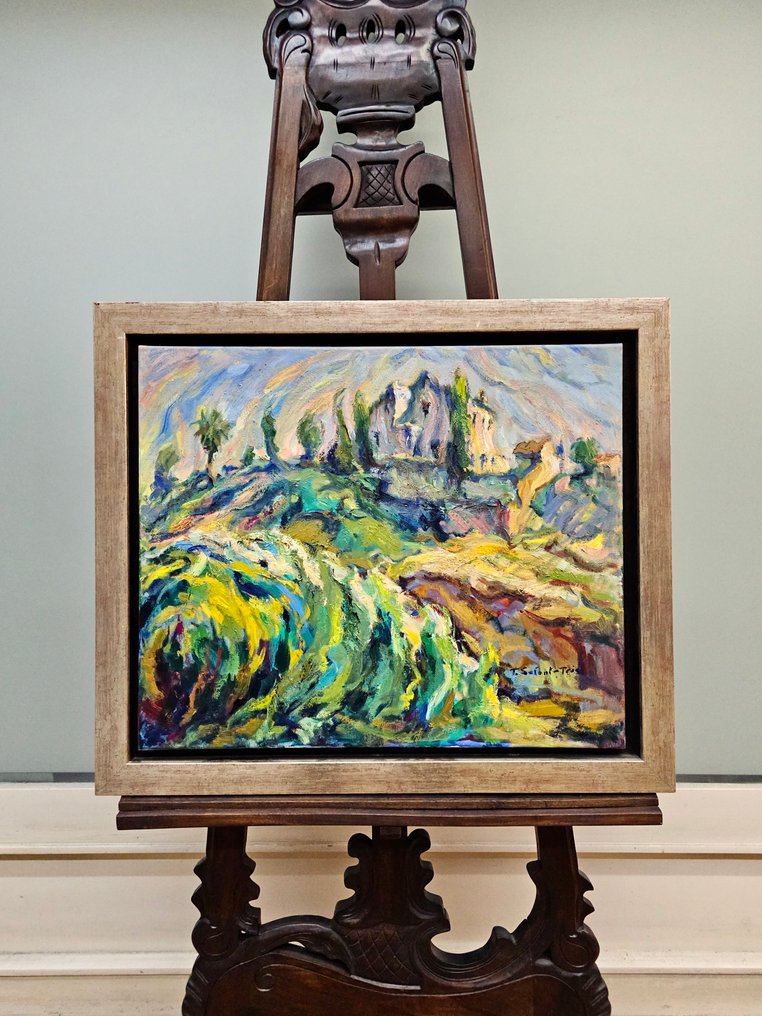
Marco: Quality wooden frame, sober and well-proportioned, with a warm matte finish that enhances the chromatic vibration of the artwork without competing with it.
2. Compositional and iconographic description
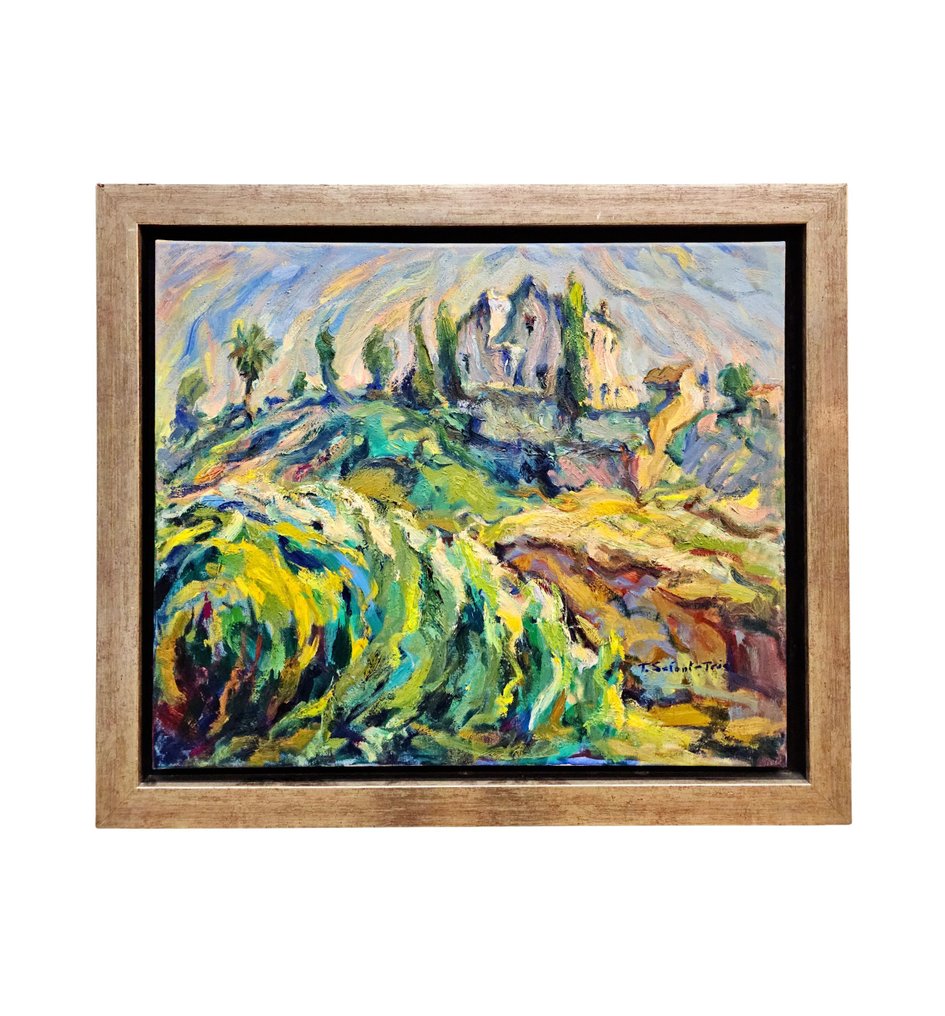
The composition presents an emotional and dynamic landscape, built from a broad, thick, and decidedly gestural brushstroke. The space is not organized through a traditional perspective but through moving chromatic masses that suggest hills, vegetation, and structures barely hinted at.
The foreground is articulated through intense greens, vibrant yellows, and deep blues, applied with generous brushstrokes that add rhythm and corporeality to the pictorial surface. In the middle and upper planes, architectural and arboreal forms emerge in an almost abstract manner, integrated into an enveloping atmosphere where the sky merges with the landscape.
Iconographically, the work does not seek a literal description of the place, but rather a sensory evocation of the landscape, understood as an inner experience rather than concrete topography. The result is a vivid, changing image, charged with energy and subjectivity.
3. Style, School, and Comparative Valuation
The work clearly belongs to the European post-impressionist tradition, with a strong expressive charge inherited from artists who prioritized color and material over faithful representation. The brushwork recalls approaches similar to Van Gogh in its treatment of the rhythm and vibration of the landscape, as well as certain late landscapes by Chaïm Soutine or more lyrical interpretations of the French and Central European post-war school.
The use of color, intense yet balanced, and the layered construction of impasto place the work within a mature, confident painting executed by an experienced hand. It is not an academic exercise, but a piece conceived from plastic freedom and emotion.
From a market and collection perspective, the painting presents a high decorative and artistic appeal, with a powerful visual presence and a clear stylistic identity, making it a very interesting piece for collectors of European post-war painting and for contemporary interiors seeking works with character.
Seller's Story
At Barcelona Art Gallery, we are a large family of art collectors in Barcelona who have been acquiring all kinds of paintings for 2 centuries.
Headquartered in the Les Corts neighborhood of Barcelona.
We offer part of our private collection for auction: high period and modern paintings that we have been acquiring over time, mainly from art galleries, antique dealers, auctions, private collections and very diverse origins.
Translated by Google TranslateWhen the earth remembers the color
Technical sheet
Author: Illegible company.
European Post-Impressionist school
Chronology: Second half of the 20th century (c. 1950–1970)
Technique: oil on canvas
Measurements: 56 × 46 cm
Measurements with frame: 67 × 57 cm
Painting style: expressive Post-Impressionism
Condition: Excellent, with a stable mount and a natural chromatic patina.
Marco: Quality wooden frame, sober and well-proportioned, with a warm matte finish that enhances the chromatic vibration of the artwork without competing with it.
2. Compositional and iconographic description
The composition presents an emotional and dynamic landscape, built from a broad, thick, and decidedly gestural brushstroke. The space is not organized through a traditional perspective but through moving chromatic masses that suggest hills, vegetation, and structures barely hinted at.
The foreground is articulated through intense greens, vibrant yellows, and deep blues, applied with generous brushstrokes that add rhythm and corporeality to the pictorial surface. In the middle and upper planes, architectural and arboreal forms emerge in an almost abstract manner, integrated into an enveloping atmosphere where the sky merges with the landscape.
Iconographically, the work does not seek a literal description of the place, but rather a sensory evocation of the landscape, understood as an inner experience rather than concrete topography. The result is a vivid, changing image, charged with energy and subjectivity.
3. Style, School, and Comparative Valuation
The work clearly belongs to the European post-impressionist tradition, with a strong expressive charge inherited from artists who prioritized color and material over faithful representation. The brushwork recalls approaches similar to Van Gogh in its treatment of the rhythm and vibration of the landscape, as well as certain late landscapes by Chaïm Soutine or more lyrical interpretations of the French and Central European post-war school.
The use of color, intense yet balanced, and the layered construction of impasto place the work within a mature, confident painting executed by an experienced hand. It is not an academic exercise, but a piece conceived from plastic freedom and emotion.
From a market and collection perspective, the painting presents a high decorative and artistic appeal, with a powerful visual presence and a clear stylistic identity, making it a very interesting piece for collectors of European post-war painting and for contemporary interiors seeking works with character.
Seller's Story
At Barcelona Art Gallery, we are a large family of art collectors in Barcelona who have been acquiring all kinds of paintings for 2 centuries.
Headquartered in the Les Corts neighborhood of Barcelona.
We offer part of our private collection for auction: high period and modern paintings that we have been acquiring over time, mainly from art galleries, antique dealers, auctions, private collections and very diverse origins.
Translated by Google TranslateDetails
Artist
Post-impressionist chool (XX)
Sold with frame
Yes
Sold by
Gallery
Edition
Original
Title of artwork
When the earth remembers its color
Technique
Oil painting
Signature
Hand signed
Country of Origin
France
Condition
Excellent condition
Height
60 cm
Width
70 cm
Weight
4 kg
Depiction/Theme
Landscape
Style
Realism
Period
1980-1990
Sold by
