2025 - 93 Wit minimalistisch wandrelief


07
days
23
hours
09
minutes
25
seconds
Current bid
€ 158
Reserve price not met

Expert
Selected by Egidio Emiliano Bianco
Holds a bachelor’s degree in art history and a master’s degree in arts and cultural management.
Gallery Estimate € 600 - € 800
23 other people are watching this object
 Bidder 9430 Bidder 9430 | €158 | |
|---|---|---|
| Bidder 8267 | €148 | |
| Bidder 9000 | €138 |
Catawiki Buyer Protection
Your payment’s safe with us until you receive your object.View details
Trustpilot 4.4 | 123294 reviews
Rated Excellent on Trustpilot.
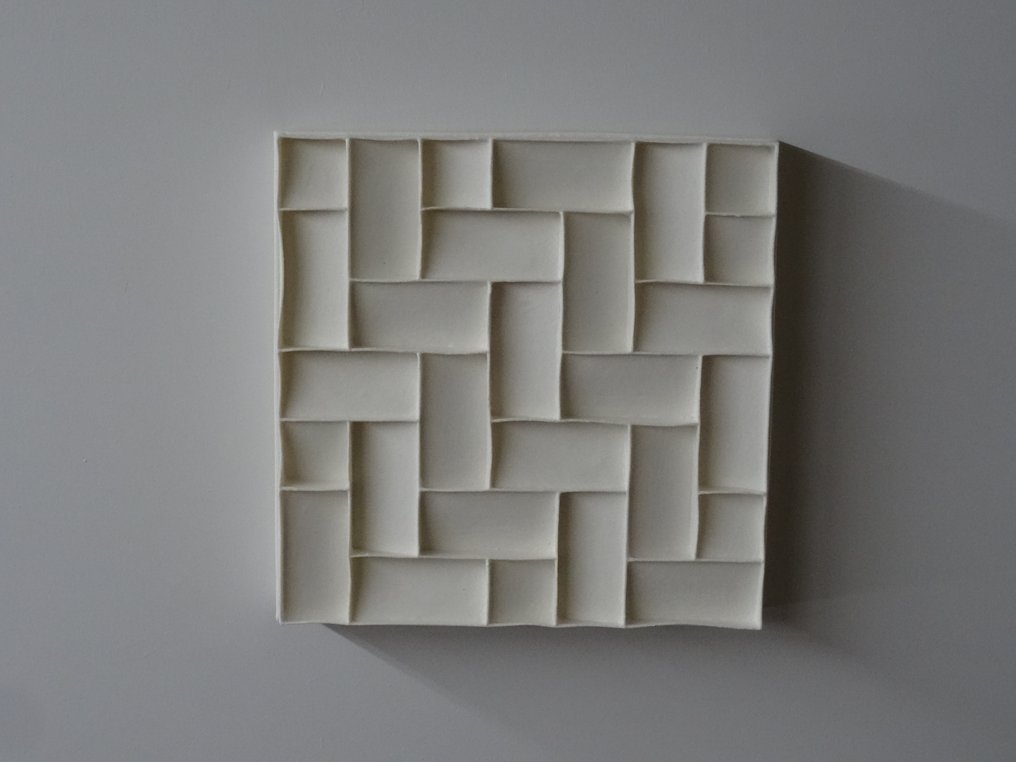
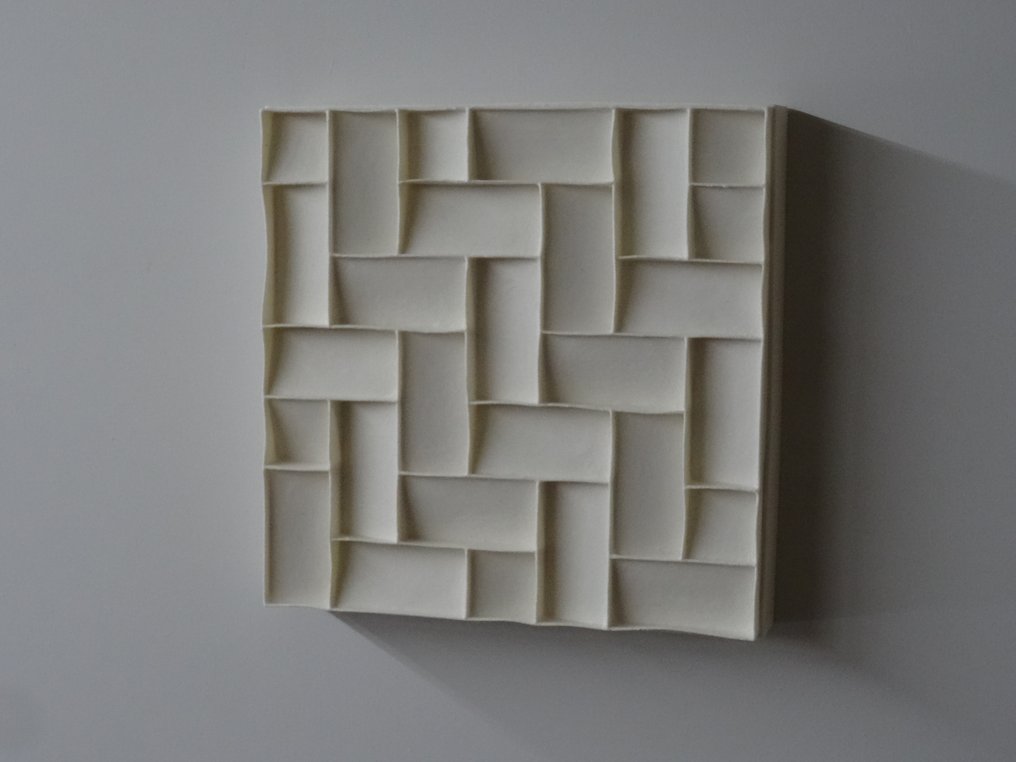
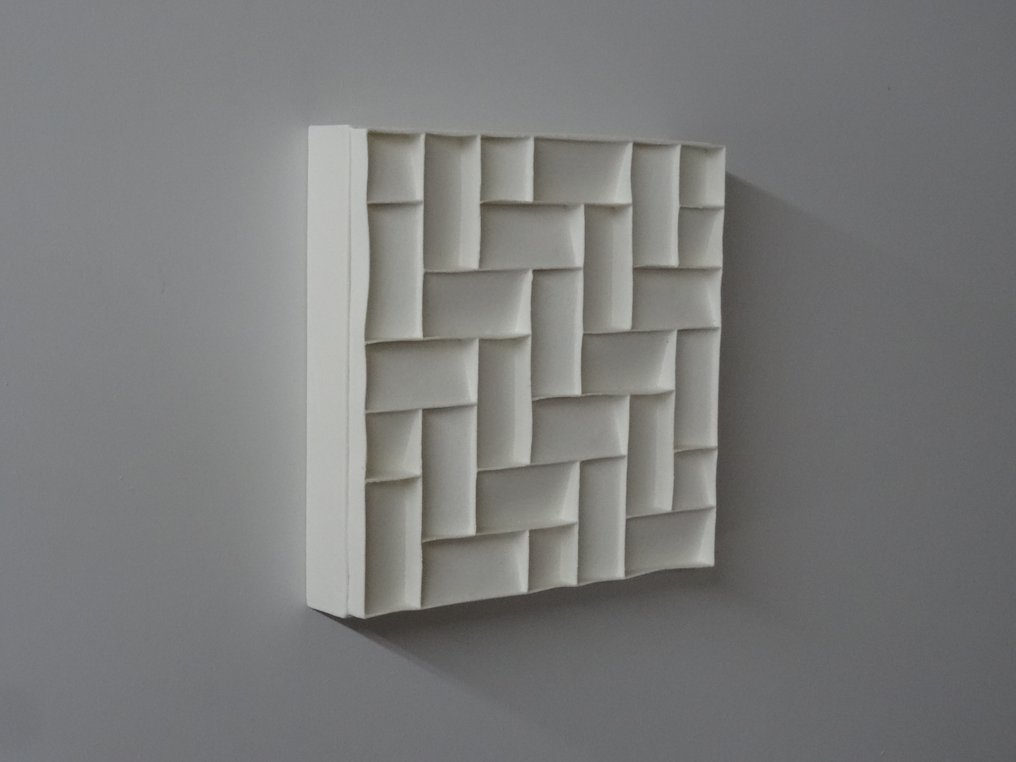
Minimalist white porcelain wall relief titled “2025 - 93 Wit minimalistisch wandrelief”, an abstract 177×177×39 mm piece made in the Netherlands in 2025, signed with two porcelain applications—one bearing the artist’s first name and an initial of the surname and the other with the Japanese characters Raku and Yakimono—and in excellent condition.
AI-assisted summary
Description from the seller
The artwork is made of porcelain, oxidatively fired at 1240 C. The wall thickness is about one millimeter.
There's a recess on the back where the work can be hung. The first five photos, with the light background, depict the object hanging.
It concerns a handmade object.
The artist signed this work with two porcelain applications, one bearing his first name and the first letter of his last name, and the other featuring two Japanese characters, Raku and Yakimono.
During shipping, this crate will be packed 'box in box,' with the space in between filled with shock-absorbing environmentally friendly material.
Hans Meeuwsen (1954, The Netherlands) graduated from the Visual Arts Academy in Tilburg to initially become a teacher in visual arts at an upper secondary school. His main specialty was drawing, but he accidentally discovered the potential of clay as a visual arts medium. Rolling, pressing, and cutting provided him with small flat clay squares that he used to build cubic shapes resembling hermetically sealed cells.
A few years later, he received national and international recognition with exhibitions in The Netherlands and Germany. Important works from that time include towers, pyramids, and other constructions, some being pure geometric abstractions, others being interpretations of the mythical Tower of Babel. Hans further developed his ceramic skills during residencies at the European Ceramic Work Centre in The Netherlands and working periods in New Zealand, Lithuania, and the Japanese Island Hirado.
During the most recent years, he has further developed his ceramic skills and works with creamy white wafer-thin slices of porcelain that are mounted into cubes or pyramids. By stacking these geometric shapes in repetitive patterns, he creates sculptures that are reminiscent of the Dutch Zero movement and, in particular, the works by Jan Schoonhoven, but ultimately clearly bear the artist's own signature. He applies his decades-long experience to create a dialogue between inner and outer space, between geometric and organic, between order and chaos.
Hans Meeuwsen is a 1987 Prix de Rome nominee and a 1992 Fletcher Challenge Ceramic merit award winner, and since then, his work has been included in many national and international collections.
Seller's Story
Hans Meeuwsen (1954, The Netherlands) graduated from the Visual Arts Academy in Tilburg to initially become a teacher in visual arts at an upper secondary school. His main specialism was drawing, but he accidentally discovered the potential of clay as a visual arts medium. Rolling, pressing and cutting provided him with little flat clay squares that he used to built cubic shapes looking like hermetically closed cells.
A few years later he received national and international recognition with exhibitions in The Netherlands and Germany. Important works from that time include towers, pyramids and other constructions, some being pure geometric abstractions, others being interpretations of the mythical Tower of Babel. Hans further developped his ceramic skills during residencies at the European Ceramic Work Center in The Netherlands and working periods in New Zealand, Lithuania and the Japanese Island Hirado.
During the most recent years he has further developped his ceramic skills and works with creamy white wafer-thin slices of egg-shell porcelain that are mounted into cubes or pyramids. By stacking these geometric shapes in repetitive patterns he creates sculptures that are reminiscent of the Dutch Zero-movement and in particular the works by Jan Schoonhoven, but in the end clearly bears the artists' own signature. He applies his decades-long experience to create a dialogue between inner and outer space, between geometric and organic, between order and chaos.
Hans Meeuwsen is a “Prix de Rome” nominee of 1987 and a Fletcher Challenge Ceramic merit award winner of 1992 and ever since then his work has found its way to many national and international collections.
Translated by Google TranslateThe artwork is made of porcelain, oxidatively fired at 1240 C. The wall thickness is about one millimeter.
There's a recess on the back where the work can be hung. The first five photos, with the light background, depict the object hanging.
It concerns a handmade object.
The artist signed this work with two porcelain applications, one bearing his first name and the first letter of his last name, and the other featuring two Japanese characters, Raku and Yakimono.
During shipping, this crate will be packed 'box in box,' with the space in between filled with shock-absorbing environmentally friendly material.
Hans Meeuwsen (1954, The Netherlands) graduated from the Visual Arts Academy in Tilburg to initially become a teacher in visual arts at an upper secondary school. His main specialty was drawing, but he accidentally discovered the potential of clay as a visual arts medium. Rolling, pressing, and cutting provided him with small flat clay squares that he used to build cubic shapes resembling hermetically sealed cells.
A few years later, he received national and international recognition with exhibitions in The Netherlands and Germany. Important works from that time include towers, pyramids, and other constructions, some being pure geometric abstractions, others being interpretations of the mythical Tower of Babel. Hans further developed his ceramic skills during residencies at the European Ceramic Work Centre in The Netherlands and working periods in New Zealand, Lithuania, and the Japanese Island Hirado.
During the most recent years, he has further developed his ceramic skills and works with creamy white wafer-thin slices of porcelain that are mounted into cubes or pyramids. By stacking these geometric shapes in repetitive patterns, he creates sculptures that are reminiscent of the Dutch Zero movement and, in particular, the works by Jan Schoonhoven, but ultimately clearly bear the artist's own signature. He applies his decades-long experience to create a dialogue between inner and outer space, between geometric and organic, between order and chaos.
Hans Meeuwsen is a 1987 Prix de Rome nominee and a 1992 Fletcher Challenge Ceramic merit award winner, and since then, his work has been included in many national and international collections.
Seller's Story
Hans Meeuwsen (1954, The Netherlands) graduated from the Visual Arts Academy in Tilburg to initially become a teacher in visual arts at an upper secondary school. His main specialism was drawing, but he accidentally discovered the potential of clay as a visual arts medium. Rolling, pressing and cutting provided him with little flat clay squares that he used to built cubic shapes looking like hermetically closed cells.
A few years later he received national and international recognition with exhibitions in The Netherlands and Germany. Important works from that time include towers, pyramids and other constructions, some being pure geometric abstractions, others being interpretations of the mythical Tower of Babel. Hans further developped his ceramic skills during residencies at the European Ceramic Work Center in The Netherlands and working periods in New Zealand, Lithuania and the Japanese Island Hirado.
During the most recent years he has further developped his ceramic skills and works with creamy white wafer-thin slices of egg-shell porcelain that are mounted into cubes or pyramids. By stacking these geometric shapes in repetitive patterns he creates sculptures that are reminiscent of the Dutch Zero-movement and in particular the works by Jan Schoonhoven, but in the end clearly bears the artists' own signature. He applies his decades-long experience to create a dialogue between inner and outer space, between geometric and organic, between order and chaos.
Hans Meeuwsen is a “Prix de Rome” nominee of 1987 and a Fletcher Challenge Ceramic merit award winner of 1992 and ever since then his work has found its way to many national and international collections.
Translated by Google TranslateDetails
Era
After 2000
Country of Origin
Netherlands
Style
Abstract
Material
Porcelain
Title of artwork
2025 - 93 Wit minimalistisch wandrelief
Signature
Two applications, one featuring a first name and the second displaying Japanese characters 'raku'
Year
2025
Colour
White
Condition
Excellent condition
Height
177 mm
Width
177 mm
Depth
39 mm
Sold by
