Geza Perneczky (1936) - untitled




08
days
09
hours
29
minutes
36
seconds
Starting bid
€ 1
Reserve price not met

Expert
Selected by Florent Fressier
Specialises in works on paper and (New) School of Paris artists. Former gallery owner.
Estimate € 600 - € 800
No bids placed
Catawiki Buyer Protection
Your payment’s safe with us until you receive your object.View details
Trustpilot 4.4 | 123253 reviews
Rated Excellent on Trustpilot.
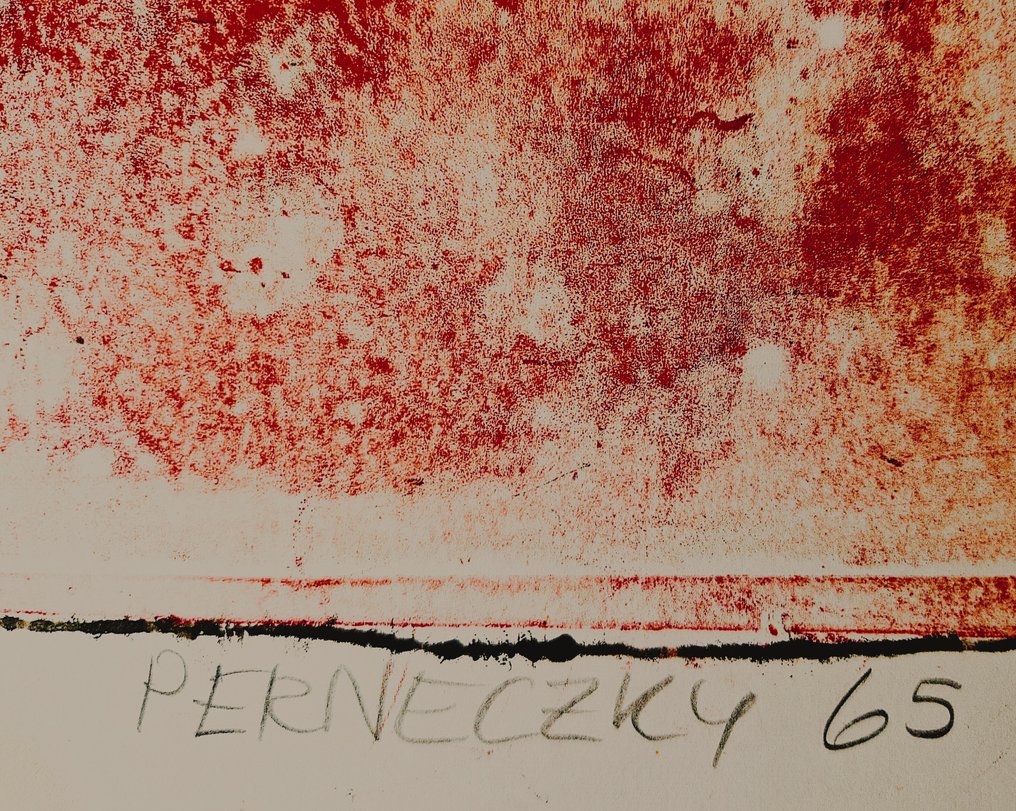
Geza Perneczky (1936) created an untitled 1965 monotype on glossy paper, measuring 50 × 65 cm, in red, black, white and pink, depicting animals in the wild, signed in gouache lower right, an original work from Hungary.
AI-assisted summary
Description from the seller
Artist: Geza PERNECZKY (1936- KESZTHELY HUNGARY)
Medium: Monotype on sturdy glossy paper.
The monotype technique is an art printing method without engraving that produces a single print. The process combines elements of drawing, painting, and printing. The result is a print from an image traced on a non-porous surface, usually a glass or metal plate, by applying ink or paint. This is a single impression, hence the name monotype, obtained by pressing the paper against the plate.
Unlike the etching technique, this creative process is carried out without the need to chisel or notch the plate. The image is created directly on the plate, covered with an appropriate medium (ink, acrylic, or oil paint), which is then transferred to paper, either using a printing press or manual pressure. The monotype results in a unique print, making it an original work.
Dating: 1965
Numbered
Signed: with gouache bottom right.
Condition: In good shape (light creases in the surrounding white margins NOT in the image itself!).
Untitled
loose leaf - sheet size 50 x 65 cm
Géza Perneczky (1936, Keszthely) is one of the key figures in Hungarian Neo-Avant-garde conceptual art.
In 1957, he graduated from the piano and choirmaster department at the Bartók Béla Music Academy in Budapest. From 1957 to 1962, he studied art history and Hungarian language and literature at Loránd Eötvös Science University (ELTE) in Budapest. From 1962 onward, he worked as an editor at the Hungary Art Publishing House and as an art critic.
Perneczky's work can be divided into several categories, the most prominent being conceptual photography. He created artists' books between 1973 and 1974. He would distribute the artists' books in A4 folders with eight works on sheets of paper. His use of rubber stamps is seen in his conceptual works created mostly on A4 sheets of paper.
Some of his photographic series include Identification Programme (1971), Concepts Like Commentary (1971), Art Balls (1971), the Yes-No series of works (1971–1972), Art Bubble (1972), Snail Action (1972), and others. Perneczky's use of mirrors is fundamental to his photographic work, which simultaneously reflects a mirror image of art in its time. From 1987 to 1994, Perneczky created The Story of the Colorful Ribbons, a series of conceptual book-objects made from wood, cardboard, and ribbons. From 1984, he became increasingly interested in painting, producing a large body of work titled String Pictures (on canvas, paper, and woodworks).
In 1970, he moved to Cologne. From 1973, he became more actively involved in the Post-Fluxus movements, creating Stamp Art, Mail Art, and Artist's Books.
Artist: Geza PERNECZKY (1936- KESZTHELY HUNGARY)
Medium: Monotype on sturdy glossy paper.
The monotype technique is an art printing method without engraving that produces a single print. The process combines elements of drawing, painting, and printing. The result is a print from an image traced on a non-porous surface, usually a glass or metal plate, by applying ink or paint. This is a single impression, hence the name monotype, obtained by pressing the paper against the plate.
Unlike the etching technique, this creative process is carried out without the need to chisel or notch the plate. The image is created directly on the plate, covered with an appropriate medium (ink, acrylic, or oil paint), which is then transferred to paper, either using a printing press or manual pressure. The monotype results in a unique print, making it an original work.
Dating: 1965
Numbered
Signed: with gouache bottom right.
Condition: In good shape (light creases in the surrounding white margins NOT in the image itself!).
Untitled
loose leaf - sheet size 50 x 65 cm
Géza Perneczky (1936, Keszthely) is one of the key figures in Hungarian Neo-Avant-garde conceptual art.
In 1957, he graduated from the piano and choirmaster department at the Bartók Béla Music Academy in Budapest. From 1957 to 1962, he studied art history and Hungarian language and literature at Loránd Eötvös Science University (ELTE) in Budapest. From 1962 onward, he worked as an editor at the Hungary Art Publishing House and as an art critic.
Perneczky's work can be divided into several categories, the most prominent being conceptual photography. He created artists' books between 1973 and 1974. He would distribute the artists' books in A4 folders with eight works on sheets of paper. His use of rubber stamps is seen in his conceptual works created mostly on A4 sheets of paper.
Some of his photographic series include Identification Programme (1971), Concepts Like Commentary (1971), Art Balls (1971), the Yes-No series of works (1971–1972), Art Bubble (1972), Snail Action (1972), and others. Perneczky's use of mirrors is fundamental to his photographic work, which simultaneously reflects a mirror image of art in its time. From 1987 to 1994, Perneczky created The Story of the Colorful Ribbons, a series of conceptual book-objects made from wood, cardboard, and ribbons. From 1984, he became increasingly interested in painting, producing a large body of work titled String Pictures (on canvas, paper, and woodworks).
In 1970, he moved to Cologne. From 1973, he became more actively involved in the Post-Fluxus movements, creating Stamp Art, Mail Art, and Artist's Books.
Details
Artist
Geza Perneczky (1936)
Edition
Original
Sold by
Owner or reseller
Title of artwork
untitled
Technique
Mixed technique
Signature
Signed
Country of Origin
Hungary
Year
1965
Condition
Good condition
Colour
Black, Pink, Red, White
Height
50.5 cm
Width
65 cm
Weight
200 g
Depiction/Theme
Animals and wildlife
Style
Abstract
Period
1960-1970
Sold with frame
No
Sold by