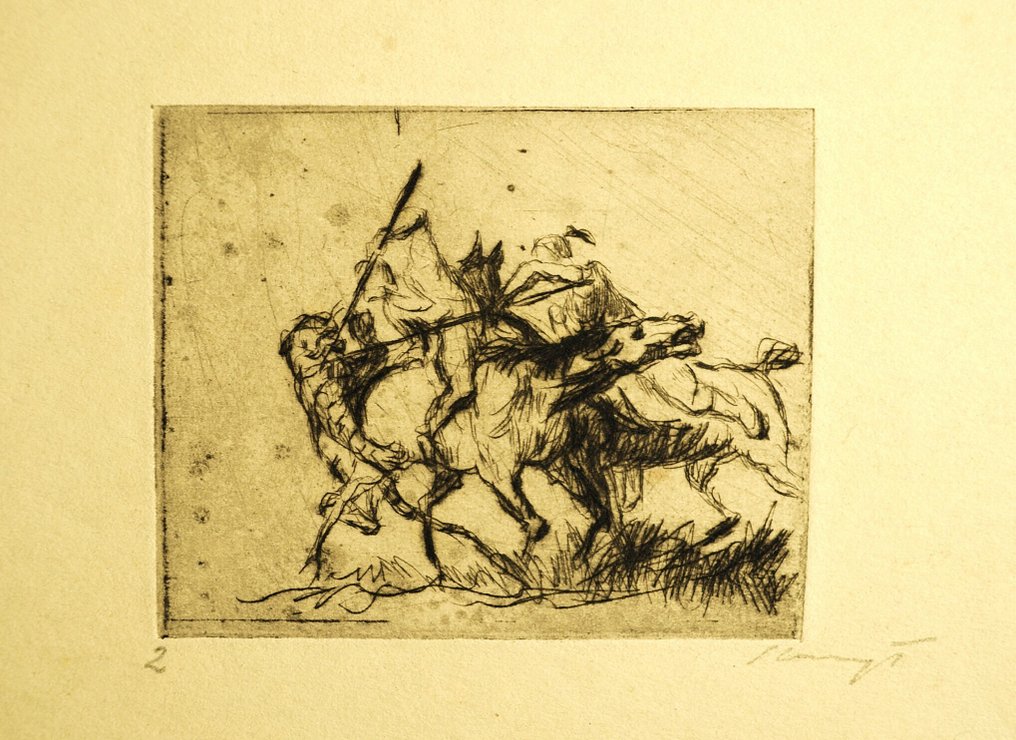
Max Slevogt (1868-1932) - Combat contre le tigre (1911)


01
day
09
hours
04
minutes
40
seconds

19 other people are watching this object
 Bidder 1005 Bidder 1005 | €20 | |
|---|---|---|
 Bidder 1136 Bidder 1136 | €15 | |
| Bidder 1005 | €10 | |
Catawiki Buyer Protection
Your payment’s safe with us until you receive your object.View details
Trustpilot 4.4 | 123641 reviews
Rated Excellent on Trustpilot.
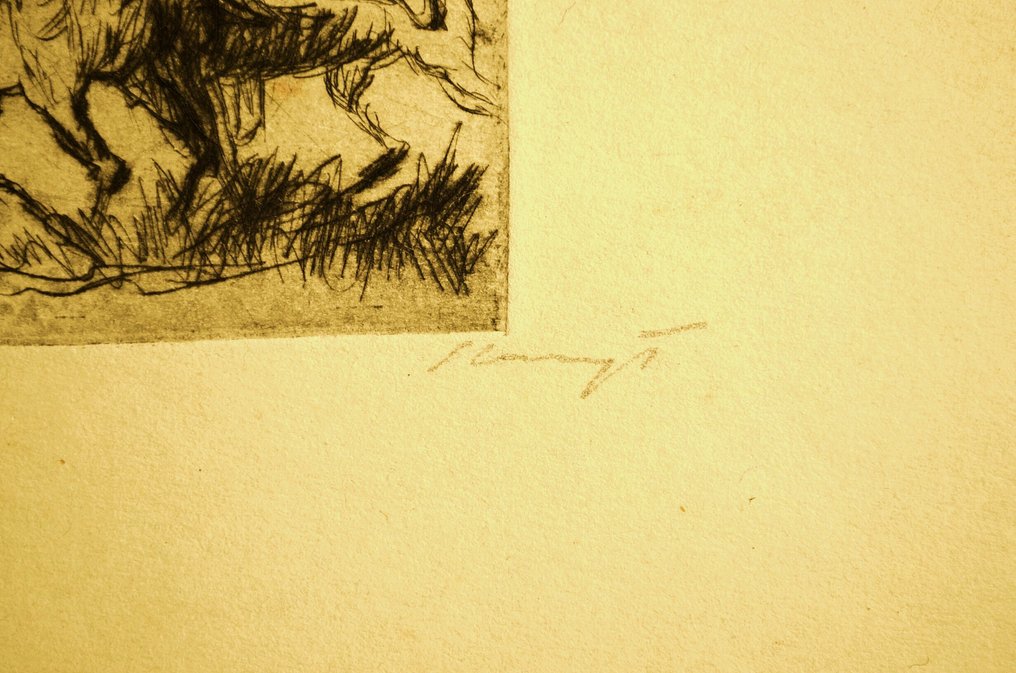
Original etching by Max Slevogt (1868-1932), Combat contre le tigre (1911), planche 10 of the series Quatorze eaux-fortes de Max Slevogt, published by Paul Cassirer Verlag, Berlin, 1912; hand-signed in pencil lower right, manuscripted number 2 lower left, edition Original, etched in Germany in 1910-1920 on Japanese paper, sheet 144 x 204 mm with plate 56 x 68 mm, depicting animals and fauna, in good condition; sold by Propriétaire ou revendeur.
AI-assisted summary
Description from the seller
Magnificent water-etching by the major German Impressionist artist Max Slevogt.
Fight against the tiger
engraved in 1911. reference Sievers/Waldmann 429 II.
Signed at the bottom right in pencil and number 2 handwritten in pencil at the bottom left (off-market copy?).
Plate 10 of the series "Fourteen etchings by Max Slevogt". Paul Cassirer Verlag, Berlin, 1912.
Very good condition with a few light marks on the edges.
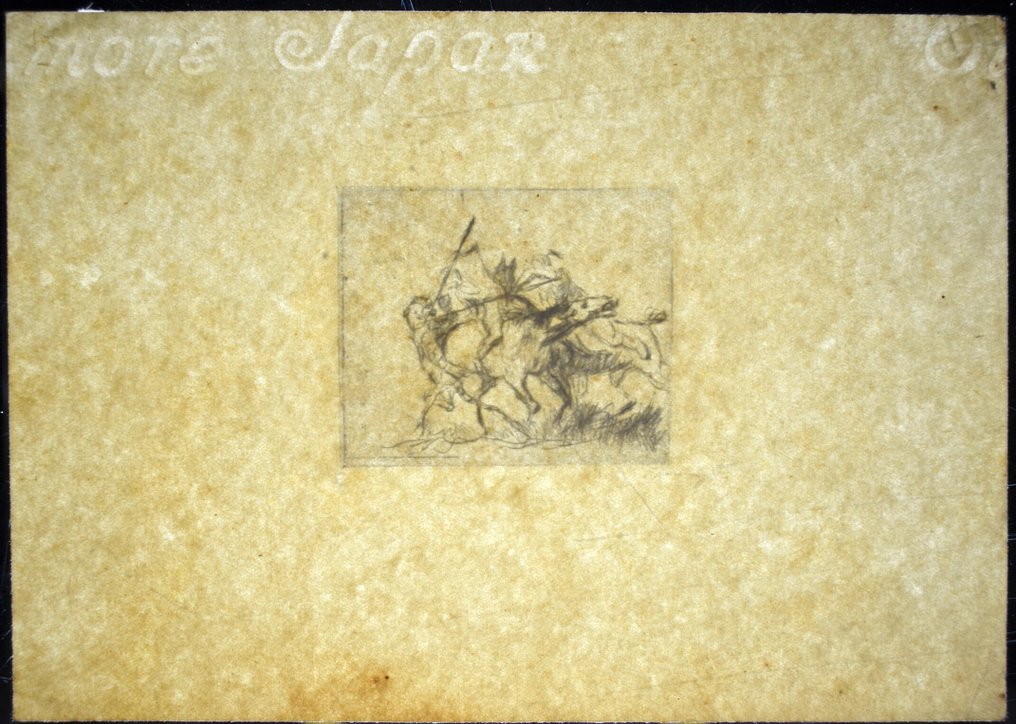
Etching on Japanese paper (see the last photo of the back in full light with the watermark Japan).
Dimensions :
Plaque: 56 × 68 mm
Sheet: 144 x 204 mm
Max Slevogt, born on October 20, 1868, in Landshut, and died on September 20, 1932, in Leinsweiler, was a German painter, engraver, and draftsman. He is one of the main representatives, along with Lovis Corinth and Max Liebermann, of Impressionism and the German 'outdoor style.'
Besides his activity as a painter, he was also a renowned engraver and illustrator. He also worked as a set designer for various theaters. Max Slevogt initially studied at the Academy of Fine Arts Munich, where he created his first landscapes. At the end of his studies, he moved to Paris and enrolled at the Julian Academy. He broke away from the academic tradition of painting and sought new modes of expression. Starting in 1890, he stopped painting in the studio and began painting outdoors. He appreciated the bright light that bathed his landscapes, characters, and objects. Max Slevogt did not limit himself to painting panels, scenery, and frescoes. Throughout his life, he also created countless watercolors and drawings. He also worked as an engraver and illustrated books. His frequent travels to Italy and Egypt inspired his work. In 1892, he founded, with other artists, the Munich Secession's XXIVth Association. This group of artists opposed the traditional academic conception of art of that time. In 1898, Slevogt visited an important Rembrandt exhibition in Amsterdam, which left a deep impression on him. During the pre-war years, he traveled extensively to southern countries: to Egypt in 1902 and again in February 1914, from which he brought back numerous watercolors and 21 paintings.
In 1905, he approached the middle of the scene. The painter befriended renowned artists who designed costumes and theater sets for Max Reinhardt.
The shipment will be secure and insured.
Seller's Story
Generalist antique dealer since 1991 and son of an antique dealer, specializing in Art Nouveau and the 19th century.
Translated by Google TranslateMagnificent water-etching by the major German Impressionist artist Max Slevogt.
Fight against the tiger
engraved in 1911. reference Sievers/Waldmann 429 II.
Signed at the bottom right in pencil and number 2 handwritten in pencil at the bottom left (off-market copy?).
Plate 10 of the series "Fourteen etchings by Max Slevogt". Paul Cassirer Verlag, Berlin, 1912.
Very good condition with a few light marks on the edges.
Etching on Japanese paper (see the last photo of the back in full light with the watermark Japan).
Dimensions :
Plaque: 56 × 68 mm
Sheet: 144 x 204 mm
Max Slevogt, born on October 20, 1868, in Landshut, and died on September 20, 1932, in Leinsweiler, was a German painter, engraver, and draftsman. He is one of the main representatives, along with Lovis Corinth and Max Liebermann, of Impressionism and the German 'outdoor style.'
Besides his activity as a painter, he was also a renowned engraver and illustrator. He also worked as a set designer for various theaters. Max Slevogt initially studied at the Academy of Fine Arts Munich, where he created his first landscapes. At the end of his studies, he moved to Paris and enrolled at the Julian Academy. He broke away from the academic tradition of painting and sought new modes of expression. Starting in 1890, he stopped painting in the studio and began painting outdoors. He appreciated the bright light that bathed his landscapes, characters, and objects. Max Slevogt did not limit himself to painting panels, scenery, and frescoes. Throughout his life, he also created countless watercolors and drawings. He also worked as an engraver and illustrated books. His frequent travels to Italy and Egypt inspired his work. In 1892, he founded, with other artists, the Munich Secession's XXIVth Association. This group of artists opposed the traditional academic conception of art of that time. In 1898, Slevogt visited an important Rembrandt exhibition in Amsterdam, which left a deep impression on him. During the pre-war years, he traveled extensively to southern countries: to Egypt in 1902 and again in February 1914, from which he brought back numerous watercolors and 21 paintings.
In 1905, he approached the middle of the scene. The painter befriended renowned artists who designed costumes and theater sets for Max Reinhardt.
The shipment will be secure and insured.
Seller's Story
Generalist antique dealer since 1991 and son of an antique dealer, specializing in Art Nouveau and the 19th century.
Translated by Google TranslateDetails
Artist
Max Slevogt (1868-1932)
Sold by
Owner or reseller
Edition
Original
Title of artwork
Combat contre le tigre (1911)
Technique
Etching
Signature
Hand signed
Country of Origin
Germany
Year
1911
Condition
Good condition
Height
144 mm
Width
204 mm
Depiction/Theme
Animals and wildlife
Style
Impressionism
Period
1910-1920
Sold with frame
No
Sold by