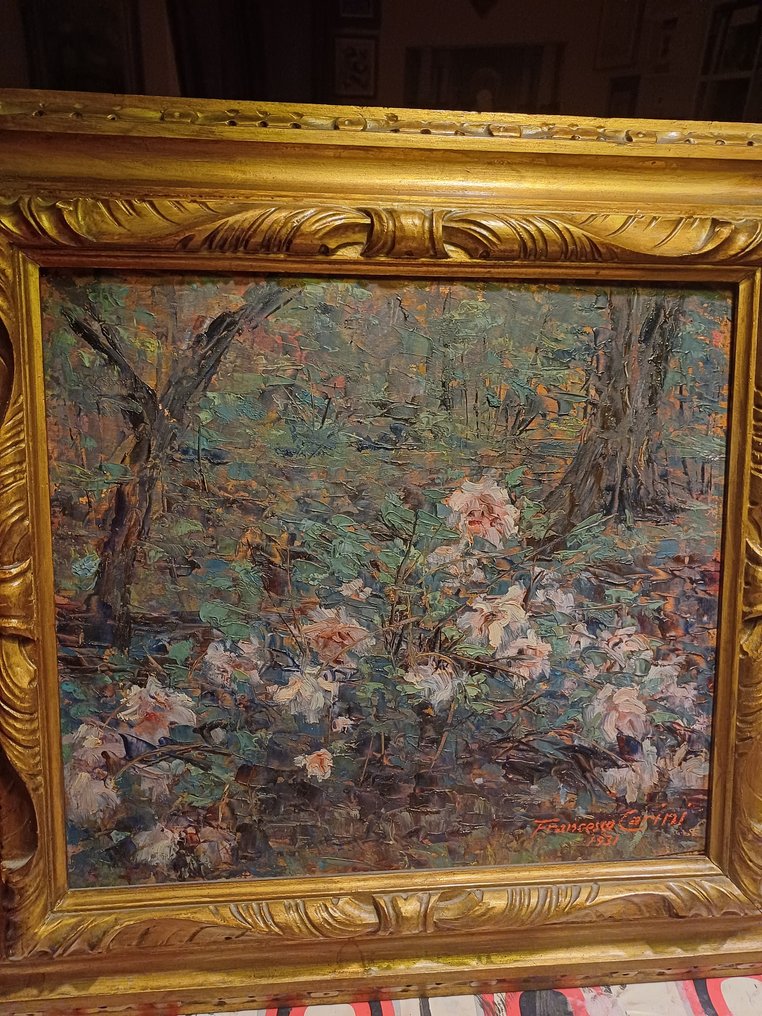
Francesco Carini (1883-1959) - Il roseto a Caspoggio



05
days
06
hours
14
minutes
01
second
Current bid
€ 600
Reserve price not met

19 other people are watching this object
 Bidder 5342 Bidder 5342 | €600 | |
|---|---|---|
 Bidder 8032 Bidder 8032 | €550 | |
| Bidder 8032 | €500 | |
Catawiki Buyer Protection
Your payment’s safe with us until you receive your object.View details
Trustpilot 4.4 | 123418 reviews
Rated Excellent on Trustpilot.
Il roseto a Caspoggio, oil on panel, 1931, Italy, original, signed, with frame, 68 x 73 cm.
AI-assisted summary
Description from the seller
Engaging work by the painter Francesco Carini (Castelnuovo Bocca d'Adda, 1883 – Caspoggio, 1959), painted in oil on panel and in good condition.
The work measures 45x50 cm.
The very beautiful frame is original and from the period.
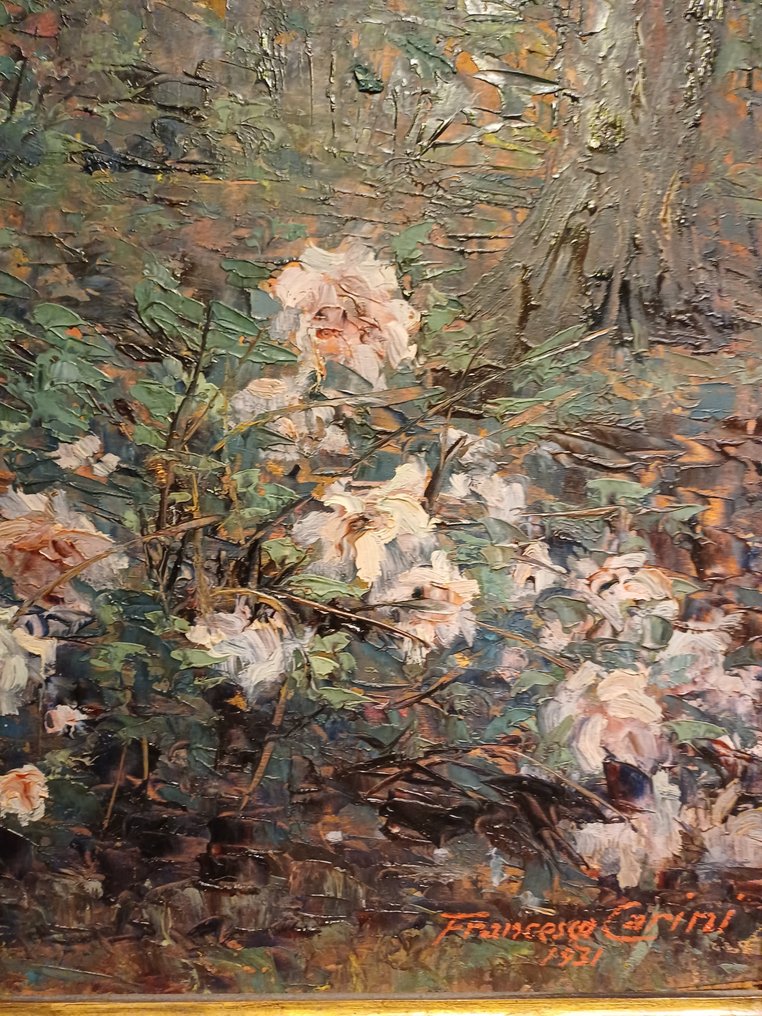
Signed and dated 1931.
Born in Sondrio in 1883, Francesco Carini was a student in Milan of the painter, decorator, and caricaturist Giuseppe Palanti (1881-1926). He taught from 1907 at the Royal Academy of Fine Arts and from 1923 at the School of Decoration in Brera.
A regular visitor to Valmalenco during holidays, he finally settles permanently in Caspoggio, redesigning an old house he owns and personally designing and creating the furniture and garden fountain.
During the 1940s, he held several solo exhibitions in Milan: at Galleria Balzani in 1943, at Galleria Internazionale in 1949, and at Galleria Gavioli, also in 1949.
Some of his works are now housed at the Galleria d’Arte moderna in Milan and the Museo Valtellinese di Storia e Arte in Sondrio, but for the most part, his works are scattered across various private collections in Valtellina.
Carini's work — still little known and studied despite its undeniable importance for landscape painting within the provincial and regional context — represents an attempt to develop the tradition of Lombard naturalist realism from the second half of the nineteenth century. Its founding figure is Filippo Carcano, with its most notable exponents including Leonardo Bazzaro, Eugenio Gignous, Francesco Gola, Enrico Filippini, and Uberto Dell’Orto.
In a certain tradition, Carini is a robust epigone from the first half of the 20th century in Valtellina, as secluded and solitary as it is. It is the rural Valmalenco, and above all the natural and human environment of Caspoggio, that emerges in his paintings as the landscape subject of choice.
Based on a rather academic matrix in its compositional structure, Carini develops a chromatic approach aimed at rendering the natural data with a brushstroke that begins compact and with large, flat areas of color, then increasingly more dynamic and frayed, with dense and textured impastos, particularly effective and expressive in rural vistas.
Provenance: private collection, Milan, Italy
Fast shipping with secure packaging
Seller's Story
Art dealer specializing in old master paintings and 19th century works
In collaboration with ART & INVESTIGATION historical and artistic investigations on works of art
Translated by Google TranslateEngaging work by the painter Francesco Carini (Castelnuovo Bocca d'Adda, 1883 – Caspoggio, 1959), painted in oil on panel and in good condition.
The work measures 45x50 cm.
The very beautiful frame is original and from the period.
Signed and dated 1931.
Born in Sondrio in 1883, Francesco Carini was a student in Milan of the painter, decorator, and caricaturist Giuseppe Palanti (1881-1926). He taught from 1907 at the Royal Academy of Fine Arts and from 1923 at the School of Decoration in Brera.
A regular visitor to Valmalenco during holidays, he finally settles permanently in Caspoggio, redesigning an old house he owns and personally designing and creating the furniture and garden fountain.
During the 1940s, he held several solo exhibitions in Milan: at Galleria Balzani in 1943, at Galleria Internazionale in 1949, and at Galleria Gavioli, also in 1949.
Some of his works are now housed at the Galleria d’Arte moderna in Milan and the Museo Valtellinese di Storia e Arte in Sondrio, but for the most part, his works are scattered across various private collections in Valtellina.
Carini's work — still little known and studied despite its undeniable importance for landscape painting within the provincial and regional context — represents an attempt to develop the tradition of Lombard naturalist realism from the second half of the nineteenth century. Its founding figure is Filippo Carcano, with its most notable exponents including Leonardo Bazzaro, Eugenio Gignous, Francesco Gola, Enrico Filippini, and Uberto Dell’Orto.
In a certain tradition, Carini is a robust epigone from the first half of the 20th century in Valtellina, as secluded and solitary as it is. It is the rural Valmalenco, and above all the natural and human environment of Caspoggio, that emerges in his paintings as the landscape subject of choice.
Based on a rather academic matrix in its compositional structure, Carini develops a chromatic approach aimed at rendering the natural data with a brushstroke that begins compact and with large, flat areas of color, then increasingly more dynamic and frayed, with dense and textured impastos, particularly effective and expressive in rural vistas.
Provenance: private collection, Milan, Italy
Fast shipping with secure packaging
Seller's Story
Art dealer specializing in old master paintings and 19th century works
In collaboration with ART & INVESTIGATION historical and artistic investigations on works of art
Translated by Google TranslateDetails
Artist
Francesco Carini (1883-1959)
Sold with frame
Yes
Sold by
Gallery
Edition
Original
Title of artwork
Il roseto a Caspoggio
Technique
Oil painting
Signature
Signed
Country of Origin
Italy
Year
1931
Condition
Good condition
Height
68 cm
Width
73 cm
Period
1930-1940
Sold by
