Canvas Fit - Alberto Ricardo - Mario Vuitton: El Reino del Lujo y la Nostalgia



05
days
06
hours
56
minutes
52
seconds

6 other people are watching this object
 Bidder 9307 Bidder 9307 | €1 |
|---|
Catawiki Buyer Protection
Your payment’s safe with us until you receive your object.View details
Trustpilot 4.4 | 123951 reviews
Rated Excellent on Trustpilot.
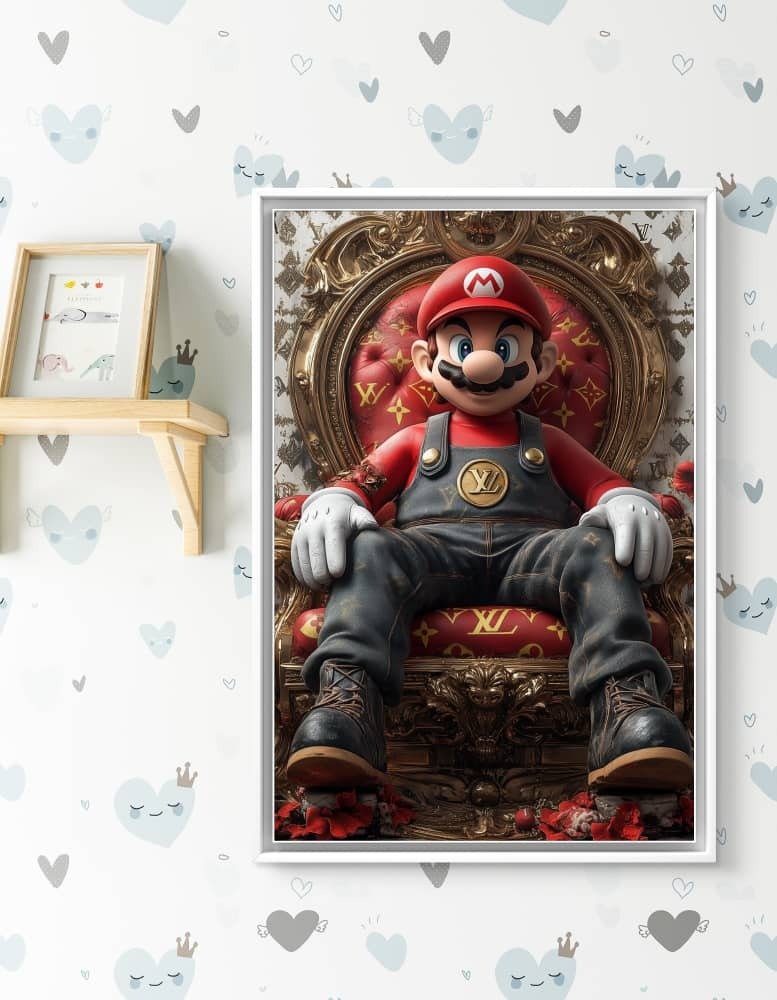
Canvas Fit - Alberto Ricardo, in a limited edition 2/5, presents Mario Vuitton: El Reino del Lujo y la Nostalgia, a 2023 Giclée on canvas (65 x 100 cm, 5 cm deep), hand-signed, in excellent condition, produced in Spain and sold directly by the artist.
AI-assisted summary
Description from the seller
Artwork created on professional canvas using the giclée printing technique on canvas. Digital art using contemporary media and AI.
Artwork by the artist Canvas Fit-Alberto Ricardo created using Giclée print technique on high-quality professional canvas, 100% cotton, highly resistant to handling and external agents, from the Eco Canvas Roma Glossy brand, satin finish.
We guarantee a durable product with visual quality.
Dimension of 65 x 100 cm with a depth of 5 cm.
Limited edition 2/5
On the back of the piece, you will find the details about the work.
The shipment will be made through United Parcel Service (UPS) for Spain and Europe, and through Fedex for the rest of the world.
The work will be rolled and protected with several layers of packaging, bubble nylon, and placed in a sturdy tube.
Once the work has been paid for, three days are required for the packaging process and delivery to the shipping company.
Sitting like a modern emperor, with a straight back and a fixed gaze on the invisible horizon of consumption and glory, Mario—the most famous plumber in the world—has left behind pixelated castles and jumping mushrooms. In this image, there are no green pipes or golden stars. There is red velvet with Louis Vuitton monograms, a baroque throne worthy of an absolute king, and an outfit that shines not for its functionality but for its symbolic power. This is not just Mario: it is Mario Vuitton, an icon reimagined for the times of aesthetic excess and brand worship.
The fascinating aspect of this scene is not its contradiction but its accuracy. Who else but Mario, who has crossed generations, consoles, styles, and trends, could sit on that throne without seeming like an impostor? His story, though humble at its start, has always been marked by conquest: of the Mushroom Kingdom, the entertainment industries, and the collective imagination. His face — with a polished mustache, bright eyes, and a frozen smile — is more recognizable than that of many celebrities. And now, adorned with symbols of luxury, his figure takes on a new nuance: that of a hero turned brand, a character elevated to a global cultural icon.
The contrast between the classic Mario and this high-fashion Mario is as striking as it is revealing. His gloves remain white, but they are no longer stained with brick dust. His boots no longer step on floating blocks but on velvet carpets. And that belt with the 'LV' insignia is not a tool; it's a statement: Mario no longer jumps for coins... now he makes them.
This image is a critique, yes, but also a celebration. It reflects how popular icons transform, are reconfigured, and are revalued in each era. Video games, once considered a simple childhood pastime, have become a cultural platform, and their protagonists — like Mario — have ascended to the altars of art, fashion, and history.
The golden throne, full of reliefs and drama, does not overwhelm it. It belongs to him. Because Mario is not just a video game: he represents the very evolution of entertainment, the triumph of simplicity over complexity, of charisma over grandeur. And although here he may seem more like a magnate than a hero, his essence remains intact.
Ultimately, this image does not seek to destroy the innocence of the character but to remind us that every icon, sooner or later, becomes a reflection of its era. Today, Mario does not run to save princesses. Today, he sits, contemplates, and rules. Not only imaginary worlds but the very heart of global culture. Because if anyone has earned the right to sit on the throne of pop... it is him.
Artwork created on professional canvas using the giclée printing technique on canvas. Digital art using contemporary media and AI.
Artwork by the artist Canvas Fit-Alberto Ricardo created using Giclée print technique on high-quality professional canvas, 100% cotton, highly resistant to handling and external agents, from the Eco Canvas Roma Glossy brand, satin finish.
We guarantee a durable product with visual quality.
Dimension of 65 x 100 cm with a depth of 5 cm.
Limited edition 2/5
On the back of the piece, you will find the details about the work.
The shipment will be made through United Parcel Service (UPS) for Spain and Europe, and through Fedex for the rest of the world.
The work will be rolled and protected with several layers of packaging, bubble nylon, and placed in a sturdy tube.
Once the work has been paid for, three days are required for the packaging process and delivery to the shipping company.
Sitting like a modern emperor, with a straight back and a fixed gaze on the invisible horizon of consumption and glory, Mario—the most famous plumber in the world—has left behind pixelated castles and jumping mushrooms. In this image, there are no green pipes or golden stars. There is red velvet with Louis Vuitton monograms, a baroque throne worthy of an absolute king, and an outfit that shines not for its functionality but for its symbolic power. This is not just Mario: it is Mario Vuitton, an icon reimagined for the times of aesthetic excess and brand worship.
The fascinating aspect of this scene is not its contradiction but its accuracy. Who else but Mario, who has crossed generations, consoles, styles, and trends, could sit on that throne without seeming like an impostor? His story, though humble at its start, has always been marked by conquest: of the Mushroom Kingdom, the entertainment industries, and the collective imagination. His face — with a polished mustache, bright eyes, and a frozen smile — is more recognizable than that of many celebrities. And now, adorned with symbols of luxury, his figure takes on a new nuance: that of a hero turned brand, a character elevated to a global cultural icon.
The contrast between the classic Mario and this high-fashion Mario is as striking as it is revealing. His gloves remain white, but they are no longer stained with brick dust. His boots no longer step on floating blocks but on velvet carpets. And that belt with the 'LV' insignia is not a tool; it's a statement: Mario no longer jumps for coins... now he makes them.
This image is a critique, yes, but also a celebration. It reflects how popular icons transform, are reconfigured, and are revalued in each era. Video games, once considered a simple childhood pastime, have become a cultural platform, and their protagonists — like Mario — have ascended to the altars of art, fashion, and history.
The golden throne, full of reliefs and drama, does not overwhelm it. It belongs to him. Because Mario is not just a video game: he represents the very evolution of entertainment, the triumph of simplicity over complexity, of charisma over grandeur. And although here he may seem more like a magnate than a hero, his essence remains intact.
Ultimately, this image does not seek to destroy the innocence of the character but to remind us that every icon, sooner or later, becomes a reflection of its era. Today, Mario does not run to save princesses. Today, he sits, contemplates, and rules. Not only imaginary worlds but the very heart of global culture. Because if anyone has earned the right to sit on the throne of pop... it is him.
Details
Artist
Canvas Fit - Alberto Ricardo
Sold by
Direct from the artist
Edition
Limited edition
Edition number
2/5
Title of artwork
Mario Vuitton: El Reino del Lujo y la Nostalgia
Technique
AI, Digital print, Giclée
Signature
Hand signed
Country of Origin
Spain
Year
2023
Condition
Excellent condition
Height
100 cm
Width
65 cm
Style
Contemporary
Period
2020+
Sold with frame
No