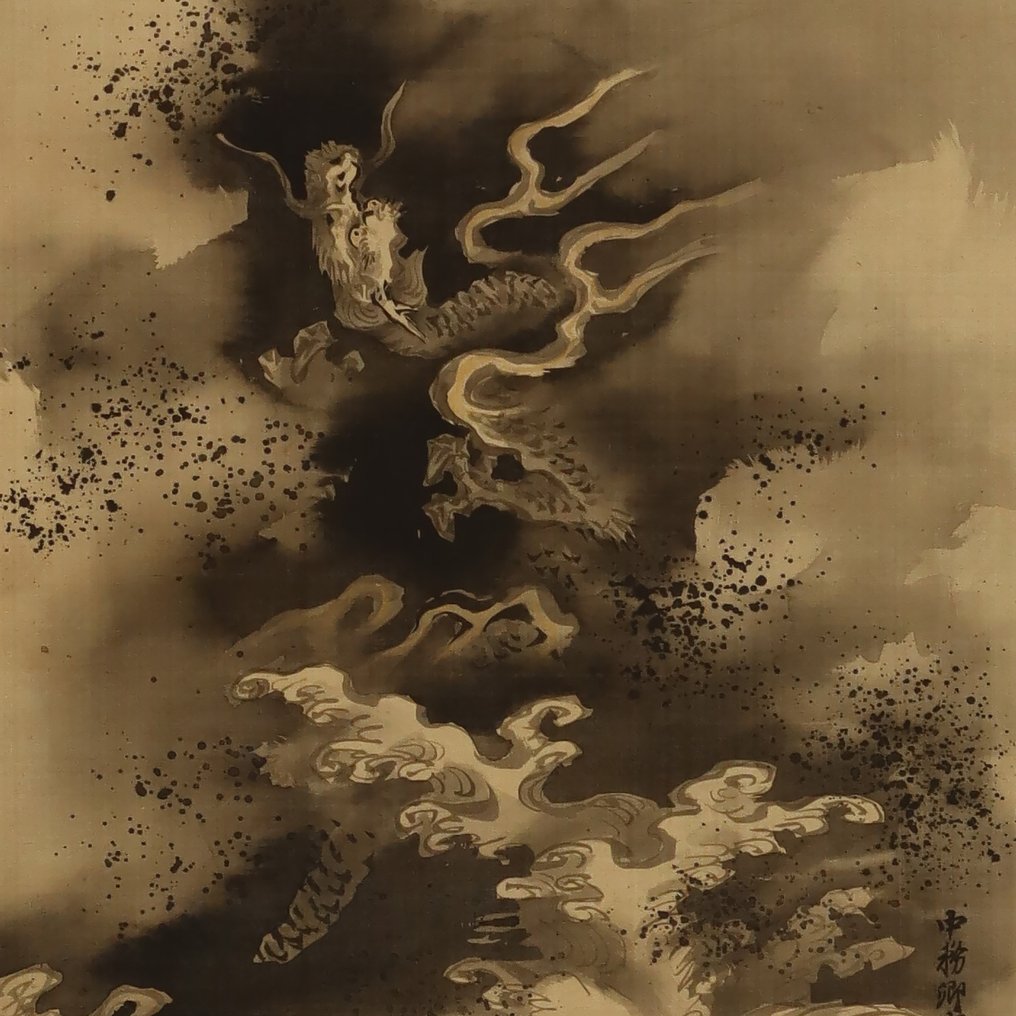
Dragon Crossing Mount Fuji - With signature Fujiwara Tadanobu hitsu 藤原雅信筆 - Silk - Kano Shōsen'in Tadonobu (1823-1879) - Japan - Late Edo period




01
day
06
hours
41
minutes
59
seconds
Current bid
€ 86
Reserve price not met

Expert
Selected by Giovanni Bottero
Holds a master’s in Japanese art history with over 10 years’ expertise in Asian art.
Estimate € 180 - € 250
28 other people are watching this object
 Bidder 0551 Bidder 0551 | €86 | |
|---|---|---|
| Bidder 0551 | €81 | |
| Bidder 0551 | €50 | |
Catawiki Buyer Protection
Your payment’s safe with us until you receive your object.View details
Trustpilot 4.4 | 123878 reviews
Rated Excellent on Trustpilot.
Dragon Crossing Mount Fuji, an ink on silk scroll by Kano Shōsen'in Tadonobu (1823–1879) from the Late Edo period, measuring 193.5 cm high by 53 cm wide and weighing 1.25 kg in fair condition.
AI-assisted summary
Description from the seller
Dragon Crossing Mount Fuji (Fuji-goe no Ryū)
It has been pointed out that depicting Mount Fuji together with a dragon is an auspicious pictorial theme based on a play on sounds.
Fuji corresponds phonetically to fuji (不時, “unexpected” or “misfortune”), while the dragon (ryū) is associated with the verb tatsu (断つ, “to cut off”), which shares the same pronunciation.
Through this phonetic wordplay, the motif conveys the meaning “to cut off misfortune,” that is, to ward off bad luck.
Because of this favorable symbolism, it was a popular subject that continued to be depicted throughout the Edo period.
------------------
Setting weight
This piece weighs 1.25 kg.
Material
Ink on silk
Size
Overall: vertical 193.5㎝(76.18 in) × width 53.0㎝(20.87 in) *width does not include roller ends.
(the work: vertical 98.5㎝(38.78 in) × width 40.6㎝(15.98 in))
Condition
・There are some burns on the Japanese paper on the back of the cover.
・There are some burns, stains on the image.
・There is some warp in the mounting.
・It has been re-mounted several decades ago.
Remarks
・Roller ends are Wooden.
・There is no signature on the box.
Materials for mounting
All of them are made of silk.
Other
There is a note about shipping restrictions and VAT. Please check before purchase.
*There may be a slight difference in color between the photo and the actual product.
*Notes on Shipping
【Important Notice Regarding Shipping to the United States】
Due to recent changes in U.S. customs and import regulations, we have been forced to switch to a different shipping carrier exclusively for shipments to the United States.
As a result, free shipping is no longer available for U.S. orders, and shipping costs may be significantly higher compared to other countries.
Please note that if EMS shipping to the United States becomes available again in the future, we may return to our regular, lower shipping rates.
We sincerely apologize for the inconvenience and greatly appreciate your understanding.
(Especially for Customers in Italy)
We generally ship by EMS from Japan.
Recently, there has been an increase in cases where packages shipped to Italy have experienced delays or difficulties reaching customers due to strict customs procedures.
As a result, please be aware that delivery to Italy may take several weeks to about one month.
We sincerely apologize for the inconvenience, but we kindly ask that you regularly check the tracking number (along with your postal code) on the website of your local postal service to monitor the status of your shipment.
In some cases, it may also be necessary to contact your local delivery company directly.
In addition, if you are a new customer in Italy, we kindly ask that you provide your codice fiscale via chat after placing your order.
Thank you very much for your understanding and cooperation.
Biography
Kano Shōsen'in Tadonobu (1823-1879)
Born into the Kobikicho Kano family in Edo. Childhood name was Eijiro; art names included Shōsen'in, Soshosai, and Shoko.
Studied under his father Kano Osanobu and served as an official painter for the Tokugawa shogunate.
In 1844, worked on the barrier paintings of Edo Castle and was granted the title of Hōgen.
Succeeded his father as the 10th head of the Kobikicho Kano family in 1846.
In 1860, received the title of Hōin, holding important duties as a shogunate painter.
After the Meiji Restoration, lost his family estate and lived with his wife's relatives.
Continued painting, producing works for Enryokan and other sites.
Taught artists such as Kano Hogai and Hashimoto Gaho, contributing to the foundation of modern Japanese painting.
Regarded as the last head of the Edo Kano school and a key figure in Japanese art history.
Dragon Crossing Mount Fuji (Fuji-goe no Ryū)
It has been pointed out that depicting Mount Fuji together with a dragon is an auspicious pictorial theme based on a play on sounds.
Fuji corresponds phonetically to fuji (不時, “unexpected” or “misfortune”), while the dragon (ryū) is associated with the verb tatsu (断つ, “to cut off”), which shares the same pronunciation.
Through this phonetic wordplay, the motif conveys the meaning “to cut off misfortune,” that is, to ward off bad luck.
Because of this favorable symbolism, it was a popular subject that continued to be depicted throughout the Edo period.
------------------
Setting weight
This piece weighs 1.25 kg.
Material
Ink on silk
Size
Overall: vertical 193.5㎝(76.18 in) × width 53.0㎝(20.87 in) *width does not include roller ends.
(the work: vertical 98.5㎝(38.78 in) × width 40.6㎝(15.98 in))
Condition
・There are some burns on the Japanese paper on the back of the cover.
・There are some burns, stains on the image.
・There is some warp in the mounting.
・It has been re-mounted several decades ago.
Remarks
・Roller ends are Wooden.
・There is no signature on the box.
Materials for mounting
All of them are made of silk.
Other
There is a note about shipping restrictions and VAT. Please check before purchase.
*There may be a slight difference in color between the photo and the actual product.
*Notes on Shipping
【Important Notice Regarding Shipping to the United States】
Due to recent changes in U.S. customs and import regulations, we have been forced to switch to a different shipping carrier exclusively for shipments to the United States.
As a result, free shipping is no longer available for U.S. orders, and shipping costs may be significantly higher compared to other countries.
Please note that if EMS shipping to the United States becomes available again in the future, we may return to our regular, lower shipping rates.
We sincerely apologize for the inconvenience and greatly appreciate your understanding.
(Especially for Customers in Italy)
We generally ship by EMS from Japan.
Recently, there has been an increase in cases where packages shipped to Italy have experienced delays or difficulties reaching customers due to strict customs procedures.
As a result, please be aware that delivery to Italy may take several weeks to about one month.
We sincerely apologize for the inconvenience, but we kindly ask that you regularly check the tracking number (along with your postal code) on the website of your local postal service to monitor the status of your shipment.
In some cases, it may also be necessary to contact your local delivery company directly.
In addition, if you are a new customer in Italy, we kindly ask that you provide your codice fiscale via chat after placing your order.
Thank you very much for your understanding and cooperation.
Biography
Kano Shōsen'in Tadonobu (1823-1879)
Born into the Kobikicho Kano family in Edo. Childhood name was Eijiro; art names included Shōsen'in, Soshosai, and Shoko.
Studied under his father Kano Osanobu and served as an official painter for the Tokugawa shogunate.
In 1844, worked on the barrier paintings of Edo Castle and was granted the title of Hōgen.
Succeeded his father as the 10th head of the Kobikicho Kano family in 1846.
In 1860, received the title of Hōin, holding important duties as a shogunate painter.
After the Meiji Restoration, lost his family estate and lived with his wife's relatives.
Continued painting, producing works for Enryokan and other sites.
Taught artists such as Kano Hogai and Hashimoto Gaho, contributing to the foundation of modern Japanese painting.
Regarded as the last head of the Edo Kano school and a key figure in Japanese art history.
Details
Dynastic Style/Period
Late Edo period
No. of items
1
Artist
Kano Shōsen'in Tadonobu (1823-1879)
Country of Origin
Japan
Material
Silk
Height
193.5 cm
Width
53 cm
Title of artwork
Dragon Crossing Mount Fuji - With signature Fujiwara Tadanobu hitsu 藤原雅信筆
Condition
Fair condition
